
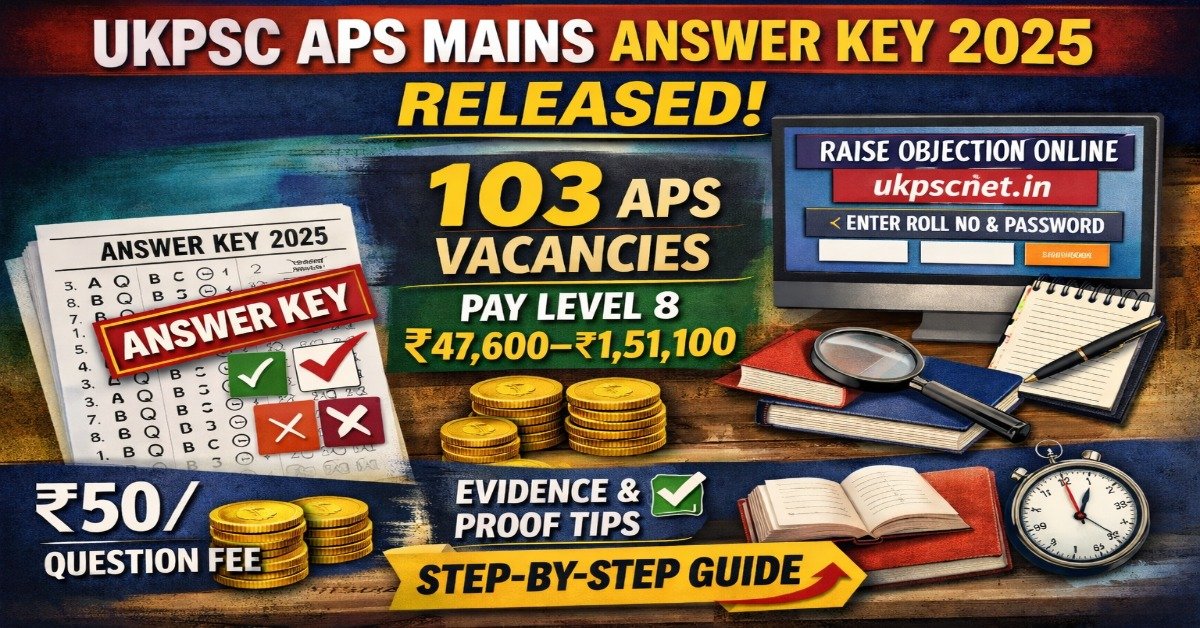
The Uttarakhand Public Service Commission (UKPSC) has released the provisional answer key for the Additional Private Secretary (APS) Mains Examination. Candidates who appeared for the Mains exam can now raise online objections from 02 April 2026 to 08 April 2026 by logging in to the dedicated portal at ukpscnet.in/aps/exam.html. Use your Roll Number and Password to access the objection interface — select the question, provide a reference, upload documentary evidence, and pay the objection fee before the deadline. This recruitment fills 103 APS vacancies in departments under the Uttarakhand Government. Pay Matrix Level 8 — ₹47,600 to ₹1,51,100 per month. Last date: 08 April 2026 — late submissions are not accepted.
Quick Facts:
- UKPSC, Uttarakhand
- Mains Answer Key — Released
- Additional Private Secretary (APS)
- 103 Vacancies
- ₹47,600 – ₹1,51,100 (Level 8)
- Objection: 02 Apr – 08 Apr 2026
- ukpscnet.in | psc.uk.gov.in
Stats:
- OUT — Mains Answer Key
- 103 — Total Vacancies
- Level 8 — ₹47,600–₹1,51,100
- 08 Apr — Objection Deadline
- 200 Marks — Mains (100+100)
- Online — Objection Mode
⚡ Raise Your Objection Now — Window Closing Soon
Objection window open: 02 April 2026 to 08 April 2026. Login with Roll Number + Password/Date of Birth at the UKPSC APS objection portal. Select questions, upload evidence, pay ₹50 per question fee. No offline submissions accepted.
Open Objection Portal → ukpscnet.in
01. Important Dates — UKPSC APS Mains Answer Key & Objection
| Event | Date |
|---|---|
| APS Recruitment Notification Released — 103 Vacancies | 18 July 2024 |
| Online Application Window | 18 July 2024 – 7 August 2024 |
| Prelims Stage — Hindi & English Typing Test | Completed |
| Prelims Stage — Computer Knowledge Test (100 Marks, 40% min.) | Completed |
| Shorthand Test Hall Ticket Released | Released at psc.uk.gov.in |
| Hindi & English Shorthand Test Conducted | 22 September – 16 October 2025 |
| Shorthand Test Result Declared | Declared — psc.uk.gov.in (1,528 shortlisted) |
| Mains Examination Conducted — Paper 1 (100 Marks GS MCQ) + Paper 2 (100 Marks Essay/Drafting) | Completed |
| Provisional Mains Answer Key Released (Paper 1 — General Studies) | Released — Active Now |
| Online Objection Window — ukpscnet.in (₹50 per question) | 02 April 2026 – 08 April 2026 |
| Final Answer Key Released (After Objection Review) | To be announced — psc.uk.gov.in |
| Mains Result / Merit List Declared (based on 200 total Mains marks) | After final key — psc.uk.gov.in |
Important: The objection window is open from 02 April 2026 to 08 April 2026. Visit ukpscnet.in/aps/exam.html#/p0b5z1d/objection-login and submit your objection(s) before 08 April 2026. No extension will be granted. Submissions after closing time are not entertained under any circumstances.
02. UKPSC APS Recruitment 2025 — Complete Overview
| Field | Details |
|---|---|
| Conducting Body | Uttarakhand Public Service Commission (UKPSC) |
| Post Name | Additional Private Secretary (APS) — Group C |
| Total Vacancies | 103 Posts (revised from 99) |
| Application Period | 18 July 2024 – 7 August 2024 |
| Posting | Various departments of Uttarakhand Government |
| Pay Scale | Pay Matrix Level 8 — ₹47,600 to ₹1,51,100/month |
| Prelims Total Marks | 400 Marks (5 qualifying tests) |
| Mains Total Marks | 200 Marks (Paper 1: 100 + Paper 2: 100) |
| Minimum Qualification | Graduation from a recognised university |
| Age Limit | 21 to 42 years (relaxation for reserved categories) |
| Official Websites | psc.uk.gov.in | ukpscnet.in |
| Answer Key Objection Portal | ukpscnet.in/aps/exam.html#/p0b5z1d/objection-login |
03. How to Raise Online Objection — Step by Step
Step 1: Open the Official Objection Portal
Go to ukpscnet.in/aps/exam.html#/p0b5z1d/objection-login — the official online objection portal for the UKPSC APS Mains Examination. Make sure you are using the correct URL and an updated browser (Chrome, Firefox, or Edge) with JavaScript enabled. The portal requires JavaScript — if you see a blank page or “You need to enable JavaScript”, enable JavaScript in browser settings and refresh. Avoid using Internet Explorer.
Step 2: Log In with Roll Number and Password
On the objection login page, enter your Roll Number (as printed on your Mains admit card) and Password or Date of Birth (in the format required by the portal — typically DD/MM/YYYY or DDMMYYYY). Enter the Security Captcha Code accurately — captchas are case-sensitive. Click Login. If the credentials are correct, your candidate dashboard will open showing your exam details, question paper set, and the objection interface.
Step 3: Select Your Question Paper Set (Booklet Series)
After login, the portal will display your Question Booklet Series — typically Series A, B, C, or D. Confirm you are in the correct series as it appeared on your question paper. This is important because question numbers and answer options vary across series. Wrong series selection leads to objection on the wrong question. If you are unsure of your series, check your question booklet front page photograph or your admit card.
Step 4: Select the Question Number to Challenge
Under “Question Paper Information”, use the dropdown menu to select the specific Question Number (out of 100 questions in the General Studies paper) you wish to object to. Only challenge questions where you have strong evidence that the official answer is incorrect. Frivolous objections waste your fee and delay the review process. Choose the question, and the portal will display the question text along with the official answer and your marked response side by side.
Step 5: Fill the Objection Details — Answer, Description & Reference
Under “Candidate Answer & Documentary File Details”, fill in: (a) Your answer choice — select the option (A/B/C/D) you believe is correct. (b) Objection Description — type a clear, concise explanation of why the official answer is wrong and why your answer is correct (in Hindi or English). (c) Reference Book Name and Page Number — name of the standard textbook or official publication that supports your answer; mention the exact page number. Vague references like “General Knowledge books” are rejected — name the specific book and page.
Step 6: Upload Supporting Documentary Evidence (PDF)
Upload a scanned PDF of the relevant page from your reference book or official publication that clearly shows the correct answer. File size must be between 50 KB and 500 KB. If the scanned file is too large, reduce scan resolution or compress the PDF. If too small, ensure the text in the document is clearly legible. Highlight or circle the relevant text for the examiner’s convenience. Click “Add Objection” to save this question’s objection. You can add multiple objections for different questions using the same session.
Step 7: Submit All Objections and Pay the Fee
Once you have added all your objections (multiple questions), click “Submit” to finalise. The portal will then redirect you to the online payment gateway. Pay the objection fee — ₹50 per question (confirmed per UKPSC standard practice). Payment can be made via Net Banking, Credit/Debit Card, or UPI. After payment is completed, no changes can be made to your objections — review everything carefully before paying. Download the payment receipt for your records.
Quick Reference:
ukpscnet.in/aps objection portal | Roll No. + Password/DOB login | ₹50 per question objection fee | PDF evidence: 50 KB–500 KB | No changes after payment
⛔ Critical Rules — Read Before Submitting
- Online only — no offline, postal, or email objections are accepted under any circumstances
- After payment is made, no modifications can be made to submitted objections
- Deadline is absolute — the portal closes at the specified time; no extension is granted regardless of technical issues at your end
- Objections without valid supporting documentary evidence are rejected without review — do not submit without attaching the reference PDF
- Object only after thorough research from recognised textbooks — fee is non-refundable even if the objection is rejected
- The UKPSC expert committee’s decision on objections is final — accepted corrections appear in the Final Answer Key
04. How to Calculate Your Score Using the Provisional Answer Key
Estimated Score (Paper 1) = (Correct Answers × 1) − (Wrong Answers × 0.25)
Total 100 Questions × 1 Mark each = 100 Marks | Unattempted questions carry 0 marks — no penalty for unattended questions
Step-by-Step Score Calculation for General Studies Paper (100 Marks)
- Step 1: Download the provisional answer key from psc.uk.gov.in / ukpscnet.in portal
- Step 2: Open your answer key alongside your question paper (100 questions) or access your recorded responses through the portal login
- Step 3: For each question, mark it as Correct (C), Wrong (W), or Unattempted (U)
- Step 4: Count totals: Total C, Total W, Total U (should add up to 100)
- Step 5: Apply formula: Score = (C × 1) − (W × 0.25). Maximum possible: 100 marks
- Step 6: Compare your estimated score against expected cut-offs to gauge your position
Example: If you attempted 80 questions — 65 correct, 15 wrong, 20 unattempted: Score = (65 × 1) − (15 × 0.25) = 65 − 3.75 = 61.25 marks out of 100.
Important: This is an estimate based on the provisional key. If your objection is accepted and an answer changes in the final key, your score will be recalculated. Keep tracking psc.uk.gov.in for the final key release.
Essay & Drafting Paper — 100 Marks, Minimum 35% (35 Marks) Required
The Essay and Drafting paper in the APS Mains is a descriptive test of 100 marks — your answers are manually evaluated by examiners. Key points:
- Candidates must score a minimum of 35 marks (35% of 100) in the Essay/Drafting paper to be considered for the merit list
- There is no answer key for descriptive papers — evaluator discretion applies
- If you believe your descriptive paper was evaluated unfairly, check the official UKPSC notification for any representation/review process available
- For the final merit list, both General Studies marks (out of 100) and Essay/Drafting marks (out of 100, subject to 35% minimum) are combined for a total of 200 Mains marks
If you are borderline: Even 1 or 2 questions corrected in the final answer key (after your successful objection) can change your selection outcome in a competitive exam. In a 100-mark paper, each correct question is worth 1 mark and each successful objection adds 1.25 marks net (saves the 0.25 deduction + gives 1 mark). If you are within 5–10 marks of the expected cut-off, reviewing every question carefully and raising valid objections with evidence is absolutely worth the effort and the ₹50 per question fee.
05. UKPSC APS Mains Exam Pattern — Papers, Marks & Topics
| Paper | Subject | Type | Questions | Marks | Min. Pass | Negative Marking |
|---|---|---|---|---|---|---|
| Paper 1 | General Studies — GK, Current Affairs, Uttarakhand GK, Hindi, English, Reasoning, Science | Objective MCQ (CBT) | 100 Questions | 100 Marks | No minimum (merit-based) | Yes — 0.25 per wrong answer |
| Paper 2 | Essay & Drafting Test — Essay writing (Hindi/English), Office letter drafting, Précis writing | Descriptive (Written) | — | 100 Marks | Minimum 35 Marks (35%) | No negative marking |
| Combined Mains — Both Papers | CBT + Descriptive | 100 Q (Paper 1) | 200 Total Marks | Used for final merit list (Paper 2 minimum 35 marks qualifying) |
📌 APS Mains — Key Points to Remember
- The General Studies paper (Paper 1) has 100 questions for 100 marks — 1 mark per correct answer, −0.25 per wrong answer. The answer key objection applies to this paper only
- The Essay & Drafting paper (Paper 2) carries 100 marks and is descriptive — no answer key is released for this paper; evaluation is done by UKPSC examiners. Minimum 35 marks (35%) required to qualify
- Mains total = 200 marks — used for preparing the final merit list. Mains marks decide your rank
- Answer key objection is only relevant for Paper 1 (Objective MCQ, 100 questions) — make sure you are objecting to the correct paper questions
- The Prelims stage consisted of 5 qualifying tests totalling 400 marks — Prelims marks are NOT counted in the final merit list
- Check the official UKPSC notification at psc.uk.gov.in for exact duration and other examination instructions
06. What Makes a Valid Objection — Reference Material & Evidence Guide
The quality of your evidence determines whether your objection is accepted. Here is what works and what does not:
✅ Evidence that UKPSC typically accepts:
- NCERT textbooks (Class 6–12) — widely used as primary reference for government exams
- Standard GK textbooks by recognised publishers (Lucent’s GK, Manorama Yearbook)
- Official Government of India / Uttarakhand Government publications and circulars
- Uttarakhand Government statistical reports, budget documents, or official handbooks
- Recognised university textbooks for Hindi, English, Science subjects
- Gazette notifications from Central or Uttarakhand State Government (for factual/legal corrections)
- Ministry or Department official press releases or data from official sources (PIB, Census)
⛔ Evidence that is typically NOT accepted:
- Coaching centre study material or printed notes
- YouTube video links or screenshots from educational channels
- Wikipedia screenshots or web page printouts from unofficial websites
- Handwritten notes or personal study material
- WhatsApp forwarded content or social media posts
- Answer keys from other coaching institutes without primary source backing
📌 How to Research the Best Reference for Each Objection
- For current affairs / GK questions: Cross-check with official government press releases (pib.gov.in), census reports, or Manorama Yearbook. Date of publication matters — use the edition relevant to the examination notification date
- For Uttarakhand-specific questions: Use Uttarakhand Government’s official statistics (dipr.uk.gov.in), state budget documents, or the UKPSC notification itself — if the notification mentions specific facts, those take precedence
- For Hindi/English language questions: Authoritative dictionaries (Hindi Academy, Oxford for English), standard grammar textbooks, or NCERT language textbooks are most credible
- For Science/Technology questions: NCERT Science books (Class 9–12) or standard BSc-level textbooks. For medical/biological facts, standard reference like NCERT Biology or Harrison’s Principles
- Before uploading: Ensure the PDF clearly shows the book title, publication year, and page number alongside the relevant content — examiners need to verify the reference quickly
What Happens After the UKPSC APS Mains Answer Key — Complete Next Steps Guide
Understanding the full roadmap helps you plan intelligently — from the current objection stage through to final appointment as APS in Uttarakhand Government:
Step 1: Current Stage — Objection Window (You Are Here)
The provisional Mains answer key (Paper 1 — 100 marks General Studies) is live and the objection window is open. Submit objections immediately if you have found errors supported by evidence. Do not wait for the last day — server load is highest at deadline time and technical issues can prevent submission. Prioritise questions where your objection can change a wrong answer to correct — especially if you are near the expected cut-off out of 200 total Mains marks.
Step 2: Final Answer Key Release
After the objection window closes, UKPSC’s subject matter experts review all submitted objections. Questions where objections are upheld get corrections. The Final Answer Key is then published at psc.uk.gov.in — this version is used to calculate final scores and prepare the merit list. Once the final key is published, no further challenges are entertained. Keep monitoring psc.uk.gov.in regularly — final keys are often released without advance notice.
Step 3: Mains Result and Merit List
UKPSC calculates scores based on the final answer key and combined Mains marks (Paper 1 out of 100 + Paper 2 out of 100 = total 200 marks, subject to 35% minimum in Essay/Drafting). A category-wise merit list is prepared based on total Mains marks. The result is published at psc.uk.gov.in in PDF format. Candidates can search for their roll number using Ctrl+F. Shortlisted candidates proceed to the next stage.
Step 4: Document Verification
Candidates shortlisted in the merit list are called for Document Verification (DV) at UKPSC or designated venues. Start preparing these documents now — do not wait for the result: Graduation certificate + marksheets, age proof (Class 10 certificate), category certificate (SC/ST/OBC/EWS) if applicable, Uttarakhand domicile certificate, typing/stenography speed certificates from recognised bodies, and disability certificate if claiming PwD benefit. DV rejections due to missing or expired documents are common — be thorough.
Step 5: Appointment as Additional Private Secretary
Candidates who clear DV receive appointment orders from the Government of Uttarakhand. Selected candidates are posted as Additional Private Secretary in their allotted departments at Pay Matrix Level 8 (₹47,600–₹1,51,100/month). A probation period as per Uttarakhand Government service rules follows the joining date, after which service is confirmed subject to satisfactory performance.
💡 Tip — Start DV preparation now: The most common reason for DV rejection in Uttarakhand Government recruitment is an expired or incorrect format domicile/category certificate. Uttarakhand Government norms require these certificates to be issued by prescribed authorities within a specified period. Check the UKPSC APS notification for the exact certificate requirements and renewal deadlines. A small administrative oversight can cost you the appointment despite strong Mains performance.
UKPSC APS Salary, Job Profile & Career Growth — Why This Post is Worth It
Many candidates appear for the APS exam without fully understanding the career they are entering. Here is a complete, honest assessment:
Salary Snapshot:
- Basic Pay (Entry): ₹47,600 — Pay Matrix Level 8
- Maximum Basic Scale: ₹1,51,100 — After full progression
- In-Hand Salary (Est.): ₹55K–₹70K — Approx. with DA+HRA+TA
- Vacancies (2025): 103 — Various departments
What an Additional Private Secretary Actually Does
The APS role is a senior secretarial support position in Uttarakhand Government departments. Day-to-day responsibilities include:
- Stenography and dictation: Taking and transcribing dictation from senior officers (Principal Secretary, Secretary level) in English and Hindi at high speeds (80 wpm Hindi / 100 wpm English)
- Correspondence management: Drafting official letters, noting files, preparing office orders and circulars, managing departmental correspondence
- Document management: Maintaining files, ensuring proper record-keeping, managing departmental documents and registers
- Scheduling and coordination: Coordinating meetings, maintaining diary of senior officers, managing official visits and appointments
- Computer operations: Working with government softwares, digital file management, e-office systems used by Uttarakhand Government
The role provides close exposure to senior government administration — a significant advantage for those who want to understand the inside functioning of the Uttarakhand Government secretariat.
Career Progression After Joining as APS
The APS post has a defined career progression within the Uttarakhand Government secretariat:
- Entry: Additional Private Secretary (Level 8) — assisting at Deputy Secretary / Director level
- Promotion 1: Private Secretary — after service years, seniority, and departmental promotion criteria. Typically posted with Joint Secretary / Special Secretary level officers
- Promotion 2: Senior Private Secretary / Personal Secretary — posted with Additional Chief Secretary or Chief Secretary
- Departmental selection: Some departments also allow APS-level officers to appear for internal exams for promotion to Group A posts
- Benefits: Government accommodation (subject to availability), medical benefits, LTC, pension under NPS, and other Uttarakhand Government allowances
The post’s Level 8 placement makes it significantly better compensated than most clerical-grade positions while offering the stability and benefits of state government service.
How to Research & Write a Winning Objection — UKPSC APS Strategy Guide
Most candidates either skip the objection window or submit objections without proper research. Neither approach is optimal. Here is a practical step-by-step strategy for making your objections count:
Day 1 After Answer Key Release — Identify Potentially Wrong Answers
- Download the provisional answer key from ukpscnet.in and compare every answer with your own remembered responses (100 questions total in Paper 1)
- Flag all questions where the official key differs from what you answered — do not immediately assume you were wrong
- Also watch for questions flagged by candidates in coaching communities and Uttarakhand exam forums — often 3–5 controversial questions emerge within hours of key release
- List all suspect questions with their numbers and the controversy (e.g., “official key says B but textbook says C”)
- Prioritise questions from Uttarakhand GK, Current Affairs, and Hindi — these are most prone to outdated or context-specific errors in provisional keys
Day 2 — Research Each Flagged Question Thoroughly
- For each flagged question, open your NCERT textbooks, standard GK references, and Uttarakhand Government publications
- Search government databases: data.gov.in, censusindia.gov.in, dipr.uk.gov.in for statistical facts about Uttarakhand
- For questions involving dates, events, or positions: cross-check with PIB press releases and official government websites
- If a question has an incorrect official answer that you can prove, note: book title, edition year, page number, and the exact sentence supporting your answer
- Scan the relevant page(s) — ensure the scan is clear, text is readable, and the reference citation is visible. PDF file size: 50 KB–500 KB
Day 3 (Before Deadline) — Write & Submit Objections
- Write the objection description clearly: “The official answer states [X], however as per [Book Name, Edition Year, Page No.], the correct answer is [Y] because [brief explanation in 2–3 sentences].” Keep it factual and concise
- Submit only the questions where you have strong, sourced evidence — do not submit emotional objections (“I remember it differently”) without textbook backing
- Keep copies of all evidence documents and your objection receipt for personal record — if the final key doesn’t reflect your accepted objection, you have documentation to follow up
- Submit at least 24–48 hours before the deadline — portal slowdowns near the deadline are very common in UKPSC exams and can prevent last-minute submissions
💡 The Objection Multiplier Effect: In UKPSC exams, when one candidate successfully objects to a question and it gets corrected in the final key, the correction applies to all candidates who answered that question correctly — not just the person who raised the objection. This means even if your own objection is rejected, someone else’s successful objection on the same question benefits you too. So actively monitoring Uttarakhand exam communities and forums for commonly flagged questions — and cross-referencing them yourself — is a worthwhile strategy even if you wouldn’t have raised the objection independently.
07. About UKPSC APS Recruitment — Exam Structure & Eligibility
About the Uttarakhand Public Service Commission (UKPSC)
The Uttarakhand Public Service Commission (UKPSC) is the constitutional body responsible for conducting recruitment examinations for various Group A and Group B posts under the Government of Uttarakhand. Established after the formation of Uttarakhand as India’s 27th state on 9 November 2000, UKPSC operates from its headquarters at Haridwar. It conducts multiple recruitment exams annually including the Upper PCS, Lower PCS, Combined State Engineering Services, Lecturer examinations, and specialised exams like the APS (Additional Private Secretary) recruitment. The official website psc.uk.gov.in hosts all notifications, answer keys, results, and important updates. ukpscnet.in is UKPSC’s dedicated online examination portal for CBT-based exams and objection management.
Complete Selection Process for UKPSC APS 2025
The UKPSC APS selection process is multi-stage and uniquely combines skill tests with a written examination:
- Stage 1A — Hindi Typing Test (qualifying): Minimum speed of 8,000 key depressions per hour; tested via 10-minute passage. Error limit applies
- Stage 1B — English Typing Test (qualifying): Minimum typing speed in English; qualifying in nature
- Stage 1C — Computer Knowledge Test (100 Marks, qualifying): Basic computer operations, MS Office, e-office, internet; minimum 40% (40 marks) required to pass
- Stage 1D — Hindi Stenography Test (qualifying): 80 words per minute dictation for 5 minutes; transcription in 35 minutes. Maximum 5% errors allowed
- Stage 1E — English Stenography Test (optional/preferential): 100 words per minute; provides preferential qualification advantage. Maximum 5 errors allowed
- Stage 2A — Mains Paper 1 — General Studies (100 Marks, MCQ): 100 questions, 1 mark each, −0.25 for wrong. CBT mode. No minimum required
- Stage 2B — Mains Paper 2 — Essay & Drafting (100 Marks, Descriptive): Essay writing, office letter drafting, précis writing. Minimum 35 marks (35%) required to qualify. Mains total: 200 marks
- Document Verification and appointment follow Mains selection
Each Prelims stage is sequential — failing one stage means not proceeding to the next. The answer key objection is only for the Stage 2A General Studies MCQ paper (100 questions). A total of 1,528 candidates were shortlisted from the Shorthand Test to appear in the Mains.
08. Important Links — UKPSC APS Mains Answer Key & Objection
- Online Objection Portal — UKPSC APS Mains Answer Key (Direct Login Link)
- UKPSC APS Exam Portal — ukpscnet.in (Answer Key, Response Sheet)
- Official UKPSC Website — psc.uk.gov.in (Notifications, Results, Final Key)
- UKPSC Answer Key Section
09. Frequently Asked Questions
Q1. How to raise objection for UKPSC APS Mains Answer Key 2025?
Visit ukpscnet.in/aps/exam.html#/p0b5z1d/objection-login. Log in with your Roll Number and Password/DOB. Select your Question Booklet Series (A/B/C/D). Choose the question number to challenge (out of 100 questions in Paper 1). Fill in your answer choice, objection description, reference book name and page number. Upload supporting PDF evidence (50 KB–500 KB). Click “Add Objection”. After adding all objections, click Submit and pay the fee (₹50 per question) online. After payment, no changes can be made.
Q2. What is the objection fee for UKPSC APS Mains answer key?
The objection fee for UKPSC answer key objections is ₹50 per question — consistent with UKPSC’s standard practice across all its examinations including Upper PCS and Lower PCS. Payment is made online through the portal’s payment gateway (Net Banking/Credit Card/Debit Card/UPI). The fee is non-refundable even if the objection is rejected by the expert committee.
Q3. What is the marking scheme for UKPSC APS Mains General Studies paper?
The UKPSC APS Mains General Studies paper (Paper 1) has 100 questions for 100 total marks. Marking scheme: +1 mark for each correct answer, −0.25 marks (1/4th) deducted for each wrong answer, 0 marks for unattempted questions — no penalty. Use the formula: Estimated Score = (Correct × 1) − (Wrong × 0.25). Maximum = 100 marks. The Mains total is 200 marks (Paper 1 + Paper 2). Paper 2 (Essay & Drafting, 100 marks) requires minimum 35 marks to qualify. Combined marks determine merit list rank.
Q4. How many vacancies are there in UKPSC APS 2025?
UKPSC has announced 103 vacancies for the post of Additional Private Secretary (APS) in various departments of the Uttarakhand Government (revised upward from the initial 99 vacancies). The recruitment notification was released on 18 July 2024, with applications accepted till 7 August 2024. Vacancies are distributed category-wise (SC/ST/OBC/EWS/General) and department-wise as per the official UKPSC APS notification available at psc.uk.gov.in. A total of 1,528 candidates qualified the Shorthand Test and appeared in the Mains.
Q5. What is the salary for UKPSC APS post?
The UKPSC Additional Private Secretary (APS) salary is drawn at Pay Matrix Level 8, with a pay scale of ₹47,600 to ₹1,51,100 per month (basic pay range). The estimated in-hand salary including Dearness Allowance (DA), House Rent Allowance (HRA), Travel Allowance (TA), and other applicable allowances as per Uttarakhand Government rules is approximately ₹55,000–₹70,000/month at entry level (varying by posting location). Other benefits include NPS pension, medical facilities, LTC, and incremental annual increase in basic pay.
Q6. What documents are needed to raise objection against UKPSC APS answer key?
To raise a valid objection you need: Roll Number and login credentials (ready before starting), objection description in text — clearly stating what is wrong and what is correct, reference book name, edition, and exact page number, and a scanned PDF (50 KB–500 KB) of the relevant page from a recognised textbook, official publication, or government document clearly supporting the correct answer. Acceptable sources: NCERT books, Lucent’s GK, Manorama Yearbook, Uttarakhand Government publications, PIB press releases. Unacceptable: Coaching notes, Wikipedia, WhatsApp content.
Q7. What happens after the objection window closes?
After the objection deadline: UKPSC experts review all submitted objections and evidence. Accepted corrections are incorporated → Final Answer Key published at psc.uk.gov.in. Final key cannot be challenged further. Mains marks are calculated using the final key: Paper 1 (up to 100 marks) + Paper 2 Essay/Drafting (up to 100 marks) = total 200 Mains marks. Category-wise merit list published based on 200 total Mains marks. Shortlisted candidates called for Document Verification (DV). DV-cleared candidates receive appointment orders from Government of Uttarakhand.
Q8. What is the APS Mains exam pattern and syllabus?
UKPSC APS Mains has two papers totalling 200 marks: Paper 1 — General Studies (100 Marks, 100 Questions, MCQ): General Knowledge, Current Affairs (national and Uttarakhand), Uttarakhand GK (history, geography, culture, government schemes), Hindi language, General English, Reasoning, General Science. Negative marking −0.25 per wrong answer. CBT mode. No minimum qualifying marks. Paper 2 — Essay & Drafting (100 Marks, Descriptive): Essay writing in Hindi/English, official letter drafting, précis writing. Minimum 35 marks (35%) required to qualify. No negative marking. Written/offline mode. Mains marks (both papers combined, out of 200) are used to prepare the final merit list. Prelims tests (400 marks total) are qualifying only and not counted in merit.
Q9. How many candidates appeared in the UKPSC APS Mains 2025?
A total of 1,528 candidates were shortlisted after the Shorthand Test stage (conducted 22 September – 16 October 2025) and were declared eligible to appear in the Mains Examination. The Shorthand Test Result was declared on the official UKPSC website psc.uk.gov.in. These 1,528 candidates competed across both the General Studies MCQ paper (100 marks) and the Essay & Drafting paper (100 marks) to secure one of the 103 APS posts.




Leave a Comment