
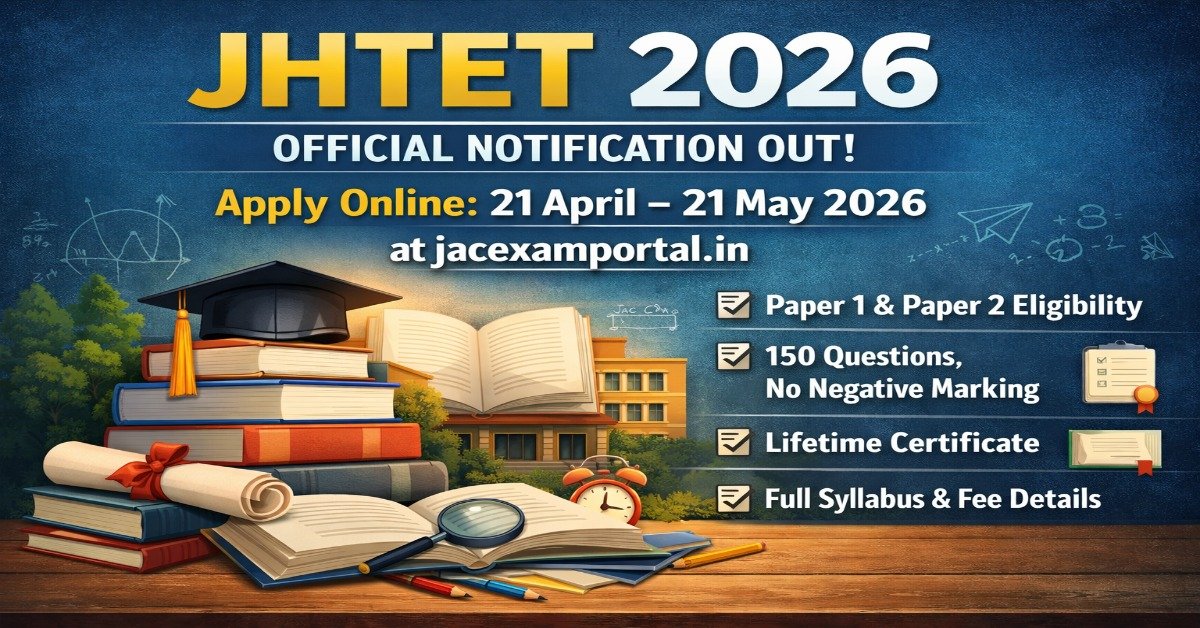
The Jharkhand Academic Council (JAC), Ranchi has officially released the Jharkhand Teacher Eligibility Test 2026 (JHTET) notification on 28 March 2026. This state-level eligibility examination is conducted under the Jharkhand Teacher Eligibility Test Rules 2026 (Advt. No. 487, dated 26.03.2026) for candidates who wish to become teachers in government primary and upper primary schools (Classes 1–8) across Jharkhand. JHTET 2026 has two papers — Paper 1 for Classes 1–5 and Paper 2 for Classes 6–8. Candidates may apply for one or both papers. Online applications are accepted at jacexamportal.in from 21 April to 21 May 2026. The exam is OMR-based with 150 MCQ questions, 150 marks, 2.5 hours per paper, and NO negative marking. The JHTET certificate, once earned, has lifetime validity. Qualifying JHTET is mandatory for Jharkhand government teacher recruitment — it does not itself guarantee appointment.
Notification: No. JAC/JTET/2406/24-Secy/258/26 | Conducted by: Jharkhand Academic Council (JAC), Paper 1 & Paper 2
Quick Facts
- JAC Ranchi
- JHTET 2026
- Apply: 21 Apr – 21 May 2026
- 150 Questions | 150 Marks | 2.5 Hrs
- No Negative Marking
- Lifetime Certificate Validity
- No Correction Window
- Portal: jacexamportal.in
| Exam Year | Papers | Questions per Paper | Negative Marking | Duration per Paper | Certificate Validity | Min Age (01 Aug 2026) |
|---|---|---|---|---|---|---|
| 2026 | 2 (P1 + P2) | 150 | Nil | 2.5 Hrs | Lifetime | 21 Yrs |
Apply Online
Apply at jacexamportal.in → Exam Form Portal section. Fill carefully — no correction window is provided after submission. Fee is non-refundable.
No Correction Window: Unlike many other TET exams, JHTET 2026 does NOT provide any correction window after form submission. Fill every detail — name, DOB, educational qualification, category, paper choice — with absolute accuracy. Errors discovered later cannot be corrected, and incorrect information will lead to cancellation of candidature at any stage, even after passing.
1. Important Dates
- 28 March 2026 — Official Notification Released (No. JAC/JTET/2406/24-Secy/258/26)
- 21 April 2026 — Online Application Opens
- 21 May 2026 — Last Date to Submit Online Application & Fee Payment
- NOT Available — Correction Window — Fill carefully
- To be announced on jacexamportal.in — Admit Card Release Date (no postal delivery)
- To be announced — Exam Date — Paper 1 & Paper 2 — likely same day, different shifts
- To be announced — Result & Certificate — Published on official website after exam
Note: Minimum age: Candidates must have attained 21 years of age as on 01 August 2026. Maximum age is determined by Jharkhand Government service rules for the exam organisation year.
2. JHTET 2026 — Complete Overview
| Particulars | Details |
|---|---|
| Conducting Body | Jharkhand Academic Council (JAC), Ranchi |
| Exam Name | Jharkhand Teacher Eligibility Test 2026 (JHTET / JTET) |
| Notification No. & Date | JAC/JTET/2406/24-Secy/258/26 | Dated: 28 March 2026 |
| Purpose | Eligibility Test for teaching in govt. primary/upper primary schools in Jharkhand (Classes 1–8). Qualifying JHTET is mandatory for teacher recruitment but does NOT guarantee appointment. |
| Papers / Levels | Paper 1 (Level 1) — Classes 1 to 5 (Primary) | Paper 2 (Level 2) — Classes 6 to 8 (Upper Primary). Can apply for one or both. |
| Exam Mode | Offline — OMR Sheet (Pen & Paper based) |
| Duration | 2 hours 30 minutes per paper | Visually impaired / Cerebral Palsy / both-hands-impaired candidates: 30 extra minutes (Scribe also provided) |
| Questions & Marks | 150 MCQ questions | 150 marks per paper | 1 mark per correct answer | NO negative marking |
| Question Paper Medium | Bilingual — Hindi and English (both). Language subject papers will be in their respective languages. Exam medium: candidate’s choice of Hindi or English. |
| Difficulty Level | Paper 1 — Matriculation/Secondary level | Paper 2 — Senior Secondary (+2) level |
| No. of Attempts | Unlimited — no restriction on number of attempts to qualify or improve score |
| Certificate Validity | Lifetime (as per NEP 2020 guidelines and Supreme Court order in Civil Appeal No. 5564/2019) |
| Official Websites | jacexamportal.in | jac.jharkhand.gov.in | Apply via: Exam Form Portal section |
3. Paper 1 vs Paper 2 — Which Should You Choose?
Paper 1 — Level 1 (Primary)
- Target Classes: 1 to 5 (Primary Level)
- Questions: 150 | Marks: 150
- Duration: 2 hours 30 minutes
- Difficulty: Matriculation/Secondary level
- Subjects: Child Dev. & Pedagogy, Language I, Language II (Regional), Mathematics, Environmental Studies (EVS)
- Who should choose: Aspiring primary teachers (Classes 1–5) in Jharkhand government schools
Paper 2 — Level 2 (Upper Primary)
- Target Classes: 6 to 8 (Upper Primary Level)
- Questions: 150 | Marks: 150
- Duration: 2 hours 30 minutes
- Difficulty: Senior Secondary (+2) level
- Subjects: Child Dev. & Pedagogy, Language I, Language II (Regional), Subject-Specific (Maths & Science OR Social Studies — 60 questions)
- Who should choose: Aspiring upper primary teachers (Classes 6–8) — choose subject based on your specialisation
Can you apply for both? Yes. Eligible candidates may appear for both Paper 1 and Paper 2 in the same exam cycle. Both exams are likely held on the same day in different shifts. Separate fee applies for each paper. A combined fee (slightly lower than two separate fees) is available if applying for both — refer to the fee table below.
4. Exam Pattern — Subjects, Questions & Marks
Paper 1 — Primary Level (Classes 1–5)
| # | Subject | Questions | Marks | Note |
|---|---|---|---|---|
| 1 | Child Development & Pedagogy | 30 | 30 | Common — both papers (Syllabus: Classes 1–5 curriculum) |
| 2 | Language I (Hindi & English or Urdu & English) | 30 | 30 | Hindi, English or Urdu — as chosen by candidate |
| 3 | Language II — Regional Language | 30 | 30 | Choose one: Panchpargania / Kurmali / Bengali / Urdu |
| 4 | Mathematics | 30 | 30 | Based on Classes 1–5 state syllabus; Matric-level difficulty |
| 5 | Environmental Studies (EVS) | 30 | 30 | Based on Classes 1–5 state syllabus; includes Jharkhand-specific content |
| TOTAL — Paper 1 | 150 | 150 | No Negative Marking | OMR Sheet |
Paper 2 — Upper Primary Level (Classes 6–8)
| # | Subject | Questions | Marks | Note |
|---|---|---|---|---|
| 1 | Child Development & Pedagogy | 30 | 30 | Common — both papers (Syllabus: Classes 6–8; Sr. Secondary level) |
| 2 | Language I (Hindi & English or Urdu & English) | 30 | 30 | Hindi, English or Urdu — as chosen by candidate |
| 3 | Language II — Regional Language | 30 | 30 | Choose one: Panchpargania / Kurmali / Bengali / Urdu |
| 4a | Mathematics & Science (for Maths/Science teachers) | 60 | 60 | Choose ONE option based on your subject specialisation |
| 4b | Social Studies / Social Science (for Social Studies teachers) | 60 | 60 | (same choice) |
| 4c | Language / Other Subject (for Language Teachers) | 60 | 60 | (same choice) |
| TOTAL — Paper 2 | 150 | 150 | No Negative Marking | OMR Sheet |
Quick Reference: OMR sheet — fill circles fully in Black or Blue pen | No negative marking — attempt all questions | Paper 1 difficulty: Matriculation level | Paper 2 difficulty: Senior Secondary level | No re-evaluation of OMR after result
5. Minimum Qualifying Marks — Category-wise
| Category | Qualifying % | Marks (out of 150) |
|---|---|---|
| General / EWS | 60% | 90 |
| OBC — BC-1 / BC-2 | 55% | ≥82–83 |
| SC / ST / PVTG / Divyang | 52% | ≥78 |
About JHTET Certificate & Validity: The JHTET certificate earned upon qualifying is valid for a lifetime, as per the Supreme Court’s order in Civil Appeal No. 5564/2019 and the subsequent NCTE letter (No. 112852 dated 04.08.2022). This means once you qualify JHTET, you never need to appear again just to renew eligibility. However, candidates may appear any number of times if they wish to improve their score for better merit in teacher recruitment. Qualifying JHTET does NOT guarantee appointment — it only makes you eligible to appear in Jharkhand government teacher recruitment processes.
6. Eligibility Criteria — Paper 1 & Paper 2
Paper 1 — Eligibility (Classes 1–5 Primary Teachers)
| Option | Educational Qualification Required |
|---|---|
| A | Higher Secondary (12th) or equivalent with minimum 45% marks AND 2-year Diploma in Elementary Education (D.El.Ed) — passed or appearing in final year |
| B | Higher Secondary (12th) or equivalent with minimum 45% marks AND 4-year Bachelor of Elementary Education (B.El.Ed) |
| C | Higher Secondary (12th) or equivalent with minimum 45% marks AND 2-year Diploma in Special Education — passed or appearing |
| D | Graduation AND B.Ed — with bridge course as notified by NCTE (for Primary level) |
5% relaxation in minimum percentage marks for SC / ST / OBC / PwD (Divyang) / PVTG candidates in all options above.
Paper 2 — Eligibility (Classes 6–8 Upper Primary Teachers)
| Option | Educational Qualification Required |
|---|---|
| A | Graduation with minimum 45% marks AND 2-year B.Ed from a recognised institution — passed or appearing in final year |
| B | Graduation AND 4-year Bachelor of Elementary Education (B.El.Ed) |
| C | Higher Secondary (12th) with minimum 45% marks AND 4-year B.A./B.Sc. Ed OR B.A.Ed./B.Sc.Ed |
| D | Graduation AND B.Ed (Special Education) from a recognised institution |
5% relaxation in minimum percentage marks for SC / ST / OBC / PwD (Divyang) / PVTG candidates in all options above.
Age Limit
Minimum age: 21 years as on 01 August 2026 (the exam organisation year). Maximum age is governed by Jharkhand Government rules (Personnel, Administrative Reforms and Rajbhasha Department). Key age relaxations:
- Para Teachers (JEPC) with minimum 2 years continuous service as on notification date (28.03.2026) and currently working: Age relaxation equal to their service period, maximum up to 58 years of age
- All candidates — Gap Year relaxation (One-time): In the interval between the previous JHTET and JHTET 2026, candidates get 1 year’s relaxation for each year of gap minus 1. For example: if previous JHTET was in 2016 and current is 2026 → 10-year gap → minus 1 → 9 years one-time relaxation added to maximum age limit
- No upper age limit for the eligibility test itself — it is primarily an eligibility exam; age limit applies to the teacher recruitment process, not to appearing in the TET
- No restriction on number of attempts
Nationality & Other Conditions
- Must be a citizen of India
- Must not have been convicted by a competent court in a criminal case
- Must meet educational and training qualifications as specified in JHTET Rules 2026 (Advt. No. 487, dated 26.03.2026)
- Candidates appearing in the final year of D.El.Ed/B.Ed training may apply conditionally — they must submit verified final mark sheet before the date fixed by the exam authority between result publication and certificate issuance. This condition is announced in newspapers by JAC.
- Admission to the exam does NOT confirm that a candidate’s eligibility is verified. Final verification happens at the time of appointment by the concerned District Education Officer (DEO)
7. Application Fee — Category & Paper-wise
| Category | Paper 1 Only | Paper 2 Only | Both Papers |
|---|---|---|---|
| General / BC-1 / BC-2 / EWS | ₹1,300 | ₹1,300 | ₹1,500 |
| Scheduled Caste (SC) | ₹700 | ₹700 | ₹800 |
| Scheduled Tribe (ST) | ₹700 | ₹700 | ₹800 |
| PVTG (Particularly Vulnerable Tribal Group) | ₹500 | ₹500 | ₹600 |
| Divyang (PwD) — All categories | ₹700 | ₹700 | ₹800 |
Note: Fee once paid is completely non-refundable under any circumstances. Pay only if you are confirmed as eligible. Online payment only — BHIM UPI, Net Banking, Debit/Credit Card through the official portal.
8. Syllabus — Subject-wise Detailed Topics
Common to Both Papers — Child Development & Pedagogy (30 Questions)
Child Development
- Child development concept and its relation to learning
- Piaget, Kohlberg, Vygotsky — theories of development
- Principles of child development (heredity & environment)
- Individual differences among learners (language, gender, caste, community)
- Intelligence — multiple intelligences; Howard Gardner
- Language and thought; Social construction of gender
- Foundational Stage (NCF-FS) and National Curriculum Framework (NEP 2020)
Learning & Pedagogy
- How children think and learn — motivation and learning
- Teaching-learning process; strategies and approaches
- Inclusive Education — understanding children with special needs
- Learning disabilities, dyslexia, ADHD — classroom strategies
- Continuous & Comprehensive Evaluation (CCE)
- Assessment for learning vs. assessment of learning
- NEP 2020 — 5+3+3+4 curricular structure; FLN (Foundational Literacy & Numeracy)
Language I & Language II (30 + 30 Questions each)
Language I — Hindi / English / Urdu
- Reading comprehension — prose and poetry passages
- Grammar — tenses, parts of speech, sentence structure
- Pedagogy of language teaching; language development
- Teaching-learning materials; multilingual resources
- Communication skills; challenges in diverse classrooms
- Role of grammar in language learning
Language II — Regional Language (Choose One)
- Options: Panchpargania | Kurmali | Bengali | Urdu
- Script, grammar, and vocabulary of chosen language
- Comprehension passages — prose and poetry
- Folk literature and cultural context
- Teaching methodology for regional language instruction
- Mother-tongue-based multilingual education (MTBMLE)
- Urdu specific: isam, fail lazim/muta’addi; Premchand stories
Paper 1 Specific — Mathematics & EVS (30 + 30 Questions)
Mathematics (Paper 1)
- Number system — natural numbers, whole numbers, integers
- Addition, subtraction, multiplication, division; BODMAS
- Fractions and decimals; factors and multiples; LCM & HCF
- Basic geometry — shapes, angles, lines
- Measurement — length, weight, capacity, time, money
- Data handling — pictographs, bar graphs, basic statistics
- Pedagogy of Mathematics — challenges, teaching strategies
Environmental Studies — EVS (Paper 1)
- Family & Friends; Food — sources, types, nutrition
- Shelter, water, travel; Plants and animals
- Natural resources and conservation
- Jharkhand-specific geography, climate, forests, rivers
- Social environment — community, occupations, festivals
- Natural disasters and safety; Environmental pollution
- EVS pedagogy — integrated approach; scope of EVS
Paper 2 Specific — Subject Section (60 Questions, Choose One)
Mathematics & Science (Paper 2)
- Mathematics: Algebra, equations, geometry, mensuration, ratio & proportion, data interpretation
- Number theory, commercial maths, statistics (up to Class 8)
- Maths pedagogy — problem-solving, errors & remediation
- Science: Living world — plants, animals, cell, reproduction
- Physical world — force, motion, energy, light, sound
- Chemical substances — elements, compounds, acids & bases
- Natural resources; Environmental science
- Science pedagogy — observation, experimentation, inquiry
Social Studies / Social Science (Paper 2)
- History: Ancient, Medieval, Modern India; Freedom movement
- Jharkhand History — tribal movements, Santhal Rebellion (1855), formation of Jharkhand state (2000)
- Geography: India & World geography; Jharkhand geography — rivers, forests, minerals
- Physical features, climate, agriculture, industries
- Civics: Indian Constitution; Government structure; Panchayati Raj
- Local self-government; Democracy & fundamental rights
- Social Science pedagogy — critical thinking, primary sources
Syllabus Difficulty Note: Paper 1 questions are set at Matriculation/Secondary level (equivalent to Class 10 standard) but test understanding of content from Classes 1–5 curriculum. Paper 2 questions are set at Senior Secondary/+2 level (equivalent to Class 12 standard) and test understanding of Classes 6–8 content. Questions are application-based and scenario-driven — especially in Child Development & Pedagogy. NEP 2020 and NCF 2023 framework topics appear in 5–7 questions across both papers.
9. How to Apply Online — Step-by-Step
- Visit the Official JAC Portal — Go to jacexamportal.in (official portal of Jharkhand Academic Council). On the homepage, look for the Exam Form Portal section or find the JHTET 2026 link under “Recent Announcements”. Alternatively visit jac.jharkhand.gov.in. Use an updated browser with JavaScript enabled — Chrome or Firefox recommended.
- Register and Create Account — Click on the JHTET 2026 apply link. Complete basic registration with your mobile number and email ID. You will receive OTP for verification. Keep your mobile and email active throughout the application period for OTP and future communication.
- Select Paper(s) and Fill the Form — Choose Paper 1, Paper 2, or Both. Fill your personal details (name EXACTLY as in 10th certificate), DOB (exactly as in marksheet), educational qualifications, category, and regional language choice for Language II. Choose your subject for Paper 2 (Mathematics & Science / Social Studies). No correction window — double-check everything.
- Upload Photo and Signature — Upload a recent passport-size photograph and signature in the prescribed format (JPEG, within size limits as specified on portal). The photo must match your current appearance. The same photo will appear on your admit card — use a clear, coloured photograph against a white/light background.
- Pay Application Fee Online — Pay the fee as per your category and number of papers selected (refer fee table above). Payment via BHIM UPI, Net Banking, or Credit/Debit Card through the portal’s payment gateway. Fee is non-refundable — ensure eligibility before paying. Completed payment generates a transaction receipt — save it.
- Submit & Download Confirmation — Review all filled information in the preview page one final time. Submit the application. Download and print the confirmation/application copy immediately after submission. Also save the PDF. This is your proof of application — it is verified at the time of appointment by the DEO (District Education Officer).
Critical Rules — Do NOT Ignore:
- Only online applications accepted — no offline/postal applications under any circumstances
- No correction window — fill name, DOB, category, educational qualification exactly correct. Errors cannot be fixed after submission.
- Information entered is used to print admit card, declare result, and issue certificate — wrong entries affect all stages
- Applications with any incorrect or incomplete information can be cancelled at any stage of the process, including after passing
- Admit card will only be available for download on the official website — JAC does not send admit cards by post
- Misconduct at exam: Candidate barred from the next two JHTET exams
10. Preparation Strategy — Subject-wise Tips
Child Development & Pedagogy: This section has the highest fail rate — over 50% of candidates underperform here. Read NCF 2005, NCF-FS 2022, and NEP 2020 summary. Focus on Piaget’s stages, Vygotsky’s ZPD, Kohlberg’s moral development. Practice case-study-based scenario questions. Expect 5–7 questions directly on NEP 2020.
EVS (Paper 1): Jharkhand-specific content is tested — know rivers (Damodar, Subarnarekha), forests (Saranda, Dalma), tribal culture, crops. NCERT EVS Books (Classes 3–5) are the primary reference. Focus on the integrated approach of teaching EVS and the concept of “themes” in EVS curriculum.
Language II — Regional Choice: Choose the language whose script you can read and write comfortably — not necessarily your mother tongue. For Panchpargania and Kurmali, focus on Devanagari-based grammar. For Bengali, practice script and comprehension. For Urdu, study Nastaliq script basics and grammar terms (isam, fail, etc.).
Mathematics: Revise NCERT Maths textbooks for Classes 1–5 (Paper 1) or Classes 6–8 (Paper 2). Focus on the “how to teach” aspect — pedagogy questions on maths often fetch more marks than pure calculation. Practice mental maths for Paper 1. Algebra and mensuration are high-weightage for Paper 2.
Social Science (Paper 2): Jharkhand history and geography carry significant weightage — study the Santhal Rebellion (1855), Birsa Munda movement, formation of Jharkhand (15 Nov 2000), mineral wealth of Jharkhand, tribal communities (Santhal, Ho, Munda, Oraon). Use NCERT History, Geography for Classes 6–8 as base.
Time Management: 150 questions in 150 minutes = 1 minute per question. Since there is NO negative marking, attempt all 150 questions. Strategy: spend ~35 min on Child Dev. & Pedagogy, ~25 min each on Language sections, ~30 min on EVS/Maths/Subject-specific. Reserve 5 min for OMR sheet verification at the end.
Best Books for JHTET 2026
- Child Development & Pedagogy: NCERT Psychology (Class 11–12), NCF 2005 PDF (free), NEP 2020 document, “Bal Vikas aur Shiksha Shastra” by Himanshi Singh
- Hindi Language: NCERT Hindi textbooks (Classes 1–8), “Hindi Grammar” by Dr. Uday Narain Tiwari
- Mathematics: NCERT Maths (Classes 1–8 as applicable), R.S. Aggarwal (Elementary Maths)
- EVS (Paper 1): NCERT EVS Classes 3–5, “Aas Paas” series; Jharkhand Government Geography booklet
- Social Science (Paper 2): NCERT History, Geography, Civics (Classes 6–8); Jharkhand State GK handbook
- Science (Paper 2): NCERT Science Classes 6–8
11. Official Links
- JHTET 2026 Official Page — jacexamportal.in/jhtet.html
- Official Notification PDF — JHTET 2026 (JAC/JTET/2406/24-Secy/258/26)
- Press Advertisement PDF — JHTET 2026
- Official Syllabus PDF — JHTET 2026 (Paper 1 & Paper 2)
- JAC Official Exam Portal — jacexamportal.in (Apply Online Here)
- JAC Official Website — jac.jharkhand.gov.in
Quick Reference: Apply: 21 April to 21 May 2026 | Portal: jacexamportal.in | Paper 1: Classes 1–5 | Paper 2: Classes 6–8 | No negative marking | Certificate: Lifetime valid | No correction window
12. Frequently Asked Questions
Q: What is JHTET 2026 and who conducts it?
JHTET stands for Jharkhand Teacher Eligibility Test 2026. It is conducted by the Jharkhand Academic Council (JAC), Ranchi under the Jharkhand Teacher Eligibility Test Rules 2026. It is a state-level eligibility examination for candidates who wish to become teachers in government primary (Classes 1–5) and upper primary (Classes 6–8) schools across Jharkhand. The exam has two papers — Paper 1 for Class 1–5 teachers and Paper 2 for Class 6–8 teachers. Qualifying JHTET is mandatory for teacher recruitment in Jharkhand but does not guarantee appointment by itself.
Q: What are the JHTET 2026 application dates?
The JHTET 2026 online application window is open from 21 April 2026 to 21 May 2026. Applications must be submitted through the official JAC portal at jacexamportal.in. No offline applications are accepted. There is no correction window after submission — fill the form carefully before final submission. The fee is non-refundable once paid.
Q: What is the application fee for JHTET 2026? The JHTET 2026 application fee varies by category and number of papers: General/BC-1/BC-2/EWS: ₹1,300 (one paper) | ₹1,500 (both papers). SC/ST: ₹700 (one paper) | ₹800 (both papers). PVTG: ₹500 (one paper) | ₹600 (both papers). Divyang (PwD): ₹700 (one paper) | ₹800 (both papers). Fee is non-refundable. Payment is online only via BHIM UPI, Net Banking, or Debit/Credit Card.
Q: What is the exam pattern of JHTET 2026?
Each paper (Paper 1 and Paper 2) consists of 150 MCQ questions for 150 marks. Duration: 2 hours 30 minutes (30 minutes extra for visually impaired and Cerebral Palsy candidates). No negative marking — 1 mark for each correct answer, 0 for wrong or unattempted. OMR sheet-based (offline). Paper 1 (Classes 1–5) covers: Child Development & Pedagogy, Language I, Language II (Regional), Mathematics, EVS. Paper 2 (Classes 6–8) covers: Child Development & Pedagogy, Language I, Language II (Regional), and 60-question subject paper (Maths & Science or Social Science).
Q: What are the minimum qualifying marks for JHTET 2026?
Category-wise minimum qualifying marks out of 150: General/EWS: 60% = 90 marks. OBC (BC-1/BC-2): 55% = approximately 82–83 marks. SC/ST/PVTG/Divyang (PwD): 52% = 78 marks. These qualifying percentages apply to both Paper 1 and Paper 2 separately. Since there is no negative marking, it is always advisable to attempt all 150 questions.
Q: What is the eligibility to apply for JHTET Paper 1 (Classes 1–5)?
For JHTET Paper 1, eligible candidates must have one of the following qualifications: Higher Secondary (12th pass) with minimum 45% marks + 2-year D.El.Ed. Higher Secondary with 45% + 4-year B.El.Ed. Higher Secondary with 45% + 2-year Diploma in Special Education. Graduation + B.Ed (with NCTE bridge course for primary level). SC/ST/OBC/PwD/PVTG candidates get 5% relaxation in the minimum percentage requirement. Candidates in the final year of qualifying training may apply conditionally.
Q: What is the eligibility to apply for JHTET Paper 2 (Classes 6–8)?
For JHTET Paper 2, eligible candidates must have one of the following: Graduation with minimum 45% marks + 2-year B.Ed from a recognised institution. Graduation + 4-year B.El.Ed. Higher Secondary (12th) with 45% + 4-year B.A./B.Sc. Ed or B.A.Ed./B.Sc.Ed. Graduation + B.Ed (Special Education). SC/ST/OBC/PwD/PVTG candidates get 5% relaxation. Candidates in final year of B.Ed may apply conditionally.
Q: What is the validity of the JHTET certificate?
The JHTET certificate is valid for a lifetime. This is in accordance with the Supreme Court’s order in Civil Appeal No. 5564/2019 and the NCTE letter No. 112852 dated 04.08.2022 issued to implement that order. Once you qualify JHTET, you do not need to reappear just to renew eligibility. However, candidates can appear multiple times if they want to improve their score for better merit in teacher recruitment processes. There is no restriction on the number of attempts.
Q: Can I apply for both Paper 1 and Paper 2 of JHTET 2026?
Yes. Candidates who are eligible for both Paper 1 (Classes 1–5) and Paper 2 (Classes 6–8) can apply for both in the same exam cycle. A combined fee option exists — slightly less than paying for two separate papers. Both exams are likely held on the same day in different shifts. You will need to meet the eligibility criteria for each paper separately. Both certificates are valid independently.
Q: Does qualifying JHTET guarantee a teaching job?
No. JHTET is only an eligibility test — not a recruitment exam. Qualifying JHTET certifies that you meet the minimum teaching aptitude and subject knowledge standard. To get a teaching job, you still need to separately apply for teacher vacancies in Jharkhand government schools (through JEPC — Jharkhand Education Project Council or other recruitment bodies) and qualify their selection process. JHTET is a mandatory prerequisite for applying to those recruitment processes, but passing it alone does not lead to appointment.
Q: Which regional language should I choose for Language II in JHTET?
JHTET Language II (Paper 1 and Paper 2) offers four regional language options: Panchpargania, Kurmali, Bengali, and Urdu. Candidates can choose any one of these four, regardless of their own background or mother tongue. The official advice is to choose the language whose script you can read and write comfortably. If your mother tongue is one of these four, that is usually the easiest choice. If not, choose based on your familiarity with the script — for example, those comfortable with Devanagari script may find Panchpargania or Kurmali easier.
Q: Is there any age limit for JHTET 2026?
The minimum age is 21 years as on 01 August 2026. There is no strict upper age limit for the eligibility test itself (since it is not a direct recruitment). However, Jharkhand Government’s rules for teacher recruitment have age limits — JHTET qualifying is only the first step. Key age relaxations in JHTET: Para Teachers (JEPC) with 2+ years continuous service get relaxation up to 58 years. All candidates benefit from a one-time relaxation for the gap years between the previous JHTET and 2026 (1 year deducted from the total gap as one-time opportunity).
Disclaimer
This article is independently written and published on JobTheta.com by Chandan Kumar for informational purposes only. All key facts — exam dates, fee structure, eligibility qualifications, qualifying marks, exam pattern, syllabus, age limit, and other details — are sourced directly from the official JHTET 2026 Press Advertisement (JAC/JTET/2406/24-Secy/258/26, dated 28.03.2026), the official JHTET 2026 Notification PDF, and the official JHTET 2026 Syllabus PDF released by the Jharkhand Academic Council (JAC), Ranchi. Application dates (21 April – 21 May 2026) are verified from multiple official sources. The JHTET exam date is not yet announced — candidates should regularly check jacexamportal.in and jac.jharkhand.gov.in for updates. JobTheta.com is not affiliated with JAC or the Jharkhand Government. Always verify all details from the official notification before applying.





Leave a Comment