
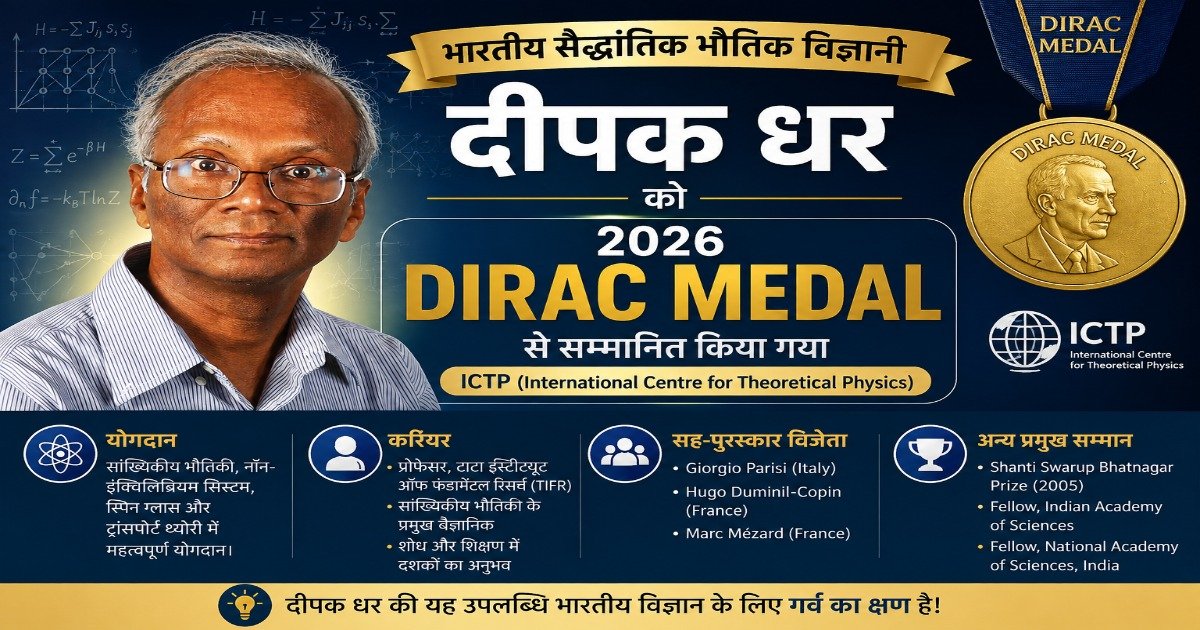
Indian theoretical physicist Deepak Dhar has been awarded the 2026 Dirac Medal by the International Centre for Theoretical Physics (ICTP), Trieste, Italy — placing him among the most celebrated scientists in the history of physics.
The ICTP announced the award on August 8, 2026. Dhar shares the honour with three other distinguished physicists from around the world, all recognised for transforming the field of statistical mechanics and extending its reach into diverse branches of modern science.
What Is the Dirac Medal?
The Dirac Medal is one of the most prestigious recognitions in theoretical physics. The ICTP instituted it in 1985 in honour of the legendary British physicist Paul Adrien Maurice Dirac, whose contributions to quantum mechanics remain foundational to modern physics.
The medal is awarded annually on August 8 — Dirac’s birthday — to physicists and mathematicians who have made outstanding contributions to theoretical physics and mathematics. Past recipients include some of the greatest names in the discipline, including Stephen Hawking, Edward Witten, Juan Maldacena, and Giorgio Parisi.
Winning the Dirac Medal places a scientist in genuinely rare company. It is not a lifetime achievement award — it targets specific, frontier-level scientific contributions that have reshaped how we understand the physical world.
Deepak Dhar — Who Is He?
Deepak Dhar was born on 30 October 1951 in Pratapgarh, Uttar Pradesh, India. Now 74 years old, he has spent over five decades advancing the frontiers of theoretical and statistical physics, becoming one of India’s most decorated scientists.
Academic Journey
Dhar completed his undergraduate studies at the University of Allahabad in 1970 and earned a master’s degree in physics from IIT Kanpur in 1972. He then moved to the United States for doctoral studies at the California Institute of Technology (Caltech) and received his PhD in 1978.
His doctoral advisor at Caltech was Jon Mathews. After completing his PhD, Dhar made a defining choice — he returned to India rather than pursuing a career abroad, a decision that would shape the trajectory of Indian theoretical physics for decades.
Career and Institutional Affiliations
He returned to India in 1978 and joined the Tata Institute of Fundamental Research (TIFR), Mumbai, as a research fellow, eventually rising to the position of professor. After retirement, he continued his association with TIFR as a distinguished professor. He also served as distinguished visiting faculty at IISER Pune from 2016 to 2024.
He has been INSA Distinguished Professor at the International Centre for Theoretical Sciences of the Tata Institute of Fundamental Research since 2024. ICTP
Throughout his career, Dhar has held editorial positions at leading international journals in statistical physics and has mentored generations of Indian researchers in the field.
Why Did Deepak Dhar Win the 2026 Dirac Medal?
The 2026 Dirac Medal honours physicists whose work has made significant contributions to the understanding of statistical mechanics — a branch of physics that examines the collective behaviour of systems comprising a large number of particles.
All four medallists were honoured for their efforts at transforming concepts from statistical mechanics into applications across diverse scientific fields.
In Dhar’s specific case, his recognition centres on two major areas of theoretical contribution:
1. The Abelian Sandpile Model
According to ICTP, Deepak Dhar showed how simple interactions can lead to complex and sometimes unpredictable behaviour in large systems. Through his pioneering work on the sandpile model, he described a familiar phenomenon: as grains are added to a sandpile, most result in no change or only small avalanches, while occasionally a single grain can cause a much larger collapse.
The sandpile model, or the self-organized criticality model, was originally proposed by Per Bak, Chao Tang, and Kurt Wiesenfeld in 1987. Dhar’s contribution was to place this intuitive concept on a rigorous mathematical foundation — specifically through his work on what he termed the Abelian sandpile model, which gave physicists and mathematicians precise tools to analyse self-organised critical systems.
The theory shows that the sandpile, like many other complex systems, spontaneously places itself in a critical regime where small effects can sometimes trigger large abrupt events. It has been used to model systems as apparently different as earthquakes, traffic jams, and fluctuations in financial markets.
In practical terms, this model helps explain why a single additional grain of sand can cause a mountain to collapse, why a single sell order can crash a stock market, and why one small slip in geological rock can trigger a massive earthquake.
2. Statistical Physics and Stochastic Processes
Beyond the sandpile model, Dhar is known for his extensive research on statistical physics and stochastic processes. His theoretical work explores how randomness, disorder, and probability interact at large scales to produce measurable, predictable physical behaviour — work that has underpinned advances in condensed matter physics, biophysics, and computational models of complex networks.
The 2026 Dirac Medal Co-Winners
Professor Dhar is among four physicists selected for the 2026 Dirac Medal. The four winners are:
- Bernard Derrida — Honorary Professor, Collège de France, France
- Deepak Dhar — INSA Distinguished Professor, International Centre for Theoretical Sciences of the Tata Institute of Fundamental Research, India
- Marc Mézard — Professor of Theoretical Physics, Bocconi University, Italy
- Haim Sompolinsky — Professor of Neuroscience and Physics, Hebrew University of Jerusalem, Israel, and Visiting Professor, Harvard University, USA
Each of the four scientists approached the mathematics and physics of complex systems from a different angle, yet their collective body of work has redefined how statistial mechanics is applied — from disordered magnets and neural networks to machine learning and artificial intelligence.
Deepak Dhar’s Awards and Honours — A Complete Timeline
Winning the Dirac Medal caps what is already one of the most decorated scientific careers in modern Indian history. Here is a full timeline of his recognitions:
| Year | Award / Honour |
|---|---|
| 1983 | Young Scientist Medal, Indian National Science Academy (INSA) |
| 1990 | Fellow, Indian Academy of Sciences |
| 1991 | Shanti Swarup Bhatnagar Prize, CSIR |
| 1993 | J. Robert Schrieffer Prize, ICTP |
| 1999 | Fellow, National Academy of Sciences, India |
| 2001 | Satyendranath Bose Medal, INSA |
| 2002 | Third World Academy of Sciences (TWAS) Prize |
| 2006 | Fellow, The World Academy of Sciences (TWAS) |
| 2007 | Fellow, JC Bose National Science and Engineering Research Board |
| 2022 | Boltzmann Medal (shared with John Hopfield) |
| 2023 | Padma Bhushan, Government of India |
| 2026 | Dirac Medal, ICTP |
In 2022, Dhar became the first Indian to be awarded the Boltzmann Medal — the highest recognition in statistical physics, awarded once every three years by the International Union of Pure and Applied Physics (IUPAP) — for exceptional contributions to the subject.
The Padma Bhushan, awarded in 2023, is one of India’s highest civilian honours — recognition not just from the scientific community but from the Government of India for his contribution to the nation’s scientific heritage.
What Is Statistical Mechanics and Why Does It Matter?
To fully appreciate Dhar’s contributions, it helps to understand the field he has dedicated his career to.
Statistical mechanics is the branch of physics that bridges the microscopic behaviour of individual atoms and molecules with the macroscopic properties we observe in everyday matter. It explains why water boils, how magnets form, and why gases exert pressure — all by studying the average collective behaviour of enormous numbers of particles.
What makes statistical mechanics particularly powerful today is its ability to describe complex, disordered systems — systems where individual parts interact in complicated, non-linear ways, leading to emergent behaviour that cannot be predicted by examining any single component in isolation.
Dhar’s work on self-organized criticality sits at the heart of this field. The idea that large systems can naturally evolve toward a critical state — without external tuning — has proven enormously powerful. It connects physics with biology, economics, geology, and even neuroscience.
India’s Growing Legacy in Global Physics
Deepak Dhar’s 2026 Dirac Medal is another milestone in India’s expanding presence on the world stage of theoretical physics. From C.V. Raman (Nobel Prize, 1930) to Subrahmanyan Chandrasekhar (Nobel Prize, 1983), Indian scientists have repeatedly made foundational contributions to global physics.
Dhar’s recognition — especially the combination of the Boltzmann Medal (2022), the Padma Bhushan (2023), and now the Dirac Medal (2026) — signals that Indian theoretical physics is not just historically significant but actively producing world-leading science today.
His decades at TIFR Mumbai and ICTS Bengaluru also highlight the critical role India’s premier research institutions play in nurturing scientific talent and providing the intellectual environment for frontier research.
Key Facts at a Glance
| Detail | Information |
|---|---|
| Full Name | Deepak Dhar |
| Date of Birth | 30 October 1951 |
| Birthplace | Pratapgarh, Uttar Pradesh, India |
| Age | 74 years |
| Education | B.Sc. – University of Allahabad; M.Sc. – IIT Kanpur; PhD – Caltech |
| Current Position | INSA Distinguished Professor, ICTS-TIFR, Bengaluru |
| Award | 2026 Dirac Medal |
| Awarding Body | International Centre for Theoretical Physics (ICTP), Italy |
| Research Focus | Statistical Physics, Stochastic Processes, Self-Organized Criticality |
| Co-Winners | Bernard Derrida, Marc Mézard, Haim Sompolinsky |
Frequently Asked Questions (FAQs)
1. What is the Dirac Medal?
The Dirac Medal is an annual award given by the International Centre for Theoretical Physics (ICTP) in Trieste, Italy. Established in 1985 in memory of physicist Paul Dirac, it is presented on August 8 each year to scientists who have made outstanding contributions to theoretical physics and mathematics.
2. Who won the 2026 Dirac Medal?
The 2026 Dirac Medal was jointly awarded to four physicists: Deepak Dhar (India), Bernard Derrida (France), Marc Mézard (Italy), and Haim Sompolinsky (Israel/USA). All four were recognised for their contributions to statistical mechanics.
3. What is Deepak Dhar famous for?
Deepak Dhar is best known for his rigorous mathematical work on the Abelian sandpile model and self-organised criticality. His research in statistical physics and stochastic processes has helped explain complex behaviours in physical, biological, and financial systems.
4. Has any Indian scientist won the Dirac Medal before?
The Dirac Medal has been awarded since 1985. Deepak Dhar’s win in 2026 is a landmark recognition, building on his earlier achievement of becoming the first Indian to win the Boltzmann Medal in 2022.
5. What is the sandpile model in physics?
The sandpile model, originally proposed by Bak, Tang, and Wiesenfeld in 1987, describes how complex systems naturally evolve to a critical state. Deepak Dhar gave it mathematical rigour through the Abelian sandpile model, showing how small events in large systems can sometimes trigger cascading, large-scale outcomes.
6. What other awards has Deepak Dhar received?
Dhar has received the Padma Bhushan (2023), Boltzmann Medal (2022), Shanti Swarup Bhatnagar Prize (1991), TWAS Prize (2002), Satyendranath Bose Medal (2001), and the J. Robert Schrieffer Prize (1993), among others.
7. Where does Deepak Dhar currently work?
Since 2024, Deepak Dhar has been serving as INSA Distinguished Professor at the International Centre for Theoretical Sciences (ICTS), Tata Institute of Fundamental Research, Bengaluru.






Leave a Comment