
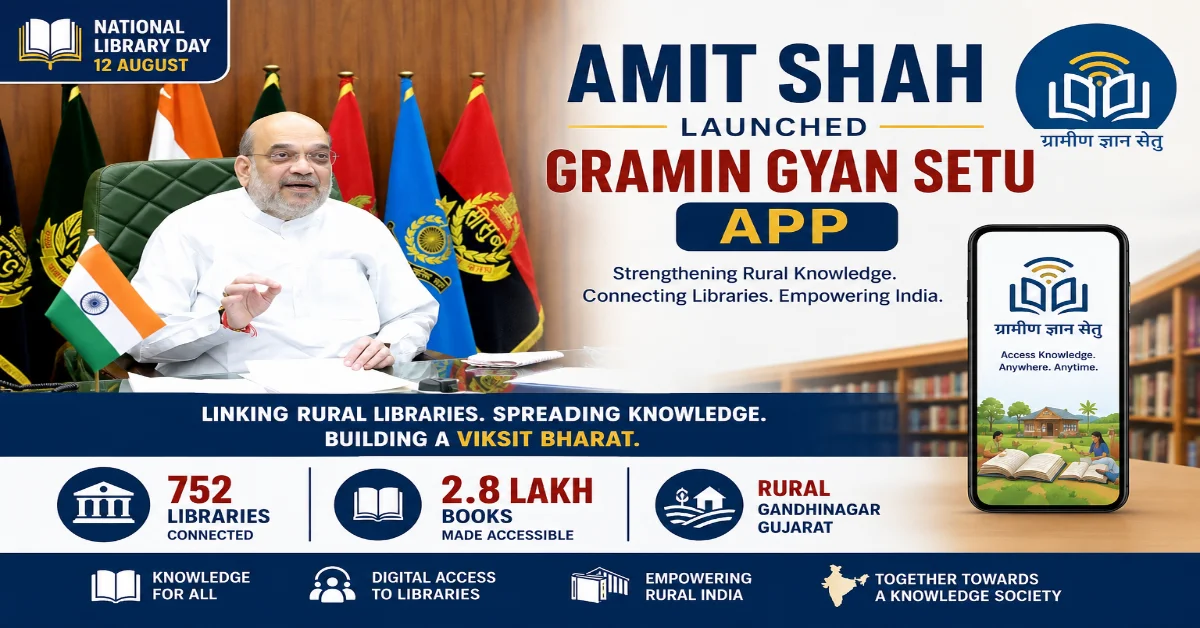
Union Home Minister and Minister of Cooperation Amit Shah launched the Gramin Gyan Setu app on August 12, 2026. He unveiled it through video conferencing. The digital initiative connects libraries across the Gandhinagar Lok Sabha constituency of Gujarat. As a result, rural readers, especially children and young people, can now access a much wider pool of books than any single village library could offer alone.
The launch date was not random. It fell on National Library Day, which India observes every year on the birth anniversary of S.R. Ranganathan. Ranganathan was a noted librarian and mathematician, and many consider him the father of library science in India.
Quick Facts: Gramin Gyan Setu App
Here is a snapshot of the key details:
- Launched by: Union Home Minister and Minister of Cooperation Amit Shah
- Date of launch: August 12, 2026 (National Library Day)
- Mode of launch: Virtual, via video conferencing
- Coverage area: Gandhinagar Lok Sabha constituency, Gujarat (Gandhinagar, Kalol and Sanand assembly segments)
- Village libraries set up: Around 63
- Libraries connected via the app: 752
- Books linked through central libraries: Around 2.8 lakh (280,000)
- Books per village library: Roughly 4,500 to 6,000
- Mobile library vans: 4, funded through MPLAD funds
- Van visit frequency: Every fortnight (15 days)
- Gujarat CM present at event: Bhupendra Patel
What Is the Gramin Gyan Setu App?
Gramin Gyan Setu means “rural knowledge bridge.” It is a technology-enabled library network. The app connects small village-level libraries to larger central libraries. It uses a hub-and-spoke digital model, so readers in rural areas can request and receive books that go far beyond their local shelves.
Each village no longer depends only on its own small collection. Instead, the app links every reader to a shared pool of resources. For example, a child at a small village library with a few thousand books can now tap into a combined collection of roughly 2.8 lakh books held across four central libraries.
How the Initiative Works
The Gramin Gyan Setu system relies on a few connected parts. Together, they form a simple but effective supply chain for books.
Village-level libraries: Officials have already set up around 63 small libraries. Each one holds approximately 4,500 to 6,000 books. Planners placed these libraries centrally, ideally near a school, so children can visit easily.
Central library hubs: Four larger libraries anchor the network. Together, they hold a combined collection of about 2.8 lakh books.
The app itself: Readers can use the app to request specific books their local library does not stock.
Mobile library vans: Four vans circulate through villages every fortnight. Amit Shah funded these vans through his MP Local Area Development (MPLAD) funds. The vans collect returned books and deliver newly requested titles.
Geographic reach: The network currently spans three assembly segments: Gandhinagar, Kalol, and Sanand. All three fall within the larger Gandhinagar Lok Sabha seat.
Gramin Gyan Setu: Key Numbers at a Glance
| Component | Detail |
|---|---|
| Village libraries established | ~63 |
| Total libraries connected via app | 752 |
| Central libraries linked | 4 |
| Combined book collection | ~2.8 lakh books |
| Books per village library | 4,500–6,000 |
| Mobile library vans deployed | 4 |
| Van visit frequency | Every 15 days |
| Assembly segments covered | Gandhinagar, Kalol, Sanand |
What Amit Shah Said at the Launch
At the virtual launch, Amit Shah explained where the idea came from. He said BJP workers first raised it in the rural areas of his own constituency. From there, workers began setting up small libraries in villages to encourage children to read.
Shah then outlined the core goal: he wants a library in every village, ideally near a school. This way, children can build reading habits early and easily. He also credited Gujarat Chief Minister Bhupendra Patel and the state government. In his words, they refined the original idea into a more structured, technology-driven system.
Shah shared a personal memory too. He recalled his long association with the Mahatma Gandhi Library in Mansa. There, he said, he built his foundational knowledge across many subjects over 16 years. He later engaged with the library of Gujarat Vidyapith in Ahmedabad as well. Finally, he encouraged parents and homemakers to build their own reading habits, since this in turn encourages children to read.
What Chief Minister Bhupendra Patel Said
Gujarat Chief Minister Bhupendra Patel spoke at the in-person event at Town Hall, Gandhinagar. He described Gramin Gyan Setu as an effort to bring knowledge to villages by connecting technology with education. He also argued that a library’s real value lies in the readers it attracts, not the size of its building.
Patel added that rural youth stand to gain the most from this initiative. Digital access, he explained, brings an entire library’s resources to their fingertips. He summed up the project’s purpose in one line: it connects villages with cities, readers with libraries, students with knowledge, and traditional libraries with the digital age.
Why National Library Day Matters
India observes National Library Day on the birth anniversary of Dr. S.R. Ranganathan. He was a pioneering librarian and mathematician, and his work laid the foundation for modern library science in the country. Organisers chose this date deliberately. It honours Ranganathan’s lifelong emphasis on making knowledge accessible to every reader, no matter where they live.
Why This Initiative Matters for Rural India
Access to books remains uneven between India’s cities and its villages. Urban readers typically enjoy large public libraries, well-stocked school libraries, and nearby bookstores. Rural students, however, often depend on whatever small collection their local school or panchayat maintains.
Gramin Gyan Setu tries to close this gap. Importantly, it does so without asking every village to build a large, fully stocked library of its own. Instead, it relies on three simple tools:
- A shared network of resources across multiple libraries
- Digital requests through the app, so readers can access titles beyond the local collection
- Physical delivery through mobile vans, so readers don’t need to travel to a central library themselves
As a result, this model could serve as a template for other constituencies. In particular, it may help areas where building large standalone libraries in every village is simply not practical.
Frequently Asked Questions (FAQs)
Q1: What is the Gramin Gyan Setu app?
It is a digital library network. The app connects small village libraries with larger central libraries in the Gandhinagar Lok Sabha constituency of Gujarat, giving rural readers access to a much wider collection of books.
Q2: Who launched the Gramin Gyan Setu app?
Union Home Minister and Minister of Cooperation Amit Shah launched the app virtually through video conferencing on August 12, 2026.
Q3: When was the Gramin Gyan Setu app launched?
The launch took place on National Library Day, August 12, 2026, which marks the birth anniversary of librarian and mathematician S.R. Ranganathan.
Q4: Which areas does the Gramin Gyan Setu app cover?
The initiative currently covers three assembly constituencies: Gandhinagar, Kalol, and Sanand. All three sit within the wider Gandhinagar Lok Sabha constituency in Gujarat.
Q5: How many libraries are connected through the app?
As of the launch, 752 libraries were connected through the Gramin Gyan Setu app. Officials also set up around 63 new village-level libraries.
Q6: How many books are accessible through the network?
Four central libraries linked to the network hold a combined collection of approximately 2.8 lakh books. Individual village libraries typically stock 4,500 to 6,000 books each.
Q7: How do books reach village libraries under this initiative?
Four mobile library vans handle the deliveries. Amit Shah funded them through his MP Local Area Development (MPLAD) funds, and they visit villages every fortnight to collect returned books and deliver new titles requested through the app.
Q8: Who else was involved in the launch event?
Gujarat Chief Minister Bhupendra Patel spoke at the in-person event held at Town Hall, Gandhinagar. He described the initiative as a bridge connecting villages with cities and traditional libraries with the digital age.
Q9: What is the main goal of the Gramin Gyan Setu initiative?
The primary goal is simple: establish a library in every village, ideally near a school, and give rural children and young people access to a far larger pool of reading material than any single village library could hold alone.
Q10: Why was National Library Day chosen for the launch?
National Library Day honours S.R. Ranganathan, whom many consider the father of library science in India. Therefore, organisers saw it as a fitting occasion to launch a new initiative focused on expanding library access.
The launch of the Gramin Gyan Setu app marks a notable step toward closing the rural-urban gap in access to books and learning resources. It combines small village libraries, larger central book collections, a dedicated app, and a fleet of mobile library vans. Together, these pieces give rural readers in the Gandhinagar Lok Sabha constituency a practical way to access a much wider range of reading material without travelling far from home. If the model succeeds, it could offer a useful blueprint for similar rural library networks across India.






Leave a Comment