
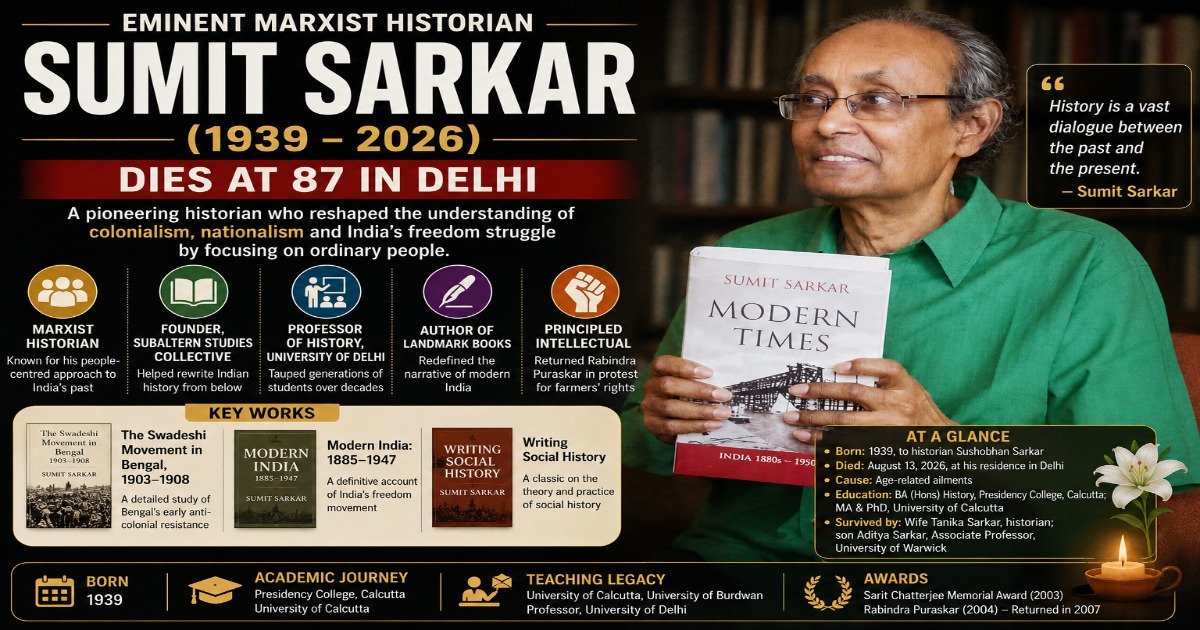
Noted historian Sumit Sarkar died on Thursday, August 13, 2026. He passed away at his residence in Delhi. He was 87 years old. Historian and family friend G Arunima confirmed that age-related ailments caused his death. Sarkar had been unwell for a long time. In fact, a fall some years ago had already limited his public activity.
His death marks a significant loss for Indian historiography. Over five decades, he reshaped how scholars study colonialism, nationalism, and the freedom movement. He did this by centring the experiences of ordinary people, rather than elite leaders alone.
Quick Facts: Sumit Sarkar
- Born: 1939, to historian Sushobhan Sarkar
- Died: August 13, 2026, at his residence in Delhi (aged 87)
- Cause of death: Age-related ailments
- Education: BA (Honours) in History, Presidency College, Calcutta; MA and PhD, University of Calcutta
- Known for: Marxist historian, founding member of the Subaltern Studies Collective
- Longest teaching position: Professor of History, University of Delhi
- Survived by: Wife and historian Tanika Sarkar; son Aditya Sarkar, Associate Professor of South Asian History, University of Warwick
- Notable books: The Swadeshi Movement in Bengal, Modern India: 1885–1947, Writing Social History
- Key award: Rabindra Puraskar (2004), later returned in 2007
Early Life and Education
Sarkar was born in 1939. He grew up in a family already steeped in the discipline of history. His father, Sushobhan Sarkar, was himself a respected historian. As a result, Sarkar grew up surrounded by scholarly debate and rigorous academic training from an early age.
He began his studies at Presidency College, Calcutta, where he completed his BA (Honours) in History. He then continued at the University of Calcutta, earning both his MA and PhD. This early grounding in Bengal’s academic culture later shaped much of his historical writing. In particular, it fed his lifelong focus on regional and social movements within colonial India.
A Career Spent Teaching History
Sarkar began his teaching career as a lecturer at the University of Calcutta. Next, he moved to the University of Burdwan, where he worked as a reader. However, his longest and most defining role came later. He joined the University of Delhi as Professor of History and stayed there for the rest of his academic career.
During his decades at Delhi University, Sarkar trained generations of students. He taught them a distinctly people-centred approach to history. Rather than treating nationalism as a story driven only by prominent leaders, he pushed students and readers alike to examine how ordinary social groups shaped India’s freedom struggle.
Landmark Books That Defined His Legacy
Sarkar’s scholarship produced several works that remain essential reading in Indian historiography. Together, these books established him as one of the most authoritative voices on colonialism, nationalism, and social history in modern India.
His major works include:
- The Swadeshi Movement in Bengal, 1903–1908 (1973) — a detailed study of Bengal’s early anti-colonial resistance and its social dimensions
- Modern India: 1885–1947 (1989) — a widely used survey text that reframed the standard narrative of India’s independence movement
- Writing Social History (1998) — a reflective collection that argued for a broader, more inclusive approach to historical writing
Through these works, Sarkar consistently challenged conventional, leader-centred accounts of Indian nationalism. Instead, he asked historians to look closely at popular movements and everyday experience during the freedom struggle.
Founding Member of the Subaltern Studies Collective
Sarkar’s most influential institutional contribution came through the Subaltern Studies Collective, which he helped found. This group of historians set out to rewrite Indian history “from below.” Specifically, they focused on peasants, workers, and marginalised communities instead of elite political actors alone. Consequently, the Collective went on to influence historical writing far beyond India, shaping postcolonial studies around the world.
Notably, Sarkar did not remain an uncritical member of the movement he helped build. Over time, he became one of the Collective’s most important internal critics. He argued that Subaltern Studies had drifted away from its original materialist and empirical foundations. This willingness to challenge his own intellectual circle reflected the same rigorous, questioning spirit that defined his broader career.
Recognition and a Principled Protest
In 2003, the Indian History and Culture Society honoured Sarkar with the Sarit Chatterjee Memorial Award. He received it for his work on the Indian freedom movement. The following year, the West Bengal government awarded him the Rabindra Puraskar for his book Writing Social History.
However, Sarkar’s political principles ran deeper than personal recognition. In 2007, he returned the Rabindra Puraskar in protest. He objected to how the CPI(M)-led Left Front government in West Bengal treated farmers during land acquisition disputes at the time. This decision reflected the same conviction that shaped his scholarship. He consistently focused on the experiences and rights of ordinary people, even when that meant publicly opposing a government he might otherwise have supported.
Family and Personal Life
History ran through Sarkar’s family across generations. His father, Sushobhan Sarkar, was a pioneering historian in his own right. His wife, Tanika Sarkar, is also a respected historian, and the couple’s intellectual partnership spanned decades.
Their son, Aditya Sarkar, has continued the family’s academic tradition. He now serves as Associate Professor of South Asian History at the University of Warwick. Sarkar is survived by both his wife and son. Reports indicate his last rites were expected to take place on Saturday, though officials had not confirmed a date and time at the time of reporting.
Tributes Pour In
News of Sarkar’s death drew tributes from historians, politicians, and readers across India. G Arunima, who confirmed his passing, described him on social media as a doyen among historians and among the kindest of human beings. She added that his contribution to modern Indian history remains immeasurable.
Rajya Sabha MP Manoj Kumar Jha also paid tribute to Sarkar. In particular, Jha recalled Sarkar’s nuanced understanding of Mahatma Gandhi’s approach to leadership. He highlighted how Sarkar’s work captured Gandhi’s ability to unite people without forcing everyone to think alike.
Why Sumit Sarkar’s Work Still Matters
Sarkar’s influence extends well beyond academic circles. His insistence on studying history “from below” changed how generations of scholars, students, and even journalists approach India’s independence story. Instead of treating freedom as something achieved solely by a handful of leaders, his work reminded readers that ordinary people and regional movements played an equally vital role.
This approach still shapes how India teaches and writes its modern history today. Given the tributes pouring in from across the political and academic spectrum, Sarkar’s legacy will likely influence Indian historiography for decades to come.
Frequently Asked Questions (FAQs)
Q1: Who was Sumit Sarkar?
Sumit Sarkar was an eminent Indian Marxist historian, best known for his work on colonialism, nationalism, and the Indian freedom movement. He was also a founding member of the Subaltern Studies Collective.
Q2: When did Sumit Sarkar die?
He died on Thursday, August 13, 2026, at his residence in Delhi, at the age of 87.
Q3: What was the cause of Sumit Sarkar’s death?
According to historian and family friend G Arunima, age-related ailments caused his death. He had been unwell for a long time.
Q4: What are Sumit Sarkar’s most famous books?
His best-known works include The Swadeshi Movement in Bengal, 1903–1908, Modern India: 1885–1947, and Writing Social History.
Q5: What is the Subaltern Studies Collective?
It is a group of historians who set out to rewrite Indian history from the perspective of peasants, workers, and marginalised communities, rather than focusing only on elite political leaders. Sumit Sarkar was one of its founding members.
Q6: Why did Sumit Sarkar return the Rabindra Puraskar award?
He returned the award in 2007 to protest the treatment of farmers by the CPI(M)-led Left Front government in West Bengal during that period.
Q7: Where did Sumit Sarkar teach?
He taught as a lecturer at the University of Calcutta and as a reader at the University of Burdwan, before spending the longest part of his career as Professor of History at the University of Delhi.
Q8: Who survives Sumit Sarkar?
He is survived by his wife, historian Tanika Sarkar, and his son, Aditya Sarkar, who is an Associate Professor of South Asian History at the University of Warwick.
Q9: Was Sumit Sarkar critical of the Subaltern Studies movement he founded?
Yes. While he helped establish the Subaltern Studies Collective, he later became one of its most prominent internal critics, arguing that the movement had moved away from its original empirical and materialist foundations.
Q10: What awards did Sumit Sarkar receive?
He received the Sarit Chatterjee Memorial Award from the Indian History and Culture Society in 2003, and the Rabindra Puraskar from the West Bengal government in 2004, which he later returned in 2007.



Leave a Comment