
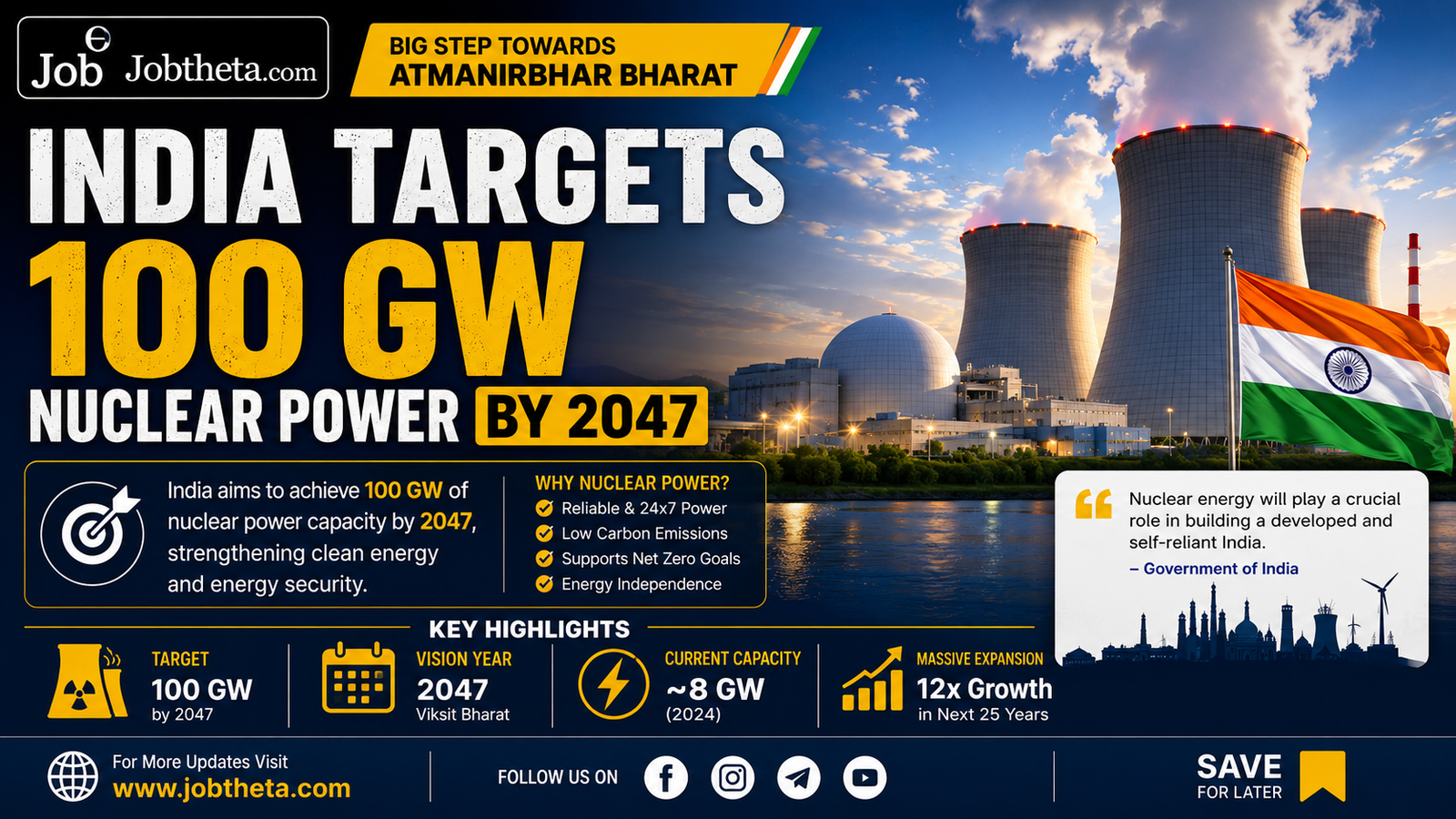
Prime Minister Narendra Modi outlined a bold energy target on Independence Day, August 15, 2026. Speaking from the Red Fort, he said India aims to reach 100 GW of nuclear energy capacity by 2047. He linked this goal directly to the country’s broader push for energy security and self-reliance.
Modi also confirmed that India is moving ahead with five new nuclear reactors. In addition, he pointed to recent progress in fast breeder technology as an important step toward nuclear fuel self-reliance. This announcement builds on months of policy groundwork, including a major legal reform passed earlier in 2026.
Quick Facts: India’s 100 GW Nuclear Target
- Target: 100 GW of nuclear power capacity by 2047
- Current capacity: Around 8.8 GW (as of 2026)
- Growth required: More than eleven-fold over roughly two decades
- Announced by: PM Narendra Modi, Independence Day speech, Red Fort, August 15, 2026
- Key enabling law: SHANTI Act, 2025
- New reactors planned: 5, expected within 6-7 years
- SMR deployment target: At least 5 Bharat Small Modular Reactors by 2033
- Wider climate goal: Supports India’s net-zero target by 2070
- Capacity growth by 2031-32 (projected): Over 22 GW
Why Is India Setting This Target Now?
India’s power demand is rising fast. Data centres and semiconductor fabrication plants, in particular, need round-the-clock electricity that solar power alone cannot reliably provide. Because nuclear energy generates steady baseload power, it fits neatly into this growing gap.
Modi highlighted this contrast directly in his speech. He noted that India’s solar capacity has jumped from roughly 2 GW in 2014 to about 160 GW today, a remarkable eighty-fold increase. However, solar power remains intermittent. Therefore, nuclear energy offers a complementary source of consistent, low-carbon electricity to support India’s expanding digital and industrial economy.
The SHANTI Act: Opening the Door to Private Players
For decades, India’s nuclear sector remained tightly controlled by the government alone. Two old laws, the Atomic Energy Act of 1962 and the Civil Liability for Nuclear Damage Act of 2010, effectively kept private and foreign companies out of the sector.
This changed in December 2025. Parliament passed the Sustainable Harnessing and Advancement of Nuclear Energy for Transforming India (SHANTI) Bill, and President Droupadi Murmu granted it assent on December 20, 2025. The new law repealed both older Acts and replaced them with a modernised framework. Here is what the SHANTI Act changed:
- Private participation allowed: Private companies and joint ventures can now build, own, operate, and decommission nuclear power plants under a government licence.
- Liability rules eased: The Act adjusted strict supplier-liability provisions that had previously discouraged foreign and domestic companies from entering the sector.
- Stronger regulation: The Atomic Energy Regulatory Board (AERB) gained statutory status, which improves its independence and oversight authority.
- Limited foreign involvement: The law does not permit foreign direct investment, though it allows international cooperation in technology, manufacturing, and research.
Budget Support and Financial Incentives
The Union Budget 2026 reinforced the SHANTI Act with fresh financial incentives. Union Minister Dr Jitendra Singh explained that these measures align directly with the Act’s goal of expanding private participation.
Specifically, the budget extended the basic customs duty exemption on imported nuclear power equipment until 2035. It also expanded this exemption to cover all nuclear plants, regardless of capacity. In addition, the government cut customs duty from 7.5 percent to zero on key components. These included fuel elements and control rods used in reactor operations. Together, these changes aim to make nuclear technology more accessible and cost-effective for both public and private developers.
Small Modular Reactors: A Key Building Block
Alongside large-scale reactors, India is betting heavily on Small Modular Reactors (SMRs). These compact, factory-built reactors promise faster construction timelines and lower upfront costs compared to traditional large plants.
According to Minister of State for Atomic Energy Jitendra Singh, India’s Nuclear Energy Mission targets the deployment of at least five domestically developed SMRs by 2033. The Bhabha Atomic Research Centre is currently working on three indigenous designs:
- A 220-MW Bharat Small Modular Reactor
- A 55-MW SMR
- A small high-temperature gas-cooled reactor, designed specifically for hydrogen production
India’s Nuclear Expansion: Key Numbers at a Glance
| Metric | Figure |
|---|---|
| Current installed capacity | ~8.8 GW |
| Target capacity by 2047 | 100 GW |
| Projected capacity by 2031-32 | 22+ GW |
| Growth needed | 11x+ over ~21 years |
| Average annual capacity addition needed | ~4.15 GW |
| SMRs targeted by 2033 | At least 5 |
| R&D allocation under Nuclear Energy Mission | Rs 20,000 crore (over 5 years, CCUS-linked) |
| New reactors PM Modi confirmed | 5, within 6-7 years |
Progress on Fast Breeder Technology
India’s nuclear roadmap follows a three-stage programme, originally designed to make the country self-reliant in nuclear fuel over the long term. A key milestone in this journey arrived with the commissioning of India’s first Prototype Fast Breeder Reactor (PFBR) at Kalpakkam, Tamil Nadu.
Developed by Bharatiya Nabhikiya Vidyut Nigam (BHAVINI), the 500 MW PFBR uses plutonium-based mixed oxide fuel and liquid sodium cooling, a significant departure from India’s earlier water-cooled reactor designs. Crucially, it is built to recycle spent fuel from Pressurised Heavy Water Reactors, forming the second stage of India’s three-stage nuclear strategy. Modi specifically referenced this achievement in his Independence Day speech, describing it as an important step toward reducing India’s reliance on imported nuclear fuel.
The Scale of the Challenge Ahead
Reaching 100 GW by 2047 will not happen easily. As of 2025, India operated 25 nuclear reactors across seven power stations, with a combined capacity of roughly 8,880 MW. This marks solid progress from just 4,780 MW in 2014, but a large gap still remains.
Industry analysts note that India would need to add an average of about 4.15 GW of nuclear capacity every year to hit the 2047 target. A report by SBICAPS pointed out that achieving this scale will require sustained reform, particularly around fuel security, site selection, and building a skilled nuclear workforce. For context, China currently leads global nuclear expansion, with roughly 30 GW of capacity under development, giving Indian planners a clear benchmark to work toward.
Frequently Asked Questions (FAQs)
Q1: What is India’s nuclear power target for 2047?
India aims to reach 100 GW of installed nuclear power capacity by 2047, up from around 8.8 GW currently.
Q2: Who announced the 100 GW nuclear target?
Prime Minister Narendra Modi reaffirmed the target during his Independence Day address from the Red Fort on August 15, 2026, though the goal had already been outlined earlier by government officials.
Q3: What is the SHANTI Act?
The SHANTI Act, short for Sustainable Harnessing and Advancement of Nuclear Energy for Transforming India, is a 2025 law that opened India’s civil nuclear sector to private participation for the first time, while also modernising liability and regulatory rules.
Q4: Does the SHANTI Act allow foreign investment in Indian nuclear plants?
No. The Act allows domestic private companies and joint ventures to participate, but it does not permit foreign direct investment. It does, however, allow international cooperation in technology and manufacturing.
Q5: How many new nuclear reactors is India building?
PM Modi confirmed that India is progressing with five new nuclear reactors, expected to become operational within six to seven years.
Q6: What are Small Modular Reactors (SMRs), and why do they matter for this target?
SMRs are compact, factory-built nuclear reactors that are faster and often cheaper to construct than traditional large reactors. India’s Nuclear Energy Mission targets deploying at least five domestically developed SMRs by 2033.
Q7: How much would India’s nuclear capacity need to grow each year to hit the target?
According to industry estimates, India would need to add an average of approximately 4.15 GW of nuclear capacity annually to reach 100 GW by 2047.
Q8: How does the 100 GW nuclear target relate to India’s climate goals?
The target directly supports India’s broader commitment to achieving net-zero carbon emissions by 2070, since nuclear energy provides reliable, low-carbon baseload power.
Q9: What is the Prototype Fast Breeder Reactor (PFBR)?
The PFBR is a 500 MW reactor at Kalpakkam, Tamil Nadu, that uses plutonium-based fuel and liquid sodium cooling. It represents the second stage of India’s three-stage nuclear programme and a major step toward fuel self-reliance.
Q10: Why is India prioritising nuclear energy alongside solar power?
Solar power is cheap and quick to build but intermittent, while nuclear energy provides steady, round-the-clock electricity. This combination helps meet the rising power demands of data centres and semiconductor manufacturing, both of which need constant electricity supply.
Also Check : India’s First Private-Branded Train: Lucknow-Delhi ‘Sprite’ Tejas Express






Leave a Comment