
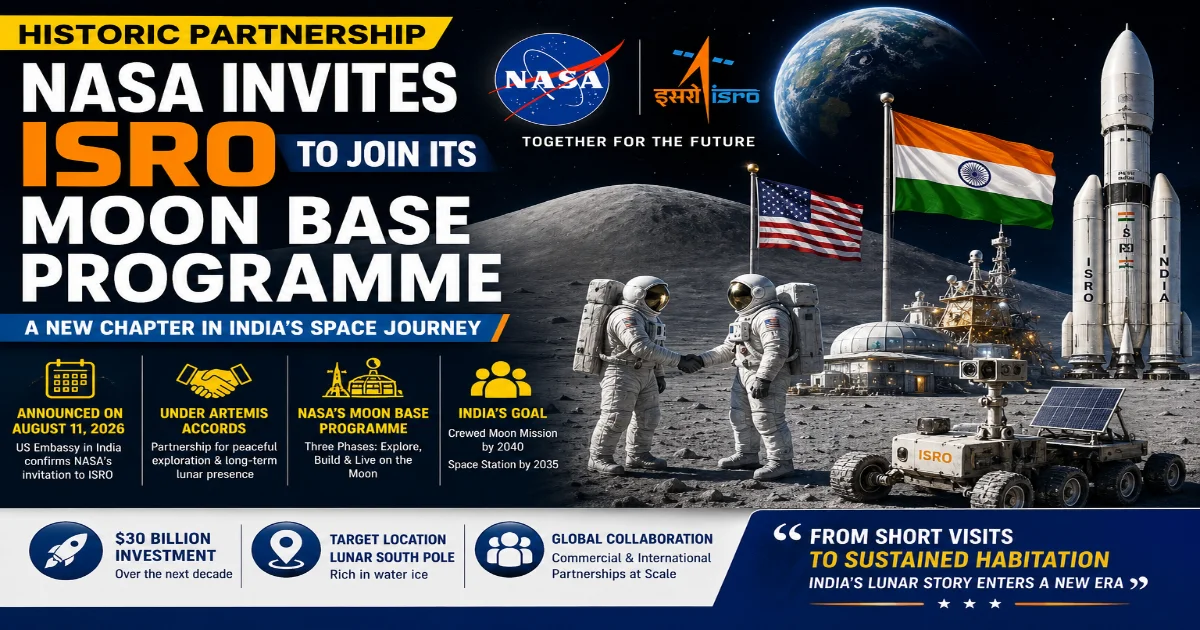
NASA has invited ISRO to join its ambitious Moon Base programme, opening a new chapter in India’s space journey. Backed by its own crewed lunar mission target for 2040, India is now positioning itself as a serious long-term player in humanity’s return to the Moon.
India’s lunar ambitions just took a major leap forward. On August 11, 2026, the US Embassy in India confirmed that NASA has invited the Indian Space Research Organisation (ISRO) to join its Moon Base programme. This announcement builds directly on the two countries’ partnership under the Artemis Accords, which India signed in 2023.
For India, the invitation means much more than another bilateral space project. It offers a real opportunity to move beyond robotic exploration and take part in building a long-term human presence on the Moon. In other words, India’s lunar story is shifting from short visits to sustained habitation.
Quick Facts: India’s Moon Base Journey
- NASA’s invitation to ISRO announced: August 11, 2026
- Announced by: US Embassy in India, following the 9th India-US Civil Space Joint Working Group meeting
- Meeting location: ISRO headquarters, Bengaluru, August 5-6, 2026
- NASA’s Moon Base programme launched: March 24, 2026, at NASA’s Ignition event
- Target location: Lunar South Pole
- Phase One (Explore and Learn): Now through 2029, entirely robotic
- Phase Two (Build and Expand): 2029 to 2032, infrastructure and early habitats
- Phase Three (Live and Work): 2032 onward, continuous human presence
- Total planned investment: Around $30 billion over the next decade
- First Moon Base mission: Targeted no earlier than fall 2026
- India’s own crewed Moon mission target: 2040 (as per ISRO Chairman V. Narayanan)
- India’s own space station (Bharatiya Antriksh Station) target: 2035
- Governing framework: Artemis Accords, joined by India in 2023
What Is NASA’s Moon Base Programme?
NASA officially launched the Moon Base programme on March 24, 2026, during its Ignition event. However, groundwork for the initiative actually began much earlier, tracing back to the first Artemis mission in November 2022. While the original Artemis programme focused on returning astronauts to the Moon through individual missions, the Moon Base programme goes several steps further.
Its core goal is ambitious: build a sustained human presence near the lunar South Pole. This area holds particular importance because it likely contains water ice, a resource that could support long-duration stays. Notably, India’s own Chandrayaan-3 mission was the first to successfully land near this exact region, which strengthens India’s credibility as a partner in this next phase.
The programme unfolds in three distinct phases, each building on the one before it:
Phase One — Explore and Learn (now through 2029): This early phase relies entirely on robots, not people. NASA will send rovers, landers, and drones to scout the South Pole, map its terrain, test power-generation methods, and learn to navigate the harsh lunar landscape, all without risking human lives. The plan allows for up to 25 missions and 21 landings during this window, starting with three foundational missions targeted for completion by late 2026. NASA is also using its Commercial Lunar Payload Services (CLPS) programme, along with landers from partners like Blue Origin and Astrobotic, to carry out this early groundwork.
Phase Two — Build and Expand (2029 to 2032): Once NASA gathers enough data and confidence from Phase One, construction ramps up significantly. This phase focuses on installing real infrastructure, including power systems, surface communication networks, mobility solutions, and early habitats. According to NASA’s own figures, this phase includes 27 launches, 24 landings, and roughly 60,000 kilograms of payload delivered to the lunar surface. Demonstration solar arrays with battery storage will go up on sunlit ridgelines, eventually generating more than 10 kilowatts of power during illuminated periods.
Phase Three — Live and Work on the Moon (2032 onward): This is the phase NASA describes as the real payoff. Astronauts will finally begin living and working on the lunar surface for extended periods, supported by proper habitats, steady power, reliable communications, and regular supply deliveries from Earth. Annual cargo delivery during this phase is expected to reach up to 38 tons every year, an even higher rate than Phase Two once averaged annually. Crucially, Phase Three introduces fission surface power, a nuclear reactor system that replaces the smaller radioisotope thermoelectric generator (RTG) demonstration used in Phase Two. At this stage, the Moon Base becomes a genuine, functioning outpost, serving both as a science hub and a stepping stone toward future Mars missions.
Unlike Phase One and Phase Two, NASA has not attached a fixed mission or landing count to Phase Three. Once continuous human presence begins, mission counting becomes more of a logistics detail than a programme milestone. NASA has also been clear that this is not a NASA-only effort. The agency is leaning heavily on private companies and international partners, describing the approach as commercial participation “at an unprecedented scale.” This is precisely where India’s potential involvement fits in, since NASA is actively inviting partner nations to contribute hardware, missions, and new technology across all three phases.
Why NASA Invited ISRO
The invitation did not come out of nowhere. Instead, it built on years of steady India-US space cooperation. Several recent milestones paved the way:
- The Axiom-4 Mission, which sent Indian astronaut Shubhanshu Shukla to the International Space Station
- The NISAR satellite, the first-ever 50-50 space collaboration between ISRO and NASA, designed to track changes in Earth’s land and ice surfaces
- India’s 2023 signing of the Artemis Accords, a framework that promotes peaceful, transparent, and sustainable cooperation in lunar and broader space exploration
- Chandrayaan-3’s successful South Pole landing, which gave India direct, hands-on experience in the exact region NASA now wants to explore further
US Ambassador to India Sergio Gor shared the announcement publicly, describing it as a deepening of the India-US partnership in deep space. Importantly, ISRO Chairman V. Narayanan also took part in the Bengaluru meeting where this invitation emerged, signalling strong engagement from India’s side as well.
Why This Matters for India
Joining the Moon Base programme could significantly expand India’s role in international lunar exploration. Until now, India’s Moon missions have relied entirely on uncrewed spacecraft. This invitation, however, opens the door to something bigger: direct involvement in technology development, scientific research, and eventually human spaceflight support.
That said, experts have been careful to frame the invitation accurately. It does not mean India is already part of a finished Moon Base project. Instead, it signals that NASA views ISRO as a key partner for humanity’s next phase of lunar exploration, one focused on infrastructure and long-term presence rather than short, flag-planting visits.
India-US Lunar Cooperation: Key Numbers at a Glance
| Milestone | Detail |
|---|---|
| Moon Base programme launch | March 24, 2026 |
| Phase One: Explore and Learn | Now through 2029, robotic missions only |
| Phase Two: Build and Expand | 2029-2032, infrastructure and early habitats |
| Phase Three: Live and Work | 2032 onward, continuous human presence |
| Total estimated investment | ~$30 billion over 10 years |
| Phase Two cargo delivered | ~60,000 kg to lunar surface |
| Phase Three annual cargo delivery | Up to 38 tons per year |
| Phase Three power source | Fission surface power (nuclear reactor) |
| First Moon Base mission | No earlier than fall 2026 |
| India’s Artemis Accords signing | 2023 |
| Chandrayaan-3 landing site | Lunar South Pole |
| India’s crewed Moon mission target | 2040 |
| India’s space station target | 2035 |
| Gaganyaan crewed mission target | Early 2027 |
India’s Own Lunar Roadmap
Even as India explores deeper cooperation with NASA, it continues building its own independent lunar and human spaceflight capabilities. ISRO Chairman V. Narayanan has laid out a clear, multi-step roadmap for the years ahead.
According to Narayanan, Prime Minister Narendra Modi has set a guideline for India to land its own citizens on the Moon and bring them back safely by 2040. Before that crewed lunar mission happens, ISRO plans to complete several important milestones first.
On the human spaceflight front, ISRO plans three uncrewed missions ahead of the first crewed Gaganyaan flight. The Vyommitra robot is scheduled to fly on one of these missions before the end of 2026, with two additional uncrewed missions planned for the following year. If these go according to plan, the first crewed Gaganyaan mission could launch in early 2027.
Beyond Gaganyaan, ISRO is also developing the Bharatiya Antriksh Station (BAS), India’s own space station. Officials expect the station’s initial modules to reach orbit as early as 2027, with the full station targeted for completion by 2035. Meanwhile, upcoming missions like Chandrayaan-4 and Chandrayaan-5, a new Mars mission, and the AXOM astronomical observatory mission round out ISRO’s broader exploration agenda.
The Bigger Picture: A Global Race for the Moon
India’s growing lunar ambitions form part of a wider international trend. Several countries are now moving beyond simple exploration and racing to build a lasting human presence on the Moon.
China, for instance, has floated plans involving a jointly built nuclear reactor to power a lunar base through the freezing fourteen-day lunar night, expected to arrive sometime between 2033 and 2035. Chinese researchers have also discussed relying on robotic systems, including robotic dogs, to handle mining, patrolling, and daily maintenance tasks while human crews focus on decision-making.
Against this backdrop, NASA’s invitation to ISRO carries added strategic weight. It positions India not just as an observer of this new space race, but as an active participant helping shape how humanity eventually settles on the Moon.
What Comes Next
For now, the India-US Moon Base collaboration remains in its early, discussion-based stage. Both sides have agreed to advance cooperation in open scientific data sharing under the Artemis Accords, and further details are expected to emerge as Phase One of the Moon Base programme progresses through 2029.
Meanwhile, India’s parallel efforts, including Gaganyaan, the Bharatiya Antriksh Station, and future Chandrayaan missions, will continue building the technical foundation ISRO needs to participate meaningfully in any eventual lunar base project. Taken together, these developments suggest that India’s lunar future will likely unfold on two tracks at once: growing international collaboration alongside steady, independent progress.
Frequently Asked Questions (FAQs)
Q1: What is NASA’s Moon Base programme?
It is NASA’s ambitious plan to establish a sustained human presence near the lunar South Pole, using a combination of crewed and uncrewed missions to build infrastructure that supports long-duration stays on the Moon.
Q2: Has NASA officially invited ISRO to join the Moon Base programme?
Yes. The US Embassy in India confirmed on August 11, 2026, that NASA has invited ISRO to join the programme, building on the two countries’ cooperation under the Artemis Accords.
Q3: Does this mean India is now part of a completed Moon Base project?
No. The invitation signals that NASA sees ISRO as a key partner for the next phase of lunar exploration. It does not mean a finished Moon Base project already includes India.
Q4: When does India plan to send its own astronauts to the Moon?
ISRO Chairman V. Narayanan has said India aims to land its own citizens on the Moon and bring them back safely by 2040, based on guidelines set by Prime Minister Narendra Modi.
Q5 : What are the Artemis Accords?
The Artemis Accords are a framework that lays out principles for peaceful, transparent, and sustainable cooperation in lunar and broader space exploration. India signed th ccords in 2023.
Q6: Why does the lunar South Pole matter so much?
The lunar South Pole is believed to contain water ice, a resource that could support long-term human habitation. India’s Chandrayaan-3 mission was the first to successfully land in this region.
Q7: What is the Bharatiya Antriksh Station?
It is India’s own planned space station. ISRO expects the station’s initial modules to launch as early as 2027, with full completion targeted for 2035.
Q8: When is India’s first crewed Gaganyaan mission expected?
ISRO plans three uncrewed missions first, including one carrying the Vyommitra robot before the end of 2026. If these succeed, the first crewed Gaganyaan mission could launch in early 2027.
Q9: What happens during Phase Three of NASA’s Moon Base programme?
Phase Three, beginning in 2032 and continuing beyond, marks the start of continuous human presence on the Moon. Astronauts will live and work on the lunar surface for extended periods, supported by permanent habitats, steady power from a nuclear fission reactor, reliable communications, and regular cargo deliveries from Earth.
Q10: How will NASA power the Moon Base during Phase Three?
NASA plans to use fission surface power, a nuclear reactor system, during Phase Three. This replaces the smaller radioisotope thermoelectric generator (RTG) technology demonstrated earlier in Phase Two, and it is designed to supply steady power through the Moon’s 14-day-long lunar night.
Q11: How does China’s lunar programme compare to India’s?
China has discussed building a jointly developed nuclear reactor to power a lunar base by 2033-2035 and has explored using robotic systems for tasks like mining and patrolling. India, meanwhile, is pursuing crewed missions, a space station, and international collaboration through NASA’s Moon Base programme.
Q12: What recent missions led to NASA’s invitation to ISRO?
Key milestones include the Axiom-4 Mission, which sent Indian astronaut Shubhanshu Shukla to the ISS, the NISAR satellite collaboration, India’s 2023 Artemis Accords signing, and the successful Chandrayaan-3 landing at the lunar South Pole.
This article is based on publicly available government and news reports on India’s lunar exploration plans and its collaboration with NASA’s Moon Base programme.






Leave a Comment