
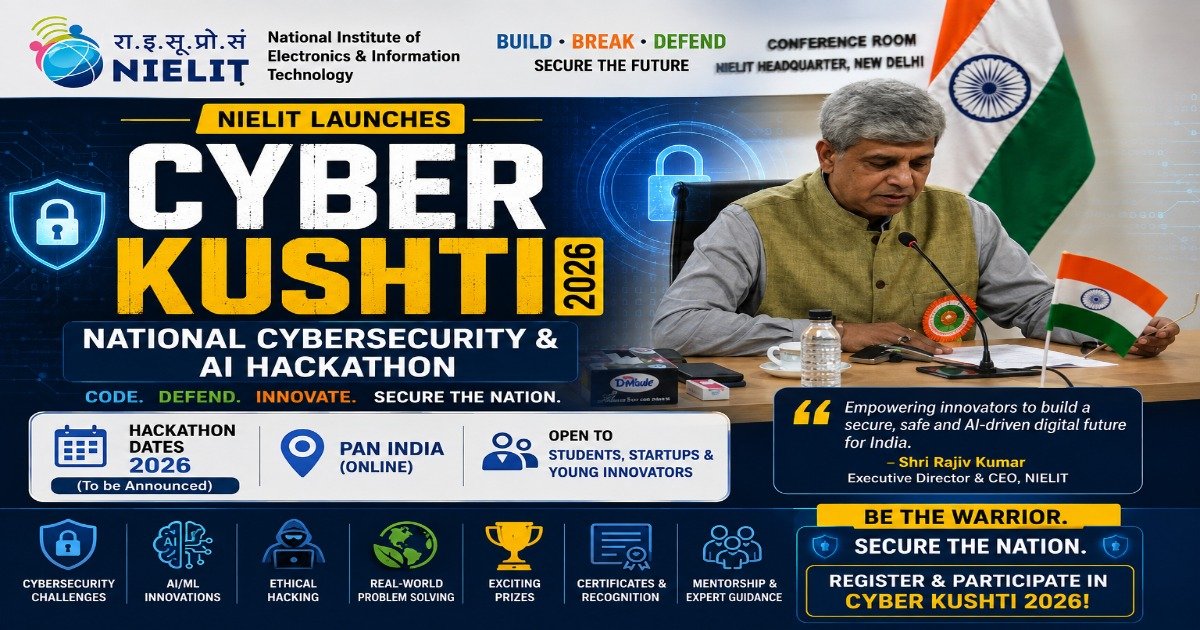
Most hackathons reward speed. CYBER KUSHTI 2026 rewards something different: judgment.
On August 15, 2026, the National Institute of Electronics and Information Technology (NIELIT) launched this new national cybersecurity and AI hackathon. NIELIT operates under the Ministry of Electronics and Information Technology (MeitY). The competition tests one specific skill. It checks whether participants can exercise sound human judgment during cybersecurity assessments, rather than just spotting vulnerabilities fast.
Why “Judgment” Instead of “Detection Speed”?
Here’s the core idea. AI tools can now generate security findings faster than any human team could ever read them. However, speed isn’t the same as accuracy. These tools still struggle to tell which findings are genuinely critical and which ones are noise.
That gap is exactly what CYBER KUSHTI 2026 wants to test. Professor Dr. M M Tripathi, Director General of NIELIT, explained that today’s machines generate findings quickly. But they can’t yet confidently judge which findings are real or urgent. So building that judgment capability is the actual goal of this competition.
Dr. Tripathi also pointed to the launch date itself. NIELIT chose to launch on Independence Day deliberately, tying the idea of “independence” to how confidently a person can question machine-generated output rather than accept it blindly. He also noted that since every team works from the same dataset, a student from any college can compete on equal footing with a corporate team.
How the Competition Works
CYBER KUSHTI 2026 breaks the mold of typical cybersecurity contests. Most competitions, including standard Capture The Flag (CTF) challenges, focus on finding vulnerabilities. This one flips that approach.
Each team receives an identical Security Assessment Package. Importantly, this package is deliberately imperfect. It includes AI-generated findings, static analysis outputs, dependency and secrets scans, architecture documentation, source code, and application logs. Within this package, some findings are real, some are duplicated, and some are simply false. On top of that, a few genuine vulnerabilities are intentionally left out.
Teams must then sort through everything. They need to produce a corrected, prioritised security assessment and defend their decisions in front of judges. Crucially, points aren’t just awarded for catching real issues. Teams also earn credit for correctly rejecting false findings, which mirrors real-world security work far more closely than a typical bug hunt.
Three Rounds to the Finish Line
The competition unfolds across three distinct stages, each with its own name drawn from wrestling tradition.
The Akhada kicks things off online on September 15. From this round, 50 teams will advance to the next stage. The Dangal follows on September 24, also held online, narrowing the field down to just 10 finalist teams. Finally, The Kesari brings everything to a close on October 9. This final round takes place in person at the Dr. Ambedkar International Centre in New Delhi.
During the final round, organisers will display an automated analysis of the same assessment material alongside each team’s presentation. This side-by-side comparison shows exactly where machine-generated analysis lines up with expert human judgment, and where the two diverge.
Who Can Participate?
Good news for students and independent researchers: participation is completely free. Teams must have exactly three members each. Registration opened on August 15, 2026, and stays open until September 10, 2026.
Participants are also free to use AI tools of their choice throughout the assessment process. This isn’t a competition about avoiding AI. Instead, it’s about using AI wisely and knowing when to override it.
Prizes and Recognition
Winning at CYBER KUSHTI 2026 comes with genuine bragging rights. The champion team receives the title “Cyber Kesari 2026,” along with a traditional Gada, a nod to the competition’s wrestling-inspired branding. Runner-up teams earn the titles “Rustam” and “Pahalwan.”
Beyond titles, there are practical rewards too. Teams that advance past the first round receive National Security Database (NSD) recognition credits. Meanwhile, every participant in the opening round gets a participation certificate and an individual scorecard.
There’s also a unique special award worth noting. Organisers will recognise the “most instructive incorrect submission,” meaning a wrong answer can still earn credit if the reasoning behind it is clearly documented and holds teaching value for others.
Safety Comes First
CYBER KUSHTI 2026 keeps everything contained. All activities happen inside controlled environments set up by the organisers. Participants are never directed toward, and are not permitted to engage with, any live system, third-party platform, or public infrastructure at any stage of the competition. This keeps the hackathon realistic without introducing any actual security risk.
Who’s Behind the Hackathon?
CYBER KUSHTI 2026 isn’t a standalone event. It’s actually the official parallel technical track of the 3rd National Conference on Cyber Security, Digital Forensics and Intelligence (NCCDFI 2026).
NIELIT is organising the hackathon in collaboration with the Information Sharing and Analysis Center (ISAC Foundation), which operates under the National Security Database (NSD). CERT-In, India’s national computer emergency response team, is serving as the knowledge partner. Finalists will face a joint jury made up of specialists from government, industry, and academia, including scholars recognised under the National Security Database programme.
Why This Hackathon Matters
CYBER KUSHTI 2026 arrives at an important moment for India’s cybersecurity ecosystem. AI-generated security findings are becoming standard practice across the industry. But without skilled humans to validate them, these findings can lead to wasted effort or, worse, missed threats.
By rewarding judgment over raw detection speed, this hackathon pushes participants toward a skill set the industry genuinely needs. It also fits into NIELIT’s broader push to build emerging-technology and cybersecurity skills across India, alongside other recent efforts around AI governance and state-level cybersecurity frameworks.
Quick Facts: CYBER KUSHTI 2026
| Detail | Information |
|---|---|
| Organiser | NIELIT, under MeitY |
| Launch Date | August 15, 2026 |
| Registration Window | August 15 – September 10, 2026 |
| Team Size | 3 members per team |
| Participation Fee | Free |
| Round 1 (Akhada) | September 15, online; 50 teams advance |
| Round 2 (Dangal) | September 24, online; 10 finalists selected |
| Final Round (Kesari) | October 9, Dr. Ambedkar International Centre, New Delhi |
| Winner Title | Cyber Kesari 2026 |
| Runner-Up Titles | Rustam, Pahalwan |
| Partners | ISAC Foundation (NSD), CERT-In (Knowledge Partner) |
| Parent Event | 3rd NCCDFI 2026 |
Frequently Asked Questions
Q1. What is CYBER KUSHTI 2026?
It’s a national cybersecurity and AI hackathon launched by NIELIT. It tests participants’ ability to exercise human judgment in cybersecurity assessments, rather than simply detecting vulnerabilities fast.
Q2. Who can register for CYBER KUSHTI 2026?
Students and independent researchers can register in teams of three. Participation is free, and registration stays open until September 10, 2026.
Q3. How many rounds does the competition have?
There are three rounds: The Akhada (online, September 15), The Dangal (online, September 24), and The Kesari (in-person final, October 9, in New Delhi).
Q4. What makes CYBER KUSHTI different from typical hackathons?
Instead of rewarding fast vulnerability detection, it scores participants on their ability to evaluate, prioritise, and defend security decisions using a deliberately imperfect dataset.
Q5. What do winners receive?
The winning team earns the title “Cyber Kesari 2026” along with a traditional Gada. Runners-up receive the titles “Rustam” and “Pahalwan.”
Q6. Who is organising CYBER KUSHTI 2026?
NIELIT is organising it under MeitY, in collaboration with the ISAC Foundation (under the National Security Database) and CERT-In as the knowledge partner.
- Also Check : India to Host BRICS Environment Meetings in New Delhi
- Also Check : Moon Base: India’s Lunar Future




Leave a Comment