
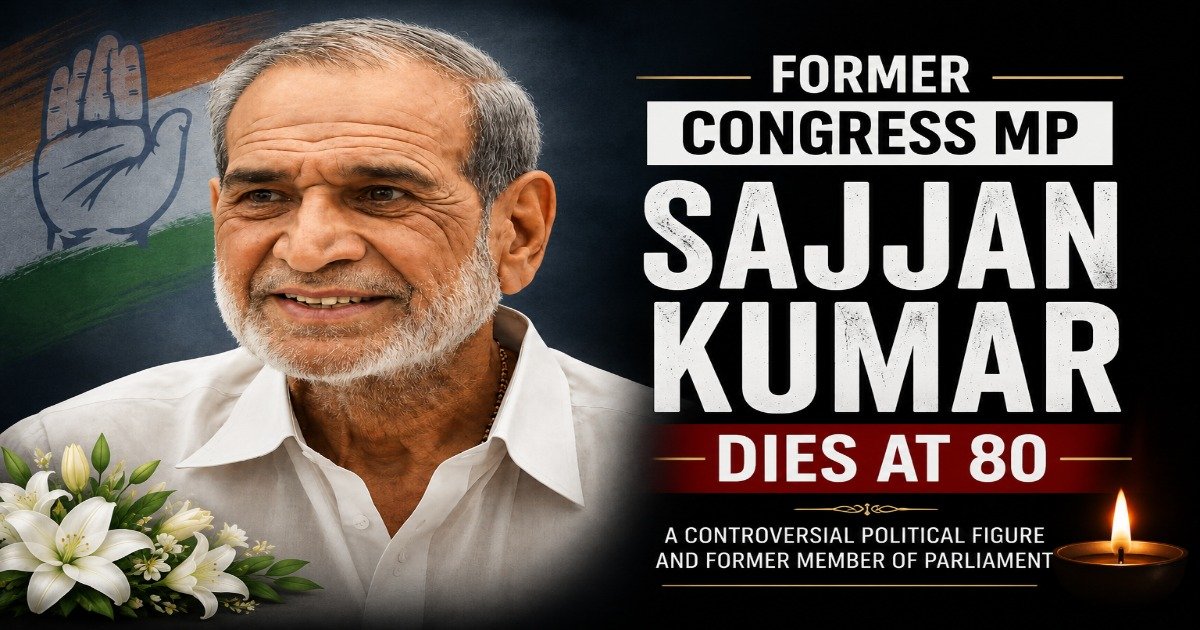
Sajjan Kumar, a former Congress MP convicted in two separate cases linked to the 1984 anti-Sikh riots, died on Thursday, August 20, 2026, while serving a life sentence in Delhi’s Tihar Jail.
Former Congress MP Sajjan Kumar died on Thursday at Delhi’s Safdarjung Hospital. He was 80 years old. Hospital sources confirmed his death to PTI, though they did not immediately state a cause. At the time of his death, Kumar was serving life sentences in Tihar Jail for his role in the 1984 anti-Sikh riots.
Kumar’s death closes a decades-long legal saga that stretched across more than 40 years. He faced multiple criminal cases tied to the violence that followed the assassination of former Prime Minister Indira Gandhi. Courts convicted him in two separate cases, acquitted him in a third, and one of his appeals remained pending before the Supreme Court at the time of his death.
Quick Facts: Sajjan Kumar
- Died: Thursday, August 20, 2026, at Safdarjung Hospital, Delhi (aged 80)
- Political background: Three-time Lok Sabha MP from Outer Delhi, Congress party
- Left Congress: After his December 2018 conviction
- First conviction: December 17, 2018, Delhi High Court — life imprisonment for the Raj Nagar case
- Second conviction: February 25, 2025 — life imprisonment for the murders of Jaswant Singh and his son
- Acquittal: January 22, 2026, Rouse Avenue Court — Janakpuri-Vikaspuri violence case
- Held at: Tihar Jail, Delhi
- Cases originated from: 1984 anti-Sikh riots following Indira Gandhi’s assassination
Who Was Sajjan Kumar?
Sajjan Kumar built a long political career within the Congress party before his convictions ended it. Voters elected him to the Lok Sabha three times from the Outer Delhi constituency, and for years, he remained a prominent Congress figure in the capital’s politics.
That career effectively ended in December 2018, when the Delhi High Court convicted him in one of several cases linked to the 1984 anti-Sikh riots. Kumar left the Congress party shortly after this conviction. Since then, his son’s political future proved more limited too. When Kumar was asked to step aside from contesting the 2009 general election, Congress instead fielded his brother, Ramesh Kumar, who won that year but lost the seat in 2014.
The 1984 Anti-Sikh Riots: Background
The violence that shaped Kumar’s later legal troubles broke out after Indira Gandhi’s assassination on October 31, 1984. In the days that followed, riots swept through Delhi and other parts of India, and mobs killed thousands of Sikhs. For decades, many of the alleged organisers and participants faced little serious legal action.
This changed in February 2015. The central government, then led by the NDA, set up a Special Investigation Team (SIT) to reopen and re-investigate several riot-related cases. This SIT eventually built the cases that led to Kumar’s two convictions and his one acquittal, decades after the violence itself took place.
Kumar’s Legal Cases: A Timeline
Kumar’s legal battle unfolded across several distinct cases, each tied to different incidents during the 1984 riots. Understanding these cases separately helps clarify why he ended up both convicted and, in one instance, acquitted.
The Raj Nagar case (first conviction): On December 17, 2018, the Delhi High Court convicted Kumar for his role in the killing of five Sikhs and the burning of a gurdwara in the Raj Nagar area of southwest Delhi. The court sentenced him to life imprisonment for the remainder of his natural life. Kumar surrendered before a Delhi court on December 31, 2018, and was initially lodged in Mandoli jail before later moving to Tihar.
The Jaswant Singh case (second conviction): In February 2025, a Delhi court awarded Kumar another life sentence, this time for the murders of Jaswant Singh and his son, Tarundeep Singh, killed on November 1, 1984, in the Saraswati Vihar area. The prosecution and the victims’ family had sought the maximum punishment. However, the court opted for life imprisonment instead.
The Janakpuri-Vikaspuri case (acquittal): On January 22, 2026, the Rouse Avenue Court acquitted Kumar in a separate case connected to violence in Delhi’s Janakpuri and Vikaspuri areas. This case involved the killings of Sohan Singh and his son-in-law Avtar Singh in Janakpuri, and the killing of Gurcharan Singh, allegedly set ablaze in Vikaspuri. The court cited a lack of credible evidence placing Kumar at the scene or establishing his involvement in an unlawful assembly.
Sajjan Kumar’s Legal Timeline at a Glance
| Date | Development |
|---|---|
| October 31, 1984 | Indira Gandhi assassinated; anti-Sikh riots follow |
| February 2015 | SIT formed to reopen 1984 riot cases |
| December 17, 2018 | Delhi HC convicts Kumar in Raj Nagar case; life sentence |
| December 31, 2018 | Kumar surrenders, lodged in Mandoli jail |
| February 25, 2025 | Second life sentence, for Jaswant Singh and son’s murders |
| January 22, 2026 | Acquitted in Janakpuri-Vikaspuri violence case |
| August 20, 2026 | Dies at Safdarjung Hospital, aged 80 |
Kumar’s Own Defence
Throughout his trials, Kumar consistently maintained his innocence. In court, he argued that no witness had named him at the time of the riots, and that his name only surfaced decades later. He described the cases against him as false and politically motivated.
Kumar also pointed to his community work as evidence of his character, telling the court that he had organised blood donation camps and peace marches to promote harmony in the area. He additionally stated that he had voluntarily undergone a lie detector test to help prove his innocence. Despite these arguments, courts ultimately convicted him in two of the three major cases he faced.
Health Struggles Behind Bars
Kumar’s years in custody were also marked by repeated legal battles over his declining health. In 2019, the Supreme Court directed that a panel of AIIMS doctors examine his condition, after his lawyers argued he had lost significant weight during his time in jail.
Later attempts to secure bail on medical grounds largely failed. In 2020, the Supreme Court rejected a plea to transfer him to a private hospital for treatment, with the bench noting that he was accused of serious crimes and should not be treated as a “super VIP patient.” The court based this decision on a medical board report indicating his health was improving at the time. Even so, Kumar’s health concerns persisted in the years that followed, right up until his death this week.
Reactions to Kumar’s Death
Kumar’s death drew swift reaction, particularly from Sikh community organisations that had pursued justice in these cases for decades. When Kumar received his second life sentence in February 2025, the Shiromani Gurdwara Parbandhak Committee (SGPC) welcomed the verdict but argued that life imprisonment fell short of what his crimes deserved. SGPC chief secretary Kulwant Singh Manan said victims’ families had waited nearly four decades for that measure of justice.
Political reactions at the time also reflected sharp divisions. BJP leader and Delhi Minister Manjinder Singh Sirsa credited the Modi government’s decision to reopen the 1984 cases through the SIT, arguing that individuals like Kumar had evaded consequences for years despite holding positions of influence.
Frequently Asked Questions (FAQs)
About Sajjan Kumar and His Cases
Sajjan Kumar was a former Congress MP who represented the Outer Delhi constituency three times in the Lok Sabha. Courts later convicted him in two separate cases linked to the 1984 anti-Sikh riots.
He died on Thursday, August 20, 2026, at Safdarjung Hospital in Delhi, at the age of 80.
He was convicted in two cases: the December 2018 Raj Nagar case, involving the killing of five Sikhs and the burning of a gurdwara, and a February 2025 case involving the murders of Jaswant Singh and his son.
Yes. On January 22, 2026, the Rouse Avenue Court acquitted him in a case related to violence in Delhi’s Janakpuri and Vikaspuri areas, citing insufficient evidence.
He was held at Tihar Jail in Delhi while serving his life sentences.
Broader Context
The riots broke out after the assassination of Prime Minister Indira Gandhi on October 31, 1984. Mobs killed thousands of Sikhs across Delhi and other parts of India in the days that followed.
In February 2015, the central government formed a Special Investigation Team (SIT) to reopen and re-investigate several 1984 riot cases, which eventually led to the cases against Kumar.
No. He consistently denied the charges throughout his trials, arguing that the cases were false and politically motivated, and pointed to community work as evidence of his character.
Yes. He faced ongoing health problems in custody, and the Supreme Court had a panel of AIIMS doctors examine him in 2019. Courts later rejected his requests for bail on medical grounds.
Reports indicate that some of Kumar’s appeals, including matters before the Supreme Court, remained pending at the time of his death. His death is likely to affect how these ongoing legal proceedings are formally closed.






Leave a Comment