
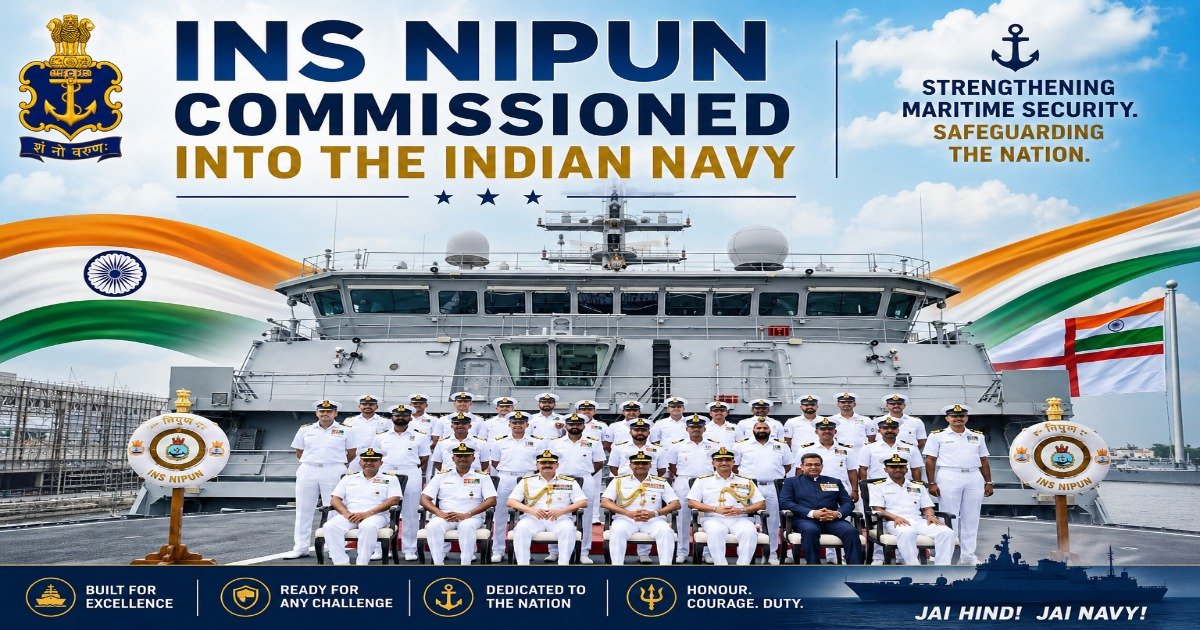
The Indian Navy added a powerful new vessel to its fleet on August 31, 2026. INS Nipun — the second Diving Support Vessel (DSV) of the Nistar Class — was formally commissioned at the Naval Dockyard in Mumbai.
The commissioning ceremony was presided over by Admiral Krishna Swaminathan, Chief of the Naval Staff. It was attended by Vice Admiral Sanjay Vatsayan, Flag Officer Commanding-in-Chief, Western Naval Command, along with senior naval officers, representatives from Hindustan Shipyard Limited (HSL), veterans, distinguished guests, and the families of INS Nipun’s commissioning crew.
The induction of INS Nipun marks a major step forward for India’s underwater and submarine rescue capabilities. It is a product of indigenous design and construction — built entirely in India, for India.
What Is INS Nipun?
INS Nipun is a Diving Support Vessel (DSV) — a specialised naval ship built to support deep-sea diving operations, underwater intervention, salvage work, and submarine rescue missions. It is the second vessel in the Nistar class of DSVs built for the Indian Navy.
The name “Nipun” comes from Sanskrit. It means skilled, capable, and proficient — qualities that perfectly describe the vessel and the highly trained crew who will operate it. True to its name, INS Nipun is built to carry out operations that require precision, advanced technology, and exceptional skill in some of the most challenging ocean environments on Earth.
The ship carries a powerful motto: “Far Beneath, Few Beyond.”
These four words say everything about the nature of its mission. The Indian Navy’s deep-sea divers go where very few dare — below the surface, into the dark, into danger. INS Nipun is their platform, their support, and their lifeline.
Who Built INS Nipun?
INS Nipun was indigenously designed and constructed by Hindustan Shipyard Limited (HSL), based in Visakhapatnam, Andhra Pradesh.
HSL is one of India’s oldest and most capable defence shipbuilders. Building a technologically complex specialist vessel like a Diving Support Vessel requires a high level of engineering skill and industrial capability. The successful delivery of INS Nipun confirms that HSL — and India’s broader defence shipbuilding ecosystem — can produce world-class naval platforms domestically.
The Ministry of Defence confirmed that INS Nipun was delivered to the Indian Navy on July 30, 2026, after completing extensive outfitting, technical evaluations, and sea trials. The ship was built under the classification rules of the Indian Register of Shipping (IRS) — a further mark of quality and technical compliance.
Approximately 75 per cent of INS Nipun’s components are indigenous. This places the vessel firmly within the framework of the Government of India’s Aatmanirbhar Bharat (Self-Reliant India) initiative in defence manufacturing. Indigenisation is not just a cost-saving measure — it builds national capability, reduces import dependence, and strengthens strategic autonomy.
Key Technical Specifications of INS Nipun
| Parameter | Specification |
|---|---|
| Vessel Type | Diving Support Vessel (DSV) |
| Class | Nistar Class (2nd vessel) |
| Builder | Hindustan Shipyard Limited (HSL), Visakhapatnam |
| Commissioned | August 31, 2026 |
| Commissioned At | Naval Dockyard, Mumbai |
| Length | Approximately 119.4 metres |
| Displacement | Approximately 10,500 tonnes |
| Max Diving Support Depth | Up to 300 metres |
| Indigenous Content | Approximately 75% |
| Classification | Indian Register of Shipping (IRS) |
| Command | Western Naval Command |
| Motto | Far Beneath, Few Beyond |
| Name Meaning | Skilled, Capable, Proficient (Sanskrit) |
Operational Capabilities — What Can INS Nipun Do?
INS Nipun is not an ordinary naval vessel. It is a specialist platform built for a range of technically demanding underwater and maritime missions. Here is a detailed look at everything it can do.
1. Deep-Sea Diving Support
INS Nipun can support diving operations at depths of up to 300 metres below the ocean surface. This is an extraordinary capability. At such depths, pressure is extreme, visibility is minimal, and conditions are hostile to human life.
The vessel provides everything a deep-sea diving team needs — compressed gas supplies, decompression chambers, diving stages, and surface support equipment — to carry out prolonged operations at great depth safely and effectively.
2. Deep-Sea Saturation Diving
One of INS Nipun’s most significant capabilities is its ability to support saturation diving — a technique in which divers live under pressure in a specially controlled onboard habitat for days or weeks at a time, allowing them to work repeatedly at great depths without needing to decompress after every dive.
Saturation diving is used for extended underwater engineering work, salvage operations, and complex interventions on the seabed that cannot be completed in a single dive session. Very few naval vessels in the world are equipped to support it. INS Nipun is one of them.
3. Side Diving Stage
The ship is fitted with a side diving stage — a platform that allows divers to enter and exit the water safely from the side of the vessel. This is essential for conducting diving operations in open-sea conditions where boarding from a small boat would be dangerous.
4. Remotely Operated Vehicles (ROVs)
INS Nipun carries Remotely Operated Vehicles (ROVs) — unmanned underwater robots that can be operated from the surface. The ROVs serve several critical functions:
- Monitoring divers working at depth
- Conducting underwater surveys and inspections
- Assisting in salvage and recovery operations
- Providing real-time video feed from the seabed
ROVs extend the ship’s operational reach beyond what human divers can physically access, making them essential for deep-sea missions.
5. Submarine Rescue — DSRV Mother Ship
Perhaps INS Nipun’s most strategically critical role is as a mother ship for the Deep Submergence Rescue Vehicle (DSRV).
A DSRV is a small, specialised submersible used to rescue the crew of a submarine that has become disabled or is in distress on the seabed. The DSRV docks with the distressed submarine’s escape hatch, transfers trapped crew to safety, and brings them to the surface.
For a DSRV to operate, it needs a mother ship — a surface vessel that carries the DSRV to the scene of the emergency, deploys it, and supports its operation. INS Nipun is designed specifically for this role. In a submarine emergency, it would be one of the first assets the Indian Navy would deploy.
This capability is not merely operationally important — it is also a humanitarian responsibility. Submariners who find themselves trapped underwater depend on vessels like INS Nipun for their survival.
6. Underwater Salvage Operations
INS Nipun is fully equipped for underwater salvage work — the recovery of damaged or sunken vessels, their equipment, and their contents. Salvage operations can be required after naval accidents, maritime disasters, or enemy action. Having a dedicated vessel with the right diving and ROV support makes these operations far more feasible.
7. Medical and Humanitarian Support
Beyond its core military and underwater capabilities, INS Nipun also has medical and humanitarian capabilities. It can support disaster relief missions and other emergency operations at sea. In the Indian Ocean region — where cyclones, floods, and maritime disasters are not uncommon — this dual-use capability is genuinely valuable.
The Commissioning Ceremony — What Was Said
At the commissioning ceremony in Mumbai, Admiral Krishna Swaminathan, Chief of the Naval Staff, spoke about the significance of INS Nipun’s induction.
He said the vessel would be a significant addition to the Navy’s specialised underwater capabilities required for multi-domain deep-water operations. He emphasised that INS Nipun would help the Western Naval Command carry out complex underwater missions, including diving support and submarine rescue.
The Admiral’s remarks placed INS Nipun in its proper operational context — not just as a new ship, but as a capability multiplier for the entire Western Naval Command.
The commissioning ceremony was attended by:
- Admiral Krishna Swaminathan — Chief of the Naval Staff (presiding officer)
- Vice Admiral Sanjay Vatsayan — Flag Officer Commanding-in-Chief, Western Naval Command
- Senior naval officers from across the fleet
- Representatives from Hindustan Shipyard Limited (HSL)
- Veterans of the Indian Navy
- Distinguished guests
- Families of INS Nipun’s commissioning crew
INS Nipun and INS Nistar — Two Ships, Two Coasts
INS Nipun does not operate in isolation. It is the second vessel in the Nistar class — and its induction completes a two-ship capability that gives the Indian Navy coverage across both its major operational fronts.
INS Nistar — The First Ship
The first vessel in the class, INS Nistar, was commissioned on July 18, 2025, at Visakhapatnam. It was also built by Hindustan Shipyard Limited. INS Nistar was commissioned in the presence of Raksha Rajya Mantri Sanjay Seth and then-Chief of Naval Staff Admiral Dinesh K Tripathi.
INS Nistar incorporated more than 80 per cent indigenous content and was built with the participation of 120 MSMEs (Micro, Small and Medium Enterprises) from across India. After commissioning, INS Nistar operated under the Eastern Naval Command and participated in international exercises — including the multinational Exercise Pacific Reach 2025 in Singapore in September 2025.
INS Nipun — The Second Ship
INS Nipun is now assigned to the Western Naval Command, headquartered in Mumbai. While INS Nistar guards and supports the eastern seaboard, INS Nipun will strengthen the Navy’s presence and operational readiness along India’s western maritime front.
Together, the two vessels give India a two-ship, two-coast capability for specialised deep-sea operations and submarine rescue — a significant leap in national maritime readiness.
| Parameter | INS Nistar | INS Nipun |
|---|---|---|
| Class | Nistar (Lead Ship) | Nistar (2nd Ship) |
| Commissioned | July 18, 2025 | August 31, 2026 |
| Commissioned At | Visakhapatnam | Naval Dockyard, Mumbai |
| Command | Eastern Naval Command | Western Naval Command |
| Indigenous Content | Over 80% | Approximately 75% |
| Builder | HSL, Visakhapatnam | HSL, Visakhapatnam |
Background — Why India Needed These Vessels
The story of India’s diving support vessels goes back decades. In 1969, the Indian Navy acquired a submarine rescue vessel — INS Nistar — from the erstwhile Soviet Navy. That ship served the Navy until 1989, after which it was decommissioned.
For many years after 1989, the Indian Navy had no dedicated diving support vessel of its own. The Navy was compelled to rely on commercially-leased vessels — such as SCI Sabarmati — to carry out diving support and submarine rescue operations. This was an operational limitation and a strategic vulnerability.
The decision to procure two indigenous Nistar-class DSVs was made to permanently address this gap. The contract for the two vessels was signed on September 20, 2018 with Hindustan Shipyard Limited. The commissioning of INS Nistar in July 2025 and INS Nipun in August 2026 has finally closed that long-standing gap — entirely through indigenous shipbuilding.
Strategic Significance — India as Preferred Submarine Rescue Partner
The commissioning of INS Nipun has implications that go beyond India’s own Navy. With two dedicated DSVs now in service — one on each coast — India is positioning itself as the “Preferred Submarine Rescue Partner” in the Indian Ocean region.
Several smaller navies in South Asia and South-East Asia operate submarines but do not have dedicated submarine rescue capabilities. In the event of a submarine emergency in the region, they would need to rely on a partner nation with the right equipment and expertise.
India, with INS Nistar and INS Nipun in service, now has the capability to offer that assistance. This is not just a military capability — it is a form of maritime diplomacy, and it reinforces India’s vision of being a net security provider in the Indian Ocean region.
Aatmanirbhar Bharat in Defence — What INS Nipun Represents
INS Nipun is more than a naval asset. It is a symbol of what India’s defence manufacturing sector is capable of achieving.
Building a vessel like this requires advanced engineering across multiple domains — hydrodynamics, marine engineering, diving systems, medical life support, ROV technology, and communication systems. Hindustan Shipyard Limited, with support from a wide base of Indian suppliers, has delivered all of this in one integrated platform.
The approximately 75 per cent indigenous content in INS Nipun means that the majority of the vessel’s components — from structural steel to electronics — were sourced, designed, or manufactured within India. This creates jobs, builds industrial capacity, and deepens India’s ability to support, repair, and upgrade its own naval assets without depending on foreign suppliers.
Every vessel like INS Nipun that is built and commissioned in India makes the next one easier, faster, and more capable. It is a virtuous cycle of capability building — and it is exactly what the Aatmanirbhar Bharat initiative in defence manufacturing is designed to accelerate.
Key Facts at a Glance
| Detail | Information |
|---|---|
| Ship Name | INS Nipun |
| Type | Diving Support Vessel (DSV) |
| Class | Nistar Class (2nd vessel) |
| Commissioned On | August 31, 2026 |
| Venue | Naval Dockyard, Mumbai |
| Presiding Officer | Admiral Krishna Swaminathan, CNS |
| Also Present | Vice Admiral Sanjay Vatsayan, C-in-C, Western Naval Command |
| Builder | Hindustan Shipyard Limited (HSL), Visakhapatnam |
| Delivered To Navy | July 30, 2026 |
| Length | ~119.4 metres |
| Displacement | ~10,500 tonnes |
| Diving Depth Support | Up to 300 metres |
| Indigenous Content | ~75% |
| Motto | Far Beneath, Few Beyond |
| Name Meaning | Skilled / Proficient (Sanskrit) |
| Command Assigned | Western Naval Command |
| Sister Ship | INS Nistar (commissioned July 18, 2025, Eastern Naval Command) |
Frequently Asked Questions (FAQs)
INS Nipun is the second Diving Support Vessel (DSV) of the Nistar Class, commissioned into the Indian Navy on August 31, 2026, at the Naval Dockyard in Mumbai. It was indigenously designed and built by Hindustan Shipyard Limited (HSL), Visakhapatnam, and supports deep-sea diving, underwater intervention, salvage work, and submarine rescue operations.
INS Nipun was commissioned on August 31, 2026, at the Naval Dockyard, Mumbai. The commissioning ceremony was presided over by Admiral Krishna Swaminathan, Chief of the Naval Staff.
The name Nipun is derived from Sanskrit and means skilled, capable, and proficient. It reflects the highly specialised and technically demanding nature of the vessel’s underwater operations.
A Diving Support Vessel is a specialised naval ship designed to support deep-sea diving operations, underwater interventions, salvage work, and submarine rescue. It carries diving equipment, saturation diving systems, ROVs, and serves as a mother ship for Deep Submergence Rescue Vehicles (DSRVs) used to rescue submarine crews.
INS Nipun was indigenously designed and constructed by Hindustan Shipyard Limited (HSL), based in Visakhapatnam, Andhra Pradesh. Approximately 75 per cent of its components are indigenous, aligning with India’s Aatmanirbhar Bharat initiative in defence manufacturing.
The motto of INS Nipun is “Far Beneath, Few Beyond.” It reflects the extraordinary skill, courage, and dedication required of the naval divers and crew who operate in the deep-sea environment.
Both INS Nipun and INS Nistar are Nistar-class Diving Support Vessels built by HSL. INS Nistar is the lead ship, commissioned on July 18, 2025, at Visakhapatnam, and assigned to the Eastern Naval Command. INS Nipun is the second ship, commissioned on August 31, 2026, at Mumbai, and assigned to the Western Naval Command.
INS Nipun can support diving operations to depths of up to 300 metres below the ocean surface. It is also equipped for deep-sea saturation diving, allowing divers to live under pressure onboard for extended periods to complete prolonged underwater missions.
A DSRV is a small specialised submersible used to rescue the crew of a disabled or distressed submarine on the seabed. It docks with the stricken submarine’s escape hatch and evacuates trapped crew to safety. INS Nipun is designed to serve as a mother ship for DSRVs during submarine rescue operations.
INS Nipun significantly enhances India’s underwater operational readiness by giving the Western Naval Command a dedicated Diving Support Vessel. Together with INS Nistar on the eastern coast, India now has a two-ship, two-coast capability for deep-sea diving, submarine rescue, and underwater intervention — positioning India as a preferred submarine rescue partner in the Indian Ocean region.






Leave a Comment