
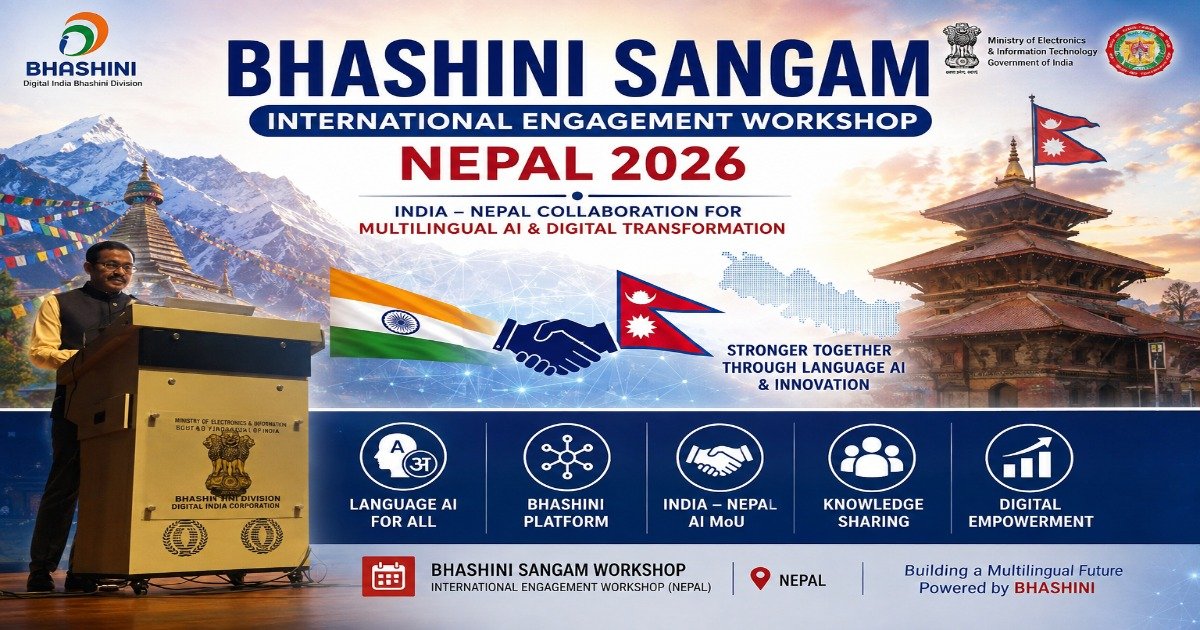
India has taken its Language AI mission beyond its own borders. The Digital India BHASHINI Division (DIBD), under the Digital India Corporation (DIC), Ministry of Electronics and Information Technology (MeitY), organised the BHASHINI SANGAM Workshop at the Embassy of India in Kathmandu, Nepal.
The workshop brought together developers, technology practitioners, academics, and innovators from Nepal. It showcased the power of Language AI. And it marked a new chapter in the growing India–Nepal partnership on digital technology.
This event builds on an important foundation. India and Nepal recently signed a formal Memorandum of Understanding (MoU) to advance Language AI, multilingual digital public infrastructure, and inclusive digital ecosystems across both countries.
What Is BHASHINI?
BHASHINI stands for BHASHa INterface for India. It is India’s national platform for Artificial Intelligence-powered multilingual digital inclusion.
It was developed by the Digital India BHASHINI Division (DIBD), under the Digital India Corporation. It falls under the Ministry of Electronics and Information Technology (MeitY), Government of India.
The goal of BHASHINI is simple. It wants every Indian citizen to be able to access digital services in their own language. Not just Hindi or English — but all Indian languages.
BHASHINI works by building an open, shared ecosystem of Language AI tools. These tools include:
- Speech-to-text — converting spoken words into written text
- Text-to-speech — converting written text into spoken audio
- Machine translation — translating content between Indian languages
- Multilingual conversational AI — AI assistants that can talk in regional languages
Today, BHASHINI supports over 800 government websites. It has facilitated more than 9 billion AI inferences in total. Every single day, it processes over 24 million AI inferences across:
- 36 Indian text languages
- 23 Indian voice languages
- 35 international languages
This scale is remarkable. BHASHINI is not a small pilot project. It is a live, working national platform that is already transforming how millions of Indians access digital services.
The BHASHINI SANGAM Workshop — What Happened?
The word “SANGAM” is a Sanskrit term meaning confluence or coming together. It perfectly captures the spirit of this event — a meeting of minds from India and Nepal around the shared goal of Language AI.
The BHASHINI SANGAM Workshop was held at the Embassy of India in Kathmandu, Nepal. It was structured as an interactive learning and innovation platform — not a traditional lecture-style seminar.
The event went well beyond a standard technology demonstration. It gave participants the chance to learn, experiment, and innovate using Language AI tools in real time. Developers got hands-on exposure to BHASHINI’s open platform. Academics and researchers explored its applications for Nepali and South Asian languages. Innovators discussed how to build new solutions on top of it.
The session showcased BHASHINI’s full capabilities. It also reinforced the collaborative spirit between India and Nepal in the area of language technology. By hosting this workshop in Kathmandu — at the Indian Embassy — India signalled its commitment to sharing its AI resources with Nepal as a trusted partner and neighbour.
💠 Digital India BHASHINI Division organises BHASHINI SANGAM Workshop in #Nepal
— PIB India (@PIB_India) September 1, 2026
🇮🇳-🇳🇵Strengthening India–Nepal collaboration in Language #AI and digital public infrastructure
💠 BHASHINI SANGAM is an international engagement initiative of the #DigitalIndia BHASHINI Division… pic.twitter.com/d6Yy48tZ1A
The India–Nepal MoU on Language AI
The BHASHINI SANGAM Workshop is the latest milestone in a deepening bilateral AI relationship. At its heart is a landmark MoU signed between two institutions.
The Digital India BHASHINI Division (DIBD) signed a Memorandum of Understanding with Kathmandu University’s Centre for Digital Public Infrastructure and Artificial Intelligence (DPI-AI), Nepal.
The MoU was signed by:
- Shri Amitabh Nag, CEO, Digital India BHASHINI Division
- Professor Bal Krishna Bal, Associate Dean, Kathmandu University
The exchange of the MoU took place at a high diplomatic level. It was conducted in the presence of:
- Dr. S. Jaishankar, External Affairs Minister of India
- Shri Shisir Khanal, Minister for Foreign Affairs of Nepal
The presence of both countries’ foreign ministers at the MoU exchange is significant. It shows that this is not just a technical or academic agreement. It is a strategic diplomatic commitment between India and Nepal to cooperate on the future of AI.
What Does the MoU Cover?
The MoU between DIBD and Kathmandu University establishes a collaborative framework for several interconnected areas.
Language AI Development
The two sides will jointly work on developing Language AI tools for languages spoken across India and Nepal. This includes the full range of AI capabilities — speech recognition, synthesis, translation, and conversational AI — in both well-resourced and underrepresented languages of the region.
Multilingual Digital Public Infrastructure
One of the most important outcomes of the collaboration is the plan to extend Digital Public Infrastructure (DPI) services to Nepali citizens in their preferred languages.
Through BHASHINI’s open and interoperable language technology ecosystem, the Government of Nepal will be supported in delivering digital public services to citizens — in the language they are most comfortable with. This directly attacks the problem of language, literacy, and digital access barriers at the last mile of service delivery.
Preservation of Linguistic Heritage
Many languages spoken across the India–Nepal region are at risk. They are low-resource languages — meaning there is very little digital content, data, or AI training material available for them. If nothing is done, these languages will gradually disappear from the digital world.
The collaboration will support the preservation and digitisation of linguistic and literary heritage for these low-resource and underrepresented languages. AI-enabled tools will be built in these mother tongues — ensuring that communities do not face digital extinction of their languages.
Research and Capacity Building
Kathmandu University’s DPI-AI Centre will work with DIBD on joint research. This includes academic study of multilingual AI, building datasets for Nepali and regional languages, and training researchers and developers in Nepal to contribute to and build on Language AI systems.
What BHASHINI CEO Amitabh Nag Said
CEO of the Digital India BHASHINI Division, Shri Amitabh Nag, explained the broader vision behind this partnership.
He said: “This partnership with Kathmandu University represents a significant step in India’s commitment to building inclusive language technology for the region. BHASHINI’s open Digital Public Infrastructure model has the potential to transform digital access for millions of citizens across South Asia. This collaboration will help us extend that vision beyond India’s borders, strengthening our shared linguistic and cultural heritage while building the next generation of multilingual AI for the Global South.”
These words are important. They position BHASHINI not just as an Indian platform — but as a global public good for the Global South. The idea is that India’s Language AI infrastructure, built with public funding, should be shared with neighbouring and developing nations as a tool for inclusive growth.
What Kathmandu University Said
Professor Bal Krishna Bal, Associate Dean of Kathmandu University, expressed the perspective from Nepal:
“This MoU reflects a shared commitment between Nepal and India to harness the power of artificial intelligence for linguistic inclusion and social impact. Through collaboration between the DPI-AI Center at Kathmandu University and Bhashini, we seek to advance research, innovation, and capacity building in multilingual AI. Our aim is to ensure that our rich linguistic heritage becomes a catalyst — not a barrier — for participation in the digital future.”
This is a powerful statement. Nepal has a rich tapestry of languages and dialects. Many Nepali citizens — especially in rural areas — cannot access digital services because those services are not available in their language. The collaboration with BHASHINI directly addresses this.
The Broader India–Nepal AI Partnership
The BHASHINI SANGAM Workshop and the DIBD-Kathmandu University MoU are part of a wider and growing India–Nepal partnership in technology and AI.
The India AI Impact Summit 2026
The India AI Impact Summit 2026 was held from February 16 to 21, 2026, at Bharat Mandapam in New Delhi. The summit drew delegations from over 100 countries. It produced the Summit Declaration, endorsed by 92 countries. Nepal was among the nations engaged in these landmark global commitments.
The Embassy of India Seminar in Kathmandu
The Embassy of India in Kathmandu, in partnership with the Nepal-India Chamber of Commerce and Industry (NICCI), hosted a seminar titled “India–Nepal Partnership in Emerging Technologies: Exploring Bilateral Opportunities for AI Collaboration”. This brought together industry leaders, startup founders, and policymakers from both countries.
NICCI President Sunil KC emphasised the importance of strengthening technology-driven economic cooperation between Nepal and India. He encouraged the Indian AI sector to explore establishing a presence in Nepal and pursuing partnerships with both public and private sector organisations.
Sarvam AI and IN-SPAN
Pratyush Kumar of Sarvam AI delivered a keynote at the India–Nepal AI seminar. He addressed the rise of AI — including large language models — and their implications for countries at earlier stages of AI adoption. He spoke about AI adoption and data sovereignty — critical concerns for smaller nations.
Sarvam AI is one of 12 organisations selected under the Innovation Centre pillar of the IndiaAI Mission. It is developing indigenous foundational AI models with financial and compute support of ₹246.72 crore.
The IN-SPAN Programme
The second cohort of the India–Nepal Startup Partnership Network (IN-SPAN) programme started on June 1, 2026, with 25 Nepali startups undertaking an 8-week, fully-funded training and innovation programme at IIT Madras Pravartak Technologies Foundation, Chennai.
This builds on the success of the first cohort. In that cohort, 9 startups received incubation offers from the IIT Madras Incubation Cell and IIT Madras Pravartak Foundation. The IN-SPAN programme is a concrete mechanism for building Nepal’s startup and AI ecosystem with India’s institutional support.
Why This Collaboration Matters
This workshop and partnership are important for several reasons. Let us look at each one.
1. Digital Inclusion for Every Citizen
Most digital services — whether government portals, banking apps, or health information platforms — are available only in English or a handful of dominant languages. Citizens who speak minority or regional languages are left out.
BHASHINI’s tools directly solve this problem. By extending these tools to Nepal, the collaboration will ensure that Nepali citizens — including those in rural areas and hill communities — can access digital services in their own language.
2. Preserving Endangered Languages
Several languages across the India–Nepal region are spoken by small communities and are at risk of dying out in the digital age. If a language has no digital presence — no keyboards, no voice recognition, no AI tools — it becomes invisible online.
The collaboration will build AI tools for these low-resource languages. It will digitise their literary and linguistic heritage. And it will give communities the ability to participate in the digital economy in their mother tongue.
3. South-South Cooperation in AI
India’s model here is significant. Rather than simply exporting technology for profit, India is sharing its open Digital Public Infrastructure — built with public money — with a neighbouring country for free, as a development partnership.
This is what genuine South-South cooperation looks like. It creates a model that other countries in the Global South can follow. It also shows that developing nations do not need to depend on Silicon Valley or Beijing for their AI future. They can build it themselves — together.
4. Strengthening India–Nepal Relations
India and Nepal share deep cultural, linguistic, and civilisational ties. Their relationship is one of the most intertwined bilateral partnerships in South Asia. Both countries share common linguistic roots — Sanskrit underpins both Hindi and Nepali, and many border communities speak the same dialects.
Collaborating on Language AI is a natural extension of this shared heritage. It uses modern technology to strengthen an ancient bond. And it creates a new domain of practical cooperation that benefits ordinary citizens on both sides of the border.
BHASHINI — Scale and Achievements at a Glance
| Parameter | Data |
|---|---|
| Organisation | Digital India BHASHINI Division (DIBD) |
| Under | Digital India Corporation (DIC), MeitY |
| Government websites supported | Over 800 |
| Total AI inferences facilitated | Over 9 billion |
| Daily AI inferences processed | Over 24 million |
| Indian text languages supported | 36 |
| Indian voice languages supported | 23 |
| International languages supported | 35 |
| CEO | Shri Amitabh Nag |
| Nepal partner | Kathmandu University DPI-AI Centre |
| MoU signed in presence of | EAM Dr. S. Jaishankar and FM Shisir Khanal |
Key Facts at a Glance
| Detail | Information |
|---|---|
| Event Name | BHASHINI SANGAM Workshop |
| Organised By | Digital India BHASHINI Division (DIBD) |
| Ministry | Ministry of Electronics and Information Technology (MeitY) |
| Location | Embassy of India, Kathmandu, Nepal |
| Date | September 1, 2026 |
| MoU Partners | DIBD (India) + Kathmandu University DPI-AI Centre (Nepal) |
| MoU Signed By | Amitabh Nag (DIBD) + Prof. Bal Krishna Bal (KU) |
| MoU Exchange In Presence Of | Dr. S. Jaishankar & Shisir Khanal |
| Focus Areas | Language AI, Multilingual DPI, Linguistic Heritage, Research |
| IN-SPAN Cohort 2 | 25 Nepali startups, IIT Madras, June 2026 |
Frequently Asked Questions (FAQs)
The BHASHINI SANGAM Workshop is an initiative organised by the Digital India BHASHINI Division (DIBD) under MeitY. It was held at the Embassy of India in Kathmandu, Nepal, on September 1, 2026. The workshop brought together Nepali developers, academics, and innovators to explore and experiment with Language AI tools developed by India’s BHASHINI platform.
BHASHINI (BHASHa INterface for India) is India’s national platform for AI-powered multilingual digital inclusion. Built by the Digital India BHASHINI Division under MeitY, it supports over 800 government websites and processes over 24 million AI inferences daily across 36 Indian text languages, 23 voice languages, and 35 international languages.
The Digital India BHASHINI Division (DIBD) signed an MoU with Kathmandu University’s Centre for Digital Public Infrastructure and Artificial Intelligence (DPI-AI). The MoU was signed by DIBD CEO Amitabh Nag and Prof. Bal Krishna Bal, Associate Dean, Kathmandu University. It was exchanged in the presence of EAM Dr. S. Jaishankar and Nepal FM Shisir Khanal.
The MoU covers four main areas: joint development of Language AI tools (speech-to-text, text-to-speech, machine translation, conversational AI); extending multilingual Digital Public Infrastructure services to Nepali citizens; preservation and digitisation of linguistic heritage for low-resource and endangered languages; and joint research and capacity building in multilingual AI.
IN-SPAN stands for the India–Nepal Startup Partnership Network. Its second cohort started on June 1, 2026, with 25 Nepali startups undergoing an 8-week, fully-funded training programme at IIT Madras Pravartak Technologies Foundation in Chennai. In the first cohort, 9 startups received incubation offers from IIT Madras institutions.
Shri Amitabh Nag is the CEO of the Digital India BHASHINI Division (DIBD). He represented DIBD at the MoU signing with Kathmandu University.
The collaboration is important because it extends India’s open Language AI infrastructure to Nepal — helping Nepali citizens access digital services in their own languages. It also supports the preservation of endangered languages, builds AI research capacity in Nepal, and strengthens the digital dimension of the India–Nepal relationship.
Sarvam AI is one of 12 organisations selected under the IndiaAI Mission’s Innovation Centre pillar. It is developing indigenous foundational AI models with ₹246.72 crore in support. Its CEO Pratyush Kumar delivered a keynote at the India–Nepal AI seminar on AI adoption and data sovereignty for nations at earlier stages of AI development.
The India AI Impact Summit 2026 was held from February 16 to 21, 2026, at Bharat Mandapam, New Delhi. It attracted delegations from over 100 countries and produced the Summit Declaration, endorsed by 92 nations — marking a landmark moment in global AI governance and cooperation.
“SANGAM” is a Sanskrit word meaning confluence or coming together. In the context of the BHASHINI SANGAM Workshop, it represents the coming together of Indian and Nepali minds — developers, academics, and innovators — to collaborate on the shared goal of inclusive Language AI for South Asia.






Leave a Comment