
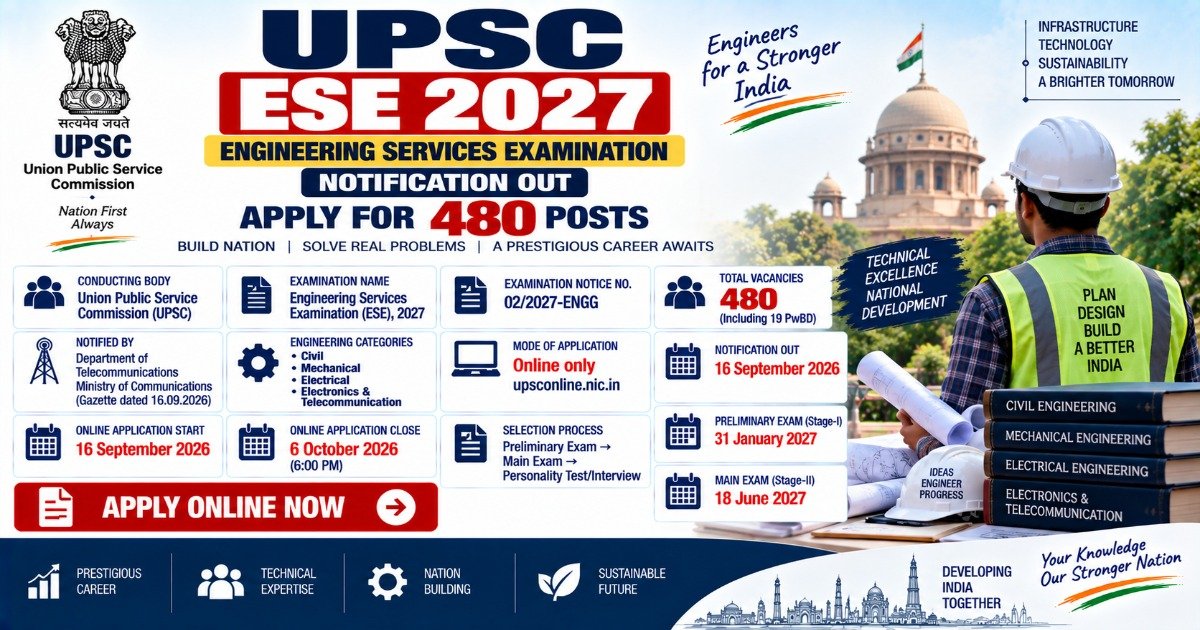
The Union Public Service Commission (UPSC) has released Examination Notice No. 02/2027-ENGG, inviting online applications for the Engineering Services Examination (ESE), 2027. This is one of India’s most prestigious engineering recruitment routes, offering entry into elite Group ‘A’ and Group ‘B’ services such as the Indian Railway Management Service, Indian Defence Service of Engineers, Central Water Engineering Service, and the Indian Telecommunications Service. Approximately 480 vacancies are expected across four engineering disciplines. This article covers everything a serious ESE aspirant needs — eligibility, the complete three-stage exam pattern, syllabus structure, fee, and how to apply.
1. Recruitment Overview
| Particular | Details |
|---|---|
| Conducting Body | Union Public Service Commission (UPSC) |
| Examination Name | Engineering Services Examination (ESE), 2027 |
| Examination Notice No. | 02/2027-ENGG |
| Notified By | Department of Telecommunications, Ministry of Communications (Gazette of India, Extraordinary, dated 16.09.2026) |
| Total Vacancies | Approximately 480 (provisional, including 19 PwBD vacancies) |
| Engineering Categories | Civil, Mechanical, Electrical, Electronics & Telecommunication |
| Mode of Application | Online only, via upsconline.nic.in |
| Selection Stages | Preliminary Exam → Main Exam → Personality Test/Interview |
2. Important Dates
| Event | Date |
|---|---|
| Notification of Examination | 16 September 2026 |
| Online application start | 16 September 2026 |
| Online application close | 6 October 2026, 6:00 PM |
| Preliminary (Stage-I) Examination | 31 January 2027 |
| Main (Stage-II) Examination | 18 June 2027 |
| Online representation window on answer keys | 5 days, starting from the 3rd day of the exam to 6:00 PM of the 7th day |
3. Vacancy Details
Total Vacancies: Approximately 480 (liable to alteration), including 19 vacancies reserved for Persons with Benchmark Disabilities (PwBD):
| PwBD Category | Vacancies |
|---|---|
| Locomotor Disability (including Leprosy Cured, Dwarfism, Acid Attack Victims, Muscular Dystrophy) | 11 |
| Hard of Hearing | 6 |
| Low Vision | 1 |
| Specific Learning Disability (SLD) & Multiple Disability | 1 |
| Total PwBD | 19 |
Important: Persons with Benchmark Disabilities in the category of Blindness are advised not to apply, as no vacancies are earmarked for them under this notification. Low Vision candidates should apply only against posts/services for which they are eligible per the Functional Classification and Physical Requirements detailed in the official notification.
Reservation for SC, ST, OBC, and EWS candidates will also be made as fixed by the Government of India. A candidate can apply for only one of the four categories below.
Participating Services by Category
| Category | Sample Participating Services |
|---|---|
| Category I: Civil Engineering | Central Engineering Service, Central Engineering Service (Roads), Survey of India Group ‘A’, Indian Defence Service of Engineers, Central Water Engineering Service, Indian Railway Management Service (Civil), Indian Skill Development Service |
| Category II: Mechanical Engineering | Indian Naval Material Management Service, Defence Aeronautical Quality Assurance Service, Indian Railway Management Service (Mechanical), Central Power Engineering Service, Central Electrical & Mechanical Engineering Service |
| Category III: Electrical Engineering | Central Electrical & Mechanical Engineering Service, Central Power Engineering Service, Indian Railway Management Service (Electrical), Indian Naval Armament Service |
| Category IV: Electronics & Telecommunication Engineering | Indian Radio Regulatory Service, Indian Telecommunications Service, Junior Telecom Officer Grade ‘B’, Indian Railway Management Service (Signal & Telecommunication) |
Candidates will be allotted to services strictly according to their merit rank, exercised preferences, and vacancy availability, subject to medical fitness.
4. Eligibility Criteria
Nationality
A citizen of India, a subject of Nepal or Bhutan, a Tibetan refugee settled in India before 1 January 1962, or a person of Indian origin who migrated from specified countries with the intention of permanently settling in India (with an eligibility certificate where required).
Age Limit
- Candidates must have attained 21 years and must not have attained 30 years as on 1 January 2027 — born between 2 January 1997 and 1 January 2006.
- Relaxable up to 35 years for Government servants holding a permanent post (or 3+ years of continuous temporary service) in specific departments listed in the notification, such as CPWD, MoRTH, DoT, DRDO’s DAQAS, Survey of India, BRO, Indian Navy, MES, and Indian Railways.
- Further relaxation:
| Category | Additional Relaxation |
|---|---|
| SC/ST | Up to 5 years |
| OBC (Non-Creamy Layer) | Up to 3 years |
| Defence personnel disabled in operations | Up to 3 years |
| Ex-Servicemen (5+ years military service) | Up to 5 years |
| ECOs/SSCOs (extended assignment) | Up to 5 years |
| PwBD (Low Vision, Deaf & Hard of Hearing, Locomotor Disability, SLD, Mental Illness, etc.) | Up to 10 years |
Relaxations under SC/ST/OBC can be combined cumulatively with Ex-Servicemen or PwBD relaxation where applicable.
Educational Qualification
A candidate must have:
- An Engineering degree from a university/institution established by an Act of Parliament/State Legislature or deemed university, or
- Passed Sections A and B of the Institution Examinations of the Institution of Engineers (India), or
- A recognised foreign university/college engineering degree/diploma, or
- Passed the Graduate Membership Examination of the Institution of Electronics and Telecommunication Engineers (India), or
- Passed Associate Membership Examination Parts II & III of the Aeronautical Society of India, or
- Passed the Graduate Membership Examination of the Institution of Electronics and Radio Engineers, London (held after November 1959).
Important restriction: Following a Delhi High Court judgment, degrees/certificates from the Institution of Electronics and Telecommunication Engineers (India) and the Aeronautical Society of India, obtained by candidates admitted after 31 May 2013, are not admissible for this examination.
Final-year/awaiting-result candidates may also apply, but must produce proof of passing within a 10-day window provided after the Main Examination result, failing which they cannot appear for the Personality Test/Interview.
5. Selection Process — Complete Three-Stage Structure
Stage-I: Preliminary Examination (Objective Type) — 500 Marks
| Paper | Subject | Duration | Marks |
|---|---|---|---|
| Paper-I | General Studies and Engineering Aptitude (common to all candidates) | 2 hours | 200 |
| Paper-II | Engineering Discipline-specific (Civil/Mechanical/Electrical/Electronics & Telecommunication) | 3 hours | 300 |
| Total | 500 |
- Negative marking: 1/3 of the marks assigned to a question is deducted for each wrong answer. Multiple answers to one question are treated as wrong. Unanswered questions carry no penalty.
- Marks scored in the Preliminary Exam count toward the final merit for candidates who qualify for the Main Exam.
- Approximately 6 to 7 times the number of vacancies are admitted to the Main Examination.
Stage-II: Main Examination (Conventional/Descriptive Type) — 600 Marks
| Paper | Subject | Duration | Marks |
|---|---|---|---|
| Paper-I | Engineering Discipline-specific | 3 hours | 300 |
| Paper-II | Engineering Discipline-specific | 3 hours | 300 |
| Total | 600 |
- Papers must be answered in English only; no scribe is permitted (except for eligible PwBD candidates, per specific provisions).
- Deduction of up to 5% of maximum marks for illegible handwriting.
- Battery-operated pocket calculators are allowed only for the Main Exam’s conventional papers, not for objective papers.
Stage-III: Personality Test/Interview — 200 Marks
- Approximately twice the number of vacancies are called for interview.
- No minimum qualifying marks are prescribed for the interview stage.
- The interview specifically assesses leadership capacity, initiative, intellectual curiosity, tact, mental and physical energy, practical application skills, and integrity of character.
Total marks across all stages: 1,300 (500 + 600 + 200), with final ranking based on combined Preliminary + Main + Interview scores.
Tie-Breaking Principles (in order)
- Higher marks in the three Engineering-discipline papers (Prelims Paper-II + both Main papers) plus Interview marks combined.
- Higher marks in just the three Engineering-discipline papers combined.
- Candidate senior in age.
- Commission’s discretion, if a tie still persists.
6. Syllabus Overview
General Studies and Engineering Aptitude (Paper-I, Prelims): Current national/international affairs, engineering aptitude (logical reasoning and analytical ability), engineering mathematics, principles of design and safety, quality practices, energy and environment basics, project management fundamentals, material science basics, ICT tools in engineering, and engineering ethics.
Discipline-specific papers (common structure across Prelims Paper-II and both Main papers) cover, depending on your chosen category:
- Civil Engineering: Building materials, solid mechanics, structural analysis, design of steel/concrete/masonry structures, construction management, fluid mechanics, hydrology, environmental engineering, geotechnical engineering, surveying, and transportation engineering.
- Mechanical Engineering: Fluid mechanics, thermodynamics and heat transfer, IC engines, refrigeration and air conditioning, turbomachinery, power plant engineering, renewable energy, engineering mechanics, materials, mechanisms and machine design, manufacturing and industrial engineering, and mechatronics/robotics.
- Electrical Engineering: Engineering mathematics, electrical materials, circuit theory, measurements, computer fundamentals, analog/digital electronics, control systems, electrical machines, power systems, and power electronics/drives.
- Electronics & Telecommunication Engineering: Basic electronics and electrical engineering, materials science, measurements, network theory, analog/digital circuits, communication systems, control systems, computer architecture, electromagnetics, and advanced VLSI/DSP/communication topics.
7. Application Fee
| Category | Fee |
|---|---|
| General/OBC/EWS male candidates | ₹200 |
| Women candidates (all categories) | Exempted |
| SC/ST/PwBD candidates | Exempted |
- Payable via Net Banking or Visa/Master/RuPay Credit/Debit Card/UPI only. No other payment mode is accepted.
- Fee once paid is non-refundable and cannot be reserved for any other examination.
8. How to Apply
- Visit upsconline.nic.in and complete your Account Creation, Universal Registration (URN), and Common Application Form (CAF) — these three modules are common to all UPSC exams and can be filled anytime.
- Complete the fourth, exam-specific module for ESE 2027, including fee payment and centre selection, within the application window.
- Use your Aadhaar Card as your ID document for smoother verification — this is strongly recommended by UPSC.
- Upload a live-captured photograph (in addition to an uploaded photo) and a signature signed three times on plain white paper in black ink.
- Choose your exam category and centre carefully — appearing at a centre/discipline other than the one on your e-Admit Card means your papers won’t be valued and your candidature will be cancelled.
- Submit before 6 October 2026, 6:00 PM. No withdrawal, correction, or modification is allowed after submission (except a one-time URN profile edit, which only applies to future applications, not ones already submitted).
- No hard copy/printout needs to be sent to the Commission.
e-Admit Card: Issued only online, on the last working day of the week preceding the exam (or 3 days prior for candidates who requested a scribe change). No admit card is sent by post. If you don’t receive it a week before the exam, you must contact UPSC immediately — non-receipt due to your own inaction is your responsibility.
Centre allotment: Except for Chennai, Dispur, Kolkata, and Nagpur, all other centres have a capacity ceiling, allotted on a first-apply-first-allot basis. Apply early to secure your preferred centre.
9. Important Exam-Day Rules
- Entry closes 30 minutes before the exam starts in each session — no late entry under any circumstances.
- Mandatory face authentication at the venue for all candidates.
- Mobile phones, smartwatches, AI-enabled glasses, Bluetooth devices, or any communication-capable device are strictly banned, even in switched-off mode — carrying one risks disciplinary action and a ban from future exams.
- Answers in the OMR sheet must be marked using black ball pen only — no pencil or ink pen.
10. Frequently Asked Questions
Approximately 480, including 19 reserved for Persons with Benchmark Disabilities, across Civil, Mechanical, Electrical, and Electronics & Telecommunication Engineering categories.
6 October 2026, 6:00 PM.
Preliminary Exam: 31 January 2027. Main Exam: 18 June 2027.
21 to 30 years as on 1 January 2027, with relaxation up to 35 years for eligible government servants in specified departments, plus further relaxation for SC/ST/OBC/PwBD/Ex-Servicemen.
No. You may apply for only one of the four categories — Civil, Mechanical, Electrical, or Electronics & Telecommunication Engineering.
Three stages: Preliminary Exam (500 marks, objective), Main Exam (600 marks, conventional/descriptive), and Personality Test/Interview (200 marks) — a total of 1,300 marks.
Yes, in the Preliminary Examination’s objective papers — 1/3 of a question’s marks is deducted for each wrong answer.
₹200 for General/OBC/EWS male candidates. Women, SC, ST, and PwBD candidates are exempted.
No. UPSC has specifically advised Blindness-category PwBD candidates not to apply, as no vacancies are earmarked for them in this cycle.
No. Withdrawal and corrections are not permitted after final submission, except a one-time URN profile update that applies only to future applications.
11. Official Links
| Resource | Link |
|---|---|
| Official Notification – UPSC ESE 2027 (Examination Notice No. 02/2027-ENGG) | Download PDF |
| Online Application Portal | upsconline.nic.in |
| Official UPSC Website | upsc.gov.in |
| Helpline | 011-24041001 / 011-40303444, email: upscsoap@nic.in (10:00 AM–5:30 PM, working days) |
Read the complete official notification carefully — it contains detailed Functional Classification and Physical Requirements for PwBD candidates, the full syllabus, and physical/medical standards. Apply early to secure your preferred exam centre, and rely only on the official UPSC website for admit card and further updates.





Leave a Comment