
APPSC TGT Recruitment 2026
389 Trained Graduate Teacher Posts — Secondary Level
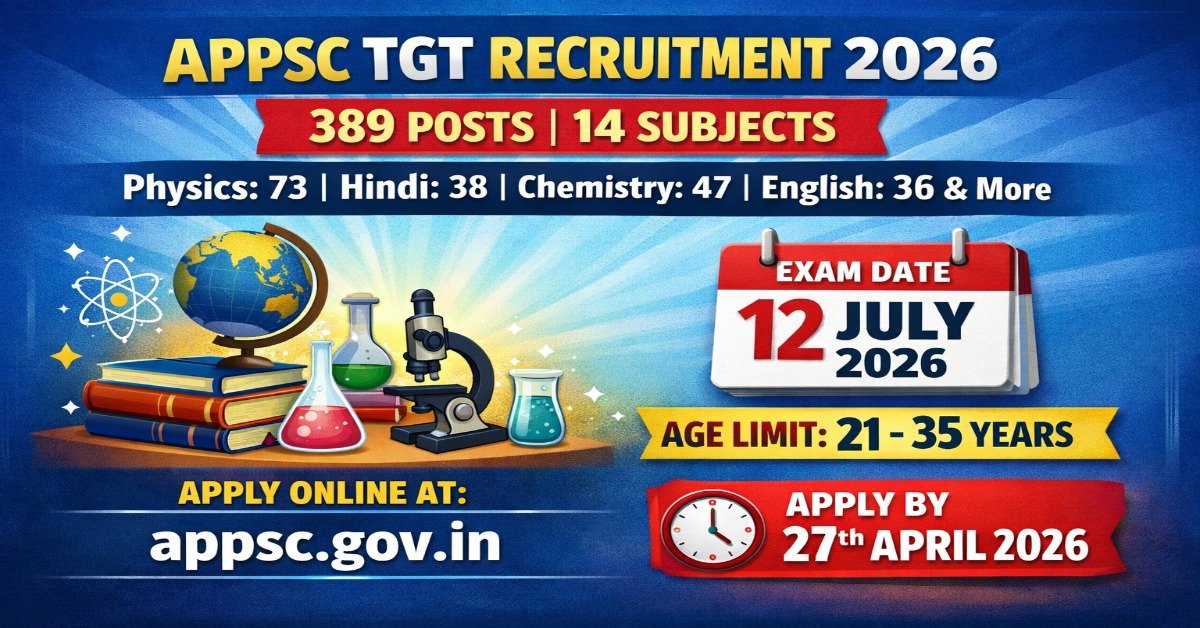
The Arunachal Pradesh Public Service Commission (APPSC), Itanagar, has released the Trained Graduate Teacher (TGT) Examination 2026 notification vide Advertisement No. 02/2026 on 23 March 2026. A total of 389 posts across 14 subjects are available under the Education Department, Government of Arunachal Pradesh in Pay Matrix Level-7 (₹44,900–₹1,42,400). The online application window is open from 26 March 2026 (5:00 PM) to 27 April 2026 (1:00 PM) at appsc.gov.in. The written examination is tentatively scheduled on 12 July 2026 (Sunday).
| Sl. | Subject | Unreserved (UR) | APST Reserved | Total Posts | PwBD Reserved |
|---|---|---|---|---|---|
| 1 | TGT English | 8 | 28 | 36 | 2 (OA/OL/LV) |
| 2 | TGT Hindi | 8 | 30 | 38 | 2 (OA/OL/LV) |
| 3 | TGT Political Science | 6 | 22 | 28 | 1 (OA/OL/LV) |
| 4 | TGT Geography | 6 | 23 | 29 | 1 (OA/OL/LV) |
| 5 | TGT Economics | 5 | 20 | 25 | 1 (OA/OL/LV) |
| 6 | TGT History | 5 | 16 | 21 | 1 (OA/OL/LV) |
| 7 | TGT Mathematics | 7 | 28 | 35 | 1 (OA/OL/LV) |
| 8 | TGT Physics | 15 | 58 | 73 | 3 (OA/OL/LV) |
| 9 | TGT Chemistry | 10 | 37 | 47 | 2 (OA/OL/LV) |
| 10 | TGT Biology | 6 | 22 | 28 | 1 (OA/OL/LV) |
| 11 | TGT Business Administration | 2 | 4 | 6 | NIL |
| 12 | TGT Accountancy | 2 | 4 | 6 | NIL |
| 13 | TGT Agriculture | 2 | 8 | 10 | NIL |
| 14 | TGT Horticulture | 2 | 5 | 7 | NIL |
| Grand Total | 84 | 305 | 389 | 15 | |
- Out of 389 posts, 305 posts (78.4%) are reserved for APST (Arunachal Pradesh Scheduled Tribe) candidates — this is the dominant reservation category.
- Physics has the highest vacancies (73 posts), followed by Chemistry (47), Hindi (38), English (36), Mathematics (35), and Geography (29).
- 15 posts are reserved for PwBD candidates across categories One Arm (OA), One Leg (OL), and Low Vision (LV) — minimum 40% disability required.
- Each candidate is permitted to apply for only one TGT subject post — choose carefully as you cannot change or apply for multiple subjects.
- Graduation in a different subject + PG in the concerned subject does NOT qualify — for example, a candidate with B.Sc. Botany + M.Sc. Physics is not eligible for TGT Physics
- Only General B.Ed is accepted for teaching Classes IX–X as per DSE notification dated 09/12/2025
- B.Ed (Special Education) is explicitly NOT recognised as an alternative professional qualification for TGT Secondary
- B.Ed duration must be a minimum of two years (including mandatory school internship). Candidates with a one-year B.Ed are eligible only if the degree was awarded before 2015
- Candidates with a Four-Year Integrated Degree Programme with B.Ed (General) embedded are also eligible, subject to subject-specific requirements
- Students currently in their final year/final semester of Bachelor's Degree or B.Ed are not eligible to apply — unlike many other recruitment exams that allow provisional applicants
- Candidates with B.Ed (Special Education) as their professional teaching qualification
- Candidates whose graduation subject does not match the TGT post applied for, even if they hold a Post-Graduation in that subject
- Candidates applying for more than one TGT subject — only one application per candidate is valid; multiple applications may lead to rejection of all
- Minimum age: 21 years
- Maximum age: 35 years as on the last date 27 April 2026
- One-time relaxation for General category: Candidates born on or after 01/01/1989 are eligible (as per Government of AP notification dated 21 April 2025)
- One-time relaxation for APST: Candidates born on or after 01/01/1984 are eligible
- PwBD candidates and regular Government servants of AP get additional age relaxation as per government rules
- Age proof: only the Matriculation Certificate issued by a recognised Board is accepted — no horoscope, affidavit, or birth extract is valid
| Paper | Subject / Component | Type | Max Marks |
|---|---|---|---|
| Paper 1 | General English, General Studies, Aptitude & Pedagogy | Objective (MCQ) | 150 |
| Paper 2 | Concerned Subject (as applied for) | Objective (MCQ) | 300 |
| Stage 3 | Viva-voce & Classroom Teaching Demonstration | Interview + Demo | 50 |
| Grand Total (Written + Viva) | 500 | ||
- Fee must be paid through online mode only — no offline challan, demand draft, or cash payment is accepted
- PwBD/PwD candidates are fully exempted from fee payment as per Section 19 of the Arunachal Pradesh Rights of Persons with Disabilities Rules, 2018
- Fee paid against one Registration ID (RID) cannot be transferred to another RID — if you accidentally submit multiple applications, only the highest RID will be considered
- Fee once paid is non-refundable under any circumstances
Complete One Time Registration (OTR) at appsc.gov.in
Before filling the application, every candidate must complete One Time Registration (OTR) on the APPSC website. Go to appsc.gov.in and find the OTR registration link. Fill in your basic personal details to create your permanent OTR profile. If you have already registered for OTR in any previous APPSC recruitment, you do not need to register again — use the same User ID and password to log in directly. 📌
Login and Open the TGT 2026 Application Form
Log in to the APPSC portal using your OTR credentials. Navigate to Advertisement No. 02/2026 — TGT (Secondary) Examination 2026 and click "Apply Online". The application link is active from 26 March 2026 (5:00 PM). Fill in all required details carefully — personal information, educational qualifications, subject being applied for, domicile details, and category (APST/UR/PwBD). Every entry must match your original documents exactly. 📌
Upload Required Documents
Upload the following in the prescribed format: Signature on white paper with black ink pen (40–50 KB, JPG). Recent colour passport-size photo — white background, front-facing, no headgear or sunglasses (40–100 KB, JPG). Self-attested photocopy of one valid Photo ID (Aadhaar/Voter ID/PAN/Passport/Driving Licence/any Government-issued photo ID). PwBD candidates: disability certificate issued by the certifying authority as per Section 57 of the Rights of Persons with Disabilities Act, 2016 — dated on or before 27 April 2026. 📌
Pay Application Fee Online
Pay the applicable fee: ₹200 for General/UR candidates, ₹150 for APST candidates, ₹0 for PwBD candidates. Payment is through online mode only at the APPSC portal. After payment, save the transaction receipt. If you accidentally submit multiple applications, the highest Registration ID (RID) will be accepted — ensure your highest RID application is complete and the fee is paid for it. 📌
Submit and Print the Application
Review your complete application carefully before final submission. After submission, download and print the final submitted application form for your records. The last date to submit is 27 April 2026 by 1:00 PM (1300 hours). No application submitted after this deadline will be considered under any circumstances. Note that admission to the written examination does not confirm eligibility — APPSC reserves the right to verify at any stage. 📌
- Candidates who clear the written exam must produce originals and self-attested photocopies in person at the document verification stage — no reprieve or extension is given for missing documents.
- Certificate information not claimed in the DAF will not be considered, even if attached — ensure every certificate detail is explicitly filled in the DAF.
- Only Matriculation Certificate issued by a recognised Board is accepted as age proof — horoscopes, affidavits, or birth extracts are categorically rejected.
- B.Ed degree must be from an NCTE recognised institute — verify your college's NCTE recognition status before applying.
- Applicants currently in service must submit an intimation letter to their HoD — failure to do so may affect candidature.
This is one of the more attractive state PSC teaching recruitments in 2026 — but a highly specific one. Here is our honest breakdown for candidates from different backgrounds:
- Pay Level-7 (₹44,900 basic) is significantly higher than most state-level TGT posts nationally — competitive even against central school pay
- Only 500-mark total selection (450 written + 50 viva) — no physically demanding tests, no multiple rounds of exams
- Physics has 73 vacancies — the single highest count — making it the best opportunity for B.Sc. Physics + B.Ed candidates
- APST candidates have 305 of 389 seats reserved — an overwhelming majority, making this effectively an APST-priority recruitment
- Permanent Group-B employment in Government of Arunachal Pradesh — job security and career growth within the state education system
- No interview-only selection — written exam performance is the primary determinant, reducing subjectivity
- Only 84 unreserved (UR) posts out of 389 — General category candidates face very limited seats, especially in Commerce and Agriculture subjects where UR seats are just 2 each
- Posting will be within Arunachal Pradesh — includes remote, hilly, and tribal areas; candidates must be genuinely willing to serve in such locations
- 1/6 negative marking is heavier than standard — unprepared guessing will hurt scores significantly
- Final year students are explicitly ineligible — unlike many other state TGT recruitments that allow provisional applications
- B.Ed (Special Education) holders are not eligible — verify your B.Ed category before applying to avoid wasted effort
- Competition for Physics, Hindi, and English will be highest due to the largest vacancies — expect lakhs of applications for these subjects
Our verdict: For APST candidates with B.Sc. Physics/Chemistry/Biology + B.Ed, this is arguably the best state teaching recruitment available in 2026 — high vacancy count, strong pay, permanent employment. For General category candidates, the 84 UR seats across 14 subjects mean fierce competition in most subjects; focus your effort on subjects where UR vacancies are relatively higher (Physics-15 UR, Chemistry-10 UR, Hindi-8 UR, English-8 UR).
Who should prioritise this: B.Sc. (Physics/Chemistry/Biology) + B.Ed graduates who have completed their degree and are ready to commit to teaching in Arunachal Pradesh long-term. Arts graduates with Hindi, Geography, or Political Science background also have strong vacancy counts. This is not an exam to apply for casually — the posting commitment to AP's remote areas requires genuine intent.
The APPSC TGT written exam carries 450 marks across two papers. Paper 2 (your subject, 300 marks) is the primary differentiator. Here is how to prepare each component strategically:
- General English (approx. 30–40 marks): Grammar (tenses, articles, prepositions, error correction), vocabulary (synonyms, antonyms, idioms), reading comprehension. Standard 10+2/graduation level. Use Wren & Martin Grammar and any standard English vocabulary book. Focus on error spotting — consistently the highest-scoring section here.
- General Studies (approx. 40–50 marks): Indian History (modern focus — freedom movement, Constitution), Geography (India + Arunachal Pradesh specifically), Polity, Science basics (10th level), current affairs (last 12 months). NCERT Class 9–12 is sufficient for History, Geography, and Polity. For AP-specific GS: focus on AP tribal groups (Adi, Nyishi, Apatani, Garo, etc.), AP geography, major rivers, and state government schemes.
- Aptitude (approx. 20–25 marks): Number series, analogies, coding-decoding, data interpretation, basic arithmetic (percentage, ratio, time-speed-distance, profit-loss). NCERT Class 8–10 maths covers most of this. Practice 30–40 MCQs daily for 3 weeks.
- Pedagogy (approx. 30–35 marks): Teaching methods and learning theories — constructivism, Bloom's taxonomy, lesson plan design, inclusive education, assessment types. For B.Ed graduates, this is revision rather than new learning. Key topics: Piaget, Vygotsky, NCF 2005 recommendations, RTI Act provisions for teachers.
- Physics: Mechanics, Thermodynamics, Optics, Electromagnetism, Modern Physics, Nuclear Physics. B.Sc. Physics first and second year material. NCERT Class 11–12 for fundamentals, then move to degree-level texts (H.C. Verma for problem-solving approach, Irodov for advanced practice). Focus on numerical MCQs — they appear frequently in TGT physics papers across states.
- Chemistry: Physical Chemistry (thermodynamics, equilibrium, kinetics), Inorganic Chemistry (periodic table, coordination compounds, p-block elements), Organic Chemistry (reaction mechanisms, named reactions, functional group transformations). NCERT Class 11–12 + JD Lee for Inorganic + Morrison Boyd for Organic.
- Biology: Cell biology, Genetics, Ecology, Physiology (plant + animal), Evolution, Biotechnology basics. NCERT Class 11–12 Biology is the core resource — read every chapter carefully as TGT biology papers heavily favour NCERT content.
- Mathematics: Calculus (differential and integral), Algebra (matrices, determinants), Coordinate Geometry, Statistics and Probability, Number Theory basics. R.D. Sharma graduation level + NCERT Class 11–12.
- Hindi / English: Language history, grammar in depth, major literary works and authors, linguistic theory basics, language pedagogy. For Hindi: Apabhramsha to modern Hindi evolution, major Chhayavadi and Pragativadi poets, prose writers. For English: British and Indian English literature survey, prosody, critical theory basics.
- Social Science subjects (History/Geography/Pol. Science/Economics): NCERT graduation-level texts + Arunachal Pradesh-specific content for each subject. For Geography: physical geography of Northeast India is particularly important. For Political Science: Indian Constitution + comparative politics basics.
- Subject depth: 5–8 conceptual questions from your TGT subject at Class IX–X teaching level. Be prepared to explain why concepts work, not just what they are — e.g., for Physics TGT: "How would you explain Newton's Third Law to a Class 9 student from a tribal area?"
- Arunachal Pradesh awareness: Basic knowledge of AP's geography, tribal communities, education system, and key government schemes is expected — local context matters to APPSC panels
- Classroom teaching demonstration (5–10 minutes): You will be asked to teach one topic from your subject — prepare 3–4 structured micro-lessons with good board work. Use examples relevant to AP's natural environment (flora, fauna, rivers) when applicable — it demonstrates contextual awareness
- Communication: Clear articulation in English (the medium of instruction in AP government schools) is evaluated. Hindi/English TGT candidates will be tested more rigorously on language proficiency
- For every 6 correct answers you gain 6 marks; one wrong answer costs you 1 mark of that. Break-even is achieving 6 correct per wrong
- In Paper 2 (300 marks, typically 300 one-mark MCQs): if you know the answer confidently, always attempt. If you can eliminate 3 of 4 options, the odds are in your favour. If you cannot eliminate anything, skip
- Target for Paper 1: 85+ out of 150. Target for Paper 2: 200+ out of 300. Combined 285+ typically places candidates in a competitive merit position for most subjects
- Do not attempt more than 5–8% of questions as pure guesses — that pattern is statistically harmful with 1/6th penalty
TGT candidates often apply to multiple state recruitments simultaneously. Here is how APPSC TGT 2026 compares to other major TGT openings — helping you prioritise your preparation effort:
| Factor | APPSC TGT 2026 (This post) | KVS TGT | NVS TGT | State TGT (UP/Bihar/Rajasthan) |
|---|---|---|---|---|
| Pay Level | Level-7 (₹44,900 basic) | Level-7 (₹44,900 basic) | Level-7 (₹44,900 basic) | Level-5 to 7 (varies by state) |
| Vacancies | 389 posts (14 subjects) | Thousands annually | Few hundred annually | Thousands but spread thin |
| Selection process | Written + Viva | Written + Demo + Interview | Written + Interview (competitive) | Written only (most states) |
| Competition level | Moderate (state-specific) | Very high (national) | Very high (national) | High (state-level) |
| Posting location | Arunachal Pradesh (remote areas) | Any state in India | Any state (often rural) | Within home state |
| Negative marking | 1/6 (heaviest) | 1/4 (standard) | 1/4 (standard) | 1/4 or nil (varies) |
| APST reservation | 305/389 posts (dominant) | Not applicable | Not applicable | State category reservations |
| Application fee | ₹150–₹200 | ₹1,000–₹1,500 | ₹1,000+ | ₹300–₹700 |
| Exam frequency | Irregular (first in years) | Annual | Irregular | Irregular to annual |
- If you are an APST candidate with the relevant subject qualifications, APPSC TGT 2026 should be your top priority — the reservation structure is overwhelmingly in your favour with 305 of 389 seats.
- For General/UR candidates: do not skip APPSC TGT, but apply in subjects where UR vacancies are meaningful (Physics: 15 UR, Chemistry: 10 UR, Hindi/English: 8 UR each). Simultaneously apply for KVS TGT if eligibility matches — broader reach.
- The low application fee (₹150–₹200) makes APPSC TGT a low-risk parallel application if you are already preparing for KVS or NVS TGT — the Paper 2 syllabus overlap is significant.
Many candidates apply for Arunachal Pradesh jobs without understanding the distinctive nature of teaching and living in the state. Here is what you genuinely need to know before applying:
- District headquarters (Itanagar, Naharlagun, Pasighat, Ziro, Bomdila) — better infrastructure, more urban amenities
- Sub-divisional towns — moderate facilities, road connectivity may be seasonal
- Remote blocks — limited connectivity, challenging living conditions, but significantly higher compensatory allowances
- Medium of instruction: English is the primary medium in AP government secondary schools — strong subject knowledge AND English communication matter for all TGT subjects, not just English TGT
- Student backgrounds: Many students are first-generation learners from tribal communities — patience, cultural sensitivity, and adaptive teaching methods are more important than in urban school settings
- Infrastructure variability: Urban schools in Itanagar have good facilities; rural district schools may have limited resources — a TGT must be capable of teaching effectively with or without technological support
- NCF 2005 alignment: AP education follows national curriculum guidelines — familiarity with NCERT textbooks (which TGT candidates should already have from their graduation) is directly useful
- Hill Compensatory Allowance: Additional monthly allowance for postings in hilly/remote areas — can be substantial depending on district classification
- Special Duty Allowance: For postings in difficult/tribal areas
- Housing: Government accommodation or HRA as applicable at posting station
- Medical benefits: CGHS-equivalent coverage for self and dependents
- NPS (National Pension System): Government contribution of 14% of basic + DA; employee contribution 10%
- Study/in-service training: SCERT and DIET Arunachal Pradesh conduct regular in-service teacher training — opportunities for professional development
- Promotion to PGT (Post Graduate Teacher): After completing the prescribed service period and clearing departmental exams, TGTs can be promoted to PGT posts — which carry Pay Level-8 or higher
- Headmaster/Principal pathway: With seniority and performance, TGTs progress to Headmaster (high school) and eventually Principal positions in the AP Education Department hierarchy
- APPSC PCS route: AP Government TGTs can simultaneously prepare for APPSC Combined Competitive Exam for Group-A/B gazetted officer posts — stability as a TGT gives time to prepare
- DIET faculty positions: Experienced TGTs with strong academic records can apply for District Institute of Education and Training (DIET) faculty positions, which carry higher pay and urban postings
- Minimum Second-Class Bachelor's Degree with the concerned subject studied in all years/semesters
- B.Ed (General) from NCTE recognised institute — 2-year duration minimum
- B.Ed (Special Education) is NOT accepted
- Final year students of graduation or B.Ed are NOT eligible
- Only ONE subject application per candidate allowed
- General/UR candidates: ₹200
- APST candidates: ₹150
- PwBD/PwD candidates: Fully exempted (Section 19, AP PwD Rules 2018)
- Paper 1 — 150 marks: General English, General Studies, Aptitude, Pedagogy (Objective MCQ)
- Paper 2 — 300 marks: Concerned Subject (Objective MCQ)
- Viva-voce & Classroom Teaching — 50 marks

With a strong interest in recruitment trends and exam processes, he regularly publishes well-structured articles covering railway, SSC, banking, and apprenticeship opportunities. His content focuses on delivering accurate information along with practical guidance such as document verification tips, selection process breakdowns, and application support.
Through Jobtheta, his goal is to simplify complex job notifications and help candidates make better decisions during their preparation and application journey.
- PSSSB Jail Warder Recruitment 2026 – 532 Warder & Matron Posts | sssb.punjab.gov.in - April 1, 2026
- ESIC Ranchi Teaching Faculty Recruitment 2026 – 78 Posts - April 1, 2026
- UKPSC PA Admit Card 2025 – Typing Exam 7–10 April 2026 - April 1, 2026