
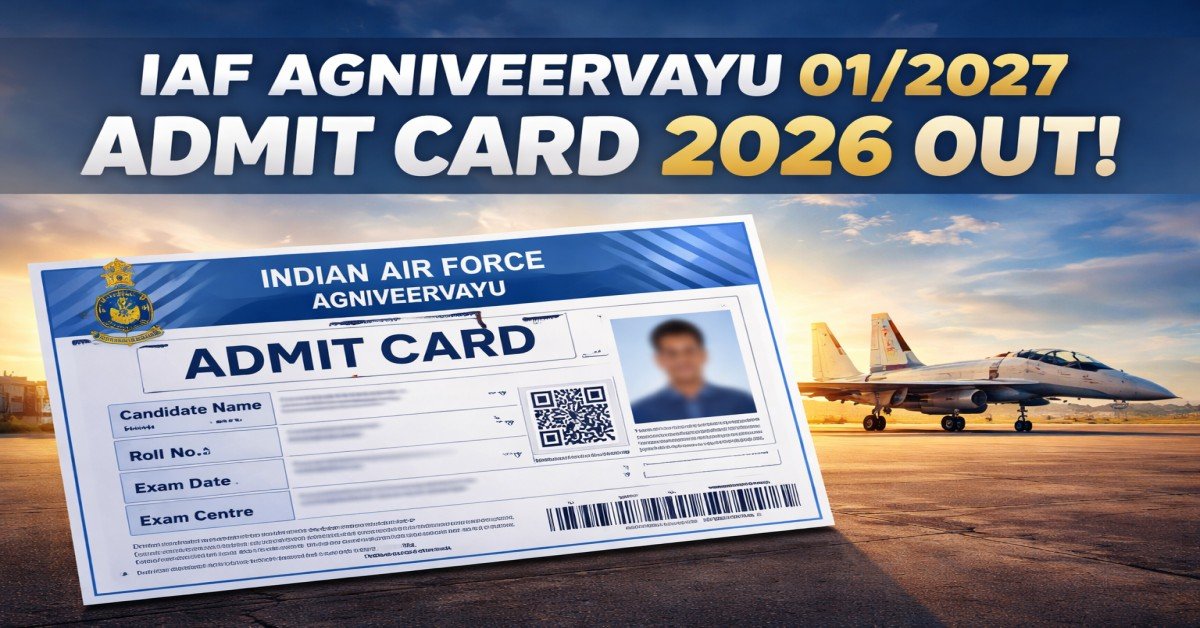
IAF Agniveervayu 01/2027 Admit Card 2026 — Hall Ticket Released, Exam on 30 & 31 March Indian Air Force | Agnipath Scheme | Phase I CBT | agnipathvayu.cdac.in & iafrecruitment.edcil.co.in
The Indian Air Force (IAF) released the Agniveervayu 01/2027 Admit Card 2026 on 27 March 2026 for candidates appearing in the Phase I Computer Based Test (CBT) scheduled on 30 and 31 March 2026. The hall ticket is available for download at agnipathvayu.cdac.in and iafrecruitment.edcil.co.in using your registered Email ID and Password. Before the admit card, IAF had released the City Intimation Slip on 24 March 2026 to help candidates plan travel. The exam will be conducted in multiple shifts across centres nationwide. Carrying a printed admit card along with valid photo ID is mandatory for entry. Mobile phones and electronic devices are strictly prohibited inside the exam hall.
The Indian Air Force conducts the Agniveervayu recruitment twice a year under the Agnipath Scheme, which was introduced by the Government of India to induct young men and women into the armed forces on a short-term contractual basis of four years. The Agniveervayu Intake 01/2027 is the current cycle, for which the notification was released in January 2026. Applications were initially accepted from 12 January to 8 February 2026, and the portal was reopened for a fresh window from 3 to 10 March 2026 with a one-year age relaxation for candidates who could not apply earlier.
The admit card release on 27 March 2026 — just three days before the exam — follows the IAF's standard pattern of issuing hall tickets 48 to 72 hours prior to the examination. This short window is why candidates must act immediately upon reading this. The City Intimation Slip was released earlier on 24 March 2026, which informed candidates of their exam centre city so they could arrange travel and accommodation in advance. If you have already seen your city slip but haven't downloaded the full admit card yet, do it now — the exam is on 30 or 31 March 2026.
| Conducting Authority | Indian Air Force (IAF) / Central Airmen Selection Board (CASB) |
| Recruitment | Agniveervayu Intake 01/2027 under Agnipath Scheme |
| Notification Released | 12 January 2026 |
| Application Period | 12 Jan – 8 Feb 2026 | Reopened: 3–10 March 2026 |
| City Intimation Slip | Released — 24 March 2026 |
| Admit Card Released | 27 March 2026 |
| Phase I Exam Date | 30 & 31 March 2026 — Multiple shifts |
| Exam Mode | Computer Based Test (CBT) — Online |
| Download Portals | agnipathvayu.cdac.in | iafrecruitment.edcil.co.in |
| Login Credentials | Registered Email ID + Password + Captcha |
| Eligibility (Age) | Born between 01 January 2006 and 01 July 2009 (both days inclusive) |
| Eligibility (Education) | 10+2 / Intermediate with minimum 50% aggregate in relevant subjects |
| Application Fee Paid | ₹550 + 18% GST (paid at registration stage) |
The IAF Agniveervayu admit card is available on two official portals — agnipathvayu.cdac.in (the primary CDAC portal used for Agniveervayu recruitment) and iafrecruitment.edcil.co.in (the EDCIL portal). Both portals show the same admit card tied to your registered credentials. You can use whichever portal loads faster for you. The login requires your registered Email ID and Password — these are the same credentials you used when submitting your application. If you registered during the reopened window in March 2026, use those credentials.
One common issue candidates face at this stage is forgetting their password. If that happens, use the "Forgot Password" option on the portal — it will send a reset link to your registered email ID. Make sure you check your spam/junk folder if the reset email doesn't arrive in your inbox within a few minutes. Once downloaded, verify every detail on the admit card carefully before printing — errors in your name, roll number, or exam date must be reported to the IAF immediately.
Visit the Official Portal
Open your browser and go to agnipathvayu.cdac.in or iafrecruitment.edcil.co.in. On the homepage, look for the notification that reads "Admit Card for Agniveervayu Intake 01/2027 is available in your login" and click on it. Avoid unofficial websites that may mimic the portal design.
Click on Candidate Login
On the portal homepage, click on the "Candidate Login" section specifically for Agniveervayu Intake 01/2027. This will take you to the login screen where you need to enter your credentials.
Enter Email ID, Password & Captcha
Enter your registered Email ID, Password (set during registration), and the Captcha code shown on screen. Click Submit. If you have forgotten your password, use the "Forgot Password" link to reset it via your registered email.
Download the Admit Card
After logging in, your IAF Agniveervayu Admit Card 2026 will appear on screen. Check all details carefully — name, registration number, exam date, shift timing, reporting time, and exam centre address. Then click Download and save the PDF to your device.
Print & Keep Multiple Copies
Take at least 2–3 printed copies of the admit card. Keep one copy safely at home and carry the rest to the exam centre. The printed admit card is mandatory for entry — digital copies on a phone screen are NOT accepted. Also keep your City Intimation Slip for reference.
The admit card is more than just an entry pass — it is an official document that contains all the critical information you need for exam day. After downloading, go through every field carefully. A mismatch in your name or roll number at the exam centre can lead to entry being denied, even if you are the right candidate. The admit card also contains your shift timing and reporting time, which are especially important since the exam is conducted in multiple shifts and different candidates are assigned different start times.
Pay particular attention to the Gate Closing Time mentioned on the admit card. The IAF strictly enforces this — candidates who arrive after the gate closes are not allowed entry, regardless of the reason. Plan to reach the exam centre at least 60–90 minutes before your reporting time to account for traffic, document verification queues, and biometric formalities at the centre.
- Candidate's Full Name — as registered in the application form
- Registration / Roll Number — unique identifier for the candidate
- Exam City and Centre Address — full address of the assigned examination centre
- Exam Date — 30 March 2026 or 31 March 2026 (assigned shift)
- Shift Timing — start and end time of the candidate's assigned exam slot
- Reporting Time — time by which candidate must be present at the centre
- Gate Closing Time — deadline after which entry is strictly prohibited
- Photograph and Signature — uploaded during registration
- Important Instructions — exam day rules, prohibited items, dress code guidance
Getting to the exam centre with the right documents is just as important as preparing for the exam itself. IAF exam centres follow strict entry protocols — only candidates with a valid printed admit card AND a matching photo ID are allowed inside. There is no exception to this rule, and centre officials do not have the authority to grant entry without both documents even if you claim a genuine emergency.
The photo ID you carry must be original (not a photocopy) and must contain your photograph and date of birth for verification. Candidates from Jammu & Kashmir, Ladakh, Assam, and Meghalaya are exempted from the Aadhaar Card requirement and may use alternative government-issued IDs. Remember that Aadhaar Card is mandatory for all other candidates as per IAF's current policy for Agniveer recruitment.
| Document | Mandatory / Optional | Notes |
|---|---|---|
| Printed Admit Card | Mandatory | Printed copy only — phone/digital copy not accepted |
| Aadhaar Card (Original) | Mandatory | Exempted for J&K, Ladakh, Assam, Meghalaya candidates |
| PAN Card | Optional (Alt. ID) | Can be used as alternative photo ID proof |
| Voter ID Card | Optional (Alt. ID) | Accepted as alternative photo ID proof |
| Passport | Optional (Alt. ID) | Valid original passport accepted |
| City Intimation Slip | Recommended | Keep for reference — released 24 March 2026 |
- Mobile phones — possession inside the testing area results in permanent debarment
- Smart watches and all electronic wearable devices
- Bluetooth devices, earphones, calculators
- Wallets, bags, pouches inside the exam hall
- Any printed material — books, notes, papers
- Candidates found with prohibited items or indulging in malpractice will be permanently debarred from all IAF recruitment
The Phase I exam is a Computer Based Test (CBT) consisting of multiple choice questions, bilingual in English and Hindi — except for the English paper which is in English only. The exam structure depends on which group you registered for during the application. Candidates who registered for Science subjects (Group X) take a 60-minute test covering English, Physics, and Mathematics. Candidates who registered for Other than Science subjects (Group Y) take a 45-minute test covering English and Reasoning & General Awareness (RAGA).
Candidates who registered for both Group X and Group Y take a combined 85-minute test covering all subjects — Physics, Mathematics, English, and RAGA. This is the most comprehensive option and opens the door to the widest range of trades in the IAF. One critical thing to note about the marking scheme: there is negative marking of -0.25 for every wrong answer. Unlike the UP Police SI exam, random guessing here will hurt your score. Attempt only questions you are reasonably confident about.
| Group | Subjects | Duration | Question Type |
|---|---|---|---|
| Science (Group X) | English, Physics, Mathematics | 60 minutes | MCQ — 10+2 CBSE syllabus |
| Other than Science (Group Y) | English, Reasoning & General Awareness (RAGA) | 45 minutes | MCQ — 10+2 CBSE syllabus |
| Both Groups (X & Y) | English, Physics, Mathematics, RAGA | 85 minutes | MCQ — Combined test |
- Correct Answer: +1 mark
- Wrong Answer: -0.25 marks (negative marking)
- Unattempted: 0 marks
- Marks Normalisation: Scores will be normalised to account for variation in difficulty levels across different shifts and sessions
- Strategy: Attempt only questions you are confident about. Four wrong answers cancel one correct answer — random guessing will reduce your score
The Phase I CBT syllabus is based on the 10+2 CBSE curriculum. Since the exam is just days away at this point, candidates should focus on revising core topics rather than attempting to cover everything from scratch. For Physics and Mathematics, prioritize chapters that have historically carried more weight in Agniveervayu exams — Kinematics, Laws of Motion, and Electricity in Physics; Algebra, Trigonometry, and Statistics in Mathematics. The English section rewards candidates with strong grammar fundamentals and reading speed.
The RAGA (Reasoning and General Awareness) section requires a different preparation approach from the technical subjects. Reasoning questions test pattern recognition and logical thinking — practicing previous year questions is the most effective way to improve your score here quickly. For General Awareness, focus on current events from the last 6 months and basic knowledge of the Indian Air Force, defence news, and national/international events.
- Physical World and Measurement, Kinematics, Laws of Motion, Work Energy and Power
- Motion of System of Particles, Gravitation, Properties of Bulk Matter, Thermodynamics
- Behaviour of Perfect Gas, Oscillations and Waves, Electrostatics, Current Electricity
- Magnetic Effects of Current, Electromagnetic Induction, Optics, Dual Nature of Matter
- Atoms and Nuclei, Electronic Devices, Communication Systems
- Sets, Relations and Functions, Trigonometric Functions, Principle of Mathematical Induction
- Complex Numbers, Quadratic Equations, Linear Inequalities, Permutations and Combinations
- Binomial Theorem, Sequences and Series, Straight Lines, Conic Sections
- Limits and Derivatives, Statistics, Probability, Matrices, Determinants
- Integrals, Differential Equations, Vector Algebra, Three Dimensional Geometry
- Comprehension: Short passage followed by inference, vocabulary, and understanding questions
- Grammar-1: Subject-Verb concord, forms of verbs, sequence of tenses, transformation of sentences
- Grammar-2: Word formation — nouns from verbs, adjectives from nouns, adverbs from adjectives
- Vocabulary: Synonyms, antonyms, contextual usage, one-word substitution
- Narration: Direct and indirect speech — commands, requests, statements, questions
- Reasoning: Verbal and non-verbal reasoning, series completion, analogy, coding-decoding, blood relations, direction sense, logical deduction
- General Awareness: Current affairs (last 6 months), Indian and world history, geography, Indian polity, science and technology, sports, defence and national security
- IAF-specific: Basic knowledge of Indian Air Force history, aircraft, ranks, and recent defence developments
Clearing the Phase I CBT on 30–31 March 2026 is just the first step in a multi-stage selection process. Candidates who clear Phase I are shortlisted state-wise — not on an all-India merit basis. This means your competition is primarily against candidates from your own state for the vacancies allocated to that state. Candidates shortlisted after Phase I are called to an Air Force Selection Centre (ASC) for Phase II testing, which includes a Physical Fitness Test, two Adaptability Tests, and a medical examination.
The Adaptability Tests are unique to IAF's Agniveer selection and are worth understanding in advance. Adaptability Test I is an objective written test that assesses whether a candidate is psychologically suited for deployment in varied geographic and weather conditions — essentially, whether you can handle the demands of being posted to any location across India. Adaptability Test II evaluates how well a candidate can adjust to military life and the disciplined environment of the IAF. Preparing mentally for these aspects — not just academically — is part of what makes a strong Agniveervayu candidate.
| Stage | Details | Status |
|---|---|---|
| Phase I — Online CBT | MCQ test — English, Physics, Maths, RAGA (based on group) | 30–31 Mar 2026 |
| State-wise Shortlisting | Candidates shortlisted based on Phase I score, state-wise | After Phase I |
| Phase II — Physical Fitness Test (PFT) | Running, physical endurance tests at Air Force Selection Centre | Pending |
| Adaptability Test I | Objective written test — suitability for deployment in varied conditions | Pending |
| Adaptability Test II | Assesses ability to adjust to military environment and life | Pending |
| Phase III — Medical Examination | Conducted by Air Force Medical Team — blood tests, X-ray, ECG, USG | Pending |
| Final Selection | State-wise merit + medical fitness + vacancy availability | |
The Agnipath Scheme was launched by the Government of India to transform the recruitment model for the armed forces. Under this scheme, selected candidates serve as Agniveers for a fixed period of four years, after which approximately 25% are retained for regular service based on performance and availability of vacancies. The remaining 75% are released with a Seva Nidhi package and a skill certificate that is intended to aid their transition into civilian employment or higher education.
For Agniveervayu specifically, the scheme means serving in the Indian Air Force for four years across various trades — technical, non-technical, and ground support roles. During the service period, Agniveers receive a monthly package, life insurance coverage of ₹48 lakhs (non-contributory), and are permitted to appear in NDA/AFCAT examinations (maximum 3 attempts) subject to conditions. Importantly, Agniveers are not eligible for Ex-Servicemen (ESM) status after completing their four-year engagement — this is a key distinction from regular service that candidates should be aware of before applying.
- Service Period: 4 years under the Agnipath Scheme
- Retention: Approximately 25% may be retained for regular IAF service based on performance
- Life Insurance: ₹48 lakhs non-contributory life insurance policy for the engagement period
- Seva Nidhi: Lump sum package on completion of 4-year service for released candidates
- NDA/AFCAT: Permitted to appear (max 3 attempts) during engagement period subject to conditions
- ESM Status: Not eligible for Ex-Servicemen status after 4-year engagement
- IAF Pension Rules: IAF Pension Regulations/Rules do not apply to Agniveervayu
Here are detailed answers to the most commonly searched questions about the IAF Agniveervayu 01/2027 Admit Card 2026, exam day rules, and the selection process.
Download from either of these two official portals:
✓ agnipathvayu.cdac.in (primary portal)
✓ iafrecruitment.edcil.co.in (alternative portal)
Login using your registered Email ID + Password + Captcha. The admit card is not sent by post or email — you must download it yourself from the official portal. Before the admit card, the City Intimation Slip was released on 24 March 2026.
Your specific exam date (30th or 31st) and shift timing are mentioned on your individual admit card. Reach the exam centre well before your reporting time — the gate closes strictly at the time mentioned on the admit card and no entry is allowed after that.
✓ Printed copy of Admit Card — digital/phone copy not accepted
✓ Original Aadhaar Card (mandatory for all candidates except those from J&K, Ladakh, Assam, Meghalaya)
Alternative photo IDs (if Aadhaar not available):
PAN Card / Voter ID / Passport — original only, not photocopy
Strictly prohibited: Mobile phones, smart watches, earphones, calculators, printed material. Possession of a mobile phone inside the testing area results in permanent debarment from all IAF recruitment.
✓ Correct Answer: +1 mark
✗ Wrong Answer: -0.25 marks (negative marking applies)
— Unattempted: 0 marks
Important: Unlike many government exams, this exam has negative marking. Four wrong answers will cancel one correct answer. Avoid random guessing — only attempt questions you are reasonably confident about.
Marks will be normalised across different shifts to account for variation in difficulty levels.
✓ Group X (Science): 60 minutes — English, Physics, Mathematics (10+2 CBSE)
✓ Group Y (Other than Science): 45 minutes — English, RAGA (Reasoning & General Awareness)
✓ Both Groups: 85 minutes — English, Physics, Mathematics, and RAGA
All questions are MCQ type and bilingual (English & Hindi) — except the English paper which is in English only. Candidates must qualify separately in both science and non-science subjects if they appeared for both groups.
1. State-wise shortlisting based on Phase I scores
2. Phase II at Air Force Selection Centre (ASC):
— Physical Fitness Test (PFT)
— Adaptability Test I (objective written — suitability for varied deployment)
— Adaptability Test II (military life adaptability assessment)
3. Phase III — Medical Examination by Air Force Medical Team
4. Final Selection based on state-wise merit, medical fitness, and vacancy availability
No TA/DA is provided for any stage. An Appeal Medical Board is available for candidates declared medically unfit (fee: ₹40).
If a candidate successfully clears all stages of selection, the maximum age at the time of enrolment must not exceed 21 years. The application portal was reopened from 3–10 March 2026 with a one-year age relaxation for candidates who had missed the initial window.
After 4 years: approximately 25% may be retained for regular IAF service based on performance and vacancies. The remaining 75% are released with a Seva Nidhi package.
Key points:
✓ Life insurance: ₹48 lakhs (non-contributory) during engagement
✓ Permitted to appear in NDA/AFCAT (max 3 attempts) during service
✗ Not eligible for Ex-Servicemen (ESM) status after 4-year engagement
✗ IAF Pension Regulations do not apply to Agniveervayu

With a strong interest in recruitment trends and exam processes, he regularly publishes well-structured articles covering railway, SSC, banking, and apprenticeship opportunities. His content focuses on delivering accurate information along with practical guidance such as document verification tips, selection process breakdowns, and application support.
Through Jobtheta, his goal is to simplify complex job notifications and help candidates make better decisions during their preparation and application journey.
- PNB Apprentices Result 2026 OUT – Download Provisional List PDF, Check Roll Number - March 29, 2026
- IAF Agniveervayu 01/2027 Admit Card 2026 – Download Hall Ticket | Exam 30-31 March - March 29, 2026
- Bank of Baroda Professional Recruitment 2026 – 104 WMS Vacancies | Apply by 16 April | JobTheta - March 29, 2026