
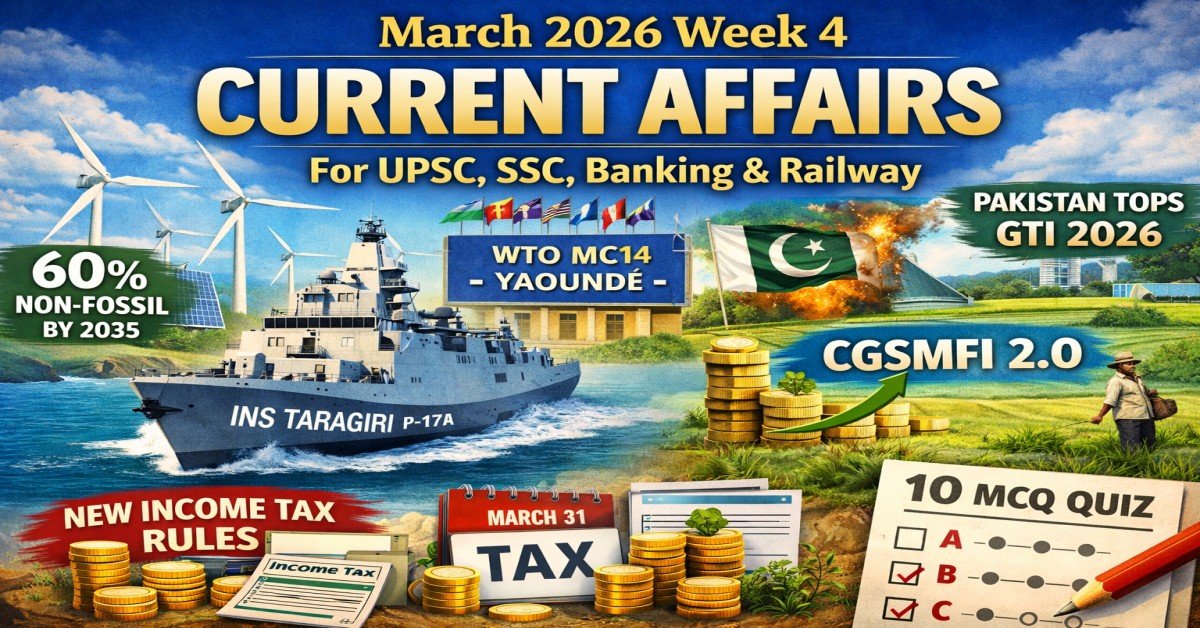
March 2026 Week 4 Current Affairs
Covering March 22–31, 2026 — India's Updated NDC (60% non-fossil by 2035), INS Taragiri Project 17A Frigate, WTO MC14 in Yaoundé (no deal), Global Terrorism Index 2026 (Pakistan tops for 1st time), New Income Tax Rules, CGSMFI 2.0, Sarhul Festival, IMEX TTX 2026 Maritime Exercise, Energy Statistics India 2026 and more. Essential for UPSC, SSC, Banking and Railway aspirants.
India Approves Updated NDC (2031–2035) — 60% Non-Fossil Power, 47% Emissions Intensity Reduction
The Union Cabinet approved India's updated Nationally Determined Contribution (NDC) for 2031–2035 on March 25, 2026. These commitments will be communicated to the UNFCCC under the Paris Agreement. India and Argentina were the only G20 nations without 2035 NDC targets until this announcement. India already exceeded the earlier 50% non-fossil capacity target — achieving 52.57% by February 2026 — nearly five years ahead of schedule.
- Target 1 — Non-Fossil Power Capacity: 60% by 2035 — raised from 50% by 2030 in the 2022 NDC; as of early 2026, India already at 52.57%
- Target 2 — Emissions Intensity: 47% reduction from 2005 GDP levels by 2035 — raised from 45%; India uses intensity-based targets (not absolute), meaning total emissions can rise if GDP grows faster
- Target 3 — Carbon Sink: 3.5–4 billion tonnes CO₂ equivalent through forest and tree cover by 2035 — up from 2.5–3 billion tonnes
- India's 2025 emissions record: CO₂ growth slowed to 0.7% — the slowest since 2001 (exc. COVID); power sector emissions fell 3.8% — first decline since 1973 outside COVID
- 2025 clean energy additions: 47 GW solar, 6.3 GW wind, 4 GW hydro, 0.6 GW nuclear — enough to meet up to 5% demand growth
- Implementation framework: National Action Plan on Climate Change (NAPCC) with 9 national missions + State Action Plans on Climate Change (SAPCC)
- Paris Agreement basics: Adopted at COP21 in 2015; entered into force 2016; goal to limit warming to 1.5°C; India's net-zero target = 2070
- Viksit Bharat link: NDC aligned with Viksit Bharat 2047 — India's vision to become a developed nation by its independence centenary
Energy Statistics India 2026 Released — 33rd Edition by NSO
The National Statistics Office (NSO) released the 33rd edition of Energy Statistics India 2026. Total Renewable Energy potential reached 47,04,043 MW as of March 2025, with solar holding the highest share at 71%. Installed RE capacity grew at a CAGR of 10.93% from 2016–2025; gross electricity generation from renewables reached 4,16,823 GWh in FY 2024-25. Six states — Rajasthan, Maharashtra, Gujarat, Andhra Pradesh, Karnataka, and Madhya Pradesh — hold over 70% of India's RE potential.
- T&D losses: Fell from 22% in FY 2015-16 to 17% in FY 2024-25 — improved grid efficiency
- Coal remains dominant: Supply reached 5,52,315 KTOE in FY 2024-25 — the core contradiction in India's climate narrative
- Credit to energy sector: Rose sixfold — from ₹1,688 crore (2021) to ₹10,325 crore (2025)
- Per capita energy consumption: Rose from 15,296 MJ (2015-16) to 18,096 MJ (2024-25)
INS Taragiri (F41) — India's 4th Project 17A Stealth Frigate to be Commissioned April 3, 2026
The Indian Navy prepares to commission INS Taragiri (F41) on April 3, 2026 at Visakhapatnam. It is the 4th ship of the Nilgiri Class (Project 17A), built by Mazagon Dock Shipbuilders Limited (MDL), Mumbai with over 75% indigenous content and involvement of 200+ MSMEs. Designed by the Warship Design Bureau (WDB), it is a reincarnation of the earlier INS Taragiri — a Leander-class frigate that previously served the Indian Navy.
- Project 17A (Nilgiri Class): 7 guided-missile frigates; advanced version of P17 (Shivalik Class); superior stealth, reduced Radar Cross Section (RCS)
- Weapon suite: Supersonic Surface-to-Surface Missiles, Medium Range SAM (MR-SAM), specialised Anti-Submarine Warfare (ASW) suite
- Propulsion: Combined Diesel or Gas (CODOG); diesel engines + gas turbines driving Controllable Pitch Propellers (CPP)
- IPMS: Integrated Platform Management System — manages all ship functions from a unified interface
- MDL: Mazagon Dock Shipbuilders Limited, Mumbai — premier defence naval shipyard; also built all 6 Scorpene-class submarines (Project 75)
- Atmanirbhar Bharat in defence: Target of ₹1.75 lakh crore in defence production by FY 2028-29; P17A exemplifies this goal
IMEX TTX 2026 — Indian Navy Hosts IONS Maritime Exercise in Kochi
The Indian Navy hosted the IONS Maritime Exercise Table-Top Exercise (IMEX TTX 2026) at the Maritime Warfare Centre, Southern Naval Command, Kochi. Conducted under the Indian Ocean Naval Symposium (IONS) framework, the exercise simulates responses to non-traditional maritime threats — piracy, maritime terrorism, disaster response, illegal trafficking, and information-sharing challenges. Nations including Bangladesh, France, Indonesia, Maldives, Mauritius, Singapore, Sri Lanka, and Tanzania participated.
- IONS: Indian Ocean Naval Symposium; established 2008 on India's initiative; 24 littoral IOR states; voluntary cooperative platform
- India's role: Currently holds IONS chairmanship; reinforces India as net security provider in IOR
- SAGAR: Security and Growth for All in the Region — India's maritime doctrine for IOR; articulated by PM Modi in 2015
- Southern Naval Command: HQ in Kochi; responsible for training; houses Maritime Warfare Centre and INS Garuda
- Indian Ocean significance: Carries ~80% of global seaborne oil trade and ~1/3 of all bulk cargo worldwide
Global Terrorism Index 2026 — Pakistan Tops for 1st Time; Sahel Remains Global Epicentre
The Global Terrorism Index (GTI) 2026 was released by the Institute for Economics and Peace (IEP) — a Sydney-based independent non-profit think tank. The GTI analyses the impact of terrorism in 163 countries on a scale of 0–10. In a landmark shift, Pakistan topped the GTI 2026 for the first time. Globally, terrorism deaths fell by 28% and incidents decreased by 22% — largely driven by improved conditions in the Middle East. However, the Sahel region in sub-Saharan Africa remains the epicentre of terrorism by deaths.
- Pakistan at No. 1: Driven by surge in attacks by Tehreek-e-Taliban Pakistan (TTP); first time any South Asian nation has led the GTI
- Sahel dominance: Accounts for over half of all global terrorism deaths; six of the ten most impacted countries are in sub-Saharan Africa
- Islamic State (IS): Remained the deadliest terrorist organisation; responsible for ~17% of all attacks worldwide; expanded to 22 countries
- Border proximity trend: Over 76% of attacks occurred within 100 km of an international border in 2025 — up from 60% in 2007
- Iran conflict warning: Escalation risks destabilising MENA region and increasing overseas attacks by Iran-sympathetic groups
- IEP also publishes: Global Peace Index (GPI) — measures peacefulness of nations annually
WTO MC14 Concludes in Yaoundé — No Agreement on E-Commerce or Agriculture
The WTO's 14th Ministerial Conference (MC14) concluded at the Palais des Congrès, Yaoundé, Cameroon — only the second WTO Ministerial Conference hosted in Africa. No binding agreement was reached on critical issues: the e-commerce customs duty moratorium (risk of lapsing), TRIPS non-violation moratorium, and agricultural domestic support disputes. India and South Africa successfully blocked the IFD (Investment Facilitation for Development) agreement, arguing it falls outside WTO's core mandate.
- WTO basics: Established January 1, 1995; replaced GATT (1948); 166 members; HQ Geneva; DG — Ngozi Okonjo-Iweala
- Ministerial Conference: Highest WTO decision-making body; meets every two years; MC13 was held in Abu Dhabi (2024)
- E-commerce moratorium: Members agree not to impose customs duties on electronic transmissions; at risk of expiry — huge implications for digital trade
- Fisheries subsidies: Ministers agreed to pursue final recommendations by MC15; aimed at eliminating harmful subsidies driving overfishing
- India's position at MC14: Blocked IFD agreement; advocated for development flexibilities for emerging and developing nations
New Income Tax Rules FY 2026-27 — Education Allowance Revised, "Tax Year" Introduced
Several significant changes come into effect from April 1, 2026 for FY 2026-27. Under the New Tax Regime, taxpayers get a rebate of up to ₹60,000 under Section 87A, making income up to ₹12 lakh effectively tax-free. In a major simplification, the terms "Financial Year" and "Assessment Year" are unified into a single term — "Tax Year". Income tax slabs remain unchanged from the previous year.
- Education Allowance: Revised to ₹3,000/month per child (from ₹100); for up to 2 children; last meaningfully revised decades ago
- Hostel Allowance: Revised to ₹9,000/month per child (from ₹300); a major real-world update to reflect current costs
- HRA disclosure: Mandatory declaration of landlord-tenant relationship now required for claiming House Rent Allowance; tightens compliance
- ITR deadline extension: ITR-3 and ITR-4 (non-audit taxpayers) extended to August 31; ITR-1 and ITR-2 remain July 31
- Section 87A: Tax rebate for resident individuals under New Tax Regime; makes income up to ₹12 lakh tax-free
- New vs Old Tax Regime: New regime — lower slab rates, no exemptions; Old regime — higher slabs but retains 80C, HRA, LTA deductions
CGSMFI 2.0 — Credit Guarantee Scheme for Microfinance Institutions Introduced
The Government of India introduced Credit Guarantee Scheme for MFIs 2.0 (CGSMFI 2.0), providing guarantee cover to banks and financial institutions via National Credit Guarantee Trustee Company Limited (NCGTC) for on-lending to small borrowers through NBFC-MFIs. The scheme is valid till June 30, 2026 or until ₹20,000 crore in loans are guaranteed, whichever is earlier. Guarantee fee: 0.50% per annum.
- Coverage rates: 80% for small NBFC-MFIs | 75% for medium | 70% for large
- NCGTC: National Credit Guarantee Trustee Company Limited — Government of India company under Ministry of Finance; runs multiple credit guarantee programmes
- Eligible borrowers: Small borrowers within RBI's microfinance regulatory definition; loan limit ₹2 lakh; household income up to ₹3 lakh
- Microfinance sector in India: Serves over 6 crore borrowers; portfolio exceeds ₹3.5 lakh crore; critical for last-mile financial inclusion in rural and semi-urban India
| Date | Day / Observance | Theme / Key Fact 2026 | Category |
|---|---|---|---|
| Mar 22 | World Water Day | UN declaration 1993; India has 4% of world's freshwater but 18% of population; Jal Shakti Abhiyan 2.0 running | Environment |
| Mar 23 | World Meteorological Day | WMO established March 23, 1950; Theme 2026: "Closing the Early Warning Gap"; UN specialised agency for weather, climate, water | Science |
| Mar 23 | Shaheed Diwas (Martyrs' Day) | Commemorates execution of Bhagat Singh, Sukhdev Thapar, and Shivaram Rajguru in Lahore on March 23, 1931 | National |
| Mar 24 | World TB Day | Marks Robert Koch's discovery of TB bacteria (1882); India's TB-free target extended to 2030 under Nikshay Poshan Yojana | Health |
| Mar 27 | World Theatre Day | Inaugurated in 1962 by International Theatre Institute (ITI); promotes theatre as a tool for peace and solidarity globally | Culture |
| Mar 28 | Sarhul Festival (Jharkhand) | "Worship of the Sal tree"; spring renewal festival of Oraon, Munda, Santal, Khadia, Ho tribes; President extended greetings 2026 | Tribal |
| Mar 31 | Mahavir Jayanti 2026 | Birth anniversary of Lord Mahavira — 24th Tirthankara of Jainism; born 599 BCE in Vaishali (present-day Bihar); principle of Ahimsa (non-violence) | Religious |
Bharat Innovates Deep-Tech Pre-Summit at IIT Bombay (March 21–22, 2026)
The Ministry of Education organised the Bharat Innovates Deep-Tech Pre-Summit at IIT Bombay Research Park. Union Minister Dharmendra Pradhan addressed it. The initiative was announced by PM Modi during the India-France Year of Innovation and operates under the Principal Scientific Adviser to the Government of India. Its purpose is to act as a global accelerator for Indian deep-tech — bridging research labs, start-ups, and global investors.
- Deep-tech: Technologies rooted in substantial scientific advances — AI/ML, quantum computing, advanced materials, biotech, semiconductors, space tech
- Bharat Innovates structure: National Basecamps in Gandhinagar and Mumbai (Dec 2025–Jan 2026) → Pre-Summit at IIT Bombay (March 2026) → Global Innovation Summit
- India-France Year of Innovation: Bilateral initiative; announced by PM Modi and French President Macron to foster joint deep-tech innovation
One-Horned Rhinoceros — Kaziranga vs Pobitora: Key Exam Fact in News
A frequently tested wildlife fact circulated in UPSC preparation sources during week 4: Kaziranga National Park (Assam) has the largest population of Indian One-Horned Rhinoceros (~2,613 rhinos), while Pobitora Wildlife Sanctuary (Assam) has the highest density (~107 rhinos in only 16 sq. km). The One-Horned Rhino is classified as Vulnerable — not Critically Endangered — on the IUCN Red List, reflecting its remarkable recovery from under 200 individuals in the early 20th century.
- Kaziranga: UNESCO World Heritage Site (1985); ~430 sq. km core; Project Tiger since 1974; also known for tigers, wild buffalo, swamp deer
- India's share: Holds ~85% of the global One-Horned Rhino population
- CITES status: One-Horned Rhino = Appendix I — prohibiting all commercial international trade
- Pobitora: Located in Morigaon district, Assam; world's highest rhino density; only 16 sq. km core area
India–Bhutan Sign Postal Cooperation MoU (March 19–22, 2026)
The Secretary (Posts) visited Bhutan (March 19–22, 2026) and signed a Postal Cooperation MoU between India's Ministry of Communications and Bhutan's Ministry of Infrastructure and Transport. The MoU covers postal operations, logistics connectivity, technology development, and philately. Bhutanese postal officials will receive training at the Rafi Ahmed Kidwai National Postal Academy, Ghaziabad.
- India-Bhutan relations: Treaty of Friendship 1949 (revised 2007); India = Bhutan's largest trade and development partner; unique security relationship
- Department of Posts: Operates ~1.57 lakh post offices — the largest postal network in the world; also provides banking (POSB) and insurance (PLI) services
- Rafi Ahmed Kidwai: India's first Minister of Communications; National Postal Academy in Ghaziabad named in his honour
🎯 Practice MCQ Quiz — March 2026 Week 4
10 high-value questions covering India's updated NDC, INS Taragiri, GTI 2026, WTO MC14, Income Tax rules, and more. Detailed explanations for every answer.

With a strong interest in recruitment trends and exam processes, he regularly publishes well-structured articles covering railway, SSC, banking, and apprenticeship opportunities. His content focuses on delivering accurate information along with practical guidance such as document verification tips, selection process breakdowns, and application support.
Through Jobtheta, his goal is to simplify complex job notifications and help candidates make better decisions during their preparation and application journey.