
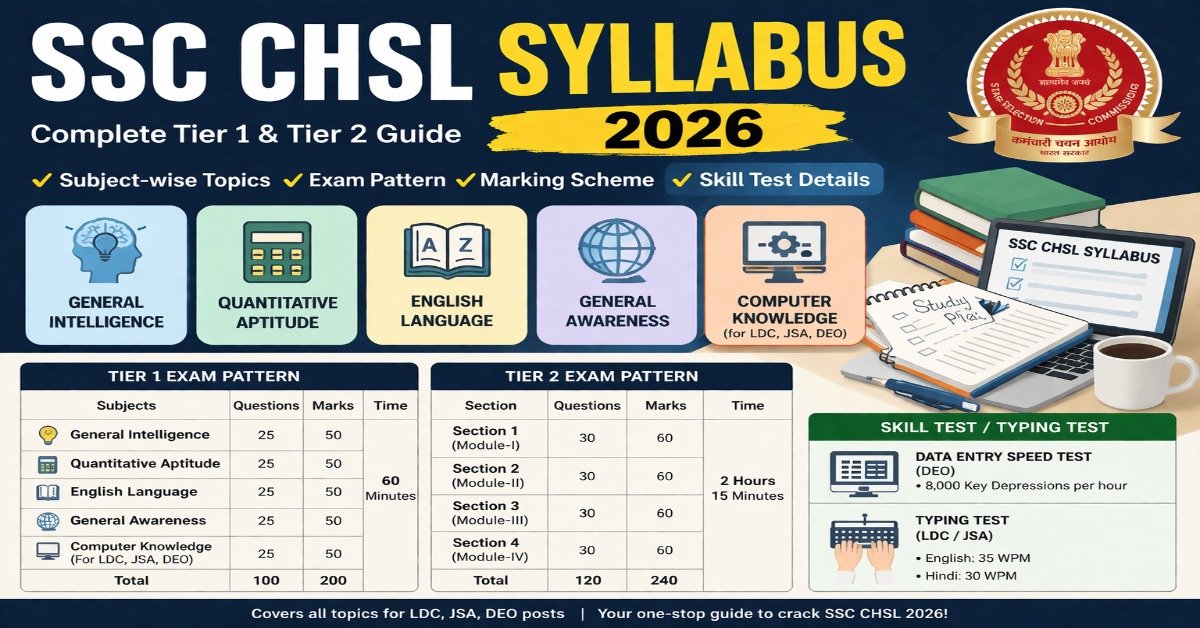
SSC CHSL Syllabus 2026
Complete Topic-Wise Guide — Tier 1, Tier 2 & Skill Test
The Staff Selection Commission (SSC) conducts the Combined Higher Secondary Level (CHSL) examination to recruit candidates for Lower Division Clerk (LDC), Junior Secretariat Assistant (JSA), and Data Entry Operator (DEO) posts across Central Government Ministries and Departments. The exam has two tiers — Tier 1 is a qualifying Computer-Based Test that acts as a gateway, while Tier 2 alone determines your final merit rank. This article provides the complete, verified, topic-wise SSC CHSL Syllabus 2026 for both tiers, with the official exam pattern, marking scheme, and subject-wise preparation tips. 📚
| Parameter | Details |
|---|---|
| Conducting Body | Staff Selection Commission (SSC) — ssc.gov.in |
| Exam Full Name | Combined Higher Secondary Level (CHSL) Examination 2026 |
| Posts Offered | Lower Division Clerk (LDC), Junior Secretariat Assistant (JSA), Data Entry Operator (DEO), DEO Grade A (CAG) |
| Educational Qualification | Passed 10+2 (Class XII) or equivalent from a recognised Board/University. For DEO in select ministries: Class XII with Mathematics from a recognised Board. |
| Age Limit | 18–27 years. Relaxation: OBC +3 yrs, SC/ST +5 yrs, PwD +10–15 yrs, Ex-Servicemen as per Govt. rules. Refer official notification for cut-off date. |
| Exam Mode | Computer-Based Test (CBT) — both Tier 1 and Tier 2 |
| Exam Language | English and Hindi — except English Language section which is English only |
| Number of Tiers | 2 Tiers — Tier 1 (Qualifying) + Tier 2 (Merit-Deciding + Skill Test) |
| Tier 1 Structure | 100 MCQs | 200 Marks | 60 Minutes | −0.50 per wrong answer |
| Tier 2 Structure | 3 Sections, 6 Modules | Merit Marks: 390 (Sec 1+2) | −1 per wrong answer |
| Minimum Qualifying Marks | UR: 30% | OBC/EWS: 25% | SC/ST/PwD & others: 20% (applies to Tier 1 and Tier 2 merit sections) |
| Final Merit Basis | Tier 2 marks only (Tier 1 scores are qualifying; Computer Knowledge and Skill Test are qualifying) |
| Official Website | ssc.gov.in — All notifications, admit cards, results published here only |
Typing: 35 WPM (English) / 30 WPM (Hindi)
Typing: 35 WPM (English) / 30 WPM (Hindi)
Class XII with Maths required for select DEO posts
Tier 1 — Computer-Based Qualifying Examination
A 100-question, 200-mark MCQ exam across four sections: General Intelligence & Reasoning, General Awareness, Quantitative Aptitude, and English Language. Duration: 60 minutes (80 minutes for PwD candidates). Negative marking: −0.50 marks per wrong answer. Tier 1 is qualifying in nature — scores are used only to shortlist candidates for Tier 2 and are not added to final merit. Category-wise cutoffs determine who proceeds to the next stage.
📝 Computer-Based Test | Qualifying StageTier 2 — Computer-Based Merit Examination (Two Sessions)
The merit-determining stage, conducted in two sessions on the same day. Session 1 covers Section 1 (Mathematical Abilities + Reasoning), Section 2 (English + General Awareness), and Module I of Section 3 (Computer Knowledge — qualifying). Session 2 contains Module II of Section 3 (Skill/Typing Test — qualifying). Negative marking: −1 mark per wrong answer in Sections 1, 2, and Module I of Section 3. Merit is calculated on 390 marks (Sections 1 and 2 only).
📊 Merit-Deciding Stage | 390 Merit MarksSkill Test / Typing Test — Qualifying (Module II, Section 3 of Tier 2)
Conducted as part of Tier 2 Session 2. For LDC/JSA: Typing speed of 35 words per minute in English or 30 words per minute in Hindi on a computer. For DEO: Data Entry speed of 8,000 key depressions per hour (KDPH). For DEO Grade A (CAG): Data Entry speed of 15,000 KDPH. Errors calculated up to 2 decimal places. Candidates must pass the Skill Test to be eligible for final selection — marks do not count in merit.
⌨️ Qualifying Only — No Merit MarksDocument Verification & Final Merit List
Candidates shortlisted after Tier 2 are called for document verification. Originals including Class X certificate (age proof), Class XII marksheet, category certificate, and identity documents are verified. The final merit list is prepared solely on Tier 2 Section 1 and Section 2 marks. Post allocation is done based on rank, preference, and available vacancies across categories.
📁 Final Stage — After Tier 2Tier 1 — Section-Wise Breakdown
| Section | Subject | Questions | Marks | Duration |
|---|---|---|---|---|
| Section 1 | General Intelligence & Reasoning | 25 | 50 | 60 Minutes (Combined) |
| Section 2 | General Awareness | 25 | 50 | |
| Section 3 | Quantitative Aptitude | 25 | 50 | |
| Section 4 | English Language & Comprehension | 25 | 50 | |
| Grand Total — Tier 1 | 100 | 200 | 60 Minutes | |
Tier 2 — Section & Module-Wise Breakdown
| Section | Module | Subject | Questions | Marks | Merit? |
|---|---|---|---|---|---|
| Section 1 Session 1 | Module I | Mathematical Abilities | 30 | 90 | ✅ Yes |
| Module II | Reasoning & General Intelligence | 30 | 90 | ✅ Yes | |
| Section 2 Session 1 | Module I | English Language & Comprehension | 45 | 135 | ✅ Yes |
| Module II | General Awareness | 25 | 75 | ✅ Yes | |
| Section 3 Session 1 & 2 | Module I | Computer Knowledge Test | 15 | 45 | Qualifying |
| Module II | Skill Test / Typing Test | — | — | Qualifying | |
| Total Merit Marks (Sections 1 & 2 only) | 130 | 390 | Sec 1 & 2 | ||
Section 1 — Mathematical Abilities + Reasoning & General Intelligence
Session 1 | 60 Questions | 180 Marks | Negative Marking: −1 per wrong | Counts in Final Merit
- Number Systems, Fractions, HCF, LCM
- All fundamental arithmetic operations
- Percentages, Ratio & Proportion, Partnership
- Profit, Loss, Discount & Marked Price
- Average, Mixture & Alligation
- Time & Work, Pipes & Cisterns
- Time, Speed & Distance, Trains, Boats
- Simple & Compound Interest, Instalments
- Algebra — Linear, Quadratic, Simultaneous
- Coordinate Geometry (basic)
- Geometry — Triangles, Quadrilaterals, Circles, Polygons
- Mensuration — 2D (Area, Perimeter) & 3D
- Trigonometry — Ratios, Identities, Heights & Distances
- Statistics — Mean, Median, Mode, Standard Deviation
- Data Interpretation — Table, Bar, Pie, Line graphs
- Permutation, Combination, Probability
- Analogies — Semantic, Symbolic, Figural
- Classification — Odd One Out
- Series — Number, Letter, Figural, Mixed
- Coding & Decoding
- Blood Relations
- Direction & Distance Sense
- Seating Arrangements (Linear & Circular)
- Venn Diagrams & Syllogisms
- Statement — Assumptions & Conclusions
- Logical Reasoning — Cause & Effect
- Critical Reasoning & Punch Lines
- Matrix-based Problems
- Non-Verbal — Embedded Figures, Paper Folding
- Mirror & Water Images
- Counting of Figures
- Puzzles — Ordering, Ranking, Scheduling
Section 2 — English Language & Comprehension + General Awareness
Session 1 | 70 Questions | 210 Marks | Negative Marking: −1 per wrong | Highest Weightage — Counts in Merit
- Reading Comprehension — Literary & Factual passages
- Advanced Cloze Test — contextual fill-in
- Para Jumbles — sentence rearrangement
- Synonyms & Antonyms (advanced vocabulary)
- Idioms & Phrases — meaning & usage
- One Word Substitution
- Spotting Errors — complex grammar rules
- Sentence Improvement & Correction
- Active & Passive Voice (complex sentences)
- Direct & Indirect Speech (complex)
- Fill in the Blanks — multiple blanks
- Spelling Check & Word Usage
- Sentence Connectors & Conjunctions
- Inference & Logical Deduction from passage
- Vocabulary in Context
- Indian History — detailed coverage, all periods
- Indian Polity — Constitution, Parliament, Judiciary
- Indian Economy — GDP, Budget, Banking, RBI
- Indian & World Geography — physical & political
- General Science — Physics, Chemistry, Biology
- Science & Technology developments
- Environment & Ecology
- Art, Culture & Literature of India
- Sports — National & International
- Awards & Honours — National & International
- International Organisations (UN, WHO, WTO, etc.)
- Government Schemes & Policies
- Current Affairs — rolling last 12 months
- Books & Authors
- National Parks, Wildlife & Biosphere Reserves
Section 3 — Computer Knowledge + Skill Test / Typing Test
Session 1 (Module I) + Session 2 (Module II) | Both modules are qualifying — marks do NOT count in merit
- Computer Fundamentals — Hardware & Software
- Input & Output Devices
- Storage Devices (HDD, SSD, Pen Drive, etc.)
- Operating Systems — Windows basics
- MS Word — formatting, tools, features
- MS Excel — formulas, functions, charts
- MS PowerPoint — slides, presentations
- Internet basics — Browsers, URLs, Search Engines
- Email — Composition, Attachments, Etiquette
- Networking — LAN, WAN, Wi-Fi, Bluetooth
- Cybersecurity — Viruses, Malware, Worms, Trojans, Firewalls
- Keyboard Shortcuts (Windows & MS Office)
- Number Systems — Binary, Decimal, Hexadecimal
- Basic Database Concepts
- For LDC / JSA: Typing Test on Computer
- English Typing: 35 Words Per Minute (WPM)
- Hindi Typing: 30 Words Per Minute (WPM)
- Language chosen during application is final
- For DEO: Data Entry Speed Test
- 8,000 Key Depressions Per Hour (KDPH)
- Test duration: 15 minutes on printed passage
- For DEO Grade A (CAG): Data Entry Speed Test
- 15,000 Key Depressions Per Hour (KDPH)
- Errors calculated to 2 decimal places
- Candidates must carry written exam Admit Card
- Bring Aadhaar / valid Government Photo ID
- General Intelligence & Reasoning — Analogies, Series, Coding-Decoding, Non-Verbal Reasoning, Blood Relations, Direction Sense, etc.
- General Awareness — Current Affairs, History, Geography, Polity, Science, Economy, Culture, Awards
- Quantitative Aptitude — Arithmetic, Algebra, Geometry, Trigonometry, Data Interpretation, Statistics
- English Language & Comprehension — Grammar, Vocabulary, Comprehension, Active/Passive Voice, Para Jumbles
- Section 1, Module I: Mathematical Abilities — 30 Qs, 90 marks
- Section 1, Module II: Reasoning & General Intelligence — 30 Qs, 90 marks
- Section 2, Module I: English Language & Comprehension — 45 Qs, 135 marks (highest)
- Section 2, Module II: General Awareness — 25 Qs, 75 marks
- Section 3, Module I: Computer Knowledge — 15 Qs, 45 marks (qualifying)
- Section 3, Module II: Skill/Typing Test (qualifying)
- Tier 1: −0.50 marks (half mark) per wrong answer. 10 wrong = −5 marks.
- Tier 2: −1 mark per wrong answer in Section 1, Section 2, and Module I of Section 3. 10 wrong = −10 marks.
- No negative marking for the Skill/Typing Test (Module II of Section 3).
- Unreserved (UR): 30% of total marks
- OBC / EWS: 25% of total marks
- All other categories (SC, ST, PwD, Ex-Servicemen, etc.): 20% of total marks
- LDC / JSA: Typing Test at 35 Words Per Minute in English or 30 Words Per Minute in Hindi on a computer. Language chosen during application is final — no changes allowed.
- DEO (Data Entry Operator): Data Entry speed of 8,000 Key Depressions Per Hour (KDPH) on a printed English passage. Test duration: 15 minutes.
- DEO Grade A (Office of CAG): Data Entry speed of 15,000 Key Depressions Per Hour (KDPH).
- Lower Division Clerk (LDC) — various Central Government Ministries and Departments
- Junior Secretariat Assistant (JSA) — Parliament Secretariat and similar bodies
- Data Entry Operator (DEO) — various offices including EPFO, DGT, and other departments
- Data Entry Operator Grade A — specifically in the Office of the Comptroller and Auditor General of India (CAG). Requires Class XII with Mathematics for select ministries.
- Computer Fundamentals — Hardware, Software, Input/Output Devices, Storage
- Operating Systems — Windows basics, file management
- MS Office — Word (formatting, tools), Excel (formulas, functions), PowerPoint (slides)
- Internet — Browsers, URLs, Email, Search Engines
- Networking — LAN, WAN, Wi-Fi, Bluetooth, protocols
- Cybersecurity — Viruses, Malware, Worms, Trojans, Firewalls, preventive measures
- Keyboard shortcuts, Number Systems (Binary, Decimal, Hexadecimal)

With a strong interest in recruitment trends and exam processes, he regularly publishes well-structured articles covering railway, SSC, banking, and apprenticeship opportunities. His content focuses on delivering accurate information along with practical guidance such as document verification tips, selection process breakdowns, and application support.
Through Jobtheta, his goal is to simplify complex job notifications and help candidates make better decisions during their preparation and application journey.