

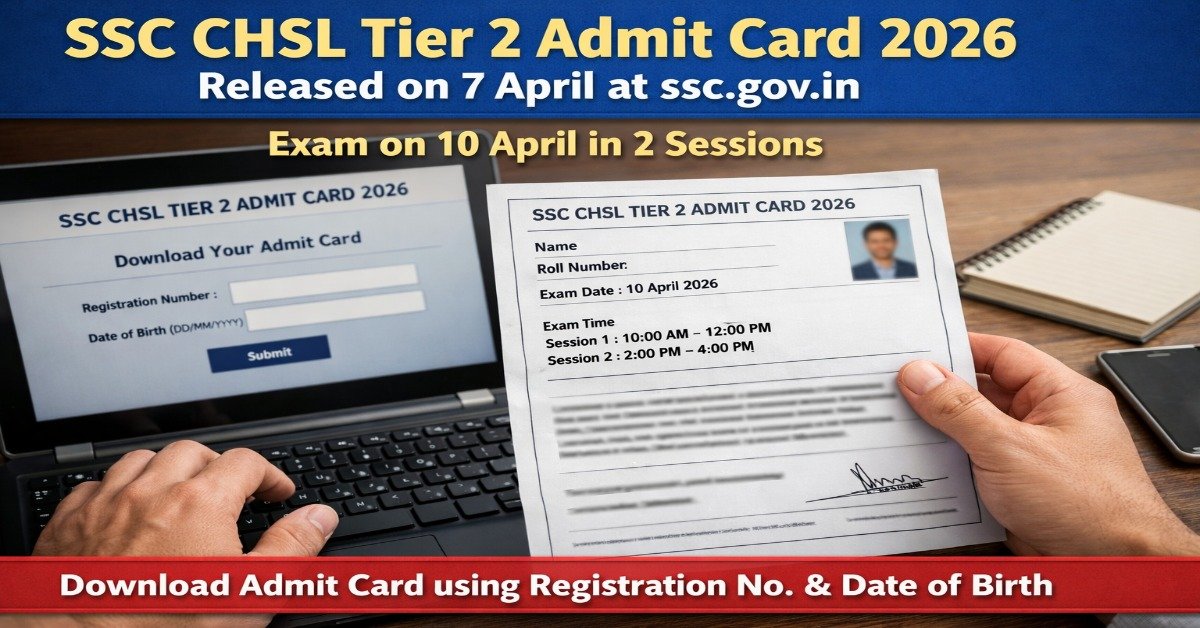
SSC CHSL Tier-II Admit Card 2026
Released 7 April — Exam on 10 April 2026
The Staff Selection Commission (SSC) has officially released the SSC CHSL Tier-II Admit Card 2026 on 7 April 2026 at ssc.gov.in. Candidates who qualified the Tier-I examination must download their hall ticket immediately using their Registration Number and Date of Birth. Entry to the exam centre without a printed admit card will not be allowed under any circumstances.
Visit the Official SSC Website
Open your browser and go to www.ssc.gov.in — the only authorised portal for SSC admit cards. Avoid third-party websites that may display fake or outdated admit cards. For regional cadre candidates, SSC may also direct you to your respective regional SSC website (e.g., sscnr.net.in, sscsr.gov.in, etc.) for the download.
Click on "Candidate Login"
On the homepage, locate and click the "Candidate Login" button. This will take you to the SSC login dashboard where all your exam-related documents — admit card, city slip, scorecard — are accessible in one place.
Enter Login Credentials
Type your Registration Number (or Enrollment ID) as username, enter your Date of Birth in DD/MM/YYYY format as password, and fill in the on-screen Captcha code accurately. Some candidates may be prompted to enter their password if they had set one during registration. Click Submit to proceed.
Locate the Tier-II Admit Card Link
Once inside the dashboard, look for the link labelled "Combined Higher Secondary Level Examination 2025 (Tier-II) – Admit Card" or similar. Click on it. The admit card PDF will either open in a new tab or begin downloading automatically, depending on your browser settings.
Verify All Details & Take Printout
Before printing, verify every detail on the admit card — name, roll number, exam centre address, date, shift timing, photograph, and signature. If any detail is incorrect, immediately contact the SSC helpdesk. Print the admit card in colour if possible — at minimum, take 2 to 3 copies. Keep one for the exam day and others as backups. Do not fold or laminate the admit card.
| Section | Module | Subject | Questions | Marks |
|---|---|---|---|---|
| Section 1 | Module I | Mathematical Abilities | 30 | 90 |
| Module II | Reasoning & General Intelligence | 30 | 90 | |
| Section 2 | Module I | English Language & Comprehension | 40 | 120 |
| Module II | General Awareness | 20 | 60 | |
| Section 3 | Module I | Computer Knowledge Test | 15 | 45 |
| Total (Session I — CBT) | 135 | 405 | ||
DEO (Data Entry Operator): Skill Test requiring 8,000 key depressions per hour — 15-minute test on a computer.
DEO in Office of C&AG: Higher standard — 15,000 key depressions per hour — 15-minute test.
LDC / JSA / PA / SA: Typing Test requiring a speed of 10,500 key depressions per hour (approximately 35 words per minute in English or 30 words per minute in Hindi) — 10-minute test.
- Negative marking of 1 mark applies for every wrong answer in Session I (Sections 1, 2, and Module I of Section 3). Unattempted questions carry zero marks.
- Candidates must score a minimum of 30% in Session I (for UR/EWS) for their Session II answers to be evaluated. Check category-wise minimum qualifying marks in the official notification.
- Session II (Skill/Typing Test) is qualifying — its marks are not added to the merit list. Candidates who fail Session II are eliminated regardless of their Session I score.
- The tie-breaking sequence for equal scorers: Session I marks → Tier-I marks → Date of birth (older candidate ranked higher) → Alphabetical order of first name.
DEO Grade A (Ministry of Consumer Affairs & SSC): 12th pass in Science stream with Mathematics as a compulsory subject from a recognised Board.
Age relaxation — OBC: +3 years | SC/ST: +5 years | PwBD (UR): +10 years | PwBD (OBC): +13 years | PwBD (SC/ST): +15 years | Ex-Servicemen: as per GoI rules
For PA / SA: Typing Test with same speed standard — 10 minutes.
For DEO: Skill Test at 8,000 key depressions per hour — 15 minutes qualifying.
For DEO Grade A (C&AG): 15,000 key depressions per hour — 15 minutes qualifying.
- Mobile phones, smartwatches, Bluetooth devices, earphones, or any electronic gadget.
- Calculators, log tables, slide rules, or any printed study material.
- Wallet, large bags, purses — leave them outside or in the locker facility if available.
- Any unauthorised material, cheat sheets, or notes written on body parts or clothing.
- City Intimation Slip alone — it is NOT the admit card and will not allow exam entry.
Tier-I — Qualifying / Shortlisting Stage (Completed)
Tier-I was conducted in November 2025. It is a 60-minute online CBT of 100 questions for 200 marks covering General Intelligence, General Awareness, Quantitative Aptitude, and English Language (25 questions × 2 marks each, with 0.5 mark negative marking per wrong answer). Tier-I marks are used for shortlisting candidates to Tier-II. The Tier-I score is also included in the final merit calculation along with Tier-II scores in case of tie-breaking.
Tier-II — Main Examination (10 April 2026) — Merit Deciding Stage
This is the current stage. Session I (2 hrs 15 min) is a CBT of 135 questions for 405 marks across Mathematical Abilities, Reasoning, English, General Awareness, and Computer Knowledge. Negative marking of 1 mark per wrong answer applies. Session II (15 or 10 minutes, post-lunch) is the qualifying Skill/Typing Test — marks not counted. Tier-II scores form the primary basis of the final merit list.
Document Verification (DV)
Candidates shortlisted based on the Tier-II merit list are called for Document Verification. Original certificates — 12th marksheet, caste/EWS certificate, age proof, photo ID, and any disability certificate — must be produced in person. Candidates who fail to produce genuine original documents at this stage are eliminated from the recruitment process.
Final Merit List & Post Allocation
The final merit list is prepared based on combined Tier-II CBT scores. There is no interview at any stage of SSC CHSL. Post allocation — LDC/JSA, PA/SA, DEO — is determined by merit rank, post preference given during application, and availability of vacancies in each category. Selected candidates are allotted to departments like CBI, Election Commission, Ministry of Commerce, Department of Revenue, India Post, and many others.

With a strong interest in recruitment trends and exam processes, he regularly publishes well-structured articles covering railway, SSC, banking, and apprenticeship opportunities. His content focuses on delivering accurate information along with practical guidance such as document verification tips, selection process breakdowns, and application support.
Through Jobtheta, his goal is to simplify complex job notifications and help candidates make better decisions during their preparation and application journey.