
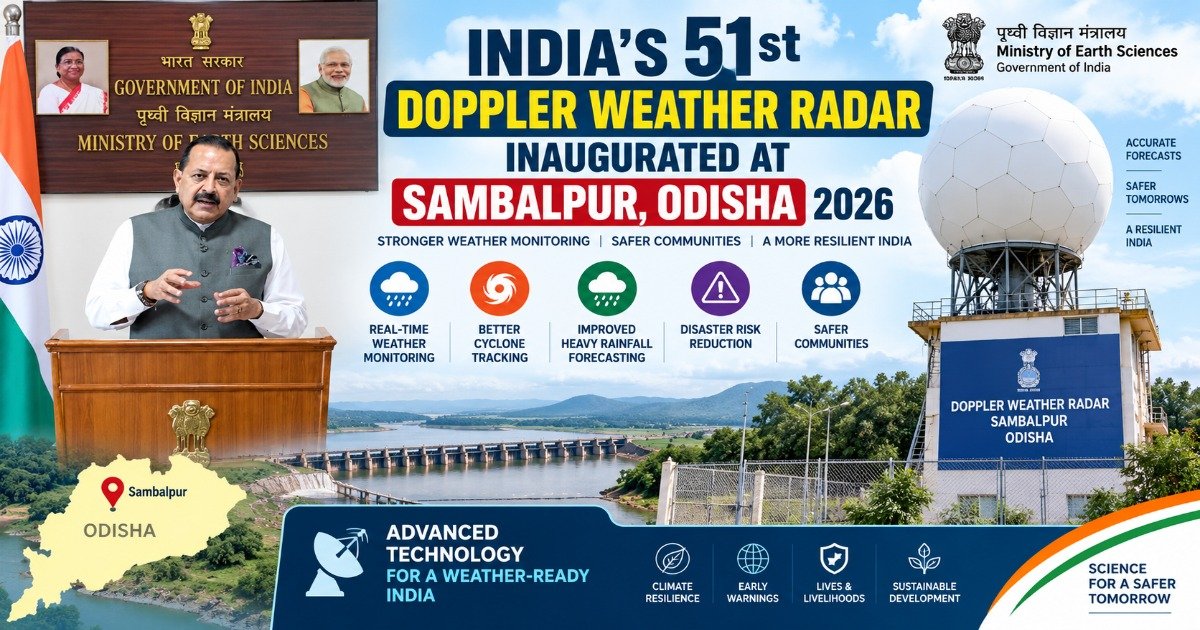
India has added a powerful new eye to its weather monitoring system. Union Minister of State (Independent Charge) for Earth Sciences, Dr. Jitendra Singh, virtually inaugurated India’s 51st Doppler Weather Radar (DWR) at Sambalpur, Odisha, on September 17, 2026.
The inauguration was held in the presence of Odisha Chief Minister Shri Mohan Charan Majhi. The physical ceremony took place at Gangadhar Meher University in Sambalpur, while the Union Minister participated virtually from New Delhi.
The new radar is located at Jamadarpali in Sambalpur. It is a Make in India installation, built under the Government of India’s flagship weather infrastructure programme — Mission Mausam.
This is a big moment for Odisha, for western India, and for India’s weather preparedness story as a whole.
What Is a Doppler Weather Radar?
Before we look at the Sambalpur radar’s significance, let us understand what a Doppler Weather Radar does.
A Doppler Weather Radar (DWR) is an active remote-sensing instrument. It works by sending out microwave pulses into the atmosphere. When those pulses hit rain, clouds, or other precipitation particles, they bounce back. The radar reads those returned signals.
What makes Doppler radar special is the Doppler effect. When precipitation particles are moving — either toward the radar or away from it — the frequency of the returned signal shifts slightly. The radar measures this shift. From that measurement, it can estimate:
- Wind speed and direction within clouds
- Movement and intensity of storms
- Rainfall rates and patterns
- Location and path of severe weather systems
This information is critical. It gives meteorologists the ability to issue early warnings for thunderstorms, lightning, heavy rainfall, hailstorms, and cyclones — often hours before they strike.
The radial velocity measured by the radar shows the motion of particles toward or away from the radar. The radar reflectivity shows how strong the returned signal is — which tells meteorologists how intense the precipitation is.
Simply put, a Doppler Weather Radar is a weather guardian. It watches the sky so that people on the ground have enough time to prepare.
Doppler Weather Radar Sambalpur is inaugurated on 16th September 2026 by Hon'ble Chief Minister of Odisha Shri Mohan Charan Majhi in presence of Hon'ble Indian Union Minister of State for Science and Technology and Earth Sciences Dr. Jitendra Singh, (contd) pic.twitter.com/LfG4cVFkPm
— Meteorological Centre, Bhubaneswar (@mcbbsr) September 17, 2026
The Sambalpur Radar — Key Technical Details
The newly inaugurated radar at Sambalpur is a state-of-the-art Doppler Weather Radar. Here are its key technical specifications and capabilities:
| Parameter | Detail |
|---|---|
| Location | Jamadarpali, Sambalpur, Odisha |
| Observation radius | 250 kilometres |
| Spatial resolution | 150 metres |
| Data update frequency | Every 10 minutes |
| Installation type | Make in India |
| Scheme | Mission Mausam |
| Inauguration date | September 16–17, 2026 |
| Inaugurated by | Dr. Jitendra Singh (virtually) |
| Also present | CM Mohan Charan Majhi |
| Districts covered | 13 districts of western Odisha |
The radar updates its observations every 10 minutes. This near-real-time data is vital for disaster management agencies, district administrations, farmers, and communities in the region.
What Areas Does the Sambalpur Radar Cover?
The Sambalpur radar has a 250-kilometre observation radius. This is an extensive reach that covers a large and important geographic zone.
Within Odisha, the radar directly serves 13 districts of western Odisha. These include districts that are regularly affected by:
- Intense monsoon rainfall
- Thunderstorms and lightning strikes
- Hailstorms that damage crops
- Flash floods and heavy rainfall events
Beyond Odisha, the radar’s coverage extends to:
- Southern Jharkhand
- Northern Chhattisgarh
- Parts of North Andhra Pradesh
- Parts of West Bengal
This cross-state coverage is highly significant. Western Odisha borders Jharkhand and Chhattisgarh. Weather systems moving through this corridor affect millions of people across multiple states. Until now, this region had an important observational gap — an area where real-time meteorological data was limited.
The Sambalpur radar bridges that gap.
Odisha’s Doppler Radar Network — Now Three Radars Strong
The commissioning of the Sambalpur radar is a major step for Odisha specifically.
Odisha now has three Doppler Weather Radars — covering its coastline and interior:
| Radar Location | Coverage Area |
|---|---|
| Paradip | Eastern Odisha and Bay of Bengal coast |
| Gopalpur | Southern Odisha coast |
| Sambalpur (New) | Western Odisha + Southern Jharkhand + Northern Chhattisgarh |
Together, these three radars give Odisha a much more comprehensive weather monitoring network. The state has historically been one of India’s most cyclone-prone and flood-vulnerable regions. A robust radar network directly strengthens its ability to warn people in time.
Odisha Minister Shri Suresh Pujari highlighted this at the inauguration event. He said the Sambalpur radar would give farmers, residents, and disaster-response agencies in 13 western Odisha districts critical advance information on lightning, heavy rainfall, and storms. He added that timely weather data would allow authorities and communities to take preventive action — improving disaster preparedness at the grassroots level.
Dr. Jitendra Singh described Odisha as a “weather-ready, climate-resilient state”. He praised the state’s deep disaster preparedness experience. He said combining that experience with modern scientific tools like the Sambalpur radar would make Odisha a model for other states.
India’s Radar Network — From 14 in 2014 to 51 in 2026
The inauguration of the 51st Doppler Weather Radar is not just about Sambalpur. It is part of a remarkable national story of weather infrastructure expansion.
Dr. Jitendra Singh highlighted this progress at the inauguration ceremony. He pointed out a striking comparison:
- In 2014, India had only 14 Doppler Weather Radars across the entire country.
- In 2026, India has 51 Doppler Weather Radars — more than three times the 2014 count.
That expansion — from 14 to 51 radars in 12 years — represents a transformation in India’s meteorological capabilities. The coverage of India’s weather observation network has grown significantly. More areas of the country can now receive timely and accurate weather warnings.
And the expansion is not finished.
Mission Mausam — 40 More Radars Planned
Mission Mausam is the Government of India’s flagship scheme for strengthening weather observation, forecasting, and early warning infrastructure across the country. It is implemented by the Ministry of Earth Sciences.
Under Mission Mausam, India plans to install approximately 40 more Doppler Weather Radars in the coming years. This will take the national total to approximately 81 radars — dramatically expanding the coverage of India’s weather monitoring network.
Dr. Jitendra Singh said at the Sambalpur event that the target is to take the national radar network close to 100 radars within the next two years. This would give India one of the most comprehensive weather radar networks among developing nations.
The mission focuses on:
- Expanding Doppler radar coverage to currently unmonitored regions
- Installing Automatic Weather Stations (AWS) at district and school-level locations
- Deploying rain gauges across Odisha and other states for hyper-local rainfall data
- Building a multi-layered weather observation network for more localised and accurate forecasting
Dr. Singh emphasised that weather preparedness cannot depend on radar infrastructure alone. He said the Government was simultaneously expanding a network of ground-based meteorological observation systems. Automatic Weather Stations and rain gauges are being established across Odisha — including at district and school level — to improve the availability of local weather data.
This ground-level data, combined with Doppler radar data, creates a much richer picture of weather conditions — enabling more precise and localised forecasts.
Why Sambalpur? Why Now?
The selection of Sambalpur for India’s 51st Doppler Weather Radar is not accidental. It is a strategically considered choice driven by meteorological need.
Western Odisha is a vulnerable region. The districts of western Odisha — including Sambalpur, Sundargarh, Bargarh, Jharsuguda, and others — are regularly affected by intense monsoon rainfall, thunderstorms, and lightning strikes.
The region had an observational gap. Before the Sambalpur radar, there was no Doppler radar providing real-time weather data for western Odisha and the adjoining areas of Jharkhand and Chhattisgarh. This gap meant that weather agencies could not provide timely, local warnings for this vast region.
The area serves multiple purposes. Western Odisha is an agricultural heartland. Farmers in this region are highly vulnerable to unseasonal rain, hailstorms, and floods. Better weather data translates directly into better crop protection decisions. It also means that industrial operations — including major industries in Jharsuguda and Sundargarh — can plan around weather more effectively.
Cross-state value. Because the radar covers parts of Jharkhand, Chhattisgarh, Andhra Pradesh, and West Bengal, its value extends far beyond Odisha. It fills a meteorological blind spot that has long existed at the junction of these four states.
The Larger Development Event in Sambalpur
The radar inauguration was part of a significantly larger development event in Sambalpur.
Chief Minister Mohan Charan Majhi inaugurated and laid the foundation stones for 50 major development projects worth approximately ₹960 crore in Sambalpur on the same occasion.
These projects span multiple sectors — infrastructure, education, sports, and industry. The CM highlighted major industrial investments in western Odisha, including:
- Hindalco’s expansion at Lapanga — projects worth ₹40,000 crore
- JSW-JFE Steel at Rengali — projects worth ₹32,000 crore
He also announced modernisation of the Krushi Bhawan, a girls’ hostel, and the Sambalpur Football Academy. A Hirakud Dam Master Plan is being formulated.
The Chief Minister reaffirmed Odisha’s ambitious economic targets — transforming into a $500 billion economy by 2036 (the state’s centenary year) and a $1.5 trillion economy by 2047.
The radar inauguration and the development projects together make September 16–17, 2026, a historic moment for Sambalpur and western Odisha.
Centre–State Partnership — A Model for Weather Preparedness
Dr. Jitendra Singh specifically appreciated the cooperation shown by the Government of Odisha in facilitating the establishment of the Sambalpur radar.
He said that Centre–State partnership in strengthening scientific and technological infrastructure can play a crucial role in enhancing a state’s preparedness for extreme weather events. He held up Odisha as an example of how a state government’s proactive engagement with national infrastructure programmes can accelerate outcomes.
This is an important message. Weather monitoring infrastructure requires land, power supply, connectivity, and administrative coordination at the state level. When states facilitate these requirements efficiently, national programmes like Mission Mausam can deploy infrastructure faster and more effectively.
What Is Mission Mausam?
Mission Mausam is a dedicated Government of India initiative under the Ministry of Earth Sciences. Its goal is to build a world-class weather observation, forecasting, and early warning system for India.
The mission focuses on three core pillars:
Pillar 1 — Observation
Expanding the network of weather monitoring instruments across India. This includes Doppler Weather Radars, Automatic Weather Stations, rain gauges, upper air observation systems, and ocean monitoring buoys.
Pillar 2 — Forecasting
Improving the quality and accuracy of weather forecasts — especially for severe weather events. This involves upgrading the India Meteorological Department’s (IMD) modelling capabilities, computing infrastructure, and data assimilation systems.
Pillar 3 — Early Warning
Ensuring that weather warnings reach the last mile — to farmers, fisherfolk, disaster management agencies, and ordinary citizens — in time for protective action to be taken.
Mission Mausam is India’s commitment to making accurate, timely, and localised weather information a public good that protects lives and livelihoods.
How the Sambalpur Radar Helps Different Groups
The new radar is not just a scientific instrument. It has direct, practical benefits for multiple groups of people.
Farmers
Western Odisha is predominantly agricultural. Paddy, pulses, and oilseeds are grown across the region. Unseasonal rain, hailstorms, and lightning strikes cause enormous crop damage every year. With 10-minute radar updates and district-level early warnings, farmers will have enough advance notice to protect standing crops, harvest in time, or take shelter.
Fishermen and Water Bodies
The Hirakud Reservoir — one of India’s largest — is located near Sambalpur. Rainfall data from the radar will support better water management for irrigation and flood control from the dam. Fishermen operating in rivers and reservoirs in the region will also benefit from timely storm warnings.
Disaster Management Agencies
ODRAF (Odisha Disaster Rapid Action Force) and NDRF teams can pre-position themselves and prepare response based on radar-driven early warnings. Advance warning of even a few hours can save hundreds of lives during flash floods, lightning strikes, and hailstorms.
Industries
Sambalpur district has significant industrial activity — including aluminium plants, power stations, and manufacturing units. Weather-driven disruptions affect production, worker safety, and logistics. Real-time radar data helps industrial operations plan around severe weather more effectively.
Schools and Educational Institutions
The deployment of school-level Automatic Weather Stations mentioned by Dr. Jitendra Singh will also benefit educational institutions. Schools will have real-time local weather data — and students will have a direct connection to India’s weather monitoring mission.
Key Facts at a Glance
| Parameter | Details |
|---|---|
| Radar Number | India’s 51st Doppler Weather Radar |
| Location | Jamadarpali, Sambalpur, Odisha |
| Date of Inauguration | September 16–17, 2026 |
| Inaugurated by | Dr. Jitendra Singh (virtually) |
| Also Present | CM Mohan Charan Majhi |
| Observation Range | 250 km radius |
| Spatial Resolution | 150 metres |
| Update Frequency | Every 10 minutes |
| Districts Covered | 13 districts of western Odisha |
| Other States Covered | Southern Jharkhand, Northern Chhattisgarh, Parts of AP and WB |
| Make in India | Yes |
| Under Scheme | Mission Mausam |
| Ministry | Ministry of Earth Sciences |
| Odisha’s Radar Count | 3 (Sambalpur, Paradip, Gopalpur) |
| India’s Radar in 2014 | 14 |
| India’s Radar in 2026 | 51 |
| Target Radar Count | ~81 (40 more under Mission Mausam) |
Frequently Asked Questions (FAQs)
India’s 51st Doppler Weather Radar is located at Jamadarpali in Sambalpur district, Odisha. It was inaugurated on September 16–17, 2026, under Mission Mausam.
Union Minister of State (Independent Charge) for Earth Sciences, Dr. Jitendra Singh, virtually inaugurated the radar. Odisha Chief Minister Shri Mohan Charan Majhi was present at the physical inauguration ceremony at Gangadhar Meher University, Sambalpur.
The Sambalpur Doppler Weather Radar has an observation range of 250 kilometres and a spatial resolution of 150 metres. It updates its observations every 10 minutes.
The radar covers 13 districts of western Odisha and extends its observation area to parts of southern Jharkhand, northern Chhattisgarh, North Andhra Pradesh, and West Bengal.
India had only 14 Doppler Weather Radars in 2014. By September 2026, this number has grown to 51 — more than three times the 2014 count. Under Mission Mausam, approximately 40 more radars are planned, which will take the total to approximately 81.
Mission Mausam is a Government of India scheme under the Ministry of Earth Sciences. It aims to strengthen India’s weather observation, forecasting, and early warning infrastructure. Key activities include expanding Doppler radar coverage, installing Automatic Weather Stations at district and school levels, deploying rain gauges, and improving the India Meteorological Department’s forecasting capabilities.
After the commissioning of the Sambalpur radar, Odisha now has three Doppler Weather Radars — at Sambalpur (new), Paradip, and Gopalpur. Together, they provide improved coverage across western, eastern, and southern Odisha.
The Sambalpur Doppler Weather Radar is designed to provide early warnings for thunderstorms, lightning, hailstorms, heavy rainfall, and approaching storm systems. It also provides wind speed and direction data within clouds — critical for tracking severe weather events.
Chief Minister Mohan Charan Majhi also inaugurated and laid the foundation stones for 50 development projects worth approximately ₹960 crore in Sambalpur during the same event. These included industrial investments, educational infrastructure, sports facilities, and plans for a Hirakud Dam Master Plan.
Yes. The Sambalpur Doppler Weather Radar is a Make in India installation. It reflects the Government of India’s commitment to building advanced weather monitoring infrastructure using indigenous manufacturing capabilities.






Leave a Comment