
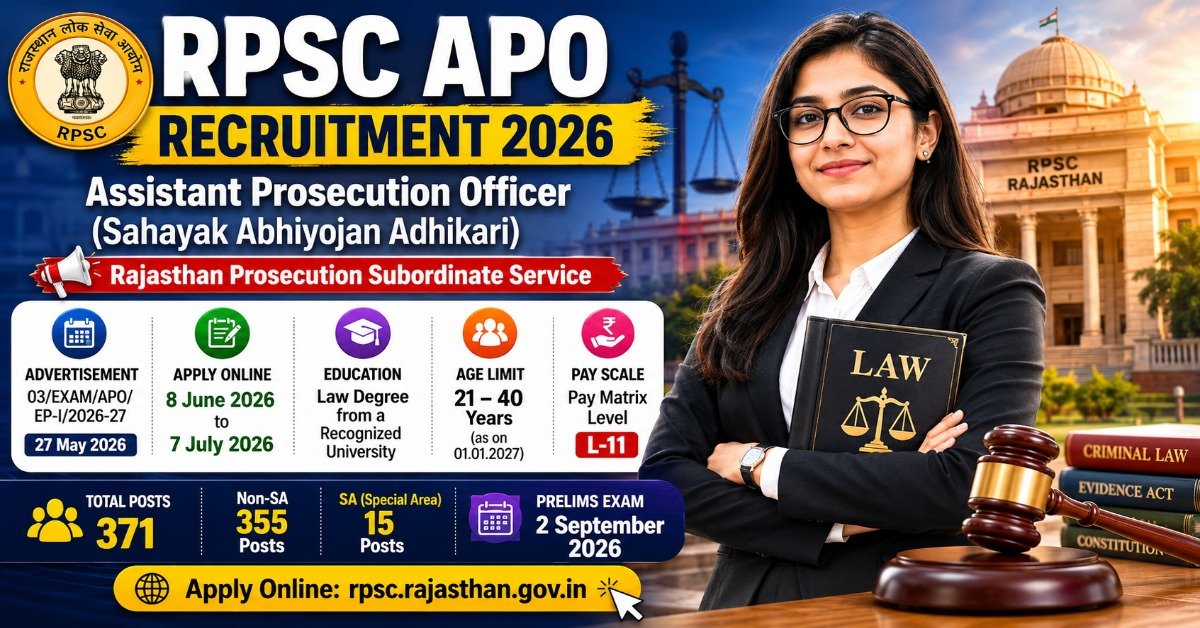
The Rajasthan Public Service Commission (RPSC), Ajmer has released Advertisement No. 03/EXAM/APO/EP-I/2026-27 dated 27 May 2026 for the recruitment of 371 posts of Assistant Prosecution Officer (APO) — known in Hindi as Sahayak Abhiyojan Adhikari — under the Rajasthan Prosecution Subordinate Service, 1978 in the Home Department (Prosecution), Government of Rajasthan. This is a prestigious state government legal post requiring a Law degree. Vacancies are split into Non-Scheduled Area (355 posts) and Scheduled Area (15 posts) plus 1 additional post. Online applications are open from 8 June to 7 July 2026 (midnight) at rpsc.rajasthan.gov.in via the SSO Portal. The Preliminary Examination is officially confirmed for 2 September 2026. Selection involves Prelims (objective, qualifying) followed by Mains (written, 400 marks). Pay Matrix Level L-11 (Grade Pay ₹4,200).
Quick Facts
| Field | Details |
|---|---|
| Total Posts | 371 (Non-SA: 355, SA: 15, +1 additional) |
| Advertisement No. | 03/EXAM/APO/EP-I/2026-27 |
| Application Window | 8 June – 7 July 2026 |
| Prelims Date | 2 September 2026 (confirmed) |
| Age Limit | 21–40 years (as on 01.01.2027) |
| Pay Level | Level L-11, Grade Pay ₹4,200 |
| Qualification | Law Degree (LLB/Integrated Law) |
| Fee | ₹600 (Gen) | ₹400 (SC/ST/OBC-NCL/PwD) |
1. Recruitment Overview
| Particulars | Details |
|---|---|
| Conducting Body | Rajasthan Public Service Commission (RPSC), Ajmer |
| Advertisement No. | 03/EXAM/APO/EP-I/2026-27 |
| Notification Date | 27 May 2026 |
| Post Name (English) | Assistant Prosecution Officer (APO) |
| Post Name (Hindi) | Sahayak Abhiyojan Adhikari (सहायक अभियोजन अधिकारी) |
| Department | Home Department (Prosecution), Government of Rajasthan |
| Service | Rajasthan Prosecution Subordinate Service, 1978, read with Rajasthan Prosecution Subordinate Service Rules, 2014 (as amended) |
| Total Vacancies | 371 posts — Non-Scheduled Area (Non-SA): 355 | Scheduled Area (SA): 15 | Additional: 1 |
| Nature of Post | Permanent State Government post — Group B/C level |
| Application Opens | 8 June 2026 |
| Application Closes | 7 July 2026 (up to 12:00 Midnight) |
| Application Mode | Online only — via SSO Portal (sso.rajasthan.gov.in) linked to rpsc.rajasthan.gov.in |
| Application Fee | ₹600 (General, BC/EBC Creamy Layer, Other State) | ₹400 (SC/ST/OBC-NCL/EBC-NCL/PwD of Rajasthan) |
| Minimum Qualification | Degree in Law (Professional) or Integrated Law Course from a recognised University + Hindi (Devnagri Script) knowledge + Rajasthani dialects knowledge |
| Age Limit | 21 to 40 years as on 01 January 2027 (born between 02.01.1987 and 01.01.2006) |
| Selection Process | Preliminary Examination (Objective, Qualifying) → Main Examination (Written, 400 marks) → Merit List |
| Prelims Exam Date | 2 September 2026 (officially confirmed) |
| Prelims Pattern | Objective type — 70% Law subjects + 30% Hindi/English language — qualifying in nature |
| Mains Pattern | Law Paper (300 marks) + Language Paper — General Hindi (50 marks) + General English (50 marks) = Total 400 marks |
| Pay Scale | Pay Matrix Level L-11 | Grade Pay ₹4,200 | Fixed Pay during initial period as per Rajasthan Govt. rules |
| Official Website | rpsc.rajasthan.gov.in | Apply via: sso.rajasthan.gov.in |
2. Important Dates
| Event | Date |
|---|---|
| Official Notification Released — Advt. No. 03/EXAM/APO/EP-I/2026-27 | 27 May 2026 |
| Online Application Window Opens — via SSO Portal | 8 June 2026 |
| Last Date to Submit Online Application (12:00 Midnight) | 7 July 2026 |
| Admit Card for Preliminary Examination | ~Late August 2026 (typically 7–10 days before the exam) |
| Preliminary Written Examination — Objective Type (Qualifying) | 2 September 2026 |
| Main Written Examination — 400 Marks (Merit-Deciding) | To be announced, after Prelims |
| Final Merit List & Appointment to Prosecution Department, Rajasthan | After Mains Result |
Note: Do not change your mobile number or email ID after submitting the application — all exam communications (admit card, result, interview) are sent only to the registered contact details.
3. Category-wise Vacancy Breakdown
| Category | Non-SA Posts | SA Posts | Additional | Total |
|---|---|---|---|---|
| General (UR) — Unreserved | ~143 | — | — | ~143 |
| OBC (Non-Creamy Layer, Rajasthan) | ~76 | — | — | ~76 |
| MBC (Most Backward Class, Rajasthan) | ~14 | — | — | ~14 |
| EBC (Economically Backward Class, Rajasthan) | ~36 | — | — | ~36 |
| SC (Scheduled Caste, Rajasthan) | ~54 | — | — | ~54 |
| ST (Scheduled Tribe, Rajasthan) | ~32 | 15 | — | ~47 |
| EWS (Economically Weaker Sections, Rajasthan) | — | — | 1 | ~1 |
| Total (Approximate) | 355 | 15 | 1 | 371 |
Note: Category-wise distribution for sub-division is as per Rajasthan Government reservation policy. The exact breakdown is in the official notification PDF. All reservations are exclusively for Rajasthan domicile candidates under the applicable categories. Out-of-state candidates apply only in the General (UR) category.
Non-SA vs SA — what does it mean? Non-SA (Non-Scheduled Area) posts are for general postings across non-tribal districts of Rajasthan. SA (Scheduled Area) posts are specifically designated for the Scheduled Tribal Areas — primarily Banswara, Dungarpur, and notified parts of other districts under the Fifth Schedule of the Indian Constitution. SA posts have specific domicile and working conditions. Candidates must carefully select the correct category (SA or Non-SA) at the time of application based on their preference and eligibility, and should verify the exact SA district notification from the official PDF.
4. Eligibility Criteria
| Criterion | Details |
|---|---|
| Nationality | Indian Citizen — domicile of Rajasthan required for reserved category benefits |
| Educational Qualification | Degree in Law (Professional) — LLB (3-year or 5-year integrated BA LLB/B.Com LLB/B.Sc LLB/BBA LLB) from a University established by law in India. Integrated law courses (5-year) also eligible. Degree must be from a Bar Council of India-approved institution |
| Language Requirement 1 — Hindi | Working knowledge of Hindi written in Devnagri Script — tested in both Prelims (language section) and Mains (General Hindi paper) |
| Language Requirement 2 — Rajasthani | Knowledge of Rajasthani dialects (Rajasthani Boli/Lokbhasha) and social customs of Rajasthan |
| Minimum Age | 21 years as on 01 January 2027 |
| Maximum Age (General) | 40 years as on 01 January 2027 (born not earlier than 02.01.1987) |
| Date of Birth Range | Born between 02 January 1987 and 01 January 2006 (both dates inclusive) |
Age Relaxation — Rajasthan Government Norms
| Category | Age Relaxation | Maximum Age |
|---|---|---|
| SC/ST/OBC/MBC/EBC/EWS — Male candidates of Rajasthan | +5 years | 45 years |
| General (Unreserved) — Women candidates | +5 years | 45 years |
| SC/ST/OBC/MBC/EBC/EWS — Women candidates of Rajasthan | +10 years | 50 years |
| PwD (Persons with Disabilities) | +10 years (additional on category relaxation) | As per Rajasthan Govt. rules |
| Ex-Servicemen/Widows/Divorcees (Rajasthan) | As per Rajasthan Government rules | Check official notification |
Note: Age relaxations apply only to permanent residents/domicile of Rajasthan for the applicable reserved categories. Out-of-state candidates are treated as General (UR) regardless of their category in their home state.
Critical eligibility conditions:
- A BCI-approved Law degree is mandatory — degrees from unrecognised or distance-mode law programmes not approved by BCI are not eligible
- Final-year LLB students may apply conditionally — the degree must be awarded and result declared before document verification. Appearing students who have not received their degree by DV are disqualified
- Rajasthan domicile is required for category benefits — OBC, SC, ST, MBC, EBC, EWS certificates from Rajasthan state authorities in the prescribed format and current validity are required. Certificates from other states are not accepted for reservation or age relaxation
- Knowledge of Rajasthani dialects (Marwari, Dhundhari, Mewari, Harauti, etc.) and social customs is a declared eligibility requirement, though not formally tested as a standalone exam
5. Application Fee
| Category | Fee |
|---|---|
| General/Unreserved | ₹600 |
| BC (Backward Class) — Creamy Layer, Rajasthan | ₹600 |
| EBC (Economically Backward Class) — Creamy Layer | ₹600 |
| Candidates from Other States (non-Rajasthan) | ₹600 |
| SC/ST (Rajasthan domicile) | ₹400 |
| OBC/EBC (Non-Creamy Layer, Rajasthan)/PwD (Rajasthan) | ₹400 |
Payment is online through the SSO Portal (sso.rajasthan.gov.in) via Net Banking, Debit Card, Credit Card, or UPI. Note: The fee is non-refundable once paid. Verify your category before fee payment — wrong category selection leads to financial loss with no refund. EWS candidates of Rajasthan should check the notification for the applicable fee.
6. Pay Scale & Salary Structure
Pay Matrix Level L-11 — ₹37,800 – ₹1,20,000/Month Basic
Grade Pay ₹4,200 | Gross incl. DA, HRA, and other allowances: approximately ₹55,000–₹70,000+ at entry
| Pay Component | Details |
|---|---|
| Pay Matrix Level | Level L-11 under Rajasthan Government 7th Pay Commission Pay Matrix |
| Grade Pay | ₹4,200 per month |
| Starting Basic Pay | Approximately ₹37,800 per month at the lowest cell of Level L-11 |
| Initial Period — Fix Pay | A Fixed Monthly Pay is applicable during the initial period of service as per Rajasthan Government rules, typically lower than the full pay scale until probation is cleared |
| Dearness Allowance (DA) | Paid as per Rajasthan Government DA rates — revised periodically |
| House Rent Allowance (HRA) | Based on posting city/town classification under Rajasthan Government HRA norms |
| Approximate Gross Monthly (Entry Level) | ₹55,000 – ₹70,000+ per month including DA, HRA, and other allowances post-probation confirmation |
| Pension | Old Pension Scheme (OPS) for eligible candidates (Rajasthan restored OPS)/NPS depending on appointment date and applicable rules |
| Job Nature | Permanent state government post — high job security, annual increments, promotion pathways within the Prosecution Department |
| Career Growth | APO can be promoted to Prosecution Officer (PO) and Senior Prosecution Officer (SPO) based on seniority and departmental evaluation, leading ultimately to Deputy Director of Prosecution and above |
7. Exam Pattern — Prelims & Mains
Prelims is qualifying — Mains decides your rank: The RPSC APO Preliminary Examination is a qualifying/screening round — its marks are not counted in the final merit list. Its only purpose is to shortlist candidates for the Main Examination. The final merit list and appointment is based entirely on Mains marks (400 marks). Strategy implication: score enough in Prelims to clear category-wise cut-offs, but dedicate primary preparation effort to the substantive Law and Language papers in Mains.
Stage 1 — Preliminary Examination (Objective — Qualifying) — 2 September 2026
| Component | Weightage | Topics |
|---|---|---|
| Law Subjects | 70% | Indian Penal Code; Criminal Procedure Code; Indian Evidence Act; Constitution of India; POCSO Act; SC/ST (Prevention of Atrocities) Act; NDPS Act; Arms Act; Juvenile Justice Act; Motor Vehicles Act; Rajasthan-specific criminal laws; legal principles relevant to prosecution |
| Hindi Language Proficiency | Part of 30% | Hindi grammar, vocabulary, comprehension, Hindi essay writing, Devnagri script proficiency, formal Hindi used in legal and official contexts |
| English Language Proficiency | Part of 30% | English grammar, vocabulary, reading comprehension, sentence construction, legal English usage |
Note: Prelims marks are not counted in final merit — it is only a qualification/elimination round. Negative marking applies as per RPSC norms. The exam is bilingual (Hindi and English). Total questions, total marks, and exact duration are confirmed in the official notification PDF.
Stage 2 — Main Written Examination (Merit-Deciding) — Date TBA
| Paper | Marks | Type | Key Coverage |
|---|---|---|---|
| Law Paper | 300 | Descriptive/MCQ (confirm from notification) | IPC, CrPC, Indian Evidence Act, Constitution, POCSO, SC/ST Act, NDPS, Arms Act, JJ Act, MVA, Rajasthan police and criminal law statutes, legal reasoning, case analysis, prosecution law principles |
| General Hindi | 50 | Written (Descriptive) | Hindi grammar; formal letter writing; précis writing; vocabulary; translation (English to Hindi); Rajasthani Hindi dialect awareness |
| General English | 50 | Written (Descriptive) | English grammar and composition; reading comprehension; formal letter/report writing; legal English terminology; vocabulary |
| Total — Mains | 400 | Written Exam | Final selection rank is based on Mains marks only — no interview mentioned in the 2026 notification |
Note: Main Examination is the merit-deciding stage. The final merit list is drawn from Mains marks within each category. Minimum qualifying marks in each paper may apply — check the official notification PDF for exact cut-off requirements. The Law Paper carries 75% of total Mains marks and is the decisive differentiator.
8. Detailed Syllabus — Law Paper Topics
| Law Subject | Key Topics |
|---|---|
| Indian Penal Code, 1860 (IPC) | General exceptions; offences against the state; offences relating to body (hurt, grievous hurt, kidnapping, abduction, murder, culpable homicide, rape); property offences (theft, extortion, dacoity, robbery, cheating, criminal breach of trust); defamation; criminal conspiracy; abetment |
| Code of Criminal Procedure, 1973 (CrPC) | Classes of criminal courts; powers of courts; FIR and investigation; arrest; bail and anticipatory bail; search and seizure; charge; trial procedures (summons trial, warrant trial, summary trial); appeals and revisions; compounding of offences; sentences; compensation |
| Indian Evidence Act, 1872 | Relevancy of facts; admissions; confessions; statements by persons who cannot be called as witnesses; documentary evidence; public and private documents; oral evidence; burden of proof; estoppel; examination of witnesses; privileged communications |
| Constitution of India | Fundamental Rights and their limitations; DPSPs; Emergency provisions; Panchayati Raj; criminal justice provisions (Articles 20, 21, 22); anti-defection law; Scheduled Areas provisions |
| POCSO Act, 2012 | Definitions; offences under POCSO; special courts; recording of evidence; obligations of media and reporting |
| SC/ST (Prevention of Atrocities) Act, 1989 | Offences under the Act; special courts; investigation; presumptions; relief and rehabilitation |
| NDPS Act, 1985 | Definitions; prohibitions; offences and punishments; investigation; bail provisions under NDPS; special courts |
| Arms Act, 1959 | Provisions for arms licences; offences; exceptions; punishment provisions |
| Juvenile Justice Act, 2015 | Definitions; Juvenile Justice Board; Child Welfare Committees; procedures for juveniles in conflict with law |
| Motor Vehicles Act, 1988 | Offences relating to motor vehicles; accident claims; compounding; prosecution provisions |
| Rajasthan-Specific Criminal Laws | Rajasthan Police Act; Rajasthan Public Safety Act; Rajasthan Prevention of Gambling Act; Excise Act provisions relevant to prosecution; State amendments to IPC/CrPC; Rajasthan Tenancy and Land Revenue provisions (criminal aspects) |
Note: The official RPSC APO Syllabus PDF is available at rpsc.rajasthan.gov.in and should be treated as the comprehensive and authoritative topic list — the above is a synthesis based on the standard RPSC APO exam pattern.
9. Complete Selection Process
| Stage | Description |
|---|---|
| 1. Preliminary Written Examination (Qualifying) — 2 September 2026 | Objective-type test on Law subjects (70% weightage) and Hindi/English language proficiency (30% weightage). Purely a screening test — marks do not contribute to final merit. Candidates must clear both sectional and overall category-wise cut-offs. Negative marking applies. Shortlisting ratio for Mains is determined by RPSC, typically a multiple of vacancies |
| 2. Main Written Examination (Merit-Deciding) | Two papers totalling 400 marks: Law Paper (300 marks) covering major criminal laws and Rajasthan-specific statutes; Language Paper — General Hindi (50 marks) and General English (50 marks). The final merit list is prepared based entirely on Mains performance within each category. Candidates not clearing minimum qualifying marks in any paper are eliminated |
| 3. Document Verification | Candidates shortlisted on the category-wise Mains merit list are called for DV. Original certificates must be produced — LLB degree and marksheets, Class 10 certificate (for DOB), Rajasthan domicile/residence certificate, category certificates (in prescribed state format), Bar Council enrolment (if any), Aadhaar card, PAN card, and recent photographs. Any discrepancy leads to immediate disqualification |
| 4. Final Appointment | Candidates who clear DV receive appointment orders for posting as Assistant Prosecution Officers across various districts of Rajasthan under the Home Department (Prosecution). Fixed Pay applies during the initial probation period; after satisfactory completion, the full Pay Matrix Level L-11 scale applies. Posting location is transferable across Rajasthan |
10. Job Profile — What Does an APO Do?
An Assistant Prosecution Officer (APO) in Rajasthan is a state government legal officer posted under the Home Department (Prosecution). The primary role is to appear on behalf of the State Government in criminal courts — representing the prosecution in cases filed by the Rajasthan Police and other investigative agencies. The APO’s daily work involves preparing the state’s case for trial, examining and cross-examining witnesses, making legal arguments before Magistrate and Sessions Courts, preparing criminal appeals, and reviewing charge-sheets. This is a demanding, intellectually stimulating legal role that gives officers hands-on courtroom exposure across a wide range of criminal justice scenarios.
| Aspect | Details |
|---|---|
| Primary Responsibility | Conducting prosecution of criminal cases in Magistrate Courts, Sessions Courts, and Special Courts across districts of Rajasthan on behalf of the State Government |
| Typical Daily Work | Reviewing police charge-sheets; preparing briefs; examining witnesses; cross-examining defence witnesses; making submissions before judges; preparing bail opposition arguments; filing criminal revision petitions |
| Courts Attended | Judicial Magistrate Courts, Chief Judicial Magistrate (CJM) Courts, Sessions Courts, Special Courts (POCSO, NDPS, SC/ST Atrocities), and other notified courts in the posting district |
| Posting Location | Various districts of Rajasthan — postings are transferable as per Prosecution Department transfer policy; SA postings involve tribal district courts |
| Department | Home Department (Prosecution), Government of Rajasthan — administrative control vested with the Director of Prosecution, Rajasthan |
| Career Progression | APO → Prosecution Officer (PO) → Senior Prosecution Officer (SPO) → Deputy Director of Prosecution → Director of Prosecution, based on seniority and departmental assessments |
| Why This Post Stands Out | One of the few government positions that offers a law graduate immediate courtroom exposure from day one — unlike private practice, where juniors often take years to get independent court work. Strong job security, government pension, and a defined career ladder within the prosecution hierarchy |
11. How to Apply Online — Step by Step
| Step | Description |
|---|---|
| 1. Create or Log In to Your SSO Account | Visit sso.rajasthan.gov.in. Register using Aadhaar Card, Bhamashah Card, Facebook, or Gmail credentials if you don’t have an SSO account, or log in with your existing ID and password |
| 2. Find the RPSC APO Recruitment 2026 Application | Navigate to RPSC Citizen Services or rpsc.rajasthan.gov.in → Recruitment Advertisements. Find Advertisement No. 03/EXAM/APO/EP-I/2026-27, download and read the official notification PDF fully, then click the Application Form link |
| 3. Fill Application Form | Enter personal details, category (General/OBC/SC/ST/EWS/MBC/EBC — Rajasthan), sub-category (Non-SA or SA), educational qualification (LLB/Integrated Law — university, year, percentage), and Hindi/language knowledge declaration. Enter active contact details and do not change them after submission |
| 4. Upload Photograph and Signature | Upload a recent passport-size colour photograph (JPEG, light background, face visible) and a handwritten signature in black ink on white paper (JPEG format), both meeting prescribed size requirements. Avoid photographs older than 6 months or with sunglasses/coloured backgrounds |
| 5. Pay Application Fee and Submit | Pay ₹600 (General/BC-CL/Other State) or ₹400 (SC/ST/OBC-NCL/PwD of Rajasthan) online via Net Banking, Debit Card, Credit Card, or UPI, then submit the final application form. Download and print the application confirmation/submission receipt with your Roll Number/Registration Number |
Quick reference: Apply only via SSO Portal (sso.rajasthan.gov.in) | Select Non-SA or SA carefully | Deadline: 7 July 2026, 12:00 Midnight | Do not change mobile/email after submission | Print the application receipt after payment
12. Frequently Asked Questions
1. How many vacancies are there in RPSC APO Recruitment 2026?
RPSC has announced 371 vacancies for the post of Assistant Prosecution Officer (Sahayak Abhiyojan Adhikari) under Advertisement No. 03/EXAM/APO/EP-I/2026-27 dated 27 May 2026. The breakdown is 355 posts for Non-Scheduled Area (Non-SA) and 15 posts for Scheduled Area (SA), plus 1 additional post. These are under the Rajasthan Prosecution Subordinate Service, 1978 in the Home Department (Prosecution), Government of Rajasthan.
2. What is the RPSC APO Prelims exam date for 2026?
The RPSC APO Preliminary Written Examination 2026 is officially confirmed for 2 September 2026 — this date was announced alongside the recruitment notification. Admit cards will be released approximately 7–10 days before the exam and downloadable from rpsc.rajasthan.gov.in using the Registration Number. All exam-related communications will be sent to the registered mobile and email.
3. Is the Preliminary Examination marks counted in the final merit for RPSC APO 2026?
No. The Preliminary Examination is qualifying in nature only — its marks are not added to the final merit list. Its sole purpose is to screen candidates for the Main Examination. The final merit list is based entirely on Mains Examination performance — Law Paper (300 marks) + General Hindi (50 marks) + General English (50 marks) = 400 marks total. Candidates should clear Prelims comfortably but invest their primary preparation energy in the Mains syllabus.
4. What law qualification is required for RPSC APO 2026?
Candidates must hold a Degree in Law (Professional) — this includes a 3-year LLB (after graduation) or a 5-year Integrated Law Course (BA LLB, B.Com LLB, B.Sc LLB, BBA LLB, etc.) from a University established by law in India and recognised by the Bar Council of India. The degree must be from a BCI-approved institution — distance-mode law programmes not approved by BCI are not eligible. Additionally, candidates must have working knowledge of Hindi (Devnagri Script) and knowledge of Rajasthani dialects and social customs.
5. What is the application fee for RPSC APO 2026?
The application fee is ₹600 for General, BC (Creamy Layer), EBC (Creamy Layer), and candidates from other states, and ₹400 for SC, ST, OBC (Non-Creamy Layer), EBC (Non-Creamy Layer), and PwD candidates of Rajasthan. Payment is made online through the SSO Portal via Net Banking, Debit Card, Credit Card, or UPI. The fee is non-refundable once paid — verify your category before paying.
6. What is the salary for RPSC APO 2026?
Selected candidates will be placed at Pay Matrix Level L-11 with Grade Pay ₹4,200 under the Rajasthan Government’s 7th CPC-aligned Pay Matrix. The starting basic pay at Level L-11 is approximately ₹37,800 per month. During the initial probation period, a Fixed Pay is applicable as per Rajasthan Government rules. After probation confirmation, gross monthly salary including DA, HRA, and other allowances is approximately ₹55,000 to ₹70,000+ per month at entry level. Rajasthan Government has restored the Old Pension Scheme (OPS) for government employees, and APO appointments may be covered under OPS depending on the date of appointment and applicable rules.
7. What is the difference between SA and Non-SA posts in RPSC APO 2026?
Non-SA (Non-Scheduled Area) posts are general posts spread across the regular (non-tribal) districts of Rajasthan — 355 posts. SA (Scheduled Area) posts are specifically for service in the Scheduled Tribal Areas of Rajasthan — primarily Banswara, Dungarpur, Pratapgarh, and parts of other districts designated under the Fifth Schedule to the Constitution — 15 posts. SA postings carry specific conditions and may involve enhanced understanding of tribal law, customs, and local issues. Candidates must select SA or Non-SA at the application stage, which affects which vacancy pool they compete in.
8. Can a final-year LLB student apply for RPSC APO 2026?
Yes, with a condition. Final-year LLB students can apply and appear in the Preliminary Examination. However, the Law degree must be awarded before the time of Document Verification — candidates whose results are not declared or who have not received their degree by DV stage are disqualified. Given that Prelims is in September 2026 and Mains will follow, final-year 2026 students who complete their degree by early 2027 should be eligible by DV time, but candidates should verify the exact cut-off date from the official notification.
9. What are the major law subjects to prepare for the RPSC APO 2026 Mains exam?
The RPSC APO Law Paper (300 marks in Mains) covers Indian Penal Code (IPC), Code of Criminal Procedure (CrPC), and Indian Evidence Act as the core backbone, together accounting for the majority of questions. Additionally: Constitution of India (criminal justice provisions, fundamental rights), POCSO Act, SC/ST Atrocities Act, NDPS Act, Arms Act, Juvenile Justice Act, Motor Vehicles Act, and Rajasthan-specific criminal legislation. Candidates should obtain the official syllabus PDF from rpsc.rajasthan.gov.in for the authoritative and complete topic list.



Leave a Comment