
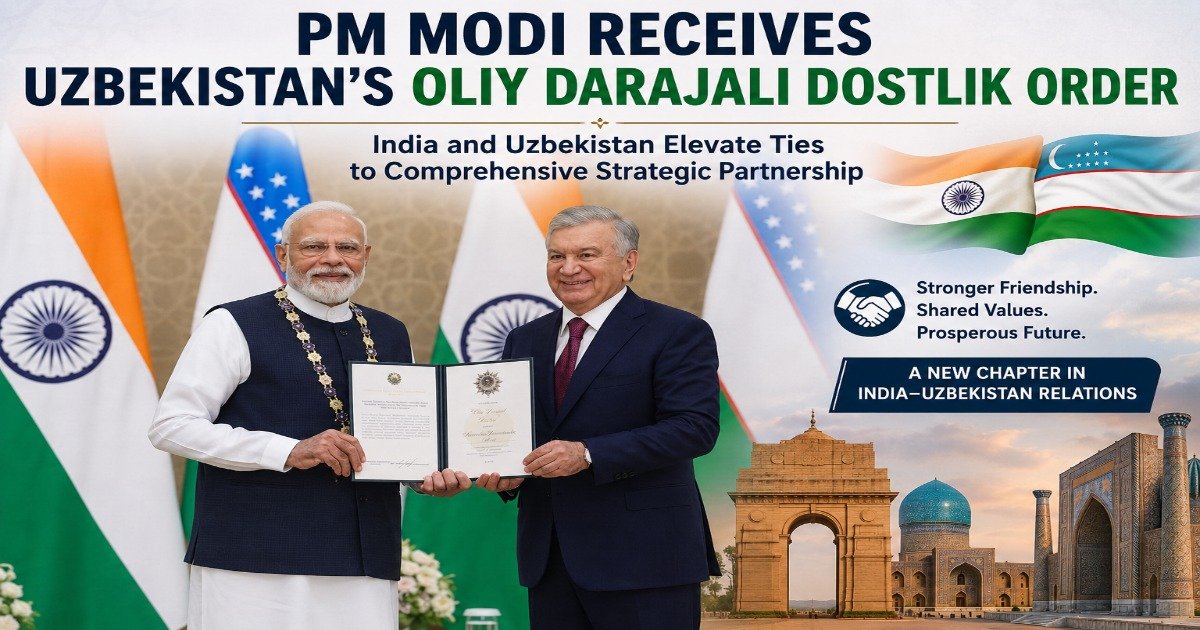
Prime Minister Narendra Modi has received Uzbekistan’s highest honour for foreign leaders. The award — the “Oliy Darajali Do’stlik” Order — was conferred on him by Uzbek President Shavkat Mirziyoyev at the Kuksaroy Presidential Palace in Tashkent on Sunday, August 30, 2026.
Modi dedicated the honour to the 1.4 billion people of India. He described it as a symbol of the enduring friendship between two great civilisations.
The award came during Modi’s two-day state visit to Uzbekistan. The visit was historic. India and Uzbekistan elevated their bilateral ties to a Comprehensive Strategic Partnership — a major diplomatic upgrade. The two countries also set a bold trade target of USD 5 billion by 2030.
What Is the Oliy Darajali Do’stlik Order?
The name “Oliy Darajali Do’stlik” is an Uzbek phrase. In English, it means “Order of Highest Friendship”. It is Uzbekistan’s highest state honour for foreign leaders and heads of government.
The award is reserved for individuals who have made exceptional contributions to:
- Promoting peace and stability in the region
- Strengthening friendship and cooperation with Uzbekistan
- Advancing mutual respect between nations and civilisations
The Ministry of External Affairs of India confirmed that the honour was conferred on Prime Minister Modi in recognition of his contribution to strengthening the friendship between India and Uzbekistan.
Only leaders of the highest stature receive this distinction. By conferring the Oliy Darajali Do’stlik Order on Modi, Uzbekistan sent a clear message — India is its most valued partner in South Asia.
Modi’s Emotional Response — “Dostlik Means Friendship”
Prime Minister Modi’s acceptance speech in Tashkent was warm, personal, and deeply rooted in cultural connection.
He said receiving the award was a matter of great pride — not for himself alone, but for every Indian citizen. He dedicated the honour to the 1.4 billion people of India.
Modi drew a beautiful linguistic connection between India and Uzbekistan. He pointed out that the word “Dostlik” in the award’s name is deeply familiar to every Indian. He said there is hardly a family in India where the word “Dostlik” is not spoken a hundred times a day. “Dostlik means friendship,” he said. “The word itself beautifully expresses the sentiment at the heart of the relationship between India and Uzbekistan.”
In a social media post on X (formerly Twitter), Modi wrote:
“Honoured to receive the ‘Oliy Darajali Do’stlik’ Order. I dedicate this to the enduring bond between India and Uzbekistan.”
Modi also said the honour brings greater responsibility for India to work together with Uzbekistan as Global South partners — for the betterment of humanity.
May the India-Uzbekistan friendship flourish!
— Narendra Modi (@narendramodi) August 30, 2026
May our bilateral partnership progress across sectors and may our people be prosperous.@president_uz https://t.co/UTGB8xJ2zm pic.twitter.com/grVQiJcS4w
The Ceremony — Kuksaroy Presidential Palace, Tashkent
The award ceremony took place at the Kuksaroy Presidential Palace — Uzbekistan’s official seat of the presidency — in Tashkent, the capital of Uzbekistan.
President Shavkat Mirziyoyev personally presented the honour to Prime Minister Modi. The ceremony was a part of the broader diplomatic engagement during Modi’s state visit to Uzbekistan on August 29 and 30, 2026.
Modi received a grand welcome in Tashkent. The streets of the Uzbek capital were adorned with the flags of both nations. Uzbek President Mirziyoyev received Modi at the airport — and in a rare gesture of personal warmth — the two leaders travelled together by car from the airport to the presidential palace.
Modi also paid floral tribute to former Prime Minister Lal Bahadur Shastri at the Shastri Memorial in Tashkent — a meaningful act, as Shastri passed away in Tashkent in January 1966 after signing the historic Tashkent Declaration with Pakistan.
This Was Modi’s Fourth Visit to Uzbekistan
The talks at the Kuksaroy Presidential Palace on August 30, 2026 marked Prime Minister Modi’s fourth visit to Uzbekistan. The visit also came at a significant moment — as the two countries marked 15 years of their existing Strategic Partnership.
India and Uzbekistan established diplomatic relations on March 18, 1992 — when a protocol establishing diplomatic ties was signed in Tashkent. India was among the first countries to recognise Uzbekistan’s sovereignty following its independence from the Soviet Union.
The two countries elevated their relationship to a Strategic Partnership in 2011. Now, in 2026, that partnership has been further elevated to a Comprehensive Strategic Partnership — reflecting the growing depth and expanding scope of cooperation.
India and Uzbekistan Elevate Ties — Key Outcomes of the Visit
The award ceremony was just one highlight of a packed diplomatic agenda. The Modi-Mirziyoyev talks produced a sweeping range of agreements and decisions across multiple sectors. A total of 16 outcomes were announced from the state visit.
Here are the key outcomes:
1. Elevation to Comprehensive Strategic Partnership
India and Uzbekistan officially elevated their bilateral relationship from a Strategic Partnership to a Comprehensive Strategic Partnership. This is the highest level of bilateral engagement India accords to a foreign nation. It reflects a long-term commitment to deepened cooperation across every major sector.
2. Trade Target of USD 5 Billion by 2030
The two leaders set an ambitious target of raising bilateral trade to USD 5 billion by 2030. The current volume of bilateral trade between India and Uzbekistan is over USD 1 billion. This means a five-fold increase is targeted over four years. The roadmap includes improving market access, building better connectivity, and developing banking and payment channels between the two countries.
A bilateral business summit was also planned. The two sides agreed to work on removing non-tariff barriers to trade and to strengthen links between Invest India and Uzbekistan’s investment promotion agency.
3. Uranium Supply Framework
One of the most strategically significant outcomes of the visit was the agreement to establish a framework for the long-term supply of uranium from Uzbekistan to India. This agreement was reached in line with cooperation in the civil-nuclear energy sector.
Uzbekistan is one of the world’s top uranium producers. India has an ambitious civil-nuclear energy programme. A long-term uranium supply arrangement strengthens India’s energy security in a meaningful way. It also adds a new strategic dimension to the India-Uzbekistan bilateral relationship.
4. Visa-Free Regime for Indian Citizens
Uzbekistan announced a 30-day visa-free regime for Indian citizens. This move is aimed at boosting tourism, business travel, and people-to-people exchanges between the two countries. It is a significant practical step that will benefit thousands of Indian travellers, students, and business professionals.
5. Digital Public Infrastructure — UPI in Uzbekistan
The two sides agreed to expand cooperation in Digital Public Infrastructure (DPI). This includes the potential extension of India’s Unified Payments Interface (UPI) system to Uzbekistan — building on the success of India’s digital financial infrastructure model.
6. Critical Minerals and Clean Energy
India and Uzbekistan identified critical minerals as a new and important area of bilateral cooperation. Both countries agreed to deepen engagement in energy — including clean energy — and to explore greater collaboration in mining and minerals.
7. Defence and Security Cooperation
Defence cooperation was strengthened. The two sides agreed to expand their institutional engagement in the areas of defence and security — recognising the importance of a stable Central Asia for India’s strategic interests.
8. Education and Cultural Ties
The visit produced several landmark decisions on education and culture:
- A Cultural Exchange Programme for 2026–2030 was signed
- New Lal Bahadur Shastri scholarships for Hindi learning were announced in Uzbekistan
- An ICCR Sanskrit chair was established at Tashkent State University of Oriental Studies
- More than 2,700 Uzbek nationals have been trained under India’s ITEC (Indian Technical and Economic Cooperation) programme
- More than 400 Uzbek students have received ICCR scholarships, including under AYUSH programmes
9. Agreements Across Key Sectors
The two sides witnessed the exchange of formal agreements covering:
- Mining and critical minerals
- Culture and education
- Tourism
- Ayurveda and traditional medicine
- Agriculture and pharmaceuticals
- Space cooperation
- Artificial Intelligence (AI)
10. Institutional Strengthening
A Foreign Ministers-led mechanism was established to track and oversee the implementation of bilateral decisions. The two sides also agreed to raise the Inter-Governmental Commission to a ministerial level — giving bilateral cooperation a more powerful institutional engine.
Why This Visit Matters — India’s Central Asia Strategy
Uzbekistan is not just any bilateral partner for India. It is the most populous country in Central Asia and sits at its geographic heart. PM Modi said it plainly during the visit: “Uzbekistan is at the heart of Central Asia and is at the heart of India’s engagement in the region.”
India’s Connect Central Asia Policy, announced in 2012, makes engagement with Uzbekistan a strategic priority. India sees Central Asia as a region of growing importance — for energy, trade, connectivity, and geopolitical balance.
This visit — with its wide-ranging agreements on uranium, critical minerals, digital cooperation, and trade — positions India as Uzbekistan’s most comprehensive and trusted partner in South Asia.
It also comes at a moment when Central Asia is seeing increasing economic engagement from China and Russia. India’s deepened ties with Uzbekistan reinforce New Delhi’s commitment to being a serious player in the region.
PM Modi’s Growing List of International Honours
The Oliy Darajali Do’stlik Order adds to what is already an extraordinary list of state and civilian awards conferred on Prime Minister Modi by close to three dozen countries. This reflects the global recognition of his leadership and his personal contribution to advancing India’s bilateral relationships across the world.
Each of these awards reflects not just personal recognition but a diplomatic signal — that the awarding country values its partnership with India and sees PM Modi as a transformative figure in India-centric global diplomacy.
After Uzbekistan — PM Modi Heads to SCO Summit in Kyrgyzstan
Immediately after concluding his two-day state visit to Uzbekistan, Prime Minister Modi departed for Bishkek, Kyrgyzstan. He was invited there by Kyrgyzstan President Sadyr Zhaparov to attend the 26th Shanghai Cooperation Organisation (SCO) Summit, scheduled from August 31 to September 1, 2026.
The SCO Summit in Bishkek marks 25 years of the grouping. India became a full member of the SCO in 2017. The summit focuses on regional security, connectivity, and economic cooperation among member states.
Modi’s back-to-back engagement — Tashkent followed by Bishkek — underscores India’s active and deepening presence in Central Asia’s diplomatic and security architecture.
India-Uzbekistan Relations — A Quick Timeline
| Year | Milestone |
|---|---|
| 1991 | Uzbekistan gains independence from the Soviet Union |
| 1992 | India and Uzbekistan establish diplomatic relations (March 18) |
| 2011 | India and Uzbekistan elevate ties to Strategic Partnership |
| 2017 | India joins SCO as full member |
| 2022 | First India-Central Asia Summit held (January) |
| 2024 | Bilateral trade crosses USD 1 billion mark |
| 2026 | India and Uzbekistan elevate ties to Comprehensive Strategic Partnership |
| 2026 | PM Modi receives Oliy Darajali Do’stlik Order |
| 2026 | Uzbekistan grants 30-day visa-free entry to Indians |
| 2030 | Target: Bilateral trade of USD 5 billion |
Key Facts at a Glance
| Parameter | Details |
|---|---|
| Award Name | Oliy Darajali Do’stlik Order (Order of Highest Friendship) |
| Awarded By | President Shavkat Mirziyoyev of Uzbekistan |
| Awarded To | Prime Minister Narendra Modi |
| Date | August 30, 2026 |
| Location | Kuksaroy Presidential Palace, Tashkent, Uzbekistan |
| Reason for Award | Contribution to strengthening India-Uzbekistan friendship |
| Visit Type | Two-Day State Visit (August 29–30, 2026) |
| Modi’s Visit Count | Fourth visit to Uzbekistan |
| Key Upgrade | Ties elevated to Comprehensive Strategic Partnership |
| Trade Target | USD 5 billion by 2030 (from current USD 1 billion+) |
| Uranium Agreement | Long-term uranium supply framework signed |
| Visa Decision | 30-day visa-free regime for Indian citizens |
| Total Outcomes | 16 bilateral outcomes announced |
| Next Destination | Bishkek, Kyrgyzstan (26th SCO Summit) |
Frequently Asked Questions (FAQs)
The Oliy Darajali Do’stlik Order, or Order of Highest Friendship, is Uzbekistan’s highest state honour for foreign leaders. It is awarded to individuals who have made outstanding contributions to promoting peace, stability, and friendship with Uzbekistan. PM Modi received it on August 30, 2026, from President Shavkat Mirziyoyev.
PM Modi received the Oliy Darajali Do’stlik Order for his contribution to strengthening friendship and bilateral ties between India and Uzbekistan. The Ministry of External Affairs of India confirmed this officially on August 30, 2026.
The award ceremony was held at the Kuksaroy Presidential Palace in Tashkent, Uzbekistan, on August 30, 2026. President Shavkat Mirziyoyev personally presented the honour to Prime Minister Modi.
“Oliy Darajali Do’stlik” is an Uzbek phrase that translates to “Order of Highest Friendship” in English. “Dostlik” means friendship — a word that PM Modi highlighted is deeply familiar to every Indian family.
The key outcomes include the elevation of India-Uzbekistan ties to a Comprehensive Strategic Partnership, a $5 billion bilateral trade target by 2030, a long-term uranium supply framework, a 30-day visa-free regime for Indians, cooperation in AI, DPI, UPI, critical minerals, defence, agriculture, health, education, and the signing of 16 bilateral agreements.
India and Uzbekistan’s current bilateral trade volume is over USD 1 billion. The two countries have now set a target of raising this to USD 5 billion by 2030.
Uzbekistan is one of the world’s top uranium-producing nations. India has a large and growing civil-nuclear energy programme. A long-term uranium supply framework strengthens India’s energy security and adds a strategic dimension to the bilateral relationship.
Uzbekistan announced a 30-day visa-free regime for Indian citizens. This is aimed at boosting tourism, business travel, and people-to-people exchanges between the two countries.
PM Modi has received state and civilian honours from close to three dozen countries. Each award reflects the awarding nation’s recognition of his leadership and his contribution to strengthening bilateral ties with India.
After his two-day state visit to Uzbekistan, PM Modi departed for Bishkek, Kyrgyzstan, to attend the 26th Shanghai Cooperation Organisation (SCO) Summit held from August 31 to September 1, 2026.
Also Check : Raksha Mantri Flags Off NCC’s Girls High Altitude Trek ‘Aparajita – Parang La 2026’




Leave a Comment