
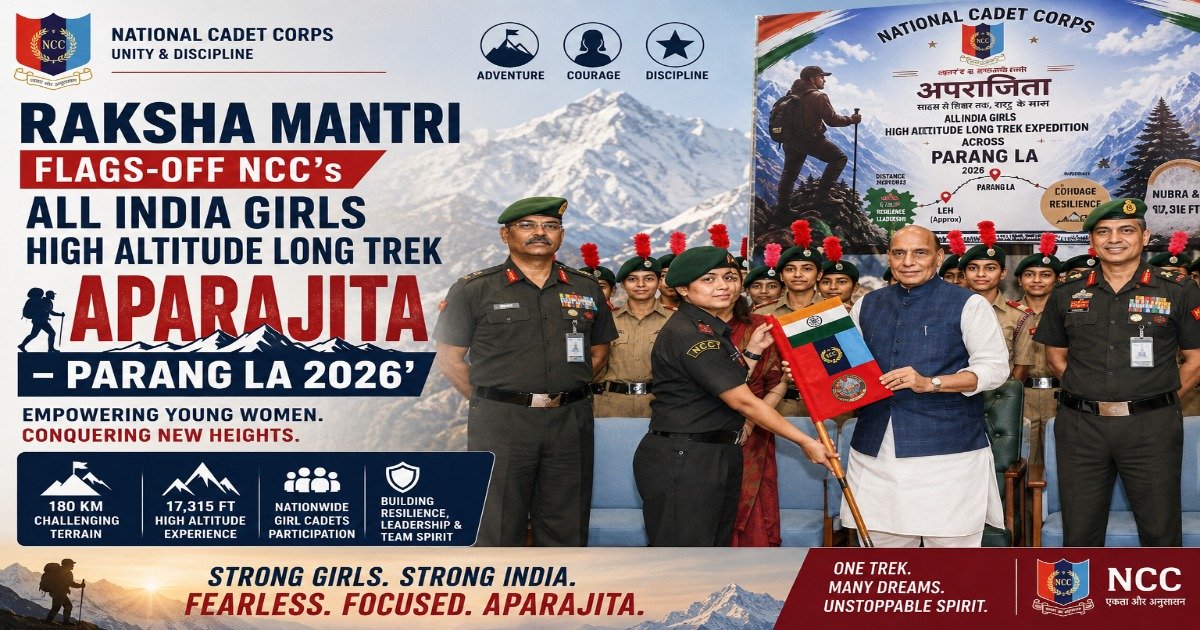
Union Defence Minister Rajnath Singh flagged off a major NCC adventure expedition in New Delhi on Tuesday, August 18, 2026. The event marked the launch of the All India Girls High Altitude Long Trek, named ‘Aparajita – Parang La 2026′. This flagship activity of the National Cadet Corps (NCC) sends 28 girl cadets on a demanding, month-long journey through some of the Himalayas’ most remote terrain.
The expedition centres on the Parang La Pass, a punishing route that connects Himachal Pradesh with Ladakh. Three women officers, one each from the Army, Navy, and Air Force, will lead the team. Through this trek, the NCC hopes to build lasting confidence, resilience, and leadership skills among its young participants.
Quick Facts: Aparajita – Parang La 2026
- Flagged off by: Defence Minister Rajnath Singh
- Date and venue: August 18, 2026, New Delhi
- Organised by: National Cadet Corps (NCC)
- Total cadets: 28 girl cadets
- Average age of cadets: 19 years
- Youngest participant: 16 and a half years old
- Trek duration: 30 days
- Total distance: Nearly 250 km
- Key pass crossed: Parang La, at 5,578 metres (18,300 feet)
- Route: Spiti Valley (Himachal Pradesh) to Changthang region (Ladakh)
- Team leadership: Three women officers, one each from the Army, Navy, and Air Force
- NCC Director General present: Lieutenant General Virendra Vats
What Is the Aparajita – Parang La 2026 Trek?
Aparajita – Parang La 2026 is a flagship adventure programme run by the NCC, built specifically for young women cadets. The name ‘Aparajita’ means “undefeated” or “invincible,” a fitting theme for an expedition designed to test physical stamina and mental grit in equal measure.
Over 30 days, the 28 participating cadets will cover close to 250 km on foot, moving through some of the most remote and difficult terrain the Himalayas have to offer. Throughout the journey, three women officers will guide the group, representing all three branches of India’s armed forces: the Army, Navy, and Air Force.
The Challenge of Parang La Pass
At the heart of this expedition lies the Parang La Pass, sitting at a towering 5,578 metres, or roughly 18,300 feet, above sea level. This high-altitude corridor links Himachal Pradesh’s scenic Spiti Valley with the remote Changthang region of Ladakh.
Experts consider this route among the toughest trekking corridors in the entire country. Thin air, unpredictable weather, and rugged terrain combine to make it a serious physical and mental test, even for experienced trekkers. Therefore, for young cadets averaging just 19 years of age, crossing this pass represents a genuine feat of endurance.
Who Are the Cadets Taking Part?
The expedition brings together 28 girl cadets from across the country, with an average age of 19 years. Notably, the youngest member of the team is only 16 and a half years old, which highlights just how early the NCC begins nurturing adventure and leadership skills among its cadets.
Three women officers will lead the group throughout the trek. Their presence reflects the tri-service character of the expedition, since each officer represents a different branch of India’s military. In turn, this structure also signals the NCC’s growing emphasis on placing women in visible leadership roles within its adventure programmes.
What the Defence Minister Told the Cadets
Speaking at the flag-off ceremony, Rajnath Singh expressed hope that the cadets would return from Parang La with more than just memorable experiences. He said the journey would also give them a deeper understanding of their own inner strength.
He then offered the team clear, practical guidance for the weeks ahead. Specifically, Singh urged the cadets to prioritise three things throughout the expedition: safety, environmental responsibility, and respectful interaction with local communities. He also asked them to follow their instructors’ guidance closely, avoid unnecessary risks, and maintain a zero-waste approach to help protect the fragile Himalayan ecology.
Beyond safety, Singh encouraged the cadets to engage meaningfully with the communities they would encounter along the route. In particular, he asked them to learn about local culture and traditions, treating the journey as an opportunity for cultural exchange, not just a physical challenge. Ultimately, he described the expedition as a milestone experience, one capable of inspiring the cadets to remain ‘Aparajita’, or undefeated, at every stage of their lives.
Celebrating ‘Nari Shakti’ Through Adventure
Rajnath Singh also used the occasion to highlight the NCC’s broader achievements in adventure activities. He pointed out that these achievements span land, water, and air, showing the wide range of challenges NCC cadets now take on. Against this backdrop, he specifically praised the girl cadets for embodying the spirit of ‘Nari Shakti’, or women’s strength and empowerment, by leading such a demanding expedition themselves.
According to the NCC, the programme’s core goals go well beyond physical achievement. Instead, organisers designed ‘Aparajita – Parang La 2026’ to promote several qualities at once: leadership, self-confidence, teamwork, endurance, and national integration, all built around the theme of Nari Shakti.
Aparajita – Parang La 2026: Key Numbers at a Glance
| Metric | Detail |
|---|---|
| Total girl cadets | 28 |
| Average age | 19 years |
| Youngest cadet | 16.5 years |
| Trek duration | 30 days |
| Total distance | ~250 km |
| Parang La Pass altitude | 5,578 m (18,300 ft) |
| Starting point | Spiti Valley, Himachal Pradesh |
| Ending region | Changthang, Ladakh |
| Leading officers | 3 (one each from Army, Navy, Air Force) |
Why This Expedition Matters
Adventure training has long formed a core part of the NCC’s mission. However, expeditions like this one carry significance well beyond physical fitness. By placing young women at the centre of one of India’s toughest high-altitude routes, the programme sends a clear message about capability and opportunity within the NCC’s ranks.
Moreover, the trek reinforces themes that resonate strongly with India’s current national priorities: women’s empowerment, environmental responsibility, and cultural understanding across regions. For the cadets themselves, completing a 250-km journey through demanding Himalayan terrain is likely to become a defining chapter in their personal and professional development, exactly as the Defence Minister described it.
About the National Cadet Corps (NCC)
The National Cadet Corps functions as India’s premier youth organisation for military-style training, discipline, and leadership development among school and college students. Alongside academic and disciplinary training, adventure activities like high-altitude treks, mountaineering, and water sports form a key part of how the NCC builds character and resilience in its cadets.
In this context, expeditions like ‘Aparajita – Parang La 2026’ represent the NCC’s flagship approach to adventure training. This particular trek stands out further because of its scale, all-women leadership, and its focus on empowering young women to take on some of the country’s most demanding physical challenges.
Frequently Asked Questions (FAQs)
Trek Basics and Route
It is a 30-day, nearly 250-km high-altitude trek organised by the National Cadet Corps (NCC) for 28 girl cadets, crossing the Parang La Pass between Himachal Pradesh and Ladakh.
Union Defence Minister Rajnath Singh flagged off the expedition during an event in New Delhi on August 18, 2026.
A total of 28 girl cadets are taking part, with an average age of 19 years. The youngest participant is 16 and a half years old.
The trek follows a route from Himachal Pradesh’s Spiti Valley to the Changthang region of Ladakh, crossing the Parang La Pass at 5,578 metres (18,300 feet) along the way.
Three women officers are leading the team, one each from the Indian Army, Indian Navy, and Indian Air Force, reflecting the tri-service nature of the expedition.
Purpose, Guidance, and Goals
Sitting at 5,578 metres above sea level, Parang La features thin air, unpredictable weather, and rugged terrain, making it one of India’s most demanding high-altitude trekking routes.
He urged them to prioritise safety, environmental responsibility, and respectful engagement with local communities, and asked them to follow their instructors closely, avoid unnecessary risks, and adopt a zero-waste approach throughout the journey.
‘Aparajita’ means “undefeated” or “invincible.” Organisers chose the name to reflect the expedition’s goal of building unshakeable confidence and resilience among the participating cadets.
According to the NCC, the trek aims to promote leadership, self-confidence, teamwork, endurance, and national integration among girl cadets, all framed around the theme of Nari Shakti, or women’s empowerment.
The expedition will run for 30 days, during which the cadets will cover close to 250 km on foot through remote Himalayan terrain.






Leave a Comment