
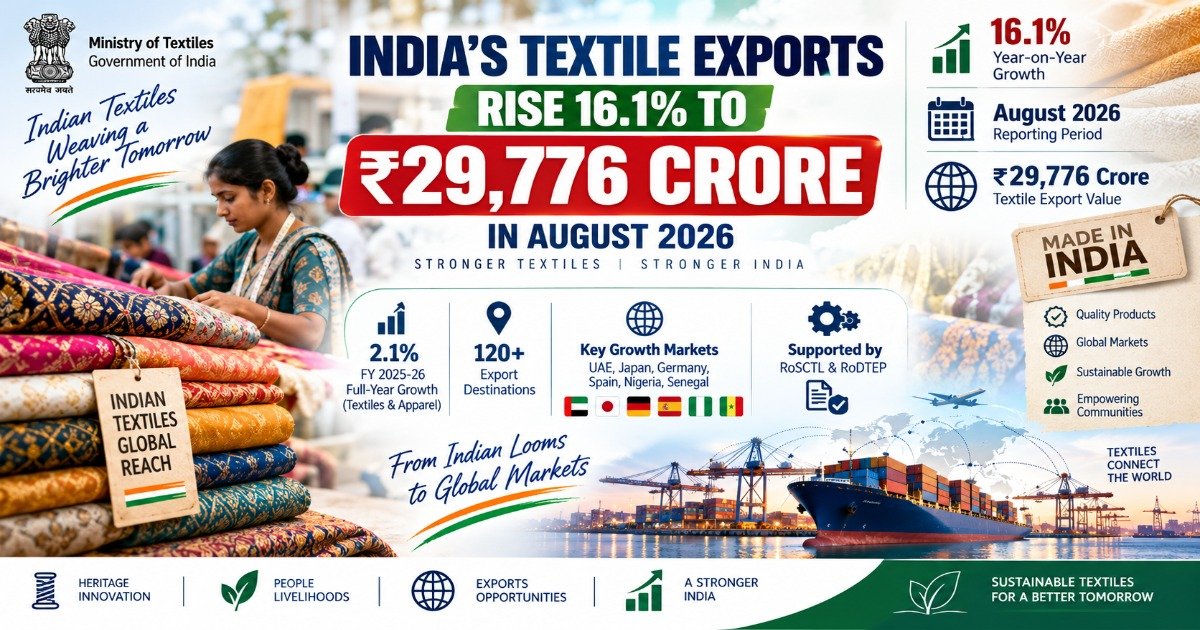
India’s textile sector just posted a strong month. According to the Ministry of Textiles, textile exports climbed 16.1% year-on-year in August 2026, reaching ₹29,776 crore. That’s a solid jump, and it comes at a time when global trade has faced real headwinds.
The announcement, released through the Press Information Bureau, adds to a string of recent updates on how India’s textile and apparel sector is performing against a backdrop of shifting global demand and tariff pressures in key markets.
Why This Growth Stands Out
Context matters here. Earlier in 2026, India’s overall textile and apparel exports, including handicrafts, grew by a much more modest 2.1% for the full 2025-26 financial year. So a 16.1% jump in a single month represents a noticeable acceleration.
This kind of month-on-month variation is fairly normal in export data. Currency movements, seasonal ordering cycles, and shifts in specific product categories can all push a single month’s numbers well above or below the yearly trend. Even so, a double-digit rise is a meaningful signal that momentum picked up going into August.
The Bigger Trade Picture
India’s textile exports haven’t moved in a straight line this year. Broader trade data covering textiles and apparel together showed exports growing around 6.39% year-on-year in August 2026, with textile shipments specifically rising faster than the apparel segment. Apparel exports, in fact, dipped slightly during the same period.
That pattern suggests textiles, as a standalone category, have been outperforming the wider textile-and-apparel basket recently. This fits with the strong 16.1% figure the Ministry has now confirmed specifically for textile exports.
What’s Driving the Sector Forward
Several factors have supported India’s textile trade performance through 2026.
Export growth has been recorded across more than 120 destinations, pointing to genuine geographic diversification rather than reliance on just one or two big markets. Key markets like the UAE, Japan, Germany, and Spain have all shown healthy growth, alongside emerging demand from markets like Nigeria and Senegal.
Government support has also played a role. Schemes like the Rebate of State and Central Taxes and Levies (RoSCTL) and the Remission of Duties and Taxes on Exported Products (RoDTEP) have continued to help exporters stay price-competitive internationally, even as some major markets impose tariffs on Indian goods.
Why This Matters for India’s Economy
Textiles remain one of India’s largest employment-generating sectors. Growth in this space doesn’t just move trade figures; it directly supports jobs across spinning mills, weaving units, garment factories, and allied industries nationwide.
Strong export numbers also help offset pressure from tariff-related challenges in some of India’s traditional markets. When exporters successfully diversify into new regions and product categories, it builds resilience against exactly these kinds of external shocks.
What We’re Still Waiting to Confirm
The Ministry’s release confirms the headline growth figure for August 2026. However, the detailed category-wise breakdown, covering segments like cotton yarn, man-made textiles, and handloom products specifically for this release, wasn’t available at the time of writing. We’ll update this article with that detail once it’s officially published.
Quick Facts: India’s Textile Exports, August 2026
| Detail | Information |
|---|---|
| Textile Export Value | ₹29,776 crore |
| Year-on-Year Growth | 16.1% |
| Reporting Period | August 2026 |
| Source | Ministry of Textiles, Government of India |
| FY 2025-26 Full-Year Growth (Textiles & Apparel) | 2.1% |
| Export Markets | 120+ destinations |
| Key Growth Markets | UAE, Japan, Germany, Spain, Nigeria, Senegal |
| Supporting Schemes | RoSCTL, RoDTEP |
Frequently Asked Questions
India’s textile exports rose 16.1% year-on-year, reaching ₹29,776 crore, according to the Ministry of Textiles.
For the full 2025-26 financial year, India’s overall textile and apparel exports, including handicrafts, grew by a more modest 2.1%. The August 2026 figure marks a sharper single-month acceleration.
Broader geographic diversification across 120+ markets, strong performance in destinations like the UAE and Japan, and continued government support through schemes like RoSCTL and RoDTEP have all contributed.
Based on broader trade data for the same period, apparel exports actually declined slightly, while textile shipments specifically showed stronger growth, consistent with this reported 16.1% rise.
Textiles are among India’s largest employment-generating sectors. Strong exports support jobs across the value chain and help the sector stay resilient against tariff pressures in key international markets.






Leave a Comment