
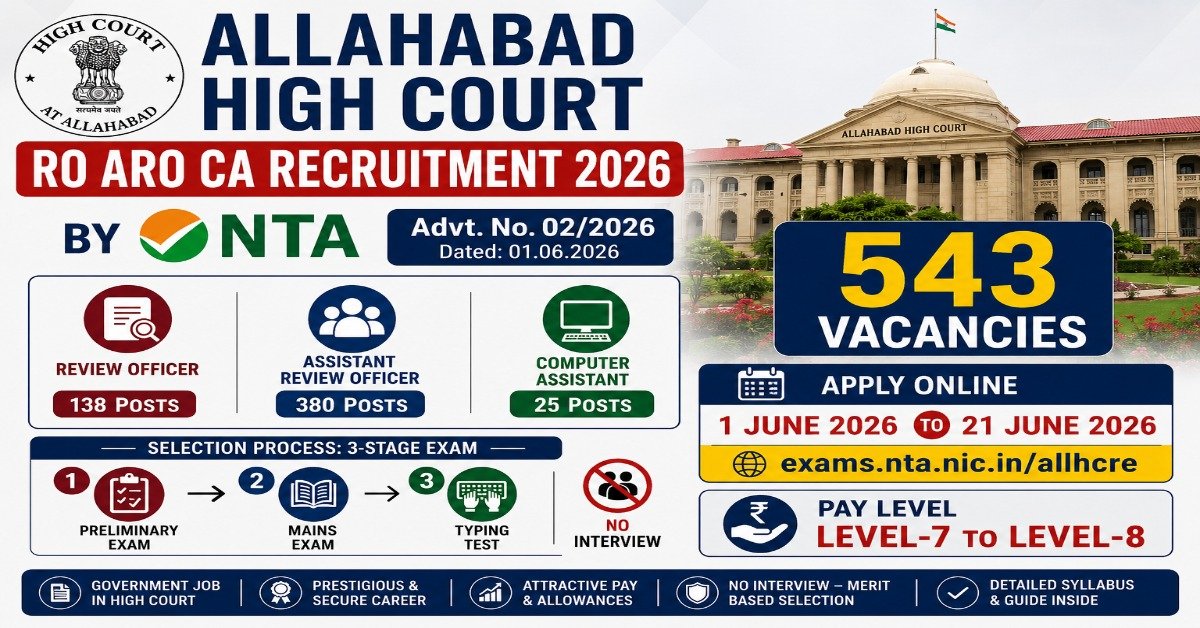
The High Court of Judicature at Allahabad, one of India’s oldest and largest High Courts, through the National Testing Agency (NTA), has released Advertisement No. 02/REVIEW OFFICER/ASSISTANT REVIEW OFFICER/COMPUTER ASSISTANT/2026 dated 01.06.2026 inviting online applications for 543 posts — Review Officer (138), Assistant Review Officer (380), and Computer Assistant (25). Apply online at exams.nta.nic.in/allhcre from 01 June 2026 to 21 June 2026 (11:50 PM). Three-stage selection: Stage-I Prelim (200 MCQ, OMR, 3 hrs, no negative marking), Stage-II Mains (150 marks, subjective, min 50/150), Stage-III Typing Test (50 marks, 20 min CBT). No interview. Final merit based on Mains + Typing only.
Notification: New — 01 June 2026 | Conducted by: NTA
Quick Facts
- Allahabad High Court, Prayagraj
- Conducted by NTA
- Advt. 02/2026 | 01.06.2026
- 543 Posts — RO + ARO + CA
- Apply: 1 June – 21 June 2026
- Pay: Level-4 to Level-8 (7th CPC)
- No Negative Marking (Stage-I)
- No Interview
- Portal: exams.nta.nic.in/allhcre
| Total Vacancies | Review Officer | Asst. Review Officer | Computer Assistant | Last Date | Exam Fee (General) |
|---|---|---|---|---|---|
| 543 | 138 | 380 | 25 | 21 Jun 2026 | ₹1,200 |
Apply Online Now
Application window: 01 June 2026 to 21 June 2026 (11:50 PM). Fee last date: 22 June 2026. Correction window: 24–25 June 2026.
1. Important Dates
- 01 June 2026 — Official Notification Released — Advertisement No. 02/2026
- 01 June 2026 — Online Application Registration Begins at exams.nta.nic.in/allhcre
- 21 June 2026 (11:50 PM) — Last Date — Online Application Form Submission
- 22 June 2026 (11:50 PM) — Last Date — Application Fee Successful Transaction (SBI)
- 24–25 June 2026 (Up to 11:00 PM) — Correction Window — Online Modification of Application Particulars
- 01 July 2026 — Age Limit Reckoned As On
Note: Last date: 21 June 2026 (11:50 PM) for application. Fee last date: 22 June 2026 (11:50 PM). Both deadlines are absolute — applications and fees not completed by the respective times will not be accepted. Correction window: 24–25 June 2026 only. After 25 June, no changes will be entertained.
2. Post-wise Vacancy, Pay Scale & Qualification Overview
Review Officer — Pay Level-8
- 138 posts | ₹47,600 – ₹1,51,100 | 7th Pay Commission Level-8
Assistant Review Officer — Pay Level-7
- 380 posts | ₹44,900 – ₹1,42,400 | 7th Pay Commission Level-7
Computer Assistant — Pay Level-4
- 25 posts | ₹25,500 – ₹81,100 | 7th Pay Commission Level-4
Category-wise Vacancy Table
| Post | Total | SC (21%) | ST (2%) | OBC (27%) | EWS (10%) | UR | Women (20% Horizontal) |
|---|---|---|---|---|---|---|---|
| Review Officer | 138 | 28 | 02 | 37 | 13 | 58 | 25 |
| Asst. Review Officer | 380 | 79 | 07 | 102 | 38 | 154 | 73 |
| Computer Assistant | 25 | 05 | 00 | 06 | 02 | 12 | 04 |
| Grand Total | 543 | 112 | 09 | 145 | 53 | 224 | 102 |
Important Reservation Notes:
- Reservation benefits (vertical + horizontal) are applicable only to bonafide residents/domicile of Uttar Pradesh. Non-UP candidates are treated as General (Unreserved) — no category benefits
- For women candidates, caste/domicile certificate must be issued from father’s side only — not husband’s
- Horizontal reservation: Women 20% | DFF 2% | Ex-Servicemen 5% | PH/PwBD 4% | Sportspersons 1% — all are overlay on vertical categories
- PH/PwBD reservation: minimum 40% disability required; includes locomotor (OA/OL/both legs/leprosy cured/dwarfism/AAV), visual impairment (low vision), and hearing impairment (hard of hearing)
- No scribe or extra time for PH candidates. Visually handicapped candidates may use their own magnifying glasses — no Braille exam material provided
- 20% women horizontal reservation is subject to final decision of Hon’ble Court in Special Appeal No. 675 of 2019
- Vacancies may increase or decrease as determined by the Hon’ble High Court
3. Eligibility Criteria — Qualification, Age & Nationality
Essential Qualification — Same for All Three Posts
All four conditions are mandatory for all three posts (RO, ARO, CA):
- Condition 1 — Academic: Bachelor’s Degree from a University established by law in India, OR a qualification recognised as equivalent thereto
- Condition 2 — Computer Qualification (any one):
- Diploma / Degree in Computer Science from a recognised Institution/University established by law in India, OR
- ‘O’ Level Certificate awarded by NIELIT / DOEACC Society, OR
- ‘CCC’ Certificate in Computer Science from a recognised institute established by law in India
- Condition 3 — Computer Skills: Knowledge of Data Entry, Word Processing, and Computer Operation
- Condition 4 — Typing Speed: Minimum 25 Words Per Minute in English Typing on Computer
All qualifications must be possessed as on the closing date: 21 June 2026.
Preferential Qualification — Tie-Breaking Advantage
Under Rule 26 of The Allahabad High Court Officers and Staff (Conditions of Service and Conduct) Rules, 1976, candidates who have served in the Territorial Army for a minimum of 2 years, OR who hold a National Cadet Corps (NCC) ‘B’ Certificate shall be given preference in direct recruitment, other things being equal. These are not mandatory but act as a tie-breaker preference.
Nationality & Character Requirements
Must be: (a) A citizen of India, OR (b) Tibetan refugee who came to India before 01.01.1972 with intention to settle permanently, OR (c) Person of Indian origin migrated from Pakistan, Myanmar, Ceylon, or East African countries. Character must be such as to render the person suitable for appointment to the Establishment of the Hon’ble High Court — opinion of Appointing Authority is final. Persons dismissed by Union/State Government or Local Authority are ineligible. Males with more than one wife living and females who married someone with a living wife are ineligible (with discretionary exemption by Chief Justice).
4. Age Limit — As on 01.07.2026 | DOB Ranges
| Post | Min Age | Max Age (Gen/EWS) | DOB Not Before | DOB Not After |
|---|---|---|---|---|
| Review Officer (RO) | 21 years | 35 years | 02.07.1991 | 01.07.2005 |
| Asst. Review Officer (ARO) | 21 years | 35 years | 02.07.1991 | 01.07.2005 |
| Computer Assistant (CA) | 18 years | 35 years | 02.07.1991 | 01.07.2008 |
Age Relaxation by Category
| Category | Max Age | Relaxation |
|---|---|---|
| Gen / EWS | 35 | Max age as on 01.07.2026 |
| SC/ST/OBC/DFF (UP) | 40 | +5 years relaxation |
| ESM (UP) | 38+ | +3 years after military service deduction |
| PH / PwBD (UP) | 50 | +15 years relaxation |
Note: Only one relaxation applies even if a candidate falls in multiple relaxation categories — whichever is most beneficial. Candidates below 21 years as on 01.07.2026 are eligible only for Computer Assistant post, not RO or ARO. Age relaxation benefits are only for domicile/residents of UP — non-UP candidates get no relaxation.
5. 3-Stage Examination Pattern — Complete Syllabus & Marking Scheme
Stage I — Preliminary: General Studies (Objective MCQ) — 200 Marks
- 200 MCQ Questions
- 3 Hours (180 minutes)
- Pen & Paper — OMR Sheet
- NO Negative Marking
- NO Minimum Qualifying Marks
- 7x Shortlisting for Stage II+III
Syllabus:
- General Science
- History of India
- Indian National Movement
- Indian Polity, Economy & Culture
- Agriculture, Commerce & Trade
- Population, Ecology & Urbanisation
- World Geography & Indian Resources
- Current National/International Events
- General Aptitude
- UP — Culture, Agriculture, Industry, Traditions
- General English & Hindi (Graduation Level)
- Elementary Computer Knowledge
Key advantage — No negative marking in Stage-I: Candidates should attempt all 200 questions. Even uncertain answers should be attempted since there is zero penalty for wrong answers. Full 3 hours should be used. Stage-I marks are NOT part of final merit — they are only used for 7x shortlisting.
Stage II — Mains: Subjective / Descriptive Examination — 150 Marks
- 4 Sections — Descriptive
- 2 Hours (120 minutes)
- Pen & Paper (Conventional)
- Minimum 50/150 to Qualify
- Same day as Stage-III (20 min gap)
| Section | Marks |
|---|---|
| Section A: Essay Writing in English (~200 words) | 30 |
| Section B: Précis Writing in English | 30 |
| Section C(i): Translation — English to Hindi | 25 |
| Section C(ii): Translation — Hindi to English | 25 |
| Section D: Comprehension in English | 40 |
Stage-II evaluation parameters: Essay — Constitutional Accuracy, Conceptual Clarity, Relevance, Logical Flow, Language Proficiency. Précis — Core ideas identification, Conciseness, Suitable Title. Translation — Accuracy of meaning, Formal tone, Grammar. Comprehension — Analytical understanding, Accuracy, Clarity. Minimum 50 out of 150 marks is mandatory to be included in Final Merit List.
Stage III — Computer Knowledge Test (English Typing) — 50 Marks
- CBT (Computer Based Test)
- 20 Minutes
- English Typing — ~500 words passage
- Minimum 25/50 + 25 wpm to Qualify
- 0.1 mark deducted per error
A passage of approximately 500 words in English is displayed on screen. Candidates must reproduce it exactly (same format) within 20 minutes. Speed (wpm) is calculated against correct words typed. Scoring formula: 01 mistake = 0.1 mark deducted. Left-out words and spelling mistakes = 1 full mistake each. Extra words typed beyond the passage = deleted and ignored. The SUBMIT button is active throughout — candidates can submit early to enhance accuracy focus, but must remain seated until dismissed. Both Stage-II and Stage-III are conducted on the same day in a single shift with a 20-minute gap.
Critical Understanding — Final Merit Calculation:
- Stage-I marks are NOT part of final merit — only used for 7x shortlisting. Topping Stage-I gives no advantage in final selection
- Final Merit = Stage-II marks + Stage-III marks (out of 150 + 50 = 200 total) — subject to meeting minimum qualifying marks in each
- Both Stage-II (min 50/150) AND Stage-III (min 25/50 + 25 wpm) minimum marks must be cleared individually — clearing one and failing the other means exclusion from final merit
- Separate merit lists are prepared for RO, ARO, and CA. A candidate selected for RO is not considered for ARO/CA. A candidate selected for ARO is not considered for CA
- Merit list is valid for 1 year or until next selection, whichever is earlier
- No interview at any stage — selection is purely exam-based
6. Pay Scale & Salary — All Three Posts (7th Pay Commission)
| Post | Starting Pay | Level / Max |
|---|---|---|
| Review Officer | ₹47,600 | Level-8 | Max ₹1,51,100 |
| Asst. Review Officer | ₹44,900 | Level-7 | Max ₹1,42,400 |
| Computer Assistant | ₹25,500 | Level-4 | Max ₹81,100 |
| Gross (RO/ARO estimate) | ₹55K–75K | Entry level with DA+HRA+TA |
All three posts are permanent government positions in the Establishment of the Hon’ble High Court of Judicature at Allahabad under The Allahabad High Court Officers and Staff (Conditions of Service and Conduct) Rules, 1976. Full government employee benefits apply: DA (revised bi-annually), HRA, medical (from Chief Medical Officer), leave entitlements, LTC, NPS pension (Central Government rules), group insurance, and the institutional prestige of High Court service. RO and ARO are Class II/Group B positions; CA is Class III/Group C.
7. Application Fee — SBI Payment Only
| Category | Fee |
|---|---|
| General / OBC Category | ₹1,200 + SBI service/processing charges, non-refundable |
| SC / ST / EWS of Uttar Pradesh | ₹1,000 + SBI service/processing charges, non-refundable |
Fee Rules:
- Payment exclusively through State Bank of India (SBI) only — other bank payments are not accepted
- Fee payment deadline is 22 June 2026 (11:50 PM) — one day after the application submission deadline
- SBI may levy additional service/processing charges over and above the exam fee — these are borne by the candidate
- Fee once paid is non-refundable under any circumstances — not even if application is rejected or candidate is found ineligible
- Only one application should be submitted. If multiple are submitted, only the last one is considered and earlier fees are NOT refunded or adjusted
- Answer key challenge fee (Stage-I): ₹500 per question — refunded only if the challenge is upheld by the expert panel
8. How to Apply Online — Step-by-Step Guide
- Visit the Official NTA Portal for Allahabad HC Recruitment — Go to exams.nta.nic.in/allhcre (NTA’s designated portal for this recruitment) OR www.allahabadhighcourt.in. Read the full official notification (available for download as PDF on both portals) and the Annexure-I (Replica Application Form) before filling the online form. The application link is active from 01 June 2026.
- Register — Create Account with Email & Mobile — Click New Registration. Fill in name, date of birth, email ID, and mobile number. A One-Time Password (OTP) is sent for verification. After OTP verification, your Application ID is generated. Note your Application ID carefully — it is used for all future logins, admit card, and result checking. Your email and mobile details as entered here will be treated as final for all NTA/HC communications.
- Fill the Application Form — All Fields Carefully — Log in with Application ID and password. Fill all mandatory fields: personal details, category (General/SC/ST/OBC/EWS/PH/ESM/DFF/Sports), qualification details (graduation degree, computer qualification — Diploma/O-Level/CCC, and typing speed confirmation), post applied for (RO / ARO / CA — the system evaluates eligibility and one fee is paid irrespective of how many posts you are eligible for). Enter complete postal address with PIN code. All information provided is treated as FINAL.
- Upload Photograph & Signature — Upload a recent passport-size colour photograph (clear, white/light background, face visible, not older than a few months) and your signature with black/blue ink on white paper. Follow NTA’s prescribed file format, size specifications, and resolution requirements exactly. Using someone else’s photograph or signature is treated as Unfair Means (UFM) and leads to disqualification. Keep at least 8 identical passport-size photographs for exam day use.
- Pay Application Fee via SBI — By 22 June 2026 — Pay ₹1,200 (General/OBC) or ₹1,000 (SC/ST/EWS of UP) through the State Bank of India payment gateway only. Payment modes available through SBI: Net Banking, Debit Card, Credit Card, or SBI Challan. SBI charges additional processing fees borne by the candidate. Fee payment deadline: 22 June 2026 (11:50 PM) — one day after form submission closes. No payment = application not processed.
- Take Printout of Confirmation Page & Application Form — After successful payment, a Confirmation Page is generated. Download and print it — it is your proof of application. Do NOT send the Confirmation Page to NTA or the High Court by post. Keep the printout for your records. Print at least 2–3 copies. Also keep 8+ passport-size photographs (identical to the one uploaded) for exam day. Use the correction window (24–25 June 2026) if you need to fix any errors.
Quick Reference: exams.nta.nic.in/allhcre — apply portal | allahabadhighcourt.in — official HC website | SBI payment only | One application per candidate | Correction: 24–25 June 2026 | Print Confirmation Page
9. Is Allahabad HC RO ARO CA 2026 Worth Applying? — Honest Career Analysis
The Allahabad High Court is one of India’s oldest and largest High Courts with jurisdiction over the entire state of Uttar Pradesh and Uttarakhand. Working in its Establishment is a prestigious, stable career. Here is a frank evaluation:
Why this recruitment is outstanding:
- 543 vacancies is a large recruitment — creating statistically reasonable chances even for competitive candidates. ARO alone has 380 posts, making it the most accessible tier
- No negative marking in Stage-I — a major advantage that rewards aggressive full attempts. Most competitive exams in UP government sector carry 1/3 or 1/4 negative marking
- No interview — pure merit-based exam selection eliminates subjective bias and political influence
- Pay Level-7 and Level-8 positions (ARO and RO) are among the best-paying Group B/C positions in UP’s judicial establishment — comparable to PCS Mains-level administrative posts in terms of basic pay
- Posting in Allahabad (Prayagraj) or High Court-related locations — urban, structured work environment unlike field postings in other departments
- NTA conducting the exam ensures standardised, transparent, and professional examination management
- Legal/judicial exposure provides enormous career enrichment for those interested in law, administration, or eventually pursuing LLB/LLM
Key considerations:
- Stage-II (Mains) is descriptive in English — Essay, Précis, Translation, Comprehension. Candidates weak in English writing skills face a structural disadvantage here
- The 25 wpm English typing minimum for Stage-III is a hard gate — candidates who don’t regularly type must practise seriously before the exam
- 20% women horizontal reservation is currently subject to a pending court matter — final vacancy distribution may change
- UP domicile mandatory for reservation benefits — out-of-state candidates compete as General (UR) regardless of category
- The correction window is only 2 days (24–25 June) — candidates must verify all application details carefully before submitting. Errors post-correction window cannot be rectified
- Stage-I marks don’t count in final merit — candidates who rely only on strong GK/aptitude performance for final selection will be disappointed if their English writing is weak
Verdict: This is one of the most valuable recruitment notifications to emerge from UP’s judiciary sector in recent years. For graduates with good English language skills (both written expression and typing), 543 vacancies across three post levels represents an excellent opportunity. The combination of no negative marking in Stage-I, no interview in final selection, and good pay levels makes this a meritocracy-friendly recruitment. Candidates should prioritise Stage-II preparation (English descriptive skills) and Stage-III typing speed — these two stages decide the final merit. Apply before 21 June 2026 and begin English writing practice immediately.
10. Preparation Strategy — How to Clear All 3 Stages
Three very different stages require three different preparation approaches. Here is a stage-by-stage strategy:
Stage-I Strategy — Attempt All 200 Questions (No NM = No Fear)
The absence of negative marking fundamentally changes the approach — attempt every single question:
- Target 140–160+ marks to be safely within the 7x shortlist for all three posts (approximate based on UP GK-heavy exam patterns)
- UP GK is the biggest differentiator: Allahabad HC exams consistently have 25–35 questions from UP history, culture, economy, geography. Use Arihant’s UP GK or Lucent’s UP Special + current UP state events
- General English (Graduation Level): Parts of speech, synonyms/antonyms, idioms, error spotting, fill in blanks — 20–25 questions expected. Standard Wren & Martin + previous year papers
- Current Affairs: Last 12 months national + UP-specific (CM’s schemes, new districts, sports achievements, cultural events)
- Computer knowledge basics: MS Office, internet fundamentals, hardware/software basics — directly relevant to the Computer Assistant post and expected in Stage-I too
- Time management: 200 questions in 180 minutes = 54 seconds per question. Don’t get stuck on any single question for over 2 minutes
Stage-II Strategy — English Writing Skills are the Final Battlefield
Stage-II is the most differentiating stage — most candidates struggle here:
- Essay Writing (30 marks): Choose topics from current affairs, social issues, governance, or philosophical topics likely for a High Court examination. Practise writing 200-word essays daily. Focus: clear introduction, logical body paragraphs (PEEL method), crisp conclusion. Avoid grammatical errors. Clarity over complexity
- Précis Writing (30 marks): Practice reducing 300–400 word passages to approximately 100 words while retaining core meaning. The title selection and proportional reduction are key evaluation criteria. Read newspaper editorials and practise précis weekly
- Translation E↔H (50 marks combined): Practise translating formal English passages into standard Hindi and formal Hindi passages into English. Focus on legal/administrative vocabulary since this is a High Court context. Avoid colloquialisms
- Comprehension in English (40 marks): Read the passage carefully before attempting questions. Focus on analytical accuracy — UPSC-level reading comprehension passages are good practice material
- Minimum 50/150: Roughly 33% minimum — scoring below this means exclusion even if Stage-III is excellent. Don’t sacrifice any section
Stage-III Strategy — Typing Accuracy + Speed for 20 Minutes
With only 20 minutes and 0.1 mark per error, accuracy is as critical as speed:
- 25 wpm minimum: 20 minutes × 25 wpm = 500 words minimum. You need to type the entire passage correctly. Practice until you comfortably maintain 30–35 wpm with less than 2% error rate
- Error cost: Every mistake costs 0.1 marks. 50 errors = 5 marks lost = net 45/50. 150 errors = 15 marks lost = net 35/50 (still above minimum but low merit score). Target: under 20 errors in the full test
- Don’t use Backspace excessively: Each backspace + retype costs more time than leaving a minor error and continuing. For words where you make 1–2 small errors, typing onward is often faster than backspacing and correcting
- Touch typing: If you currently hunt-and-peck, invest 4–6 weeks practising touch typing. Even reaching 30 wpm with touch typing is more reliable than 35 wpm hunt-and-peck
- Practise formal passages: The test passage is formal English (~500 words). Use typing test websites (Typing.com, 10FastFingers) with formal text settings for practice
Final merit insight: Your rank in the final merit list = Stage-II marks (out of 150) + Stage-III marks (out of 50). Stage-I is purely for 7x shortlisting. The competitive battleground is Stage-II — candidates who invest seriously in English writing skills (essay, précis, translation, comprehension) will consistently outrank those who focus only on Stage-I GK preparation. Stage-III typing adds to your score but is largely binary (clear/fail). The difference between a Stage-II score of 70 vs 100 is the difference between getting ARO and missing RO.
11. Important Links
- NTA Application Portal — exams.nta.nic.in/allhcre (Apply Online / Admit Card / Result)
- Official High Court Website — allahabadhighcourt.in (Notifications / Score Cards)
- Official Notification PDF — Advt. No. 02/REVIEW OFFICER/ASSISTANT REVIEW OFFICER/COMPUTER ASSISTANT/2026
12. Frequently Asked Questions
Q: How many vacancies are in Allahabad High Court RO ARO CA Recruitment 2026?
Total 543 vacancies across three posts: Review Officer (RO) — 138 posts (Pay Level-8, ₹47,600–₹1,51,100), Assistant Review Officer (ARO) — 380 posts (Pay Level-7, ₹44,900–₹1,42,400), Computer Assistant (CA) — 25 posts (Pay Level-4, ₹25,500–₹81,100). Vertical reservation: SC 21%, ST 2%, OBC 27%, EWS 10%. Horizontal: Women 20%, DFF 2%, ESM 5%, PH 4%, Sportsperson 1%. UP domicile mandatory for benefits. Advt. No. 02/2026 dated 01.06.2026.
Q: What is the last date to apply for Allahabad HC RO ARO CA 2026?
Key dates: Application submission last date: 21 June 2026 (11:50 PM). Fee payment last date: 22 June 2026 (11:50 PM). Correction window: 24–25 June 2026 (up to 11:00 PM). Apply at exams.nta.nic.in/allhcre or allahabadhighcourt.in. No offline applications.
Q: What is the exam pattern for Allahabad HC RO ARO CA 2026?
Three-stage exam by NTA: Stage-I (Prelim) — 200 MCQ, 200 marks, 3 hours, OMR-based, NO negative marking, NO minimum marks. 7x shortlisting for Stage-II+III. Stage-II (Mains) — 150 marks, 2 hours, descriptive — Essay (30) + Précis (30) + Translation E↔H (50) + Comprehension (40). Minimum 50/150 to qualify. Stage-III (Computer Test) — 50 marks, 20 minutes, CBT English typing ~500 words. Minimum 25/50 + 25 wpm to qualify. 0.1 mark per error. Final merit = Stage-II + Stage-III only. No interview.
Q: Is there negative marking in Allahabad HC RO ARO CA 2026?
NO negative marking in Stage-I (Preliminary Examination) — candidates should attempt all 200 questions without hesitation. Each correct answer = 1 mark; wrong answer = 0 marks; unattempted = 0 marks. In Stage-II (Mains), evaluation is by examiners — no negative marking concept applies. In Stage-III (Typing Test), 0.1 mark is deducted per typing error — this is an error penalty within the typing test, not a negative marking system.
Q: What is the application fee for Allahabad High Court Recruitment 2026?
Examination fee: General/OBC candidates: ₹1,200. SC/ST/EWS (of UP): ₹1,000. Payment via State Bank of India only. SBI’s additional service/processing charges are borne by the candidate. Fee is non-refundable. Answer key challenge (Stage-I): ₹500 per question — refunded if challenge is upheld. Only ONE application per candidate — one fee only, even if eligible for all three posts.
Q: What is the age limit for Allahabad HC RO ARO CA 2026?
Age as on 01.07.2026: RO & ARO: Min 21 years, Max 35 years | DOB: 02.07.1991 to 01.07.2005. CA: Min 18 years, Max 35 years | DOB: 02.07.1991 to 01.07.2008. Relaxation (UP domicile only): SC/ST/OBC/DFF — +5 years (max 40) | ESM — +3 years after military service deduction | PH — +15 years (max 50). Only one relaxation allowed (most beneficial). Candidates below 21 years as on 01.07.2026 eligible for CA only.
Q: What is the qualification required for RO ARO CA in Allahabad HC 2026?
All 4 conditions mandatory for all three posts: Bachelor’s Degree from any recognised university in India. Computer Qualification: Diploma/Degree in Computer Science from recognised institution, OR NIELIT/DOEACC ‘O’ Level Certificate, OR CCC Certificate from recognised institute. Knowledge of Data Entry, Word Processing, and Computer Operation. Minimum 25 Words Per Minute English Typing Speed on Computer. Preferential: 2-year Territorial Army service OR NCC ‘B’ Certificate (tie-breaking preference).
Q: How is the final merit list prepared for Allahabad HC RO ARO CA 2026?
Final merit list is based on aggregate marks in Stage-II + Stage-III only (out of 200 total). Stage-I marks are NOT included in final merit — only used for 7x shortlisting. Eligibility for final merit: minimum 50/150 in Stage-II AND minimum 25/50 + 25 wpm in Stage-III. Separate merit lists for RO, ARO, and CA. Tie-breaking: (1) Older age → (2) Higher Stage-II marks → (3) Higher Stage-I marks. No interview. Merit list valid for 1 year or until next selection.




Leave a Comment