
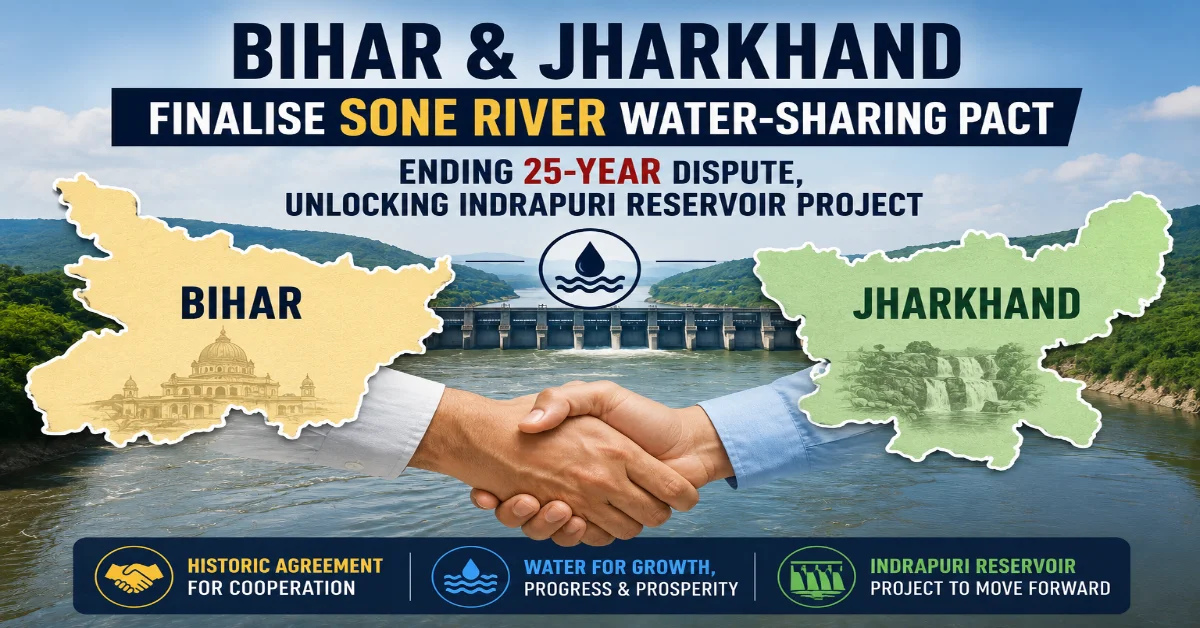
Bihar and Jharkhand have finalised a landmark water-sharing agreement over the Sone River, closing a dispute that lingered for nearly 25 years. The pact clears the way for the long-delayed Indrapuri reservoir project and promises major irrigation benefits across Bihar.
A water dispute that outlasted a generation has finally reached its conclusion. Bihar and Jharkhand formally signed a water-sharing agreement over the Sone River on Monday, August 31, 2026, ending a disagreement that began the moment Jharkhand split away from Bihar in November 2000. The Union Jal Shakti Ministry hosted the signing ceremony, bringing together representatives of both state governments to close a chapter that had remained open for nearly 25 years.
This resolution carries real, practical significance. It clears the path for the long-pending Indrapuri reservoir project, a development that had remained stuck for years because of the unresolved water-sharing question. For farmers across eight districts of Bihar, the agreement finally opens the door to stronger, more reliable irrigation.
Quick Facts: The Sone River Water Pact
- States involved: Bihar and Jharkhand
- Dispute duration: Nearly 25 years (since Jharkhand’s formation in November 2000)
- Formal signing date: Monday, August 31, 2026
- Signing hosted by: Union Ministry of Jal Shakti
- Governing framework: Bansagar Accord, 1973 (Bihar, Madhya Pradesh, Uttar Pradesh)
- Total water under dispute: 7.75 Million Acre Feet (MAF)
- Bihar’s share: 5.75 MAF
- Jharkhand’s share: 2 MAF
- Cabinet approval (Bihar): Chaired by then CM Nitish Kumar, January 2026
- Approving body for the draft: Central Water Commission (CWC)
- Key breakthrough meeting: Eastern Zonal Council (EZC), chaired by Union Home Minister Amit Shah, July 10, 2025
- Major project unlocked: Indrapuri Reservoir, Rohtas district, Bihar
- Districts set to benefit: Bhojpur, Buxar, Rohtas, Kaimur, Aurangabad, Patna, Gaya, Arwal
What Was the Sone River Dispute About?
The roots of this dispute stretch back more than five decades. In 1973, Bihar, Madhya Pradesh, and Uttar Pradesh signed the Bansagar Accord, which allocated 7.75 MAF of Sone River water to the then-undivided state of Bihar. At the time, this arrangement worked smoothly, since Bihar existed as a single administrative unit.
Everything changed in November 2000, when the state of Jharkhand split away from Bihar. Once this happened, Jharkhand naturally sought its own defined share of the water that had previously belonged entirely to undivided Bihar. However, Bihar resisted this demand for years, citing the heavy irrigation needs of its largely agrarian economy. As a result, the two states spent the next quarter-century negotiating, disputing, and searching for a workable formula, all while a major reservoir project remained stalled in the meantime.
How the Two States Finally Reached an Agreement
Progress on this long-running dispute unfolded in clear stages. The real turning point arrived during a meeting of the Eastern Zonal Council (EZC) on July 10, 2025, chaired by Union Home Minister Amit Shah. At this meeting, representatives from both states engaged directly with the Centre, and this discussion ultimately produced the breakthrough that had eluded negotiators for years.
Following this meeting, the Central Water Commission prepared a formal draft agreement. The Bihar Cabinet then approved this draft in January 2026, officially clearing state-level hurdles on the Bihar side. Officials at the time confirmed that approving the agreement mattered specifically because it would pave the way for constructing the Indrapuri reservoir.
The process reached its conclusion on August 31, 2026, when representatives of both state governments formally signed the agreement at a ceremony hosted by the Union Ministry of Jal Shakti. With the signing complete, the water-sharing dispute that had persisted since Jharkhand’s formation in 2000 officially came to an end.
Sone River Water Allocation: Key Numbers at a Glance
| Detail | Figure |
|---|---|
| Total water under the 1973 Bansagar Accord | 7.75 MAF |
| Bihar’s allocated share | 5.75 MAF |
| Jharkhand’s allocated share | 2 MAF |
| Years the dispute remained unresolved | ~25 years |
| EZC breakthrough meeting date | July 10, 2025 |
| Bihar Cabinet approval | January 2026 |
| Formal signing date | August 31, 2026 |
| Districts benefiting from Indrapuri reservoir | 8 |
Understanding the Water-Sharing Formula
Under the finalised arrangement, Bihar will receive 5.75 MAF of Sone River water, while Jharkhand will receive 2 MAF. Both figures come out of the original 7.75 MAF that the 1973 Bansagar Accord had allocated to undivided Bihar.
This formula did not emerge overnight. Instead, it followed prolonged, multi-stage negotiations between the two states, since Bihar’s agricultural economy depends heavily on consistent irrigation supply from the Sone. Ultimately, both sides accepted this division as a fair resolution, one that finally matched Jharkhand’s post-bifurcation water needs against Bihar’s long-standing agricultural priorities.
The Indrapuri Reservoir: What Comes Next
Perhaps the most tangible outcome of this agreement is the Indrapuri reservoir project. For years, this project remained stuck precisely because the water-sharing dispute made planning impossible. Now, with the pact formally signed, construction can finally move forward.
Officials plan to build the reservoir between Kadwan in Jharkhand’s Garhwa district and Matiwan in Bihar’s Rohtas district. Once completed, the project is expected to significantly strengthen irrigation facilities through the existing Sone river canal system. According to officials, this development will directly benefit eight districts across Bihar: Bhojpur, Buxar, Rohtas, Kaimur, Aurangabad, Patna, Gaya, and Arwal.
Why This Agreement Matters
Interstate river disputes in India often drag on for decades, frequently outlasting the political administrations that first raised them. The Sone River dispute followed this familiar pattern for 25 years, standing as one of the country’s longer-running water-sharing disagreements between neighbouring states.
Its resolution, therefore, carries importance well beyond the immediate water allocation numbers. It demonstrates that a structured, Centre-facilitated process, in this case run through the Eastern Zonal Council, can help break decades-long deadlocks between states. Moreover, the signed agreement offers a genuinely practical benefit: it unlocks a major infrastructure project that will directly improve irrigation security for millions of farmers across Bihar’s Sone basin districts.
About the Bansagar Accord
The Bansagar Accord of 1973 forms the legal foundation underlying this entire dispute. Signed between Bihar, Madhya Pradesh, and Uttar Pradesh, the accord governs water sharing linked to the Bansagar Dam, a multipurpose hydroelectric project located in Madhya Pradesh’s Shahdol district.
Beyond irrigation, the Bansagar Dam also serves flood control and power generation purposes, producing around 425 MW of electricity. The Sone River itself originates in the Amarkantak hills of Madhya Pradesh and flows for roughly 784 km, passing through Madhya Pradesh, Chhattisgarh, Uttar Pradesh, Jharkhand, and finally Bihar, where it joins the Ganga near Koilwar, close to Patna.
Frequently Asked Questions (FAQs)
About the Dispute and Agreement
The dispute centred on how to divide the Sone River water originally allocated to undivided Bihar under the 1973 Bansagar Accord, after Jharkhand separated from Bihar in November 2000.
The dispute lasted nearly 25 years, from Jharkhand’s formation in 2000 until Bihar and Jharkhand formally signed the water-sharing agreement on August 31, 2026.
Bihar will receive 5.75 Million Acre Feet (MAF) of water, while Jharkhand will receive 2 MAF, out of the total 7.75 MAF originally allocated to undivided Bihar.
A meeting of the Eastern Zonal Council, chaired by Union Home Minister Amit Shah on July 10, 2025, produced the key breakthrough that led both states toward the final signed agreement.
Representatives of the Bihar and Jharkhand governments formally signed the agreement on August 31, 2026, at a ceremony hosted by the Union Ministry of Jal Shakti.
About the Indrapuri Reservoir and Broader Impact
It is a planned reservoir on the Sone River, to be built between Kadwan in Jharkhand’s Garhwa district and Matiwan in Bihar’s Rohtas district, aimed at strengthening irrigation across the Sone canal system.
Eight districts in Bihar are expected to benefit: Bhojpur, Buxar, Rohtas, Kaimur, Aurangabad, Patna, Gaya, and Arwal.
It is an agreement signed between Bihar, Madhya Pradesh, and Uttar Pradesh governing water sharing linked to the Bansagar Dam, which allocated 7.75 MAF of Sone River water to undivided Bihar.
The project remained stalled for years because the unresolved water-sharing dispute between Bihar and Jharkhand made it impossible to finalise construction plans.
he Sone River originates in the Amarkantak hills of Madhya Pradesh and flows approximately 784 km through Madhya Pradesh, Chhattisgarh, Uttar Pradesh, Jharkhand, and Bihar, joining the Ganga near Koilwar, close to Patna.





Leave a Comment