
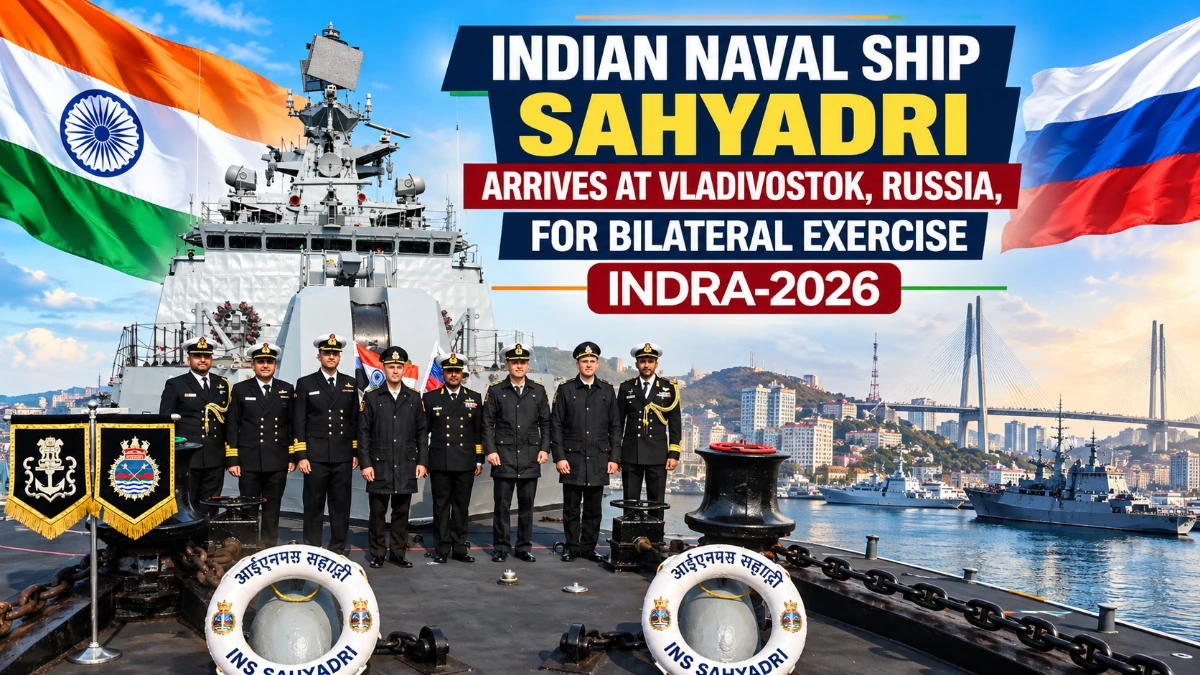
The arrival of INS Sahyadri Vladivostok Indra 2026 marks a significant strategic deployment as the Indian Navy’s indigenously built stealth frigate berthed at the Russian Pacific port of Vladivostok on October 10, 2026. Taking part in the bilateral maritime exercise INDRA-2026 scheduled from October 13 to October 18, 2026, the mission demonstrates enduring naval cooperation between the Indian Navy and the Russian Federation Navy (RuFN). Conducted across harbour and sea phases in the Sea of Japan, the deployment aligns directly with India’s overarching maritime framework of MAHASAGAR and builds upon the momentum established during the 23rd India-Russia Annual Summit.
Exercise INDRA-2026 & INS Sahyadri: Quick Overview
| Parameter | Official Details |
|---|---|
| Participating Nations | India and the Russian Federation |
| Indian Navy Warship | INS Sahyadri (F49) |
| Warship Class & Category | Shivalik-class (Project 17) Multi-Role Stealth Frigate |
| Host Nation / Base | Vladivostok (Headquarters of Russian Pacific Fleet), Russia |
| Russian Participating Vessel | Corvette Hero of the Russian Federation Aldar Tsydenzhapov |
| Exercise Dates | October 13 to October 18, 2026 |
| Operational Operating Waters | Sea of Japan / East Sea |
| Exercise Components | Harbour Phase (Vladivostok) & Sea Phase (Sea of Japan) |
| Strategic Framework | MAHASAGAR Vision & Special and Privileged Strategic Partnership |
| Diplomatic Anchor | 23rd India-Russia Annual Summit Follow-up |
5 Best Official Facts: INS Sahyadri Vladivostok Indra 2026
The deployment under INS Sahyadri Vladivostok Indra 2026 highlights critical geopolitical, operational, and technical dimensions. Here are the 5 best official facts defining this bilateral maritime engagement:
1. Dual-Phase Operational Architecture in the Sea of Japan
Exercise INDRA-2026 is structured into two complementary operational stages:
- Harbour Phase (October 13–15, 2026): Held at the Golden Horn Bay naval facilities in Vladivostok. Focuses on subject matter expert exchanges (SMEEs), cross-deck visits, tactical table-top planning, official calls on senior naval dignitaries, and friendly sports interactions.
- Sea Phase (October 16–18, 2026): Conducted in the waters of the Sea of Japan. Encompasses complex tactical maneuvers, live surface weapon firings, air defense drills, anti-submarine warfare (ASW) tracking exercises, and visit, board, search, and seizure (VBSS) operations.
2. Deployment of Indigenously Designed Shivalik-Class Stealth Frigate
Representing India’s self-reliant defense manufacturing capabilities, INS Sahyadri (F49) is the third and final multi-role stealth frigate of the Shivalik class (Project 17), built by Mazagon Dock Shipbuilders Limited (MDL) in Mumbai. Armed with long-range anti-ship cruise missiles, Barak surface-to-air defense systems, heavy torpedoes, and multi-role combat helicopters, the frigate showcases Indian design maturity under the Aatmanirbhar Bharat defense initiative.
3. Pairing with Russian Pacific Fleet Corvette Aldar Tsydenzhapov
The Russian Federation Navy deployed its advanced Project 20380 Steregushchiy-class corvette, Hero of the Russian Federation Aldar Tsydenzhapov. Both surface combatants will test multi-domain interoperability, shared tactical communications, and cooperative maritime domain awareness (MDA) protocols during combat evolutions.
4. Anchoring India’s MAHASAGAR Maritime Vision
The long-distance operational turnaround to Russia’s Far East reflects the Indian Navy’s adherence to the Government of India’s vision of MAHASAGAR—Mutual and Holistic Advancement for Security and Growth Across Regions. The doctrine underscores constructive forward presence, cooperative maritime security, open sea lanes of communication (SLOCs), and rules-based maritime order across Indo-Pacific waters.
5. Follow-Through to the 23rd India-Russia Annual Summit
The maritime interaction carries forward defense momentum and high-level strategic alignment reaffirmed during the 23rd India-Russia Annual Summit held in December 2025. Joint exercises under the INDRA banner reinforce the enduring defense architecture binding the armed forces of both nations, which spans reciprocal logistics arrangements and military-technical cooperation.
Evolution and Milestones of Bilateral Exercise INDRA
The INDRA series of military drills holds historical significance in India’s defense diplomacy:
- 2003 (Inception): The exercise began as a bilateral naval drill between the Indian Navy and the Russian Navy, symbolizing post-Cold War defense synchronization.
- 2005 (Expansion to Land Forces): The scope broadened to include joint counter-terrorism and tactical ground combat drills between the Indian Army and the Russian Ground Forces.
- 2014 (Air Force Integration): The bilateral umbrella expanded to include the Indian Air Force and Russian Aerospace Forces for tactical air defense operations.
- 2017 (Historic Tri-Services Exercise): In October 2017, Exercise INDRA made history in Vladivostok by transforming into the first full-fledged Tri-Services exercise involving simultaneous coordination of army, navy, and air force elements.
- 2026 (Naval Drill at Vladivostok): Exercise INDRA-2026 focuses on specialized anti-surface, anti-submarine, and coordinated electronic warfare maneuvers in the Sea of Japan.
Technical Profile: INS Sahyadri (F49) Capabilities
Commissioned into the Indian Navy in 2012, INS Sahyadri is known for its balanced offensive and defensive combat suite:
- Vessel Class: Shivalik Class (Project 17) Multi-Role Stealth Frigate
- Shipbuilder: Mazagon Dock Shipbuilders Limited (MDL), Mumbai
- Displacement: Approximately 6,200 tonnes (Full Load)
- Propulsion System: Combined Diesel or Gas (CODOG) configuration delivering high operational speeds
- Stealth Architecture: Engineered with radar cross-section (RCS) reduction, infrared suppression, and structural acoustic dampening
- Missile & Weapon Armament: Long-range Klub-N / BrahMos anti-ship cruise missiles, Shtil-1 and Barak surface-to-air missile systems, and an Oto Melara 76mm super rapid gun mount
- Anti-Submarine Warfare: RBU-6000 anti-submarine rocket launchers and indigenous heavy-weight torpedo tubes
- Aviation Facilities: Enclosed hangar accommodating two multi-role combat helicopters (Sea King Mk 42B or HAL Dhruv)
- Fleet Assignment: Operates under the Eastern Fleet of the Eastern Naval Command, headquartered at Visakhapatnam
Geostrategic Significance: The Eastern Maritime Corridor (EMC)
INS Sahyadri’s presence at Vladivostok underscores growing regional connectivity via the Chennai-Vladivostok Eastern Maritime Corridor (EMC):
- Logistical Efficiency: The maritime link cuts transit time between India and the Russian Far East to roughly 24 days, compared to over 40 days via the traditional Western European and Suez Canal route.
- Energy & Trade Resilience: Connects ports across the Bay of Bengal, the South China Sea, and the Sea of Japan, facilitating bilateral mineral, hydro-carbon, and agricultural trade flows while bolstering mutual maritime safety.
- Strategic Autonomy: Ensures diversified shipping channels across vital Indo-Pacific choke points while sustaining India’s active engagement in northern maritime waters.
Static GK & Examination Notes for Competitive Aspirants
Review these essential defense and geopolitical facts for UPSC, CDS, NDA, and AFCAT exams:
- Port of Vladivostok: Located in the Golden Horn Bay near the borders of China and North Korea, Vladivostok is the eastern terminus of the Trans-Siberian Railway and the principal headquarters of Russia’s Pacific Fleet.
- Project 17 Class Ships: Three stealth frigates comprise this class—INS Shivalik (F47), INS Satpura (F48), and INS Sahyadri (F49). The follow-on class is Project 17A (Nilgiri class).
- Eastern Naval Command (ENC): Headquartered at Visakhapatnam, Andhra Pradesh, overseeing naval operations in the Bay of Bengal, Andaman Sea, and broader Pacific transit routes.
- Meaning of MAHASAGAR: An acronym for Mutual and Holistic Advancement for Security and Growth Across Regions, representing India’s vision for collective maritime security.
Practice Multiple-Choice Questions (MCQs)
Q1. Which Indian Naval Ship arrived at Vladivostok, Russia, for the bilateral maritime exercise INDRA-2026?
A) INS Vikrant
B) INS Sahyadri
C) INS Kolkata
D) INS Mormugao
Answer: B) INS Sahyadri
Explanation: INS Sahyadri (F49), an indigenous Shivalik-class multi-role stealth frigate, arrived at Vladivostok on October 10, 2026, for Exercise INDRA-2026.
Q2. Exercise INDRA is a regular bilateral military exercise conducted between India and which country?
A) France
B) Russia
C) United States
D) Japan
Answer: B) Russia
Explanation: Exercise INDRA is the longstanding bilateral exercise series conducted between the armed forces of India and the Russian Federation, initiated in 2003.
Q3. Under which indigenous warship construction project was INS Sahyadri constructed?
A) Project 15B
B) Project 17
C) Project 28
D) Project 75I
Answer: B) Project 17
Explanation: INS Sahyadri was constructed under Project 17 (
Shivalik class) by Mazagon Dock Shipbuilders Limited (MDL), Mumbai.
Q4. The proposed Chennai-Vladivostok Eastern Maritime Corridor (EMC) passes through which of the following water bodies?
A) Mediterranean Sea
B) Sea of Japan
C) Red Sea
D) Baltic Sea
Answer: B) Sea of Japan
Explanation: The Chennai-Vladivostok corridor connects the Bay of Bengal through the Malacca Strait, South China Sea, and Sea of Japan to Russia’s Far East.
Frequently Asked Questions (FAQs)
What is Exercise INDRA-2026?
Exercise INDRA-2026 is a bilateral maritime exercise between the Indian Navy and the Russian Federation Navy designed to build operational interoperability, surface tactical coordination, and mutual naval cooperation.
Where is Exercise INDRA-2026 being held?
The exercise is taking place in Vladivostok, Russia (Harbour Phase) and the adjacent waters of the Sea of Japan (Sea Phase).
Which warships are participating in INDRA-2026?
The Indian Navy is represented by the multi-role stealth frigate INS Sahyadri (F49), while the Russian Federation Navy is represented by Pacific Fleet combatants, including the corvette Hero of the Russian Federation Aldar Tsydenzhapov.
What are the scheduled dates for INDRA-2026?
The exercise is being held from October 13 to October 18, 2026.
What is the strategic significance of the MAHASAGAR framework?
MAHASAGAR stands for Mutual and Holistic Advancement for Security and Growth Across Regions, guiding India’s active defense diplomacy, cooperative maritime security, and open international sea lines of communication.





Leave a Comment