
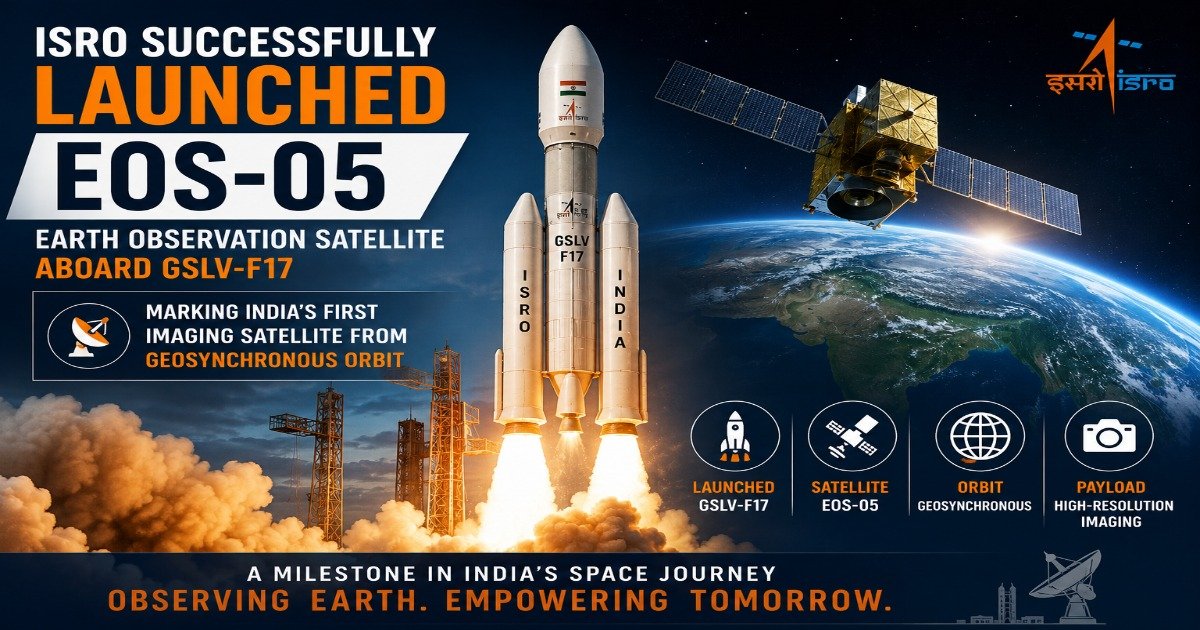
The Indian Space Research Organisation (ISRO) achieved a significant milestone in the early hours of Friday, September 4, 2026. The agency successfully launched its EOS-05 Earth observation satellite aboard the GSLV-F17 rocket from the Satish Dhawan Space Centre in Sriharikota, Andhra Pradesh. Liftoff took place at 2:55 AM IST from the Second Launch Pad, and the satellite reached its intended sub-geosynchronous transfer orbit roughly 18 minutes later.
ISRO Chairman V Narayanan confirmed the mission’s success shortly after the launch. He stated that the GSLV-F17 vehicle had successfully and precisely injected the satellite into its intended orbit. This mission marked ISRO’s first launch success of 2026, giving the space agency a strong start to its calendar year of planned missions.
Quick Facts: GSLV-F17/EOS-05 Mission
- Launch date and time: September 4, 2026, at 2:55 AM IST
- Launch site: Second Launch Pad, Satish Dhawan Space Centre, Sriharikota
- Rocket: GSLV-F17 (Geosynchronous Satellite Launch Vehicle)
- Payload: EOS-05 Earth observation satellite
- Satellite mass: 2,367 kg
- Orbit achieved: Sub-Geosynchronous Transfer Orbit (Sub-GTO)
- Time to orbit insertion: Approximately 18 minutes after liftoff
- GSLV mission number: 19th flight of the GSLV programme
- Overall Sriharikota launch count: 107th launch from the spaceport
- Payload fairing: 4-metre diameter Ogive (composite) version
- Rocket dimensions: 51.7 metres tall, 420.5 tonnes at liftoff
- Confirmed by: ISRO Chairman V Narayanan
What Is EOS-05?
EOS-05 stands as a landmark satellite for India’s Earth observation programme. ISRO describes it as a state-of-the-art Earth observation spacecraft and, notably, the country’s first-ever imaging satellite designed specifically for geosynchronous orbit. This distinction matters because most of India’s previous Earth observation satellites have operated from lower, sun-synchronous orbits instead.
Union Minister for Science and Technology Jitendra Singh described the satellite’s capabilities in more detail following the launch. He noted that EOS-05 enables advanced imaging across visible, infrared, multi-spectral, and hyperspectral bands, giving it a broad range of observational tools compared to earlier Earth observation missions.
Mission Details: How the Launch Unfolded
The GSLV-F17 rocket lifted off precisely on schedule at 2:55 AM IST from the Second Launch Pad at Sriharikota. Standing 51.7 metres tall and weighing 420.5 tonnes at liftoff, the three-stage rocket carried EOS-05 through its ascent phase before releasing the satellite into its intended orbit.
Approximately 18 minutes after liftoff, ISRO confirmed that the satellite had separated from the rocket and reached its intended sub-geosynchronous transfer orbit successfully. This particular mission also set a new benchmark for the GSLV programme: at 2,367 kg, EOS-05 became the heaviest satellite that GSLV has ever placed into a geosynchronous or sub-geosynchronous transfer orbit.
GSLV-F17/EOS-05 Mission: Key Numbers at a Glance
| Metric | Detail |
|---|---|
| Liftoff time | 2:55 AM IST, September 4, 2026 |
| Time to orbit insertion | ~18 minutes |
| Satellite mass | 2,367 kg |
| Rocket height | 51.7 metres |
| Rocket mass at liftoff | 420.5 tonnes |
| GSLV flight number | 19th |
| Sriharikota launch number | 107th |
| Payload fairing diameter | 4 metres (Ogive, composite) |
The Satellite’s Onward Journey to Final Orbit
Reaching the sub-geosynchronous transfer orbit marks only the first stage of EOS-05’s journey. According to ISRO, the satellite will eventually achieve a nominal perigee of 170 km, an apogee of 28,934 km, and an inclination of 19.28 degrees.
To reach this final position, ISRO will move the satellite through a series of orbital manoeuvres, using its onboard thrusters to gradually adjust its trajectory. This staged approach allows the satellite to settle into a stable, functional orbit suited to its long-term Earth observation role.
What EOS-05 Will Do Once Operational
Once fully operational, EOS-05 is expected to deliver near-real-time imagery of large areas at frequent intervals, a capability made possible by its geosynchronous vantage point. From this position, the satellite can maintain a consistent view of the Indian subcontinent, rather than passing overhead periodically like satellites in lower orbits.
ISRO has indicated that the satellite will support applications including monitoring of natural resources and disaster events, subject to cloud-free conditions. Science and Technology Minister Jitendra Singh added that the satellite will strengthen India’s Earth observation capabilities across agriculture, disaster management, and broader strategic monitoring, describing it as a significant step in India’s growing space capabilities.
Reactions to the Successful Launch
ISRO Chairman V Narayanan expressed clear satisfaction following the mission’s success. He confirmed that the rocket had injected the satellite precisely into its intended orbit and noted that this achievement followed some earlier setbacks for the agency, making the successful outcome an important morale boost for the organisation.
Union Minister Jitendra Singh also welcomed the mission’s success publicly. He said India’s space capabilities continue to reach new heights, further strengthening the country’s position as a global space power. According to reports, GSLV-F17 Mission Director Thomas Kurian also reflected on the years of effort behind the launch, noting that the mission’s success reflected extensive design, testing, and integration work carried out well before the actual launch day.
Why This Mission Matters for India’s Space Programme
This successful launch carries significance well beyond a single satellite reaching orbit. By becoming India’s first imaging satellite operating from geosynchronous orbit, EOS-05 adds an entirely new capability to the country’s Earth observation fleet, one that complements the lower-orbit satellites ISRO has traditionally relied on.
The mission’s success also matters symbolically for ISRO’s broader 2026 launch calendar. As the agency’s first successful mission of the year, GSLV-F17 sets a positive tone heading into further planned launches, including preparations for India’s Gaganyaan human spaceflight programme.
Frequently Asked Questions (FAQs)
About the Launch and Satellite
Yes. ISRO successfully launched EOS-05 aboard the GSLV-F17 rocket on September 4, 2026, at 2:55 AM IST, and confirmed that the satellite reached its intended sub-geosynchronous transfer orbit approximately 18 minutes later.
EOS-05 is a state-of-the-art Earth observation satellite and India’s first-ever imaging satellite designed specifically for geosynchronous orbit, capable of advanced imaging across visible, infrared, multi-spectral, and hyperspectral bands.
The launch took place from the Second Launch Pad at the Satish Dhawan Space Centre, Sriharikota, Andhra Pradesh, at 2:55 AM IST on September 4, 2026.
EOS-05 weighs 2,367 kg, making it the heaviest satellite GSLV has ever placed into a geosynchronous or sub-geosynchronous transfer orbit.
The satellite reached its intended sub-geosynchronous transfer orbit approximately 18 minutes after liftoff.
Mission Significance and What Comes Next
The satellite will eventually reach a nominal perigee of 170 km, an apogee of 28,934 km, and an inclination of 19.28 degrees, using a series of onboard thruster manoeuvres to move from its initial transfer orbit to its final position.
The satellite will provide near-real-time imagery to support applications including natural resource monitoring, disaster management, agriculture, and broader strategic and environmental monitoring.
ISRO Chairman V Narayanan confirmed the mission’s success, stating that the GSLV-F17 vehicle had successfully and precisely injected the satellite into its intended orbit.
GSLV-F17 marked the 19th flight of India’s Geosynchronous Satellite Launch Vehicle programme.
The mission marked ISRO’s first successful launch of 2026, providing a strong start to the year and reinforcing India’s growing space capabilities ahead of further planned missions, including preparations for the Gaganyaan human spaceflight programme.






Leave a Comment