
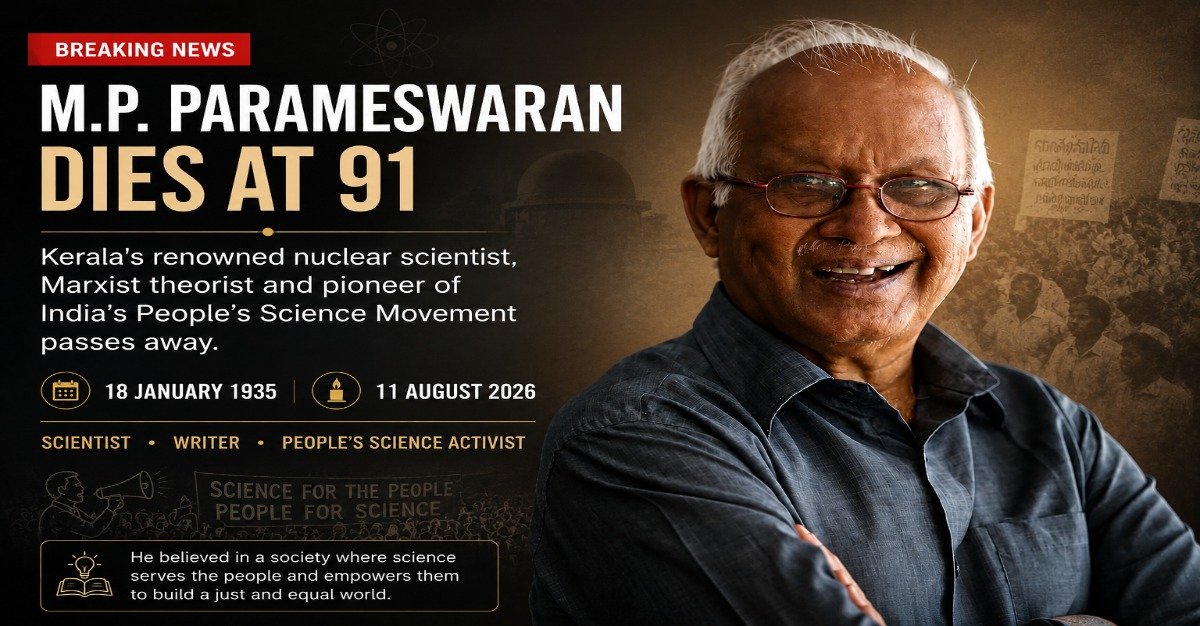
M.P. Parameswaran, one of India’s most respected nuclear scientists and a leading Marxist thinker from Kerala, passed away on August 11, 2026, at his home in Thrissur. He was 92 years old. Known simply as “MP” to generations of activists, students, and readers across Kerala, Parameswaran was that rare figure who gave up an elite scientific career to spend his life bringing science, rational thought, and social justice to ordinary villagers.
His death marks the end of an era for the people’s science movement in India — a movement he helped build almost from the ground up. Tributes have poured in from political leaders, scientists, writers, and activists across the state, remembering him as a man who chose conscience over comfort.
Quick Facts: M.P. Parameswaran
- Full name / known as: M.P. Parameswaran (“MP”)
- Born: January 18, 1935, Kiralur, Thrissur district, Kerala
- Died: August 11, 2026, Thrissur, Kerala (aged 92)
- Education: B.Sc. Engineering (Electrical), College of Engineering, Thiruvananthapuram; PhD Nuclear Engineering, Moscow Power Engineering Institute (1965)
- Known for: Nuclear scientist, science communicator, Marxist theorist, founder-leader of KSSP
- Career: Bhabha Atomic Research Centre (1957–1975); full-time KSSP activist (1975 onward)
- Key theory: “Fourth World” — decentralised, ecological socialism
- Notable books: Fourth World: Dream and Reality, ~29 other books in Malayalam and English
- Major honour: Kerala Sree Award (2022), Government of Kerala
Early Life and Education
Born on January 18, 1935, in the village of Kiralur in Kerala’s Thrissur district, Parameswaran grew up in a period when India itself was fighting for independence and searching for a scientific, modern identity. He pursued his early academic training at the College of Engineering, Thiruvananthapuram, where he earned a degree in electrical engineering.
His pursuit of higher learning later took him to the Soviet Union, where he completed a PhD in nuclear engineering at the Moscow Power Engineering Institute in 1965. This period shaped much of his later thinking, exposing him not only to nuclear science but also to the ideological currents of socialism that would come to define his political worldview.
A Career at the Heart of India’s Nuclear Programme
After returning to India, Parameswaran joined the Bhabha Atomic Research Centre (BARC), the country’s premier nuclear research institution, where he worked as a scientist from 1957 to 1975. During these years, he was closely associated with India’s early nuclear programme, contributing his expertise at a time when the country was laying the technical foundations for its atomic energy ambitions.
Between 1969 and 1973, he also served on deputation as Assistant Director of the State Institute of Languages in Kerala — an early hint of his growing interest in communication, education, and public life beyond the laboratory.
Career Timeline at a Glance
| Year | Milestone |
|---|---|
| 1935 | Born in Kiralur, Thrissur district, Kerala |
| 1956 | B.Sc. Engineering, College of Engineering, Thiruvananthapuram |
| 1957–1975 | Scientist at Bhabha Atomic Research Centre (BARC) |
| 1965 | PhD in Nuclear Engineering, Moscow Power Engineering Institute |
| 1969–1973 | Deputed as Assistant Director, State Institute of Languages, Kerala |
| 1975 | Resigns from BARC to join KSSP full-time |
| Late 1970s–80s | Leads Save Silent Valley environmental movement |
| 1987 | Convener, National Organising Committee, Bharat Jan Vigyan Jatha |
| 1990 | Organises Bharat Gyan Vigyan Jatha for the National Literacy Mission |
| 2004 | Expelled from CPI(M) over “Fourth World” theory |
| 2022 | Awarded the Kerala Sree Award |
| 2026 | Passes away in Thrissur, Kerala, aged 92 |
The Turning Point: Leaving BARC for the People
In 1975, Parameswaran made the decision that would define the rest of his life. He resigned from his secure, prestigious position at BARC to devote himself entirely to the Kerala Sasthra Sahithya Parishad (KSSP), a grassroots organisation founded in 1970 with the goal of spreading scientific literacy and rational thinking among ordinary citizens.
It was an unusual and, for many, an incomprehensible choice — a nuclear scientist walking away from a stable government career to work among farmers, students, and factory workers. But Parameswaran believed that science had no real value unless it reached the people who needed it most.
Under his leadership, KSSP grew from a small group of science teachers into one of the largest people’s science movements in the world, eventually counting more than 50,000 members. The organisation became a model that other Indian states would later try to replicate.
Champion of Environmental and Social Movements
Parameswaran’s influence extended far beyond classrooms and lecture halls. He believed development decisions should never be made without the informed consent of the people who live with their consequences. This belief shaped several major public campaigns:
- Save Silent Valley movement (late 1970s–80s): Played a central role in stopping a hydroelectric dam that would have submerged a rare evergreen forest in Palakkad district.
- Athirappilly hydroelectric project opposition: Continued to question large dam projects on ecological and social grounds.
- Anti-unsafe-drugs campaign: Pushed for stricter scrutiny of harmful pharmaceuticals sold in India.
- Total literacy campaigns: Worked to make basic literacy accessible across Kerala’s villages.
- Rural energy efficiency: Promoted cleaner, more efficient cooking stoves for rural households.
Building a National Movement
Parameswaran’s ambitions were never limited to Kerala alone. His key contributions at the national level include:
- 1987 — Bharat Jan Vigyan Jatha: Served as Convener of the National Organising Committee for this massive nationwide science communication campaign.
- All India People’s Science Network (AIPSN): Helped found this common platform, uniting grassroots science movements from West Bengal, Andhra Pradesh, Karnataka, and other states.
- 1990 — Bharat Gyan Vigyan Jatha: Helped organise this campaign in support of India’s National Literacy Mission.
- Bharat Gyan Vigyan Samiti (BGVS): This effort eventually led to the formation of BGVS, which coordinated one of the largest literacy drives in Indian history.
The Fourth World: A Marxist Thinker Ahead of His Time
Beyond his scientific and organisational work, Parameswaran was a serious political theorist. He is best remembered in Left intellectual circles for his “Fourth World” theory, laid out in his book Fourth World: Dream and Reality. The theory proposed a socialist model built on the decentralisation of political and economic power, ecological sustainability, and a rejection of unchecked consumerism — ideas that many observers compared to Gandhian concepts of Gram Swaraj and Swadeshi.
The Fourth World theory triggered sharp internal debate within the Communist Party of India (Marxist), or CPI(M). Party leadership ultimately rejected his position, and Parameswaran was expelled from the CPI(M) in 2004. Yet, according to those close to him, the split was never bitter. Parameswaran understood the party’s reasoning even as he disagreed with it, and the CPI(M), in turn, recognised that his critique came from within the Left rather than as a rejection of socialism itself. He continued to be respected as a Marxist thinker long after his formal expulsion.
A Prolific Author
Parameswaran was also a gifted writer, authoring numerous books in both Malayalam and English on subjects ranging from nuclear science and technology policy to socialism and rural development. Over his career he wrote close to 30 books and more than 300 articles across various periodicals, making complex scientific and political ideas accessible to ordinary readers. His writing earned him early recognition, including the Books for Neoliterates Award in 1962, the Basic and Cultural Literature Award in 1964, and the Children’s Literature Award in 1984. In 2022, the Government of Kerala honoured him with the Kerala Sree Award, the state’s third-highest civilian honour.
Tributes and Legacy
Following news of his passing, condolences came in from across Kerala’s political and cultural spectrum. Kerala Chief Minister V.D. Satheesan and senior CPI(M) leader Pinarayi Vijayan both paid tribute to him, describing him as someone who gave up scientific privilege to bring rational thought closer to ordinary citizens. He is widely regarded as one of the founding figures of India’s people’s science movement — a legacy that reaches classrooms, village reading rooms, and environmental campaigns across the country.
Parameswaran’s life stands as a rare example of a scientist who chose activism over comfort, and public service over personal advancement. He believed, until the very end, that science and democracy were inseparable — that ordinary people had both the right and the capacity to question power, technology, and the direction of development in their own lives.
Frequently Asked Questions (FAQs)
Q1: Who was M.P. Parameswaran?
M.P. Parameswaran was an Indian nuclear scientist, science communicator, and Marxist theorist from Kerala. He worked at the Bhabha Atomic Research Centre before leaving to lead the Kerala Sasthra Sahithya Parishad (KSSP), a grassroots science movement.
Q2: When did M.P. Parameswaran die, and what was the cause?
He passed away on August 11, 2026, at his home in Thrissur, Kerala, at the age of 92. Public reports have not specified a cause of death.
Q3: What is M.P. Parameswaran famous for?
He is best known for resigning from BARC in 1975 to popularise science among ordinary people, for leading the KSSP into one of India’s largest people’s science movements, and for developing the “Fourth World” theory of decentralised socialism.
Q4: What is the “Fourth World” theory?
It is a political and economic model Parameswaran proposed in his book Fourth World: Dream and Reality. It calls for decentralising power, protecting the environment, and reducing consumerism — ideas often compared to Gandhi’s concept of Gram Swaraj.
Q5: Why was M.P. Parameswaran expelled from the CPI(M)?
The CPI(M) rejected his “Fourth World” theory as inconsistent with the party’s official ideological line and expelled him in 2004. Despite this, the split was reportedly amicable, and he remained widely respected within the broader Left movement.
Q6: What role did he play in the Save Silent Valley movement?
He was a central figure in the campaign that stopped a proposed hydroelectric dam from submerging the Silent Valley forest in Palakkad district, one of India’s most significant environmental victories.
Q7: What awards did M.P. Parameswaran receive?
He received the Books for Neoliterates Award (1962), the Basic and Cultural Literature Award (1964), the Children’s Literature Award (1984), and the Kerala Sree Award (2022), Kerala’s third-highest civilian honour.
Q8: How many books did M.P. Parameswaran write?
He authored close to 30 books in Malayalam and English, along with more than 300 articles across various periodicals.
Q9: Where was M.P. Parameswaran born?
He was born in the village of Kiralur in Thrissur district, Kerala, on January 18, 1935.
Q10: What is the Kerala Sasthra Sahithya Parishad (KSSP)?
KSSP is a grassroots people’s science movement founded in Kerala in 1970. It works to spread scientific literacy, rational thinking, and social awareness among ordinary citizens. Parameswaran left his BARC career in 1975 to lead it full-time, and under him it grew to more than 50,000 members.
Q11: Did M.P. Parameswaran work on India’s nuclear weapons programme?
He worked as a scientist at the Bhabha Atomic Research Centre from 1957 to 1975 and has been associated with India’s early nuclear programme, though public sources do not detail his specific involvement in any particular weapons project.
Q12: What did Kerala’s political leaders say after his death?
Kerala Chief Minister V.D. Satheesan and senior CPI(M) leader Pinarayi Vijayan both paid tribute to him, describing him as someone who gave up scientific privilege to bring rational thought closer to ordinary people.
Q13: Was M.P. Parameswaran still active in his final years?
He remained a respected voice in Kerala’s Left and science-communication circles well into his later years, continuing to write and comment on social and political issues even after his formal break from the CPI(M) in 2004.
Q14: How is M.P. Parameswaran remembered today?
He is regarded as one of the founding figures of India’s people’s science movement — a scientist who chose to spend his life making science, literacy, and rational thought accessible to ordinary citizens rather than pursuing personal advancement.







Leave a Comment