
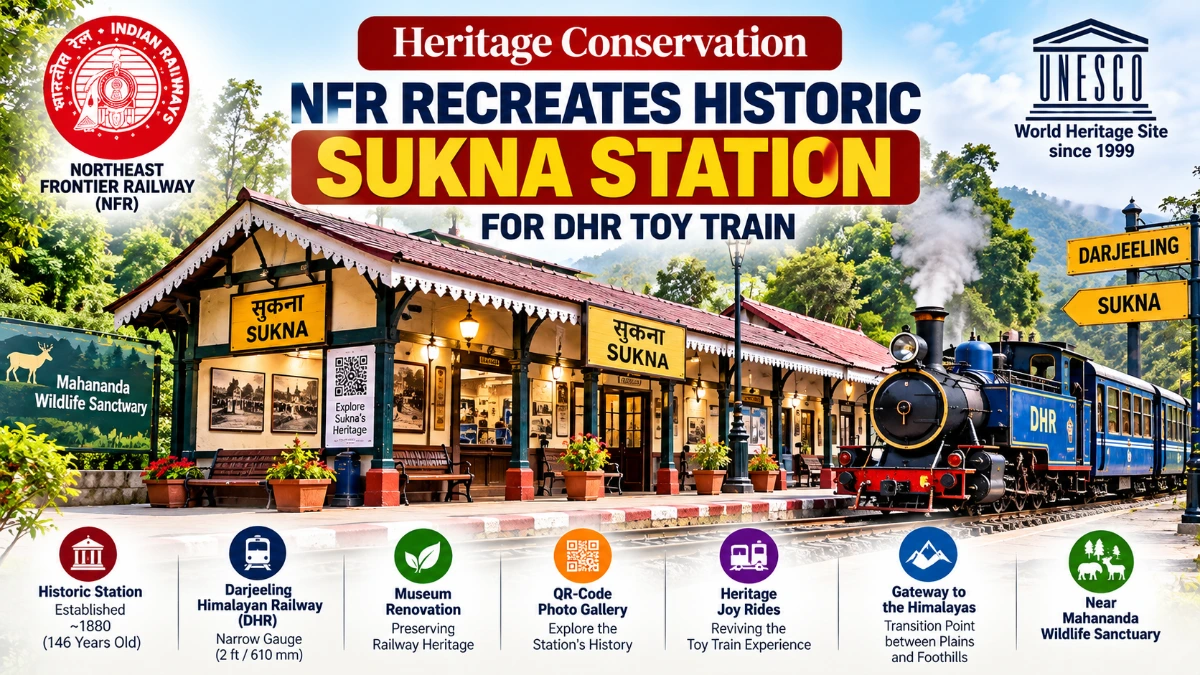
In a major boost to Indian railway heritage tourism, NFR recreates historic Sukna Station to celebrate the timeless legacy of the UNESCO World Heritage Darjeeling Himalayan Railway (DHR). As part of a dedicated conservation project led by the Northeast Frontier Railway (NFR), the 146-year-old station has been revitalized into an interactive living-heritage landmark. The initiative was unveiled during the “Sukna Station Mahotsav” in early October 2026, marking a significant milestone in blending colonial-era preservation with modern digital storytelling.
Situated at the picturesque gateway where the famous narrow-gauge toy train leaves the plains of Siliguri and begins its dramatic ascent into the Eastern Himalayas, Sukna holds immense operational and historical importance. Under the restoration initiative, NFR has upgraded the station’s vintage museum, installed an innovative QR-code-enabled photo gallery, and restored the original colonial wooden architecture while preserving the lush natural surroundings of the Mahananda Wildlife Sanctuary.
For competitive examination aspirants preparing for UPSC Civil Services, SSC CGL, State PSCs, and Railway Recruitment Board exams (RRB NTPC, RRB Group D), railway heritage and UNESCO cultural sites form an essential segment of Current Affairs and Indian Art & Culture. Below is the comprehensive factual breakdown of the restoration, station history, DHR heritage, and key exam takeaways.
Quick Fact Sheet: Sukna Station Heritage Restoration
| Parameter | Official Detail |
|---|---|
| Heritage Initiative | NFR Recreates Historic Sukna Station for DHR Toy Train |
| Zonal Railway | Northeast Frontier Railway (NFR) |
| Railway Division | Katihar Division |
| Railway System | Darjeeling Himalayan Railway (DHR) – Narrow Gauge (2 ft / 610 mm) |
| UNESCO Recognition | Inscribed as a World Heritage Site in 1999 |
| Station Name & Age | Sukna Railway Station (Established ~1880, 146 Years Old) |
| Key Upgrades | Museum renovation, QR-code photo gallery, heritage joy rides |
| Geographical Significance | Transition point between North Bengal plains and Himalayan foothills |
| Adjacent Forest Region | Mahananda Wildlife Sanctuary |
Why NFR Recreates Historic Sukna Station for the DHR Toy Train
The decision by the Northeast Frontier Railway to restore the station stems from the need to preserve authentic 19th-century railway engineering while providing a modern, experiential tourism platform:
- Preserving 146 Years of Living History: Sukna was among the earliest stations built when the DHR began passenger operations in the early 1880s. Revitalizing the station preserves original timber eaves, manual mechanical levers, and heritage stone masonry.
- Promoting Eco-Tourism and Joy Rides: By highlighting Sukna as a designated heritage destination, NFR offers regular steam and diesel joy rides along the forested Siliguri–Sukna–Rangtong stretch, boosting sustainable tourism in North Bengal.
- Interactive Heritage Education: The restored complex functions as an educational hub, offering tourists, school students, and rail enthusiasts deep insights into the engineering ingenuity required to construct the mountain railway across challenging terrains.
Key Heritage Features & Digital Upgrades at Sukna Station
The restoration of Sukna goes beyond cosmetic repairs, integrating technology with historical preservation:
- Revamped Heritage Museum: The station houses a curated museum displaying archival photographs, antique brass bells, vintage token-less block instruments, historic station registers, and miniature models of the iconic B-Class steam locomotives.
- Smart QR-Code Photo Gallery: A newly curated outdoor photo gallery features rare archival images documenting the construction of the DHR. Each display is equipped with a digital QR code that visitors can scan using their smartphones to access detailed historical narratives, audio guides, and multilingual background notes.
- Cultural and Community Integration: As part of the revival, the station premises host cultural programs, local Gorkha and Rajbanshi folk performances, and artisanal handicrafts exhibitions, ensuring that the conservation model supports local economic development.
Historical Significance of the 146-Year-Old Sukna Station
Established around 1880, Sukna serves as the critical operational pivot of the entire Darjeeling Himalayan Railway:
- The Climb Begins: From Siliguri Junction (elevation ~122 metres), the railway runs virtually level across the tea plantations until reaching Sukna (elevation ~163 metres). Immediately past Sukna station, the gentle terrain ends, and the line plunges into dense sal forests, climbing steep 1-in-20 gradients into the mountains.
- Pioneering Engineering Loops: Beyond Sukna, the railway deployed world-famous engineering innovations, including loops (where the train circles to gain elevation) and “Z-reverses” (zigzag track layouts) designed by Franklin Prestage to bypass steep gradients without requiring tunnels.
Static GK: Darjeeling Himalayan Railway & Mountain Railways of India
For candidates appearing for competitive exams, understanding the statutory profile of DHR and India’s mountain railways is vital:
- Inception of DHR: Conceived by Franklin Prestage, the railway was opened between 1879 and 1881 to connect the plains with the summer capital of Darjeeling.
- Gauge: Built on a unique 2-foot (610 mm) narrow gauge.
- UNESCO World Heritage Listing: In 1999, the Darjeeling Himalayan Railway became the first railway in Asia and only the second in the world (after Austria’s Semmering Railway) to be declared a UNESCO World Heritage Site.
- Mountain Railways of India (Serial Inscription):
- Darjeeling Himalayan Railway (West Bengal) – Inscribed in 1999.
- Nilgiri Mountain Railway (Tamil Nadu) – Added in 2005 (famous for its unique alternate-biting rack and pinion system).
- Kalka-Shimla Railway (Himachal Pradesh) – Added in 2008 (famous for its 100+ tunnels and multi-arch bridges).
- Highest Railway Station: Ghum (located at an altitude of 2,258 metres / 7,407 feet) is the highest railway station in India on the DHR route.
High-Yield Takeaways for UPSC, SSC & Railway (RRB) Exams
- Executing Body: Northeast Frontier Railway (NFR), Katihar Division.
- Key Station: Sukna Railway Station, Darjeeling district, West Bengal.
- UNESCO Status: Inscribed in 1999 under “Mountain Railways of India”.
- Key Innovation Introduced: QR-code-based digital history gallery.
- Gauge Measurement: 2 feet (610 mm) Narrow Gauge.
- Adjacent Ecological Zone: Mahananda Wildlife Sanctuary.
Practice Questions for Competitive Exams
Multiple Choice Questions (MCQs)
Q1. The historic Sukna Railway Station, recently restored under a heritage conservation initiative, belongs to which iconic railway system?
- (a) Kalka-Shimla Railway
- (b) Nilgiri Mountain Railway
- (c) Darjeeling Himalayan Railway
- (d) Matheran Hill Railway
Answer: (c) Darjeeling Himalayan Railway
Q2. In which year was the Darjeeling Himalayan Railway (DHR) inscribed as a UNESCO World Heritage Site?
- (a) 1989
- (b) 1999
- (c) 2005
- (d) 2011
Answer: (b) 1999
Q3. Consider the following statements regarding the Mountain Railways of India inscribed on the UNESCO World Heritage list:
- The Darjeeling Himalayan Railway was the first mountain railway in India to receive UNESCO World Heritage status.
- The Nilgiri Mountain Railway uses a rack-and-pinion system to climb steep gradients.
- Sukna Station marks the transition point where the DHR track begins its ascent into the Himalayan foothills.
Which of the statements given above are correct?
- (a) 1 and 2 only
- (b) 2 and 3 only
- (c) 1 and 3 only
- (d) 1, 2, and 3
Answer: (d) 1, 2, and 3
Frequently Asked Questions (FAQs)
What is the significance of the project where NFR recreates historic Sukna Station?
The project is significant because NFR recreates historic Sukna Station to safeguard 146 years of mountain railway legacy, restore vintage colonial architecture, and introduce interactive QR-code digital galleries for tourists along the UNESCO-listed DHR corridor.
Which railway zone manages the Darjeeling Himalayan Railway (DHR)?
The DHR is maintained and operated by the Northeast Frontier Railway (NFR) under the administrative jurisdiction of the Katihar Railway Division.
Where is Sukna Railway Station located?
Sukna Railway Station is situated in the Darjeeling district of West Bengal, right on the fringe of the Mahananda Wildlife Sanctuary, where the plains of Siliguri meet the foothills of the Himalayas.
What are the main tourist attractions at the restored Sukna Station?
The restored station features a renovated railway museum displaying vintage artifacts, an outdoor photo gallery with scan-and-read QR codes, and designated boarding facilities for heritage steam joy rides.
Why is the Darjeeling Himalayan Railway globally famous?
The DHR is globally renowned as a masterpiece of 19th-century hill transport engineering. It utilizes ingenious loops, zigzags, and reverse curves to navigate dramatic gradients on a 2-foot narrow gauge without long tunnels.
Which other mountain railways in India share UNESCO World Heritage status with DHR?
The Nilgiri Mountain Railway in Tamil Nadu (inscribed in 2005) and the Kalka-Shimla Railway in Himachal Pradesh (inscribed in 2008) are part of the joint UNESCO inscription titled “Mountain Railways of India”.
Also Check : INS Trishul Arrives in Spain: 5 Major Facts on 2026 Naval Deployment






Leave a Comment