
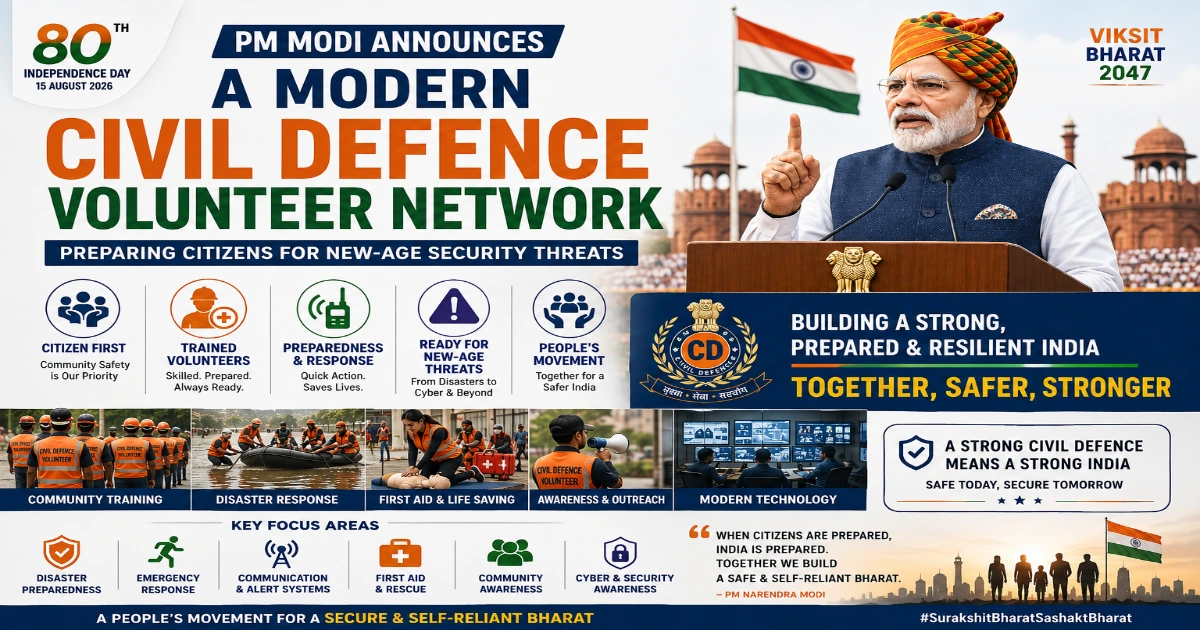
Prime Minister Narendra Modi made a major security announcement on India’s 80th Independence Day. Speaking from the Red Fort on August 15, 2026, he said the government would build a “vibrant Civil Defence network” in the coming days. He described it as a massive, modern volunteer force capable of handling contemporary security challenges.
Modi explained his reasoning clearly. According to him, India’s existing civil defence systems were designed for the needs of the previous century and have since become outdated. Therefore, he called for a network trained in modern systems and prepared to protect citizens both within the country and across its borders.
Quick Facts: The New Civil Defence Force
- Announced by: PM Narendra Modi, Red Fort, Independence Day, August 15, 2026
- Occasion: India’s 80th Independence Day
- Stated goal: A large, modern Civil Defence volunteer network
- Governing law (existing): Civil Defence Act, 1968
- Recent precedent: Volunteers mobilised during Operation Sindoor, May 2025
- Volunteers deployed then: 2,818, across Jammu and Kashmir
- Mock drills held: In 244 districts, on May 7, 2025
- Nature of force: Civilian, not armed, according to available details
Why Modi Wants a New Civil Defence Network
Modi framed the announcement around a changing definition of warfare. He pointed out that conflicts today no longer stay confined to national borders. Instead, they increasingly target data centres, banking systems, and other critical digital infrastructure.
As a result, he argued that India must modernise on two fronts at once. First, the country needs to upgrade its defence weapons and military technology. Second, and just as importantly, it needs to prepare ordinary citizens to respond to these emerging threats. This is where the new Civil Defence network comes in.
What Is Civil Defence, and Is This Really New?
Contrary to how the announcement might sound, India does not lack a Civil Defence system altogether. In fact, the country already runs a statutory Civil Defence Corps under the Civil Defence Act, 1968. This law allows the government to appoint civilian volunteers who can be called upon for training or emergency duties.
The Civil Defence Rules, 1968 already cover several important functions. These include evacuation procedures, protection of vital installations, fire prevention, public awareness campaigns, and precautions against hostile attacks. So, Modi’s announcement does not create Civil Defence from scratch. Instead, it points toward a larger, more modernised version of a system that already exists.
What Could the Modernised Volunteers Actually Do?
Traditionally, Civil Defence volunteers have helped authorities manage evacuations, protect essential services, fight fires, and relay emergency instructions to the public. A modernised version of this network could potentially expand into new areas.
Likely additions may include:
- First aid and emergency medical support
- Search and rescue operations
- Emergency communications during crises
- Evacuation and shelter management
- Broader disaster-response coordination
However, these remain likely functions rather than confirmed features. The government has not yet released detailed operational plans, so the exact scope of the new force will only become clear once official guidelines follow.
A Recent Preview: Operation Sindoor
India actually tested a version of this modernised approach already. Following Operation Sindoor and the resulting tensions with Pakistan in May 2025, the government deployed civil defence volunteers directly. Officials reported that 2,818 volunteers took part in health services, firefighting, emergency response, livestock management, and the supply of essential goods across Jammu and Kashmir.
Beyond that, the Centre also ordered civil defence mock drills across 244 districts on May 7, 2025. These exercises tested a wide range of emergency scenarios, including air-raid sirens, blackout procedures, evacuation drills, firefighting response, search and rescue operations, and emergency medical arrangements. In many ways, this real-world exercise offers the clearest preview yet of how Modi’s proposed network might eventually function.
How Civil Defence Differs From Other Volunteer Forces
India already runs several organisations that involve citizen volunteers in national service. However, each one serves a distinct purpose, so it helps to understand how Civil Defence fits alongside them.
National Cadet Corps (NCC): Established under the NCC Act, 1948, the NCC primarily focuses on youth development. It builds discipline, leadership, and a spirit of service among students. While NCC cadets do take part in community service and disaster relief, the NCC itself is not designed as an emergency-response force.
Home Guards: First raised in 1946 to assist the police, Home Guards support authorities during emergencies such as floods, fires, earthquakes, and cyclones. They can also perform Civil Defence duties when needed. Importantly, Home Guards function primarily as a police auxiliary, and they receive payment only for the days they are called upon for duty.
Territorial Army: This force consists of civilians who hold regular jobs but receive military training and can be called up for service. Territorial Army personnel form part of India’s military reserve structure. Unlike Home Guards, they receive full military pay and allowances during training and deployment, matching an officer of equivalent rank.
Civil Defence volunteers, by contrast, are neither soldiers nor Home Guards. Their core purpose remains focused specifically on protecting civilians and maintaining essential services during emergencies, rather than supporting police operations or military service.
Will the New Volunteers Carry Weapons?
Based on available details, the answer appears to be no. Nothing in Modi’s announcement suggests that the proposed Civil Defence volunteers will be armed. Civil Defence, by design, exists to protect civilians, assist emergency services, and maintain critical functions during a crisis. It is not intended to operate as another armed force.
This distinction matters because it separates India’s Civil Defence model from citizen-militia concepts seen elsewhere in the world, where armed civilian defence has historically played a larger role.
Frequently Asked Questions (FAQs)
Q1: What did PM Modi announce about Civil Defence?
PM Modi announced plans to build a large, modernised Civil Defence volunteer network during his Independence Day address from the Red Fort on August 15, 2026.
Q2: Is this India’s first Civil Defence volunteer force?
No. India already has a statutory Civil Defence Corps under the Civil Defence Act, 1968. Modi’s announcement points to a larger, modernised expansion of this existing system, not an entirely new concept.
Q3: Why did PM Modi say the current system is outdated?
He explained that civil defence systems designed for the previous century no longer match today’s security threats, which now include attacks on data centres and banking systems, not just traditional battlefield conflict.
Q4: Will the new Civil Defence volunteers be armed?
There is no indication that the volunteers will carry weapons. Civil Defence is designed to protect civilians and support emergency services, not to function as an armed force.
Q5: What tasks might the modernised volunteers handle?
Likely functions include first aid, search and rescue, emergency communications, evacuation and shelter management, and broader disaster response, though the government has not yet confirmed exact operational details.
Q6: How is Civil Defence different from the NCC?
The NCC is primarily a youth development organisation focused on discipline and leadership training. Civil Defence, on the other hand, exists specifically to protect civilians and maintain preparedness during emergencies.
Q7: How is Civil Defence different from Home Guards?
Home Guards mainly function as a police auxiliary, assisting during emergencies like floods and fires. Civil Defence focuses more broadly on civilian protection and emergency preparedness, separate from police support duties.
Q8: What happened during Operation Sindoor that relates to this announcement?
Following Operation Sindoor in May 2025, the government deployed 2,818 civil defence volunteers across Jammu and Kashmir and conducted mock drills in 244 districts, offering a working example of how a modernised network might operate.
Q9: Which law currently governs India’s Civil Defence system?
The Civil Defence Act, 1968, along with the Civil Defence Rules, 1968, currently governs the appointment and duties of civil defence volunteers in India.
Q10: When will more details about the new force become available?
The government has not yet released a detailed rollout plan. Further operational details are expected in the coming days, following Modi’s Independence Day announcement.
- Also Check : India Targets 100 GW Nuclear Power by 2047






Leave a Comment