
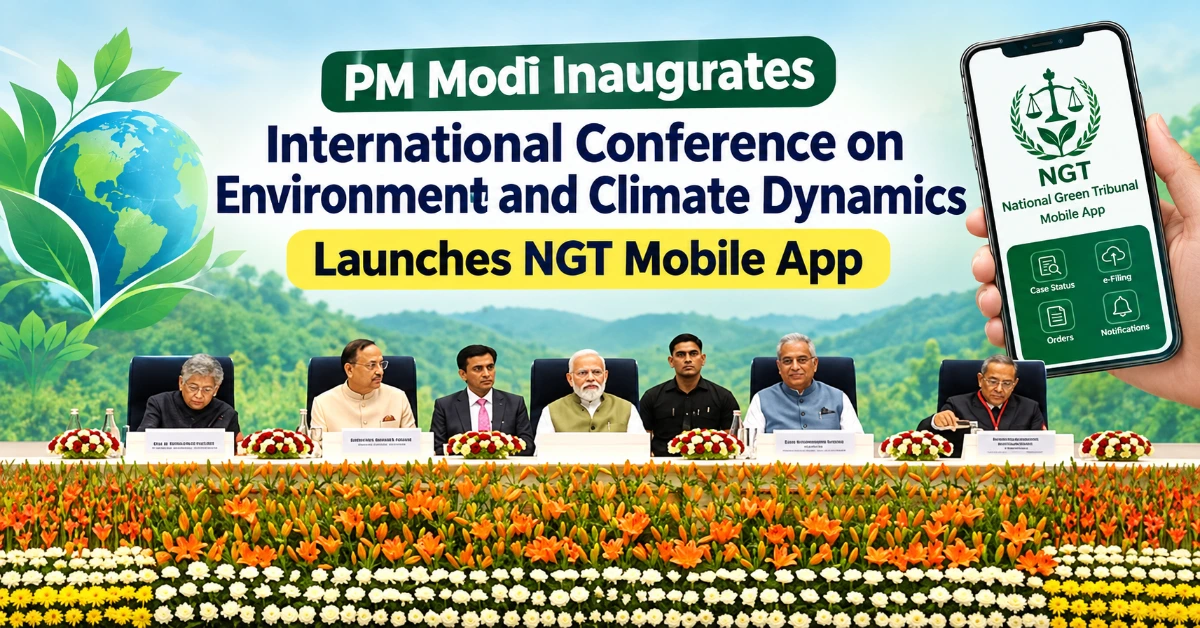
Prime Minister Narendra Modi inaugurated a major international conference in New Delhi on September 19, 2026. The event, organised by the National Green Tribunal (NGT), focused on global environmental and climate challenges. During the same session, PM Modi also launched the new NGT Mobile Application.
This two-day conference brought together judges, scientists, policymakers, and environmental experts from around the world.
Quick Facts
| Detail | Information |
|---|---|
| Event | International Conference on ‘The Future of Environment and Climate Dynamics’ |
| Organiser | National Green Tribunal (NGT) |
| Inaugurated By | Prime Minister Narendra Modi |
| Date | September 19, 2026 (Saturday) |
| Location | New Delhi |
| Duration | Two days |
| Key Launch | NGT Mobile Application |
| Participating Countries | 17 countries |
| International Bodies Involved | UNEP, Asian Development Bank (ADB) |
What Happened at the Inauguration
PM Modi spoke about India’s deep historical connection with nature. He explained how the country’s traditional knowledge continues to guide modern climate solutions today. He also praised the National Green Tribunal for its consistent work in this field and congratulated the event organisers.
During his address, the Prime Minister pointed out that India’s per capita carbon emissions remain less than half the global average. He noted that developed countries, by comparison, emit roughly six times more per person. He also mentioned that developing nations are often unfairly blamed for global emissions.
NGT Mobile Application Launch
PM Modi launched the NGT Mobile Application during the inaugural session. The app is designed to make the tribunal’s services easier to access. It supports the broader goal of using technology to strengthen environmental justice systems in India.
Who Attended the Event
Several senior dignitaries joined PM Modi at the inaugural session:
- Justice Surya Kant — Chief Justice of India
- R. Venkataramani — Attorney General for India
- Bhupender Yadav — Union Minister for Environment, Forest and Climate Change
- Justice Prakash Shrivastava — Chairperson, National Green Tribunal
What the Chief Justice Said
Chief Justice Surya Kant spoke about India’s long history of environmental jurisprudence. He noted that the Supreme Court has, over time, recognised the right to a pollution-free environment as a fundamental right. He also referred to key legal principles that Indian courts have developed, including:
- The precautionary principle
- The polluter pays principle
- Absolute liability
- The public trust doctrine
He added that Indian courts have increasingly linked climate change to constitutional rights involving equality, livelihood, and health. He called for stronger cooperation between courts, scientists, and international partners to protect the environment.
What the Attorney General Said
Attorney General R. Venkataramani stressed that no single country can solve environmental challenges alone. He said the world needs to move from mere statements to real, enforceable action. He referred to the Prime Minister’s message that global efforts must match global goals, and said India can lead by balancing growth with environmental protection.
What the Environment Minister Said
Union Minister Bhupender Yadav highlighted the importance of bringing together judges, scientists, and policymakers to tackle environmental issues that cross national borders. He said the real choice facing the world isn’t between development and environmental protection — it’s between sustainable growth and growth that cannot last.
Global Participation
The conference welcomed representatives from 17 countries. International organisations such as the United Nations Environment Programme (UNEP) and the Asian Development Bank (ADB) also took part, reflecting the global scale of the discussions.
Key Goals of the Conference
The two-day conference set out several important objectives:
- Strengthen environmental law and institutions across participating countries
- Advance climate justice and support fairness between generations
- Promote sustainable, resilient cities for the future
- Support a fair and just energy transition
- Encourage cooperation on environmental issues that cross national borders
- Share research and best practices among global experts
- Build lasting partnerships between nations and institutions
- Develop a practical roadmap for future environmental cooperation
Why This Conference Matters
| Focus Area | Why It’s Important |
|---|---|
| Environmental Law | Builds stronger legal systems to protect the environment worldwide |
| Climate Justice | Ensures fair treatment for communities most affected by climate change |
| Sustainable Cities | Prepares urban areas for future climate challenges |
| Energy Transition | Supports a fair shift toward cleaner energy sources |
| Global Cooperation | Encourages nations to work together on shared environmental problems |
Frequently Asked Questions
What did PM Modi inaugurate in New Delhi?
He inaugurated the National Green Tribunal’s two-day International Conference on ‘The Future of Environment and Climate Dynamics’ on September 19, 2026.
What is the NGT Mobile Application?
It’s a new digital tool launched by PM Modi during the conference to make the National Green Tribunal’s services more accessible to the public.
Who attended the inaugural session?
Chief Justice of India Justice Surya Kant, Attorney General R. Venkataramani, Union Environment Minister Bhupender Yadav, and NGT Chairperson Justice Prakash Shrivastava were present.
How many countries took part in the conference?
Stakeholders from 17 countries participated, along with global bodies like UNEP and the Asian Development Bank.
What did PM Modi say about India’s carbon emissions?
He said India’s per capita carbon emissions are less than half the global average, while developed countries emit around six times more per person.
What are the main goals of the conference?
The conference aims to strengthen environmental law, advance climate justice, promote sustainable cities, support a just energy transition, and build global cooperation on environmental issues.
What did the Chief Justice of India say at the event?
Justice Surya Kant spoke about India’s environmental legal history, including the recognition of a pollution-free environment as a fundamental right, and called for stronger global judicial cooperation.




Leave a Comment