
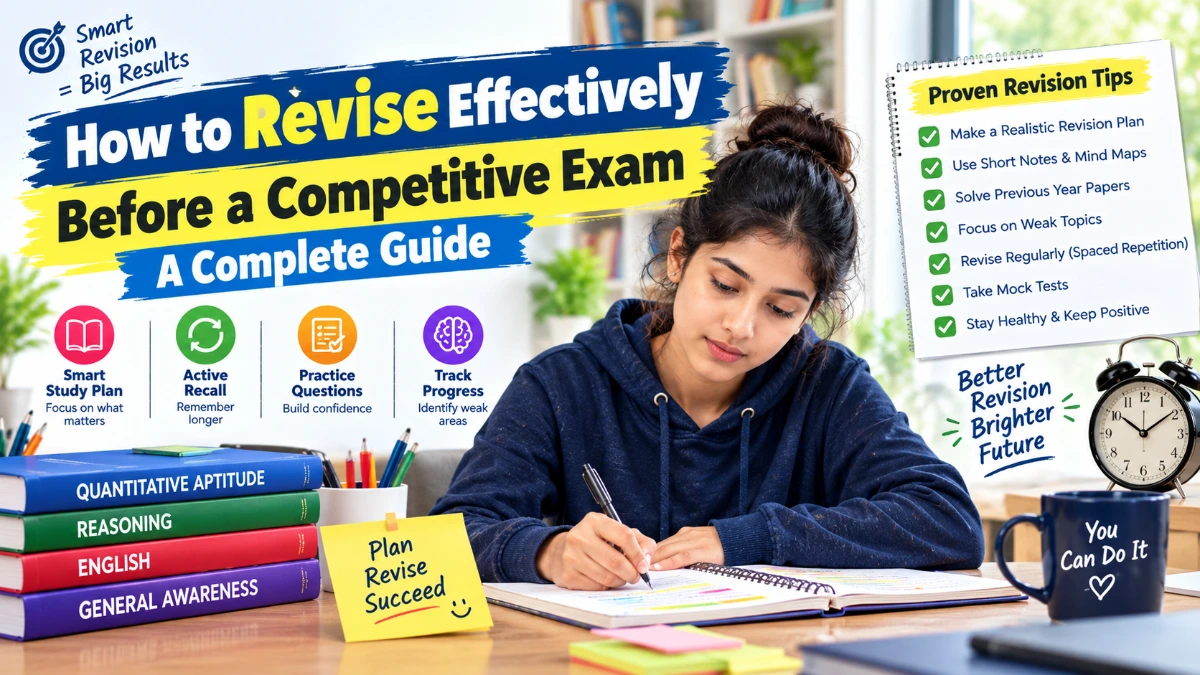
Mastering how to revise effectively before a competitive exam is often the deciding factor between securing a top rank and falling short. Whether you are preparing for the MCAT, USMLE, Bar Exam, CFA, GRE, or national civil service tests, the sheer volume of material can quickly induce cognitive overload.
Most students approach the final month with panic-driven cramming: re-reading massive textbooks, highlighting hundreds of pages, and sacrificing sleep. However, cognitive science proves that these passive methods create an “illusion of competence”—you recognize the material on the page, but your brain cannot retrieve it under timed exam pressure.
If you want to revise effectively before a competitive exam, you must shift away from passive review and adopt high-retrieval learning frameworks. In this comprehensive guide, you will discover the science of memory consolidation and seven proven, actionable steps to peak on test day.
The Cognitive Science: Why Passive Cramming Fails
To revise effectively before a competitive exam, your brain requires active retrieval, not passive consumption. In 1885, psychologist Hermann Ebbinghaus formulated the Forgetting Curve, which illustrates how human memory decays exponentially over time without deliberate reinforcement.
Without revision, your brain loses nearly 70% of new information within 48 hours. However, when you re-engage with that information at strategic intervals, the curve flattens, converting temporary memories into permanent neural storage.
According to research published by the American Psychological Association, passive re-reading produces the lowest rates of long-term knowledge retention. Conversely, the “Testing Effect” (retrieval practice) forces neurons to rebuild synaptic pathways, ensuring facts and problem-solving skills remain accessible under high stress.
Pro-Tip: Wondering how to optimize your daily focus blocks? Check out our breakdown on [The Pomodoro Technique vs. Flowtime: Which Study Method Wins?] to eliminate mental fatigue during long study sessions.
7 Proven Strategies to Revise Effectively Before a Competitive Exam
1. Build an Inverted 30-Day Revision Timeline
When planning how to revise effectively before a competitive exam, time management is paramount. Do not schedule subjects in the chronological order of your syllabus. Instead, use an inverted priority matrix based on the Pareto Principle (80/20 Rule):
- Identify High-Yield Topics: Pinpoint the 20% of the syllabus that accounts for 80% of the exam weight.
- Target High-Deficit Areas: Allocate your freshest morning hours to your weakest subjects, not the topics you already feel comfortable with.
- Lock in Final Review Buffers: Reserve the final 5 days exclusively for high-yield summary sheets and timed simulation drills.
2. Swap Passive Reading for Ruthless Active Recall
Candidates who revise effectively before a competitive exam rarely keep their textbooks open while studying. Instead, they test themselves continuously using the Feynman Technique:
- Close your notes entirely.
- Take a blank sheet of paper and explain a core concept, formula, or legal doctrine in plain language as if teaching a beginner.
- Identify where your explanation stalls or becomes vague.
- Return to your primary source to patch that exact knowledge gap.
This method instantly exposes artificial confidence and cements true conceptual clarity.
3. Implement Systematic Spaced Repetition
Using spaced repetition algorithms ensures you revise effectively before a competitive exam without burnout. Rather than reviewing all biology or quantitative formulas in a single marathon, space out review sessions across expanding intervals: Day 1, Day 3, Day 7, Day 14, and Day 28.
- Digital Flashcards: Utilize open-source tools like Anki to automate spaced repetition flashcards for rapid-fire definitions, formulas, and historical precedents.
- Leitner Box System: For physical flashcard learners, group cards into compartments based on how easily you answer them. Difficult cards are reviewed daily, while mastered cards are checked weekly.
4. Treat Full-Length Mock Exams as Inflexible Rehearsals
Simulated mock exams are the single most powerful way to revise effectively before a competitive exam. Taking practice questions in an untimed, comfortable setting breeds false security.
- Match Exam Conditions: Sit at a rigid desk, silence all notifications, and take the practice test at the exact hour your real exam will take place.
- Train Mental Stamina: Competitive exams test cognitive endurance just as much as knowledge. Taking full 3-to-4-hour practice tests conditions your brain to maintain executive function and avoid careless mistakes in the final hour.
How to Maintain an Error Log That Drives Score Increases
Taking a mock test without reviewing your mistakes is a wasted exercise. Top performers maintain a dedicated Error Log that categorizes every incorrect answer into one of three buckets:
- Category A: Conceptual Gap: You did not know the underlying theory or formula. Solution: Reread the core concept.
- Category B: Misinterpretation: You misread the prompt or skipped a critical constraint. Solution: Practice active reading and underline keywords in questions.
- Category C: Execution Slip: You rushed or made a mental math mistake. Solution: Slow down pacing on calculations.
By categorizing every error, you immediately discover whether you need more theory study or better pacing.
5. Consolidate Notes into 1-Page Summary Sheets
During the final two weeks of prep, reading 500-page binders is mathematically impossible. Consolidate whole chapters into dense, single-page mind maps or summary sheets.
- Limit each topic to a single sheet of paper.
- Focus strictly on non-negotiable formulas, core exceptions, diagnostic flowcharts, and high-frequency mnemonics.
- Reviewing these high-density sheets in the final 72 hours refreshes thousands of data points without causing mental exhaustion.
6. Protect REM Sleep for Memory Consolidation
Many examinees pull late-night study sessions in the final weeks. This is biologically counterproductive. Clinical research published by Harvard Medical School shows that during slow-wave and REM sleep, the brain replays waking memories and transfers them into long-term storage.
Cutting your sleep from 8 hours down to 5 hours blunts memory recall by up to 40%. Prioritize 7 to 8 hours of consistent, high-quality sleep every single night during your revision period.
Health Tip: For targeted nutritional habits that protect your mental clarity, read our actionable guide on [Brain Foods and Morning Routines for Peak Focus].
7. Regulate Autonomic Stress and the Freeze Response
When test day anxiety spikes, your body floods with cortisol and adrenaline, temporarily reducing prefrontal cortex function. This is the physiological cause of “blanking out.”
Practice physiological self-regulation during your mock tests:
- The Physiological Sigh: Inhale twice through your nose (one deep breath followed by a sharp top-off inhale), followed by a slow, extended exhale through your mouth. Two to three cycles rapidly resets elevated heart rates.
- Cognitive Reappraisal: Reframe a racing heart not as panic, but as your cardiovascular system pumping oxygen to sharpen your brain.
The 30-Day Master Revision Schedule
Use this progressive timeline to structure your final month:
Phase 1: Days 30 to 21 (High-Yield Coverage & Weak Areas)
- 70% of your time dedicated to weak topics using active recall.
- 30% of your time dedicated to flashcard drills.
- Complete 1 full-length diagnostic test to establish your baseline score.
Phase 2: Days 20 to 11 (Timed Sectional Drills & Error Audits)
- Complete daily timed question blocks under strict exam pacing.
- Update and thoroughly review your Error Log daily.
- Take 2 full-length mock exams.
Phase 3: Days 10 to 3 (Simulations & Note Condensation)
- Take final mock exams at the exact time of your scheduled exam.
- Condense all notes into 1-page summary sheets.
- Avoid starting any brand-new theoretical topics.
Phase 4: Final 48 Hours (Calm Consolidation & Logistics)
- Light review of 1-page summary sheets only.
- Confirm exam ID, permits, supplies, and travel route.
- Get a full 8 hours of restorative sleep.
4 Common Revision Mistakes to Avoid
Even hardworking students can fall into strategic traps. Avoid these four common pitfalls:
- The Collector’s Fallacy: Hoarding ten different textbooks, question banks, and video courses. Pick one or two gold-standard resources and master them thoroughly instead of skimming through multiple sources.
- Introducing Brand-New Topics in the Final Week: Trying to cover brand-new textbooks at the last minute makes it impossible to revise effectively before a competitive exam. It induces panic and erodes confidence. Consolidate what you already know.
- Passive Highlighting: Highlighting sentences gives a false sense of productivity while leaving almost zero imprint on long-term memory.
- Neglecting Time Management: Failing to practice with question-by-question time limits leaves points on the table during the real test.
For advanced clinical insights into performance anxiety, explore the Nature Neuroscience Portal.
Frequently Asked Questions (FAQ)
How many hours a day do I need to revise effectively before a competitive exam?
Quality always trumps quantity. Four to six hours of intense, distraction-free active recall and mock testing produce far better retention than ten hours of distracted, passive reading. Split your study blocks into 90-minute focused sessions separated by short walking and hydration breaks.
What should I do if I feel overwhelmed 3 days before the test?
Stop taking full-length mock tests 72 hours before the exam. A poor score right before exam day will shatter your mental composure. Shift exclusively to light reviews of your 1-page summary sheets, eat balanced meals, and do light physical exercise to keep nervous energy in check.
Should I study on the day before the competitive exam?
Limit day-before studying to a maximum of two to three hours in the morning. Dedicate the afternoon to packing your exam materials, printing entry tickets, hydrating, and unwinding. Resting your brain allows memory consolidation to finish before the big day.
Also Check : Daily, Weekly & Monthly Current Affairs MCQs




Leave a Comment