
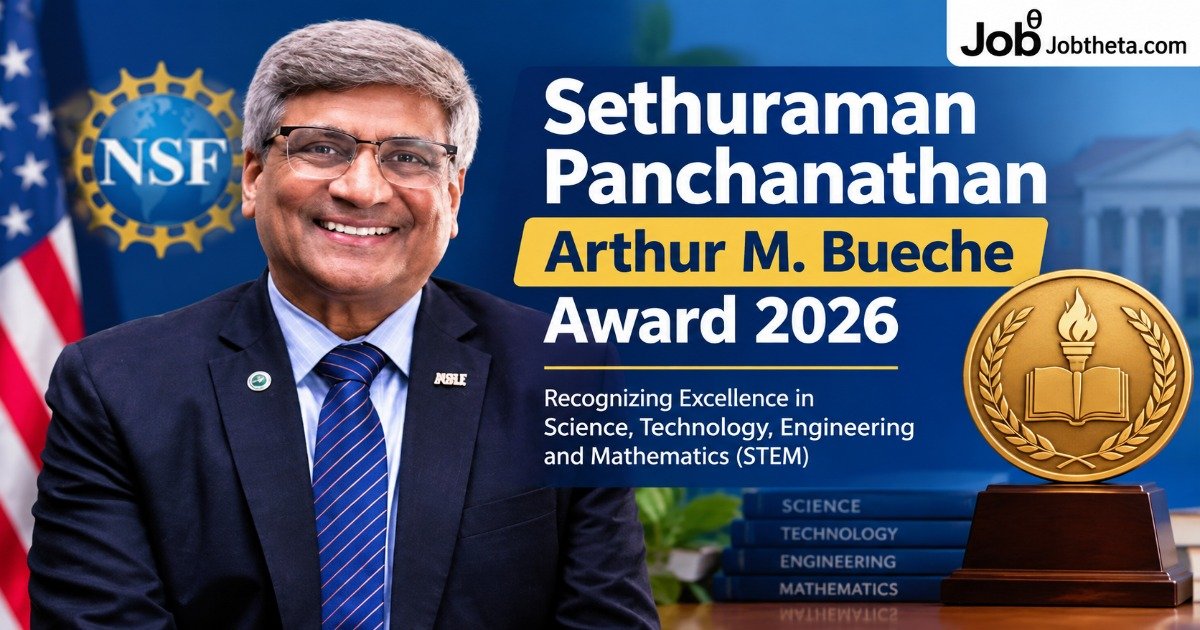
Sethuraman Panchanathan, University Professor of Technology and Innovation at Arizona State University and the 15th director of the U.S. National Science Foundation, has been selected for the National Academy of Engineering’s 2026 Arthur M. Bueche Award. The announcement, made in early September 2026, marks the first time in the award’s more than forty-year history that an Indian American has received it; Panchanathan is also the first recipient from Arizona.
The Bueche Award recognises engineers who have been actively involved in shaping U.S. science and technology policy, advancing technological development, and strengthening the working relationship between industry, government, and universities. Panchanathan’s citation credits his leadership in advancing fundamental science, technology, and policy that supports translational research and widens access to opportunity across the country. The award will be formally presented in October at the NAE’s annual meeting in Washington, D.C.
Quick Facts
- Award: Arthur M. Bueche Award, 2026
- Awarding body: U.S. National Academy of Engineering (NAE)
- Recipient: Sethuraman Panchanathan
- Current role: University Professor of Technology and Innovation, Arizona State University
- Previous role: 15th Director, U.S. National Science Foundation
- Historic first: First Indian American and first Arizonan to win the award in its 40+ year history
- Presentation: October 2026, NAE annual meeting, Washington, D.C.
- Elected to NAE: 2024
- Other recent honour: Padma Shri (India), 2025
- Birthplace: Chennai, India
From Apollo 11 Moon Rocks to the NSF
Panchanathan has often traced his interest in science to a single day in 1969. As an eight-year-old in Chennai, he stood with his father among hundreds of others outside the American Center to view lunar samples brought back by the Apollo 11 mission. By his own account, it was not the rocks themselves that captured him so much as the engineering and human effort that had made retrieving them possible — a distinction that would go on to shape a career built around translating scientific capability into real-world outcomes.
More than five decades later, that trajectory has run through research, university leadership, and the highest levels of American science administration.
Research and Academic Career
Panchanathan’s research has spanned human-centered multimedia computing, haptic interface technologies, ubiquitous computing, machine learning, and media processor design. At Arizona State University, he founded and directed the Center for Cognitive Ubiquitous Computing, which developed technologies and assistive devices for people with disabilities — work that reflects the applied, human-impact orientation running through much of his career.
Over the course of his academic career he has published more than 500 research papers and mentored over 150 graduate students, postdoctoral fellows, engineers, and scientists. Before joining the NSF, he served as executive vice president of ASU’s Knowledge Enterprise and as the university’s chief research and innovation officer.
Leading the National Science Foundation
Panchanathan’s tenure as the NSF’s 15th director covered an unusually demanding period, spanning the COVID-19 pandemic and the accelerated push for vaccine development. During his time in the role, the agency established its first new directorate in more than thirty years — the Directorate for Technology, Innovation and Partnerships (TIP).
TIP was designed to move discoveries beyond the laboratory by accelerating use-inspired and translational research, supporting regional innovation ecosystems, and strengthening the national STEM workforce. Under his leadership, the NSF also expanded investments and partnerships across artificial intelligence, quantum science, semiconductors, and other emerging technology areas. That focus on bridging fundamental research and practical application sits at the centre of what the Bueche Award is designed to recognise.
Career at a Glance
| Period / Milestone | Role or Recognition |
|---|---|
| 1969 | Views Apollo 11 moon rocks in Chennai as an eight-year-old |
| Pre-NSF | Executive VP, ASU Knowledge Enterprise; chief research and innovation officer |
| NSF tenure | 15th Director, U.S. National Science Foundation; established TIP directorate |
| 2024 | Elected to the National Academy of Engineering |
| 2025 | Awarded the Padma Shri by the Government of India |
| 2026 | Named recipient of the Arthur M. Bueche Award |
Reactions
ASU President Michael M. Crow described Panchanathan as one of the country’s most notable systems thinkers, framing the recognition as an acknowledgment of the breadth of his impact across research and policy.
Panchanathan, for his part, deflected attention from himself in his response, noting that honours of this kind are never really about one individual but about the many people whose contributions produce the outcomes being recognised. He extended thanks to his family, teachers, and mentors as sources of inspiration.
A Year of Recognition
The Bueche Award caps a period of sustained recognition on both sides of the India-U.S. relationship. In 2025, Panchanathan received the Padma Shri, one of India’s highest civilian honours. He was elected to the National Academy of Engineering in 2024, itself among the highest professional distinctions available to an American engineer.
Separately, as the United States marked its 250th anniversary, Indiaspora featured him in an initiative documenting 250 moments of Indian American achievement, and he was named to the U.S.-India Strategic Partnership Forum’s list of 250 influential voices who have shaped relations between the two countries.
Why This Recognition Matters
The Bueche Award is unusual among engineering honours in that it rewards work at the intersection of research, policy, and institution-building rather than a single technical breakthrough. That makes it a close fit for a career defined less by one discovery than by the systems Panchanathan helped construct — a new NSF directorate, a research centre focused on assistive technology, and partnerships spanning universities, federal agencies, and industry.
For the Indian American scientific community, the recognition also carries symbolic weight: it is the first time in more than forty years of the award’s existence that an Indian American has been named, a milestone that several diaspora publications have highlighted alongside the substance of the citation itself.
Frequently Asked Questions
It is an award given by the U.S. National Academy of Engineering to engineers who have been actively involved in shaping U.S. science and technology policy, promoting technological development, and strengthening ties between industry, government, and universities.
He is the first Indian American and the first Arizonan to receive the Bueche Award in its more than forty-year history.
His citation credits leadership in advancing fundamental science, technology, and policy that supports translational research and expands opportunity nationwide.
He served as the NSF’s 15th director, a tenure that spanned the COVID-19 pandemic and saw the creation of the agency’s first new directorate in over thirty years, focused on technology, innovation, and partnerships.
In October 2026, at the National Academy of Engineering’s annual meeting in Washington, D.C.
He is University Professor of Technology and Innovation at Arizona State University.
Yes — he was elected to the National Academy of Engineering in 2024 and received India’s Padma Shri in 2025.
His work spans human-centered multimedia computing, haptic interfaces, ubiquitous computing, machine learning, and media processor design; he founded ASU’s Center for Cognitive Ubiquitous Computing, which developed assistive technologies for people with disabilities.





Leave a Comment