
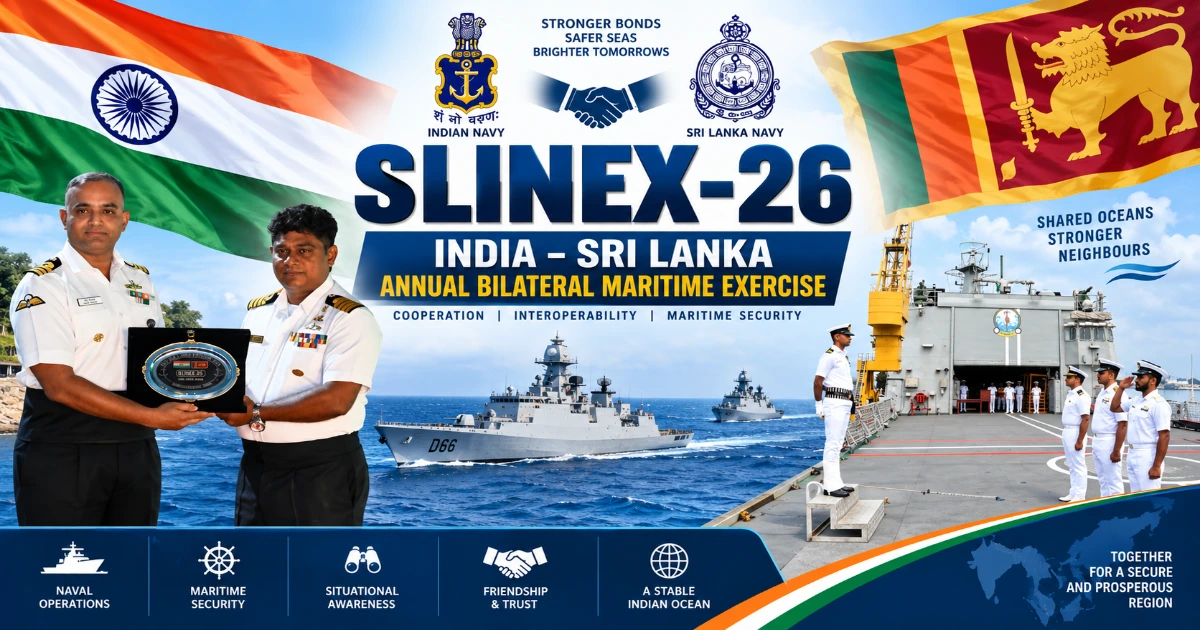
In a major boost to bilateral defense cooperation and maritime security in the Indian Ocean, the Indian Navy and the Sri Lanka Navy successfully conducted SLINEX-26, the 13th edition of their annual bilateral maritime exercise. Held from September 17 to September 21, 2026, off the coast of Visakhapatnam, the exercise demonstrated high-level operational synergy and interoperability between the two neighboring navies.
Conducted under the operational command of the Eastern Naval Command, SLINEX-26 reaffirmed the shared vision of both nations toward keeping vital sea lines of communication open, safe, and secure. The bilateral exercise directly aligns with India’s visionary MAHASAGAR framework and the overarching Neighbourhood First policy.
For government job seekers and competitive exam aspirants preparing for UPSC, CDS, NDA, AFCAT, and SSC examinations, SLINEX-26 is an essential current affairs topic. Below is the complete factual breakdown, operational details, participating warship capabilities, practice questions, and FAQs.
Quick Fact Sheet: SLINEX-26 at a Glance
| Feature | Key Information |
|---|---|
| Exercise Name | SLINEX-26 (Sri Lanka-India Bilateral Maritime Exercise) |
| Edition | 13th Edition |
| Dates of Conduction | 17th September to 21st September 2026 |
| Host Location | Visakhapatnam, Andhra Pradesh, India |
| Host Command | Eastern Naval Command (ENC), Indian Navy |
| Indian Navy Warships | INS Kavaratti (ASW Stealth Corvette) & INS Jyoti (Fleet Replenishment Tanker) |
| Sri Lanka Navy Warship | SLNS Sindurala (Advanced Offshore Patrol Vessel) |
| Operational Phases | Harbour Phase (17–19 Sep) and Sea Phase (20–21 Sep) |
| First Conceptualized | 2005 (Alternates between India and Sri Lanka) |
| Guiding Doctrine | MAHASAGAR & SAGAR (Security and Growth for All in the Region) |
Background and Evolution of SLINEX
The SLINEX series was conceptualized and first conducted in 2005 to build mutual trust and standardize operational procedures between the Indian Navy and the Sri Lanka Navy. Over the past two decades, the exercise has progressed from basic communication drills and formation steaming into an advanced, multi-threat tactical warfare exercise.
Conducted alternately between Indian and Sri Lankan ports, the exercise serves to:
- Institutionalize communication protocols and tactical signaling.
- Enhance interoperability during conventional combat as well as asymmetric security threats.
- Foster institutional synergy and personal camaraderie between officers and sailors.
Building on the foundation of previous editions, SLINEX-26 expanded the operational scope by including complex anti-submarine warfare simulations, live weapon firings, and underway replenishment exercises.
Key Highlights of SLINEX-26
Hosted under the aegis of the Eastern Naval Command in Visakhapatnam, SLINEX-26 placed strong emphasis on real-world operational readiness.
The core objectives fulfilled during the exercise included:
- Standard Operating Procedures (SOPs): Refining tactical communication channels, tactical maneuvering, and joint radar tracking.
- Maritime Domain Awareness (MDA): Enhancing real-time maritime intelligence sharing to monitor suspicious activities across the Bay of Bengal and the Palk Strait.
- Non-Traditional Threat Response: Strengthening joint capabilities against maritime piracy, drug trafficking, contraband smuggling, and unauthorized fishing.
- Search and Rescue (SAR): Practicing coordinated disaster relief and maritime rescue operations during offshore emergencies.
Participating Warships and Naval Assets
The naval units participating in SLINEX-26 highlighted high levels of technological advancement, self-reliance, and bilateral defense industrial cooperation.
1. INS Kavaratti (P31) – Indian Navy
- Type: Kamorta-class Anti-Submarine Warfare (ASW) Stealth Corvette.
- Indigenization: Designed by the Indian Navy’s Warship Design Bureau and constructed by Garden Reach Shipbuilders & Engineers (GRSE), Kolkata under Project 28.
- Combat Capabilities: Features an advanced carbon-composite superstructure for low radar visibility (stealth), indigenous anti-submarine rocket launchers, heavyweight torpedo tubes, and a sophisticated combat management suite.
2. INS Jyoti (A58) – Indian Navy
- Type: Fleet Replenishment Tanker.
- Operational Role: Specializes in refueling, provisioning, and re-arming combat vessels while underway on the high seas. During SLINEX-26, INS Jyoti conducted multiple Replenishment-at-Sea (RAS) evolutions to demonstrate sustained blue-water deployment capability.
3. SLNS Sindurala (P623) – Sri Lanka Navy
- Type: Advanced Offshore Patrol Vessel (AOPV).
- Significance: Built in India by Goa Shipyard Limited (GSL) and commissioned into the Sri Lanka Navy, standing as a proud example of India’s defense manufacturing exports.
- Operational Role: Equipped with modern surveillance systems, a helicopter landing deck, and rapid-intervention surface craft for maritime patrol and interdiction.
Operational Structure: Harbour Phase vs. Sea Phase
To ensure focused and methodical execution, SLINEX-26 was structured into two operational segments:
1. The Harbour Phase (17–19 September 2026, Visakhapatnam)
The opening phase was centered on professional dialogue, operational planning, and bilateral defense diplomacy:
- Subject Matter Expert Exchanges (SMEE): Delegations exchanged operational knowledge regarding asymmetric threats, coastal surveillance systems, and environmental safety measures.
- Cross-Deck Ship Visits: Officers and sailors toured each other’s warships to study platform capabilities, operational layouts, and bridge protocols.
- Soft Diplomacy & Sports: Personnel engaged in friendly sports matches (cricket and volleyball), joint yoga sessions, and cultural exchange dinners to build interpersonal goodwill.
2. The Sea Phase (20–21 September 2026, Bay of Bengal)
The sea phase tested tactical execution and joint combat capabilities in the open waters of the Bay of Bengal:
- Live Weapon Firings: Ships engaged surface and aerial targets with main and secondary guns to validate weapon coordination.
- Replenishment-at-Sea (RAS) Approaches: Warships conducted close-quarter maneuvering alongside fleet tanker INS Jyoti to simulate underway fuel transfer.
- Aviation & Interdiction Drills: Naval helicopters executed cross-deck landings, while boarding teams practiced Visit, Board, Search, and Seizure (VBSS) procedures against simulated rogue vessels.
Strategic Significance: The MAHASAGAR Doctrine
A central strategic pillar emphasized during SLINEX-26 is its alignment with India’s expanded maritime doctrine: MAHASAGAR.
Understanding MAHASAGAR
- Full Form: Mutual and Activistic / Holistic Advancement for Security And Growth Across Regions.
- Strategic Evolution: Building upon the foundational SAGAR (Security and Growth for All in the Region) initiative, MAHASAGAR signifies a proactive and cooperative framework aimed at:
- Strengthening collective maritime capacity among Indian Ocean littoral states.
- Maintaining an open, transparent, and rules-based international maritime order.
- Solidifying India’s role as the Preferred Security Partner and the First Responder during regional humanitarian crises.
- Safeguarding critical global sea routes connecting Asia, Africa, and Europe.
Through regular editions like SLINEX-26, India and Sri Lanka continue to build the institutional trust necessary to keep the northern Indian Ocean stable and resilient against external security challenges.
Regional Maritime Security Impact
The shared maritime boundary between India and Sri Lanka spans narrow waterways, including the Palk Strait and the Gulf of Mannar. Close coordination between both navies is vital to address common regional security challenges:
- Combating Transnational Crime: Joint monitoring prevents maritime narcotics trafficking, illegal arms movement, and contraband smuggling.
- Protecting Marine Ecology: Coordinated readiness ensures rapid containment of potential oil spills and environmental hazards from major commercial shipping lines.
- Disaster Management: Seamless interoperability guarantees fast, synchronized relief operations during severe regional weather events and cyclones.
Important Practice Questions for Competitive Exams
Review these model questions designed for candidates preparing for UPSC, CDS, NDA, and State PSC exams:
Multiple Choice Questions (MCQs)
Q1. Consider the following statements regarding the bilateral naval exercise SLINEX-26:
- The 13th edition of SLINEX was conducted at Visakhapatnam under the Eastern Naval Command.
- The Indian Navy was represented by the indigenous ASW corvette INS Kavaratti and fleet tanker INS Jyoti.
- SLNS Sindurala, which represented the Sri Lanka Navy, was indigenously built in India by Goa Shipyard Limited.
Which of the statements given above is/are correct?
- (a) 1 and 2 only
- (b) 2 and 3 only
- (c) 1 and 3 only
- (d) 1, 2, and 3
Answer: (d) 1, 2, and 3
Q2. Which strategic maritime framework was prominently highlighted during the conduct of SLINEX-26?
- (a) Operation Sankalp
- (b) MAHASAGAR
- (c) Project Mausam
- (d) Mission Sagar Amrit
Answer: (b) MAHASAGAR
Q3. What is the name of the annual bilateral military exercise conducted between the Indian Army and the Sri Lanka Army?
- (a) Exercise Mitra Shakti
- (b) Exercise Surya Kiran
- (c) Exercise Sampriti
- (d) Exercise Nomadic Elephant
Answer: (a) Exercise Mitra Shakti
Frequently Asked Questions (FAQs)
What is SLINEX-26?
SLINEX-26 is the 13th edition of the annual bilateral maritime exercise conducted between the Indian Navy and the Sri Lanka Navy, held in Visakhapatnam from September 17 to September 21, 2026.
Where was SLINEX-26 conducted?
The exercise took place in Visakhapatnam, Andhra Pradesh, under the Eastern Naval Command of the Indian Navy, with sea phase operations executed in the Bay of Bengal.
Which warships participated in SLINEX-26?
The Indian Navy was represented by the indigenous anti-submarine warfare corvette INS Kavaratti and the fleet tanker INS Jyoti. The Sri Lanka Navy was represented by the Advanced Offshore Patrol Vessel SLNS Sindurala.
When was the SLINEX bilateral exercise first started?
The SLINEX exercise series was conceptualized and first held in 2005 to build operational synergy, mutual trust, and maritime domain awareness between India and Sri Lanka.
What are the two operational phases of SLINEX-26?
The exercise is divided into two phases:
Harbour Phase (17–19 September 2026): Consisting of subject matter expert exchanges, operational briefings, cross-deck visits, and sports activities.
Sea Phase (20–21 September 2026): Consisting of live surface gunnery, replenishment-at-sea approaches, cross-deck helicopter operations, and tactical maneuvers.
What is the full form of the MAHASAGAR doctrine?
MAHASAGAR stands for Mutual and Holistic Advancement for Security and Growth Across Regions. It expands on the SAGAR policy to promote collective security, transparency, and regional cooperation across Indian Ocean littoral nations.
How does SLINEX benefit regional maritime security?
SLINEX improves coordination against non-traditional maritime threats such as piracy, smuggling, and illegal fishing, while ensuring rapid, coordinated responses during natural disasters and maritime search-and-rescue operations.






Leave a Comment