
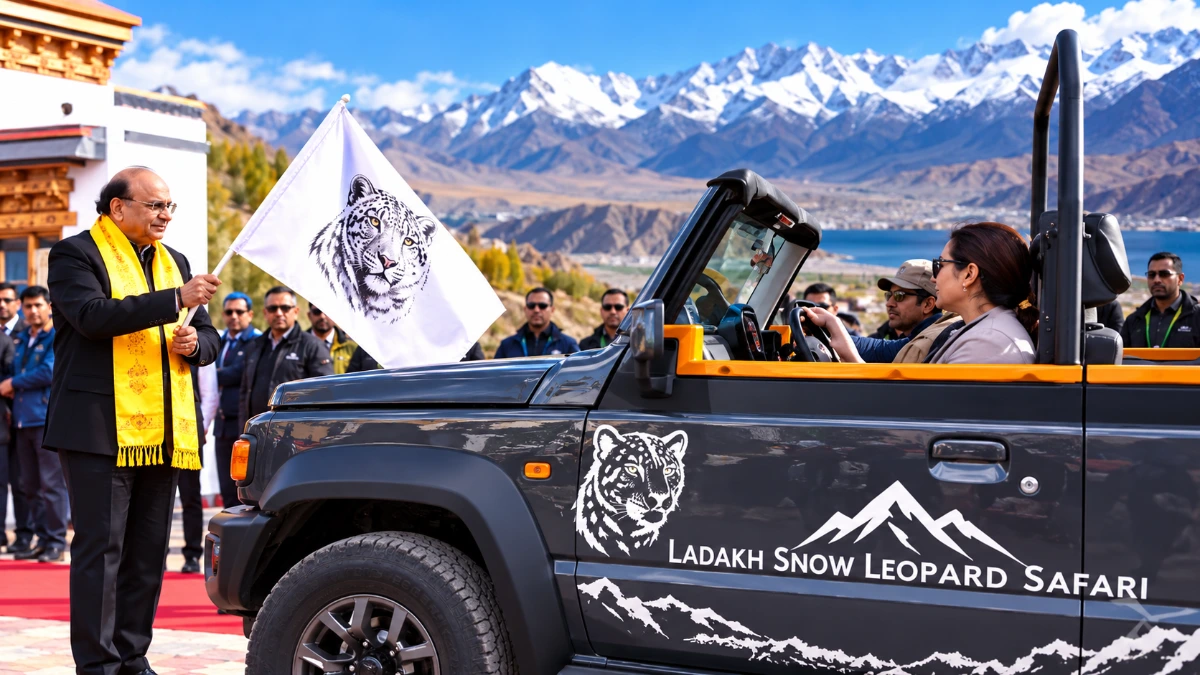
In a groundbreaking initiative for high-altitude wildlife conservation and sustainable mountain tourism, Lieutenant Governor of Ladakh Vinai Kumar Saxena (V.K. Saxena) officially flagged off India’s first Snow Leopard Wildlife Safari Ladakh on October 7, 2026, from Leh. This regulated eco-tourism venture establishes an organized mechanism for tourists and wildlife photographers to observe the elusive “Ghost of the Mountains” without damaging the sensitive cold-desert ecology.
Managed by the Snow Leopard and High-Altitude Nature Conservation (SHAN) Society in close collaboration with the Department of Forest, Ecology and Environment, Union Territory of Ladakh, the safari operates with an initial fleet of six customized, all-terrain open-back safari vehicles. Designed as a community-driven model, the project directly trains and employs local Ladakhi youth, traditional trackers, and drivers, ensuring that tourism revenues support local mountain economies.
Quick Fact Sheet: India’s First Snow Leopard Wildlife Safari
| Parameter | Official Details |
|---|---|
| Milestone Initiative | India’s First High-Altitude Snow Leopard Wildlife Safari |
| Inaugurated By | Lieutenant Governor of Ladakh, Shri Vinai Kumar Saxena |
| Launch Date | October 7, 2026 |
| Location / Base | Leh, Union Territory of Ladakh |
| Operational Fleet | 6 Specially Engineered Open-Back Wildlife Vehicles |
| Initial Safari Circuits | Rumbak, Shang, and Uley valleys |
| Expanded Safari Corridors | Hemis National Park, Changthang, and Karakoram Wildlife Sanctuary |
| Implementing Body | SHAN Society & Department of Forest, Ecology & Environment (UT Ladakh) |
| Key Conservation Tool | AI-Based Human-Wildlife Conflict Mitigation Device |
| Target Species | Snow Leopard (Panthera uncia), locally called Shan |
5 Best Facts: Snow Leopard Wildlife Safari Ladakh
Here are the 5 major official facts and ecological breakthroughs established by India’s first high-altitude snow leopard safari:
1. India’s First Organized High-Altitude Wildlife Safari
While traditional wildlife safaris in India operate across tropical tiger reserves and scrub forests (such as Ranthambore or Jim Corbett), this initiative marks the country’s first dedicated high-altitude wildlife safari operating at elevations between 11,000 and 15,000 feet. The regulated system replaces unmonitored tourist excursions with structured, environmentally certified routes.
2. Initial Operations Across Rumbak, Shang, and Uley Valleys
The safari vehicles are deployed initially along three internationally renowned snow leopard tracking circuits in Ladakh: the Rumbak Valley (frequently described as the snow leopard capital of the world), the Shang Valley, and Uley. In subsequent phases, the network will expand across Hemis National Park, Changthang, the Karakoram Wildlife Sanctuary, as well as routes in Nubra, Zanskar, Sham, Kargil, and Drass.
3. Community-Led Conservation Model by the SHAN Society
The operations are overseen by the Snow Leopard and High-Altitude Nature Conservation (SHAN) Society. Local drivers and indigenous spotters—who possess generational knowledge of tracking pugmarks and predator behavior on snow-clad cliffs—are registered as certified guides. Revenue generated from safari fees will be reinvested into village development funds, livestock insurance, and solar fencing.
4. Integration of AI-Based Human-Wildlife Conflict Mitigation Devices
Alongside flagging off the vehicle fleet, the administration inaugurated cutting-edge AI-based Human-Wildlife Conflict Mitigation Devices. Installed near vulnerable village corrals, these automated sensor systems use acoustic and visual deterrents to ward off snow leopards from preying on domestic sheep, goats, and yaks, preventing retaliatory killings by pastoralist communities.
5. Safeguarding Ladakh as India’s Snow Leopard Capital
According to the landmark Snow Leopard Population Assessment in India (SPAI), the country hosts an estimated 718 snow leopards, with Ladakh sheltering the largest share of 477 individuals. By curbing illegal off-roading, restricting noise pollution, and capping vehicular movement, the safari ensures the apex predator’s pristine mountainous habitat remains protected.
Ecological Profile: The Snow Leopard (Panthera uncia)
For candidates preparing for competitive examinations, understanding the biological and legal status of the snow leopard is essential:
- Common Name: Snow Leopard (referred to as Shan in the Ladakhi language; known globally as the “Ghost of the Mountains”).
- Official Recognition: Declared the official State/UT Animal of Ladakh and Himachal Pradesh.
- Conservation Status:
- IUCN Red List: Vulnerable (VU).
- CITES: Appendix I (highest international trade protection).
- Wildlife (Protection) Act, 1972: Schedule I (highest degree of legal protection in India).
- CMS: Appendix I of the Convention on the Conservation of Migratory Species.
- National Conservation Programs:
- Project Snow Leopard: Launched in 2009 to promote an inclusive, participatory community approach to high-altitude biodiversity conservation.
- SPAI Protocol: The Snow Leopard Population Assessment in India (coordinated by WII, WWF-India, and Nature Conservation Foundation).
- Global Snow Leopard and Ecosystem Protection Program (GSLEP): Inter-governmental alliance of 12 range countries.
Static GK: Protected Areas and National Parks in Ladakh
- Hemis National Park:
- Located in the eastern part of Ladakh.
- Recognized as the largest national park in India (spanning ~4,400 sq km) and the premier sanctuary globally for the highest density of snow leopards.
- Bound by the Indus River to the north and home to the historic Hemis Monastery.
- Karakoram (Nubra) Wildlife Sanctuary:
- Located in the Leh district along the northern border.
- Vital habitat for snow leopards, Tibetan gazelles, and the critically endangered Tibetan Antelope (Chiru).
- Changthang Cold Desert Wildlife Sanctuary:
- Spans the high-altitude plateau of southeastern Ladakh, harboring Tso Moriri and Pangong Tso lake systems, black-necked cranes, and Kiang (Tibetan wild ass).
High-Yield Takeaways for UPSC, SSC & State PSC Exams
- Project: India’s First High-Altitude Snow Leopard Wildlife Safari.
- Inaugurated By: Lieutenant Governor V.K. Saxena.
- Location: Leh, UT of Ladakh.
- Initial Circuits: Rumbak, Shang, and Uley.
- Managing Society: SHAN (Snow Leopard and High-Altitude Nature Conservation) Society.
- Snow Leopard Population in Ladakh: ~477 (out of 718 in India according to SPAI).
- IUCN Status: Vulnerable (Schedule I, WPA 1972).
Practice Questions for Competitive Exams
Multiple Choice Questions (MCQs)
Q1. India’s first high-altitude Snow Leopard Wildlife Safari was officially flagged off in October 2026 in which State/UT?
- (a) Himachal Pradesh
- (b) Sikkim
- (c) Ladakh
- (d) Uttarakhand
Answer: (c) Ladakh
Q2. Which national park in India hosts the highest density of snow leopards and is the largest national park in the country?
- (a) Great Himalayan National Park
- (b) Hemis National Park
- (c) Khangchendzonga National Park
- (d) Pin Valley National Park
Answer: (b) Hemis National Park
Q3. Consider the following statements regarding the snow leopard (Panthera uncia):
- It is classified as ‘Vulnerable’ on the IUCN Red List of Threatened Species.
- It is listed under Schedule I of the Indian Wildlife (Protection) Act, 1972.
- According to the Snow Leopard Population Assessment in India (SPAI), Ladakh hosts over 470 snow leopards, the highest in India.
Which of the statements given above are correct?
- (a) 1 and 2 only
- (b) 2 and 3 only
- (c) 1 and 3 only
- (d) 1, 2, and 3
Answer: (d) 1, 2, and 3
Frequently Asked Questions (FAQs)
What is the Snow Leopard Wildlife Safari in Ladakh?
The Snow Leopard Wildlife Safari Ladakh is India’s first organized, high-altitude wildlife safari service operating in Leh, designed to provide regulated eco-tourism experiences to view snow leopards while safeguarding high-altitude habitats.
Who inaugurated the Snow Leopard Wildlife Safari in Ladakh?
The safari was officially flagged off by the Lieutenant Governor of Ladakh, Vinai Kumar Saxena (V.K. Saxena), on October 7, 2026, in Leh.
Which areas are covered in the initial phase of the safari?
The safari operates across three prime snow leopard observation corridors: the Rumbak Valley, the Shang Valley, and Uley, with future expansion planned across Hemis National Park and Changthang.
Who manages the operations of the snow leopard safari?
The safari is managed by the SHAN Society (Snow Leopard and High-Altitude Nature Conservation Society) in collaboration with the Department of Forest, Ecology and Environment, UT of Ladakh.
How does this safari prevent human-wildlife conflict?
The initiative introduced AI-based Human-Wildlife Conflict Mitigation Devices to deter snow leopards from approaching livestock enclosures, while revenue from safari tickets supports village welfare funds and local livestock insurance schemes.
What is the IUCN conservation status of the snow leopard?
The snow leopard (Panthera uncia) is listed as Vulnerable (VU) on the IUCN Red List and enjoys the highest statutory protection under Schedule I of India’s Wildlife (Protection) Act, 1972.






Leave a Comment