
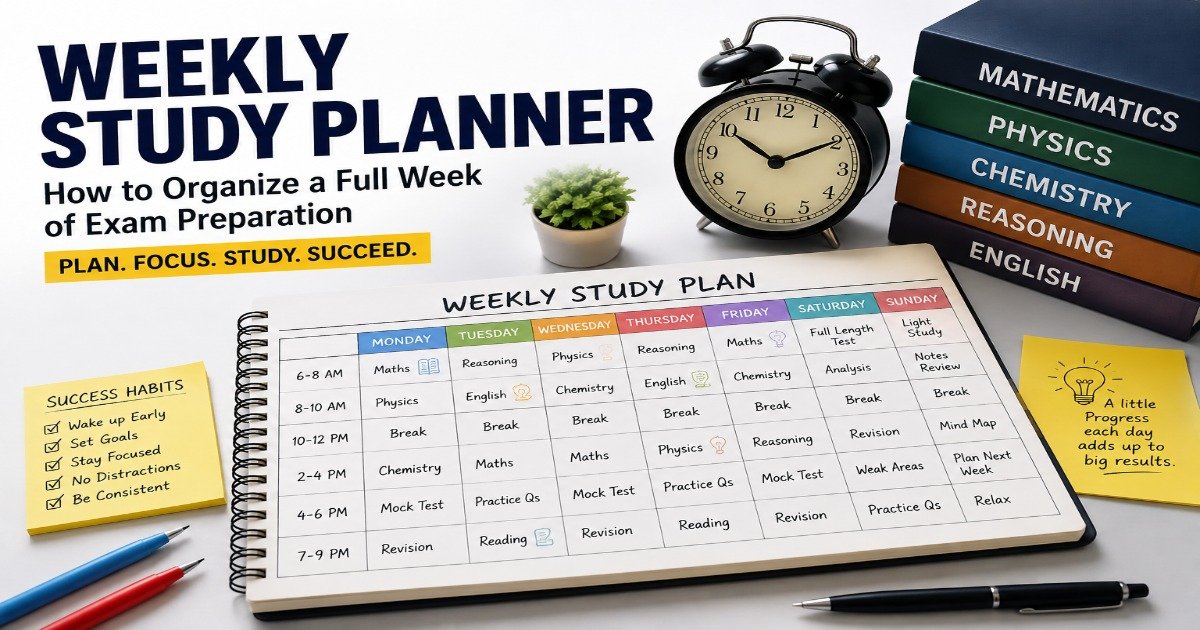
A single day of good studying rarely wins an exam. What actually decides the outcome is how well a student manages an entire week, every week, for months in a row. Daily planning helps with today’s tasks, but it often misses the bigger picture: are all subjects getting fair time, is revision keeping pace with new topics, and is there room for rest before the cycle repeats. A weekly study planner solves exactly this gap by giving students a wider view of their preparation, one full week at a time.
This article explains why weekly planning matters, what a good weekly study planner should contain, and how students can use one to prepare for competitive exams without losing balance or consistency.
Why a Single Day’s Plan Is Not Enough
Daily planners are useful for managing hours, but they are short-sighted by design. A student following only daily plans often runs into these patterns without realizing it.
| Problem With Daily-Only Planning | Result Over Time |
|---|---|
| Favorite subjects get planned first, every day | Weaker subjects fall further behind |
| No fixed day for revision | Old topics are forgotten before exams |
| No visibility into the coming week | Sudden clashes with tests or deadlines |
| No planned rest day | Fatigue builds up unnoticed |
A weekly planner catches these issues early because it forces a student to look at the full seven days together, not one isolated day at a time.
What a Weekly Study Planner Should Include
A well-designed weekly planner is more than seven daily boxes placed side by side. It should give a clear, connected view of the whole week.
| Section | Purpose |
|---|---|
| Weekly Subject Grid | Assigns each subject to specific days across the week |
| Daily Time Blocks | Breaks each day into focused study slots |
| Weekly Priority List | Highlights the two or three most important goals for the week |
| Revision Day | Reserves at least one day purely for revisiting earlier topics |
| Test/Deadline Tracker | Notes any exams, mock tests, or submissions due that week |
| Rest and Buffer Time | Sets aside time for breaks or unfinished tasks to prevent overload |
This structure keeps daily study connected to a larger weekly goal, instead of each day existing in isolation.
How Weekly Planning Improves Exam Preparation
1. Balanced Coverage Across Subjects
When a full week is mapped out in advance, it becomes obvious if one subject is getting far more time than another. This visibility makes it easy to correct the imbalance before it becomes a habit.
2. Built-In Revision Cycle
Competitive exams reward retention, not just first-time learning. A weekly planner that reserves fixed slots for revision ensures older topics are reviewed regularly instead of being pushed aside for new material.
3. Realistic Handling of Deadlines
Assignments, mock tests, and mini-deadlines are far easier to manage when they are visible for the whole week rather than discovered a day before they are due. A weekly view gives enough lead time to prepare properly.
4. Reduced Weekly Overload
Daily planning alone can lead to overloaded days without warning. Weekly planning spreads the same workload more evenly, since a student can shift tasks between days based on what the rest of the week already looks like.
5. Clearer Sense of Progress
Reviewing a completed weekly planner at the end of seven days gives a much stronger sense of progress than reviewing a single day. This wider view helps students notice patterns, both good and bad, in their preparation.
6. Built-In Rest, Not Accidental Burnout
Without a weekly view, rest days often happen only when a student feels too exhausted to continue. Planning a rest or lighter day in advance turns recovery into a scheduled part of preparation rather than an emergency response to burnout.
How to Fill a Weekly Study Planner
| Step | Action |
|---|---|
| Step 1 | List all subjects or topics that need attention this week |
| Step 2 | Assign each subject to two or three specific days, not every day |
| Step 3 | Reserve one day mainly for revision of earlier material |
| Step 4 | Mark any tests, mock exams, or deadlines falling within the week |
| Step 5 | Set two or three top priorities for the week, not a long list |
| Step 6 | Divide each study day into time blocks matching the day’s assigned subjects |
| Step 7 | Leave at least one lighter day or half-day for rest and buffer |
| Step 8 | Review the completed week briefly before planning the next one |
Filling the planner at the start of the week, ideally on a Sunday or the night before the week begins, takes only a few minutes but sets the direction for the entire week.
Common Mistakes to Avoid With Weekly Planning
| Mistake | Why It Fails |
|---|---|
| Assigning every subject to every day | Leads to shallow coverage instead of focused study |
| Skipping the revision day | Older topics fade from memory by exam time |
| Planning every day at full intensity | Leaves no room for setbacks or unexpected events |
| Not reviewing the previous week | Repeats the same imbalance week after week |
| Treating the plan as fixed and unchangeable | Small adjustments become impossible, and the plan gets abandoned |
A weekly planner works best when it is treated as a flexible guide, adjusted slightly each week based on what worked and what did not.
Daily Planner vs Weekly Planner: When to Use Each
| Aspect | Daily Planner | Weekly Planner |
|---|---|---|
| Time Frame | One day | Seven days |
| Best For | Managing hour-by-hour tasks | Balancing subjects and long-term goals |
| Revision Tracking | Limited | Built into the structure |
| Deadline Visibility | Only same-day | Full week in advance |
| Ideal Use | Daily execution | Weekly strategy |
Most successful study routines use both together: a weekly planner to set the direction, and a daily planner to execute it hour by hour.
Who Benefits Most From Weekly Planning
| Student Type | How Weekly Planning Helps |
|---|---|
| School students | Balances homework, tuition, and revision across the week |
| College students | Manages coursework alongside competitive exam preparation |
| Competitive exam aspirants | Structures long preparation cycles across multiple subjects |
| Working professionals preparing for exams | Fits study realistically around a fixed weekly work schedule |
Frequently Asked Questions
It is a planning tool that maps out study subjects, revision time, deadlines, and rest across a full seven-day period instead of a single day.
A daily planner manages hour-by-hour tasks for one day, while a weekly planner gives a broader view that balances subjects, revision, and deadlines across the whole week.
This depends on individual strengths and exam requirements, but weaker subjects generally need more weekly slots than subjects a student is already confident in.
Yes. Including at least one lighter day or rest period prevents burnout and keeps the overall pace sustainable.
Ideally at the start of the week, such as Sunday evening, so the entire week ahead is already mapped out.
Yes. It should be treated as a flexible guide, and shifting tasks between days is normal when priorities change.
Yes. Competitive exams cover multiple subjects over long periods, and weekly planning ensures no subject is neglected while keeping revision consistent.






Leave a Comment