
India’s judiciary has gained five new appointees across two High Courts. The Ministry of Law and Justice notified these appointments on Tuesday, September 8, 2026, following recommendations from the Supreme Court Collegium. Union Law Minister Arjun Ram Meghwal announced the development on social media platform X.
In exercise of the powers conferred by the Constitution of India, in consultation with Chief Justice of India, the President is pleased to appoint the following Advocate/Judicial Officers as Judges / Additional Judges in the High Courts:- pic.twitter.com/CMrkgW4FzQ
— Arjun Ram Meghwal (@arjunrammeghwal) September 8, 2026
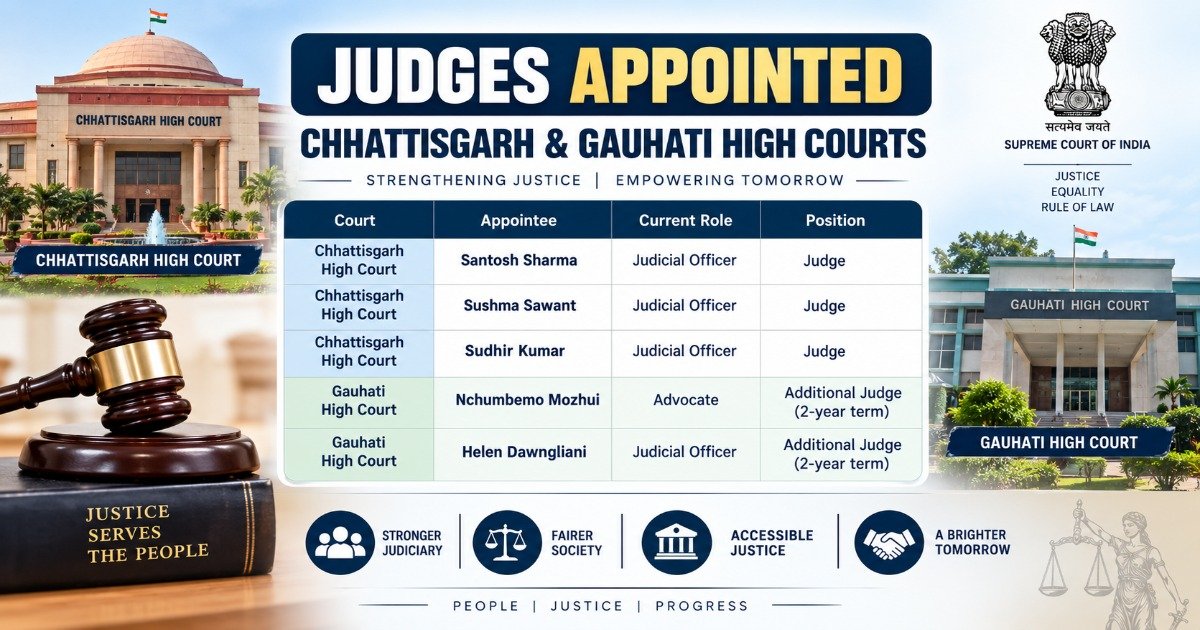
The appointments span two separate benches. Three judicial officers have been appointed as Judges of the Chhattisgarh High Court, while one advocate and one judicial officer have been appointed as Additional Judges of the Gauhati High Court. Both sets of appointments were made by the President of India, in exercise of powers conferred by the Constitution and in consultation with the Chief Justice of India.
Quick Facts: The New Judicial Appointments
- Notified by: Ministry of Law and Justice
- Notification date: September 8, 2026
- Announced by: Union Law Minister Arjun Ram Meghwal
- Chhattisgarh High Court appointees: 3 (as regular Judges)
- Gauhati High Court appointees: 2 (as Additional Judges, two-year term)
- Constitutional provision (Gauhati appointments): Article 224(1)
- SC Collegium recommendation (Gauhati): August 18, 2026
- Gauhati HC working strength before appointments: 24 judges (against a sanctioned strength of 30)
Who Has Been Appointed to the Chhattisgarh High Court?
Three judicial officers have been notified as Judges of the Chhattisgarh High Court. The appointees are Santosh Sharma, Sushma Sawant, and Sudhir Kumar, all of whom currently serve as judicial officers rather than practising advocates.
Unlike the Gauhati appointments, these three appointees have been notified directly as Judges of the Chhattisgarh High Court, rather than as Additional Judges. This distinction matters within India’s judicial appointment framework, since Additional Judge appointments typically carry a fixed initial term, while regular Judge appointments do not carry the same time-limited structure.
Who Has Been Appointed to the Gauhati High Court?
Two appointees have been notified as Additional Judges of the Gauhati High Court: Advocate Nchumbemo Mozhui and Judicial Officer Helen Dawngliani. Their appointments were made under Article 224(1) of the Constitution, and both will serve as Additional Judges for a period of two years.
The Supreme Court Collegium had recommended this pair for judgeship on August 18, 2026. According to the collegium’s recommendation, Mozhui, an advocate, and Dawngliani, a judicial officer, were jointly approved for elevation to the Gauhati High Court. Their appointments will take effect from the date each of them formally assumes charge of their respective office.
New Judicial Appointments: Key Facts at a Glance
| Court | Appointee | Current Role | Position |
|---|---|---|---|
| Chhattisgarh High Court | Santosh Sharma | Judicial Officer | Judge |
| Chhattisgarh High Court | Sushma Sawant | Judicial Officer | Judge |
| Chhattisgarh High Court | Sudhir Kumar | Judicial Officer | Judge |
| Gauhati High Court | Nchumbemo Mozhui | Advocate | Additional Judge (2-year term) |
| Gauhati High Court | Helen Dawngliani | Judicial Officer | Additional Judge (2-year term) |
How Judicial Appointments Work in India
These appointments followed India’s established constitutional process for elevating judges to High Courts. Under this system, the Supreme Court Collegium, led by the Chief Justice of India, first reviews and recommends candidates for judgeship. The Central Government then formally notifies these appointments once the President grants approval.
For Additional Judge appointments specifically, such as those made to the Gauhati High Court in this round, Article 224(1) of the Constitution allows the President to appoint additional judges for a defined period, typically two years, to help address a High Court’s workload or vacancies. Regular Judge appointments, like those made to the Chhattisgarh High Court, do not carry this same fixed-term structure.
Addressing Vacancies at the Gauhati High Court
Before these two new appointments, the Gauhati High Court operated with a working strength of 24 judges against its sanctioned strength of 30. This meant the court was functioning with six fewer judges than its approved capacity, even before accounting for these latest additions.
Adding Mozhui and Dawngliani as Additional Judges helps narrow this gap somewhat, though the court’s working strength will still likely remain below its full sanctioned capacity even after their appointments take effect. Addressing judicial vacancies of this kind remains an ongoing priority for High Courts across India, given the direct impact vacant judgeships can have on case backlogs and disposal timelines.
Why These Appointments Matter
Timely judicial appointments play a critical role in maintaining the functioning of India’s High Courts. Every vacancy left unfilled can contribute to slower case disposal and a growing backlog, making each new appointment a meaningful step toward keeping courts adequately staffed relative to their caseload.
These particular appointments also reflect the ongoing collaborative process between the Supreme Court Collegium and the Central Government in staffing India’s High Courts. The recommendation-to-notification pipeline seen in this case, from the collegium’s August 18 recommendation to the government’s September 8 notification for the Gauhati appointments, illustrates the typical sequence through which India fills judicial vacancies at the High Court level.
Frequently Asked Questions (FAQs)
About the Appointments
Five appointees in total were notified: three as Judges of the Chhattisgarh High Court and two as Additional Judges of the Gauhati High Court.
Santosh Sharma, Sushma Sawant, and Sudhir Kumar, all judicial officers, were appointed as Judges of the Chhattisgarh High Court.
Advocate Nchumbemo Mozhui and Judicial Officer Helen Dawngliani were appointed as Additional Judges of the Gauhati High Court.
The Ministry of Law and Justice notified the appointments on September 8, 2026.
Union Law Minister Arjun Ram Meghwal announced the appointments on social media platform X.
Process and Context
The Gauhati High Court Additional Judges were appointed under Article 224(1) of the Constitution of India.
Nchumbemo Mozhui and Helen Dawngliani will serve as Additional Judges for a period of two years.
The collegium recommended the appointments on August 18, 2026.
The court had a working strength of 24 judges against a sanctioned strength of 30 before these two new Additional Judges were appointed.
The Supreme Court Collegium, led by the Chief Justice of India, recommends candidates for judgeship, after which the Central Government formally notifies the appointment following the President’s approval.






Leave a Comment