
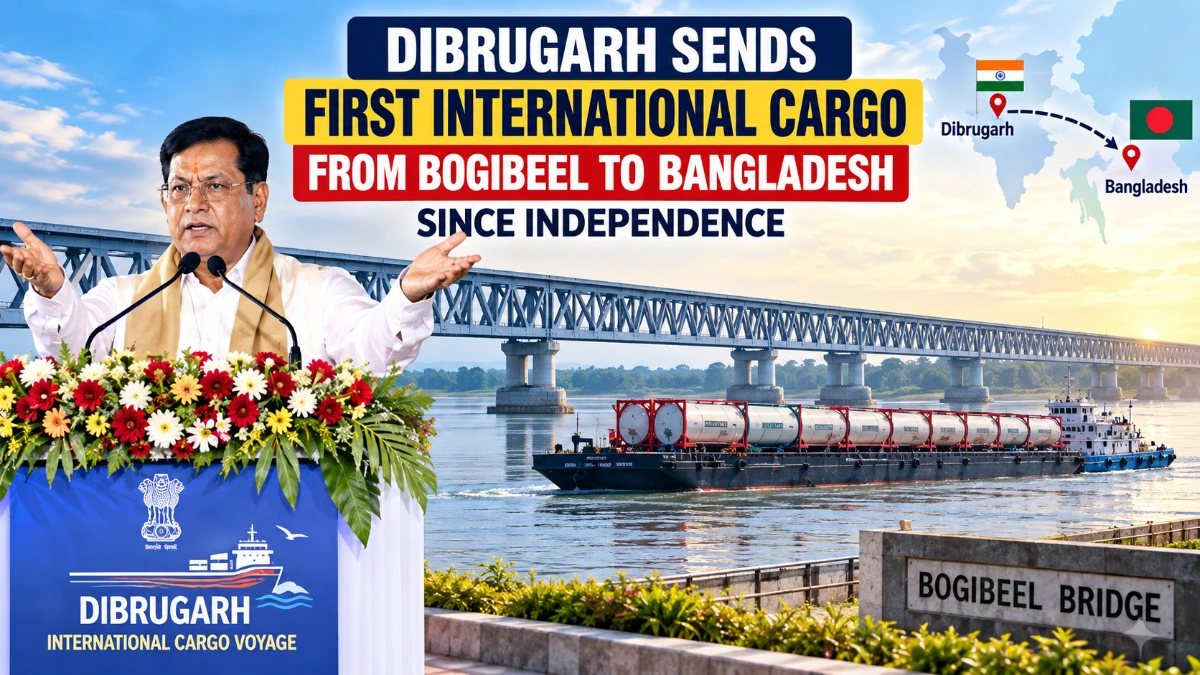
In a monumental achievement for India’s inland navigation and regional cross-border commerce, Dibrugarh sends first international cargo from the Bogibeel Terminal in Assam to Dhaka, Bangladesh, on October 5, 2026. Flagged off by Union Minister of Ports, Shipping and Waterways Sarbananda Sonowal, alongside Assam Chief Minister Dr. Himanta Biswa Sarma who joined virtually, this historic voyage marks the first time since India’s Independence in 1947 that commercial export freight has sailed directly from Upper Assam to an international port.
Carrying a massive industrial consignment of 540 metric tonnes of green methanol produced by Assam Petro-Chemicals Limited (APCL), the cargo vessel DLB Patkai, pushed by the tug Kushal Konwar, set sail along National Waterway-2 (River Brahmaputra). The vessel is navigating through the Indo-Bangladesh Protocol Route (IBPR) to dock at the Pangaon Inland Container Terminal near Dhaka, covering a total distance of approximately 1,300 kilometers.
Quick Fact Sheet: Maiden Bogibeel International Cargo Voyage
| Parameter | Official Details |
|---|---|
| Milestone Event | Dibrugarh Sends First International Cargo Since Independence |
| Departure Date | October 5, 2026 |
| Departure Terminal | Bogibeel Inland Water Terminal, Dibrugarh, Assam |
| Destination Port | Pangaon Inland Container Terminal, Dhaka, Bangladesh |
| Vessels Deployed | Barge DLB Patkai (Pushed by Tug Kushal Konwar) |
| Cargo Consignment | 540 Metric Tonnes (MT) of Methanol |
| Cargo Manufacturer | Assam Petro-Chemicals Limited (APCL), Namrup |
| Total Navigational Distance | Approximately 1,300 Kilometers |
| Waterway Network | National Waterway-2 (NW-2) via Indo-Bangladesh Protocol Route (IBPR) |
| Dignitaries Present | Union Minister Sarbananda Sonowal & Assam CM Dr. Himanta Biswa Sarma |
5 Historic Facts: Dibrugarh Sends First International Cargo
Here are the 5 major historic facts and strategic breakthroughs established by this maiden voyage from Bogibeel:
1. First Direct Foreign Export from Upper Assam in 79 Years
Prior to India’s Independence and partition in 1947, the Brahmaputra River served as a bustling commercial waterway, transporting tea, timber, and crude from Upper Assam directly to ports in the Bay of Bengal. Since 1947, direct commercial riverine shipping from Dibrugarh to a foreign nation remained dormant. This voyage officially re-establishes Dibrugarh’s status as an international river port after a hiatus of nearly eight decades.
2. Deployment of Dedicated Fleet: DLB Patkai and Kushal Konwar
The maiden voyage utilized modern inland navigation vessels engineered for shallow-draft river transit. The cargo was loaded onto the specialized deck-loading barge DLB Patkai, which is propelled and maneuvered by the powerful inland pusher-tug Kushal Konwar, ensuring safe navigation through braided river channels, sandbars, and varying depths across the Brahmaputra.
3. Maiden Industrial Export of 540 Metric Tonnes of Methanol
The shipment carried 540 metric tonnes of methanol in specialized secure containers, manufactured by state-run Assam Petro-Chemicals Limited (APCL) at Namrup. This marks the first time indigenously manufactured petrochemicals from Assam are being exported via inland waterways, establishing a cost-effective export pipeline to industrial consumers in Bangladesh.
4. Comprehensive 1,300-Kilometer Navigational Route
The journey covers an extensive inland waterway network spanning two nations:
- Indian Leg (NW-2): Navigating approximately 783 kilometers downstream along the Brahmaputra River from Bogibeel (Dibrugarh), passing Neamati, Pandu (Guwahati), and Jogighopa, to reach the customs border terminal at Dhubri.
- Bangladesh Leg (IBPR): Crossing into Bangladesh at Chilmari and traversing the Jamuna and Padma river systems along the designated Indo-Bangladesh Protocol Route for over 500 kilometers to reach the Pangaon Container Terminal near Dhaka.
5. Cost-Effective, Green Alternative to the Siliguri Corridor
Currently, cargo originating from the Northeast must travel over congested road and rail networks through the narrow Siliguri Corridor (popularly called the “Chicken’s Neck”). Utilizing inland waterways slashes freight logistics costs by 30% to 40% and drastically lowers carbon emissions, providing an eco-friendly transport corridor aligned with the PM Gati Shakti National Master Plan and India’s Act East Policy.
Infrastructure Spotlight: Bogibeel Terminal as a Multimodal Hub
The dispatch of this international cargo shipment confirms the operational transformation of the Bogibeel Terminal in Dibrugarh:
- Strategic Geography: Located adjacent to the historic Bogibeel Bridge, the terminal connects Upper Assam and eastern Arunachal Pradesh to the National Waterways network.
- Modern Amenities: Developed by the Inland Waterways Authority of India (IWAI), the terminal features heavy cargo berths, automated material-handling cranes, roll-on/roll-off (Ro-Ro) vessel ramps, and round-the-clock digital river navigation aids.
- Economic Ripple Effect: Direct waterborne access enables local agricultural produce, tea consignments, coal, and petrochemicals from Upper Assam and neighbouring northeastern states to access international ocean terminals without costly multi-point road transfers.
Static GK: National Waterway-2 & Indo-Bangladesh Protocol Route
For candidates preparing for competitive examinations, understanding the statutory profile of India’s inland waterways is essential:
- National Waterway-2 (NW-2):
- Declared Year: 1988.
- River: Brahmaputra River.
- Terminals / Stretch: Sadiya to Dhubri (Assam).
- Total Length: 891 Kilometers.
- Major River Ports: Sadiya, Dibrugarh (Bogibeel), Neamati, Tezpur, Silghat, Pandu (Guwahati), Jogighopa, and Dhubri.
- Indo-Bangladesh Protocol on Inland Water Transit and Trade (IBPR):
- Concluded in: 1972 (regularly updated to add new ports of call and extended routes).
- Objective: Facilitates bilateral waterborne commerce between India and Bangladesh and allows transit freight movement between the Indian mainland and the northeastern states.
- Inland Waterways Authority of India (IWAI):
- Statutory Establishment: Established on October 27, 1986, under the Inland Waterways Authority of India Act, 1985.
- Headquarters: Noida, Uttar Pradesh.
- Parent Ministry: Ministry of Ports, Shipping and Waterways (MoPSW).
High-Yield Takeaways for UPSC, SSC & APSC Exams
- Milestone: Dibrugarh sends first international cargo to Bangladesh since 1947.
- Departure Terminal: Bogibeel Inland Water Terminal, Dibrugarh, Assam.
- Destination Port: Pangaon Inland Container Terminal, Dhaka, Bangladesh.
- Vessel Name: Barge DLB Patkai pushed by tug Kushal Konwar.
- Cargo Details: 540 Metric Tonnes of Methanol by Assam Petro-Chemicals Limited (APCL).
- Navigational Distance: Approx. 1,300 km (NW-2 and IBPR).
- Key Policy Alignment: Act East Policy and PM Gati Shakti.
Practice Questions for Competitive Exams
Multiple Choice Questions (MCQs)
Q1. Which specialized vessel transported the first international cargo shipment from Bogibeel (Dibrugarh) to Bangladesh in October 2026?
- (a) MV Ganga Vilas
- (b) Barge DLB Patkai (pushed by tug Kushal Konwar)
- (c) MV Ram Prasad Bismil
- (d) Barge Brahmaputra Star
Answer: (b) Barge DLB Patkai (pushed by tug Kushal Konwar)
Q2. What quantity of methanol was shipped on the maiden international cargo voyage from Dibrugarh to Dhaka?
- (a) 250 Metric Tonnes
- (b) 380 Metric Tonnes
- (c) 540 Metric Tonnes
- (d) 750 Metric Tonnes
Answer: (c) 540 Metric Tonnes
Q3. Consider the following statements regarding National Waterway-2 (NW-2):
- It is defined along the Brahmaputra River from Sadiya to Dhubri, spanning 891 km.
- The Bogibeel Terminal at Dibrugarh serves as an international multimodal river port along NW-2.
- The Indo-Bangladesh Protocol on Inland Water Transit and Trade (IBPR) was first signed in 1972.
Which of the statements given above are correct?
- (a) 1 and 2 only
- (b) 2 and 3 only
- (c) 1 and 3 only
- (d) 1, 2, and 3
Answer: (d) 1, 2, and 3
Frequently Asked Questions (FAQs)
What is the historical significance of the fact that Dibrugarh sends first international cargo?
It is historic because Dibrugarh sends first international cargo directly to a foreign destination for the first time since India’s Independence in 1947, restoring the Brahmaputra’s legacy as a commercial river highway to Bangladesh.
Which vessels were used for this maiden international cargo voyage?
The cargo was transported on the deck-loading barge DLB Patkai, propelled and navigated by the pusher-tug Kushal Konwar.
What cargo was transported from Bogibeel to Bangladesh?
The vessel carried 540 metric tonnes of methanol manufactured by state-owned Assam Petro-Chemicals Limited (APCL) located in Namrup, Assam.
What is the total travel distance of the voyage from Dibrugarh to Dhaka?
The voyage spans approximately 1,300 kilometers, comprising around 783 km along National Waterway-2 (Brahmaputra) in India and over 500 km along the Indo-Bangladesh Protocol Route (IBPR) in Bangladesh.
Where is Pangaon Port located?
Pangaon Inland Container Terminal is located on the Buriganga River in Dhaka, Bangladesh, functioning as a premier inland container terminal for river-sea freight.
How does this voyage benefit trade in Northeast India?
It reduces freight logistics costs by 30% to 40% compared to road transport, avoids the congested Siliguri Corridor, lowers greenhouse emissions, and provides a direct export corridor for northeastern goods to international markets.
Also Check : India Cheetah Population Reaches 60: 5 Major Official Facts on Kuno Birth in 2026






Leave a Comment