
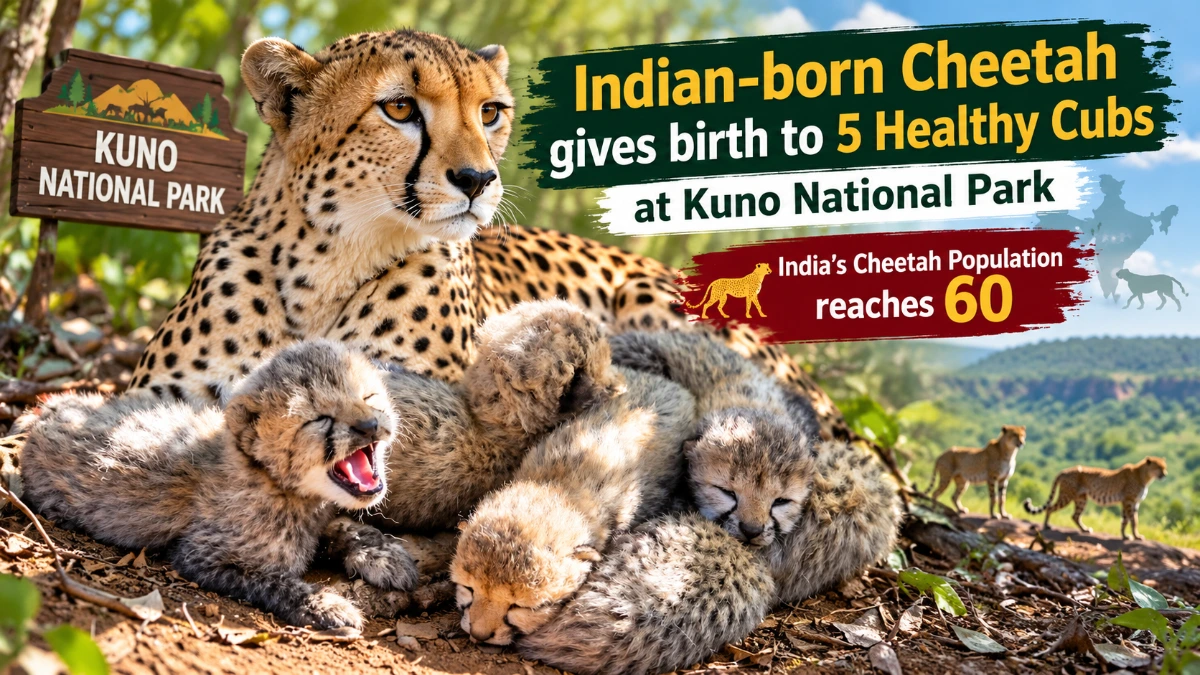
In an extraordinary conservation milestone for global wildlife rewilding, India cheetah population reaches 60 following the birth of five healthy cubs at Kuno National Park (KNP) in Madhya Pradesh on October 5, 2026. The historic litter was delivered by KJP21, a 32-month-old female cheetah who was herself born on Indian soil.
Announced officially by Union Minister for Environment, Forest and Climate Change (MoEFCC) Bhupender Yadav, this landmark birth marks the flourishing of second-generation Indian-born cheetahs. With this latest addition of five cubs, the total count of Indian-born cheetahs in the country has risen to 41, demonstrating that the translocated species has successfully adapted to the grassland-woodland ecosystem of the Vindhyan landscape.
Another historic and joyous milestone for Project Cheetah! 🐆❤️ KJP21, a 32-month-old Indian-born female cheetah, has given birth to five healthy cubs in Kuno National Park today. KJP21 is the third Indian-born female cheetah to give birth, after Mukhi and KGP12—an important milestone in the emergence of the next generation of India’s cheetah population. With the arrival of these five cubs, the cheetah population in India has reached 60, including 41 Indian-born cheetahs. Importantly, these cubs also mark the beginning of the Botswanan lineage in India, as their father is a Botswanan male cheetah—adding a new genetic lineage to India’s growing cheetah population. Another generation born on Indian soil, adding yet another beautiful chapter to the remarkable story of cheetah reintroduction in India. Heartfelt congratulations to the veterinarians, field staff, managers and everyone associated with Project Cheetah, whose dedication, commitment and tireless efforts have made these moments possible. Welcome to the world, little ones 🐆 #WildlifeWeek2026
— Bhupender Yadav (@byadavbjp) October 5, 2026
Quick Fact Sheet: Kuno National Park Cheetah Birth 2026
| Parameter | Official Details |
|---|---|
| Historic Milestone | India Cheetah Population Reaches 60 (5 New Cubs Born) |
| Location / Habitat | Kuno National Park (KNP), Sheopur district, Madhya Pradesh |
| Mother Cheetah | KJP21 (32-month-old, Indian-born female cheetah) |
| Father Cheetah | Male Cheetah translocated from Botswana |
| Litter Size | 5 Healthy Cubs |
| Generation Milestone | 3rd Indian-born female cheetah to reproduce (after Mukhi & KGP12) |
| Total Cheetah Count in India | 60 Individuals |
| Total Indian-Born Cheetahs | 41 Individuals |
| Official Announcement | Union Minister Bhupender Yadav (MoEFCC) |
| Nodal Agency | National Tiger Conservation Authority (NTCA) |
5 Major Official Facts: India Cheetah Population Reaches 60
Here are the 5 major official facts and ecological breakthroughs established by the latest birth at Kuno:
1. Total National Population Hits Milestone 60 (With 41 Born in India)
When Project Cheetah commenced in September 2022, critics questioned whether foreign big cats could survive and breed in Indian conditions. The birth of these five cubs has pushed the total national tally to 60 cheetahs. Remarkably, 41 of these 60 cheetahs are Indian-born, meaning that indigenously born felines now significantly outnumber the original surviving translocated adults, confirming reproductive stabilization.
2. KJP21 Becomes Third Indian-Born Female to Successfully Give Birth
The mother, KJP21, is a 32-month-old female born at Kuno National Park. By giving birth to a healthy litter of five, she has become the third Indian-born female cheetah to successfully reproduce in the wild, following the successful litters of “Mukhi” and “KGP12”. This confirms that female cubs born in India are reaching physiological maturity and reproducing naturally.
3. Historic Introduction of the Botswana Genetic Lineage
In wildlife reintroduction projects, genetic diversity is critical to avoid the dangers of inbreeding depression. The father of this new litter is a robust male cheetah brought to India from Botswana. This makes the new litter the first to establish a direct Botswanan-Indian genetic lineage, broadening the gene pool that originally comprised founder animals from Namibia and South Africa.
4. High Cub Survival Rates in Kuno’s Controlled Enclosures
While cheetah cub mortality in the African wild often exceeds 70% due to larger apex predators like lions and spotted hyenas, the dedicated monitoring protocol at Kuno National Park—managed by veterinary teams, forest trackers, and the Wildlife Institute of India (WII)—has ensured optimal nutritional support and protection from secondary infections.
5. Benchmark Validation for Global Intercontinental Rewilding
Project Cheetah stands as the world’s first intercontinental translocation of a large wild carnivore. Achieving a population milestone of 60 animals within four years validates India’s habitat restoration model, providing a strong template as authorities prepare Gandhi Sagar Wildlife Sanctuary in Madhya Pradesh as the second home for cheetahs.
Ecological Significance: Why Kuno’s Success Matters
The revival of the cheetah in India represents more than the return of a single charismatic big cat:
- Restoration of Open Forest & Grassland Ecosystems: Cheetahs are an “umbrella species” for savannahs and scrub forests. Conserving them directly protects lesser-known grassland fauna, including the blackbuck, chinkara, Indian wolf, and the endangered Great Indian Bustard.
- Overcoming Historical Extinction: The Asiatic cheetah (Acinonyx jubatus venaticus) was officially declared extinct in India in 1952, after the last three individuals were hunted down in 1947 in Koriya (present-day Chhattisgarh). Reintroducing the species restores India’s unique historical status as the only country in the world to host five major wild big cats: Lion, Tiger, Leopard, Snow Leopard, and Cheetah.
Static GK: Project Cheetah, NTCA & Protected Areas
For candidates preparing for competitive examinations, understanding the institutional framework of Project Cheetah is essential:
- Project Cheetah Launch: Formally launched on September 17, 2022, by Prime Minister Narendra Modi with the release of eight cheetahs from Namibia into special quarantine enclosures at Kuno.
- Second Batch Translocation: Twelve cheetahs were brought from South Africa in February 2023. Subsequent introductions included breeding stock from Botswana.
- Implementing Bodies:
- National Tiger Conservation Authority (NTCA), a statutory body under the Wildlife (Protection) Act, 1972.
- Madhya Pradesh Forest Department.
- Wildlife Institute of India (WII), Dehradun.
- Kuno National Park Profile:
- Location: Sheopur and Morena districts of Madhya Pradesh.
- River System: Kuno River (a major tributary of the Chambal River).
- Vegetation Type: Northern Tropical Dry Deciduous Forest dominated by Kardhai, Khair, and Salai trees interspersed with expansive grassy clearings.
- Alternative / Second Habitats Being Developed:
- Gandhi Sagar Wildlife Sanctuary: Located in Mandsaur and Neemuch districts of Madhya Pradesh (nearing completion for cheetah release).
- Nauradehi Wildlife Sanctuary: Located across Sagar, Damoh, and Narsinghpur districts of Madhya Pradesh.
African Cheetah vs. Asiatic Cheetah: Key Differences
| Feature | African Cheetah (Acinonyx jubatus jubatus) | Asiatic Cheetah (Acinonyx jubatus venaticus) |
|---|---|---|
| IUCN Status | Vulnerable (VU) | Critically Endangered (CR) |
| Global Population | ~6,500 to 7,000 in wild Africa | Survives only in Iran (< 40 individuals) |
| Physical Stature | Slightly larger, heavier build, prominent spots | Slightly smaller, shorter legs, thicker neck coat |
| Indian Translocation | Selected for Project Cheetah due to viable wild numbers | Could not be sourced due to extremely low global count |
High-Yield Takeaways for UPSC, SSC & State PSC Exams
- Milestone: India Cheetah Population Reaches 60.
- Location: Kuno National Park, Sheopur, Madhya Pradesh.
- Mother: KJP21 (32-month-old, Indian-born).
- Litter Size: 5 healthy cubs.
- Indian-Born Count: 41 out of 60 total cheetahs.
- Paternal Lineage: Botswana.
- Extinction Declared in India: 1952.
- Second Home Prepared: Gandhi Sagar Wildlife Sanctuary (MP).
Practice Questions for Competitive Exams
Multiple Choice Questions (MCQs)
Q1. With the birth of five cubs to female cheetah KJP21 in October 2026, what is the total population of cheetahs in India?
- (a) 48
- (b) 52
- (c) 60
- (d) 65
Answer: (c) 60
Q2. The female cheetah KJP21, which gave birth to five cubs at Kuno National Park, was mated with a male cheetah translocated from which country?
- (a) Namibia
- (b) South Africa
- (c) Botswana
- (d) Kenya
Answer: (c) Botswana
Q3. Consider the following statements regarding Project Cheetah in India:
- The Asiatic cheetah was officially declared extinct in India in 1952.
- Out of the total 60 cheetahs in India as of October 2026, 41 are Indian-born.
- Gandhi Sagar Wildlife Sanctuary in Madhya Pradesh is being prepared as the second home for cheetahs.
Which of the statements given above are correct?
- (a) 1 and 2 only
- (b) 2 and 3 only
- (c) 1 and 3 only
- (d) 1, 2, and 3
Answer: (d) 1, 2, and 3
Frequently Asked Questions (FAQs)
What is the new cheetah population count in India as of October 2026?
The India cheetah population reaches 60 following the birth of five healthy cubs at Kuno National Park, announced on October 5, 2026.
Who is KJP21, the mother of the five newborn cubs?
KJP21 is a 32-month-old female cheetah born in India at Kuno National Park. She is the third Indian-born female cheetah to give birth, following “Mukhi” and “KGP12”.
How many cheetahs in India were born on Indian soil?
Out of the total 60 cheetahs currently in India, 41 are Indian-born, signifying successful second-generation breeding and acclimatization.
What is the significance of the father cheetah being from Botswana?
The father being from Botswana introduces a new genetic lineage into India’s cheetah population, preventing inbreeding depression and ensuring strong genetic diversity alongside the Namibian and South African lineages.
Where is Kuno National Park located?
Kuno National Park is situated in the Sheopur and Morena districts of Madhya Pradesh, characterized by open grasslands, scrub woodlands, and the Kuno River basin.
When was the cheetah declared extinct in India, and when was Project Cheetah launched?
The cheetah was officially declared extinct in India in 1952. Project Cheetah was launched 70 years later on September 17, 2022, by Prime Minister Narendra Modi.
Also Check : NFR Recreates Historic Sukna Station: 5 Major Facts on 2026 DHR Revamp






Leave a Comment