
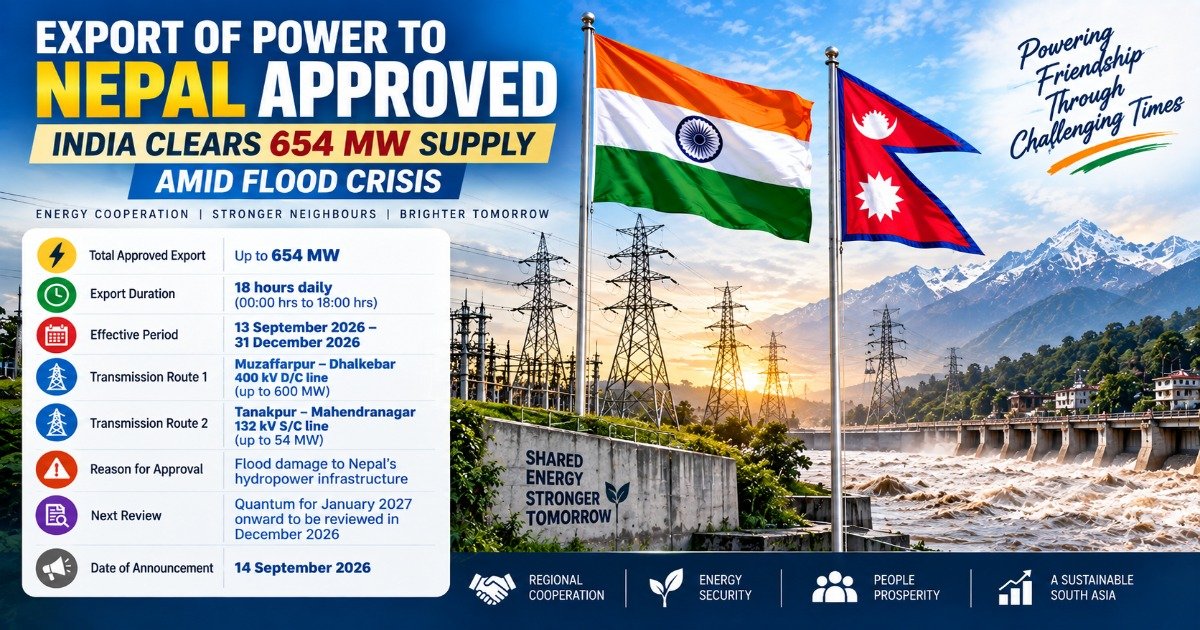
The Ministry of Power, Government of India, has approved the export of up to 654 MW of electricity to Nepal, offering critical energy support to the neighbouring country after devastating floods severely damaged its hydropower infrastructure. The approval covers supply to the Nepal Electricity Authority (NEA) for 18 hours a day, from 00:00 hours to 18:00 hours, effective from September 13, 2026, through December 31, 2026.
Quick Facts
| Detail | Information |
|---|---|
| Approving authority | Ministry of Power, Government of India |
| Recipient | Nepal Electricity Authority (NEA) |
| Total approved export | Up to 654 MW |
| Export duration | 18 hours daily (00:00 hrs to 18:00 hrs) |
| Effective period | September 13, 2026 – December 31, 2026 |
| Transmission Route 1 | Muzaffarpur–Dhalkebar 400 kV D/C line — up to 600 MW |
| Transmission Route 2 | Tanakpur–Mahendranagar 132 kV S/C line — up to 54 MW |
| Reason for approval | Flood damage to Nepal’s hydropower infrastructure |
| Next review | Quantum for January 2027 onward to be reviewed in December 2026 |
| Date of announcement | September 14, 2026 |
Why the Approval Was Needed
Nepal has been grappling with catastrophic flash floods, including a major flood event on the Bhotekoshi River, which damaged around a dozen power projects along with associated transmission infrastructure. The disruption has created a power shortfall of an estimated 350–400 MW, sharply cutting into Nepal’s domestic hydropower generation capacity precisely as the country enters its usual dry-season import period, when lower river flows already reduce output from its own hydropower plants.
Dirghayu Kumar Shrestha, acting managing director of the Nepal Electricity Authority, confirmed that Nepal had formally requested additional power from India to bridge this gap for the dry season, and that India had responded positively to the request.
How the Power Will Be Routed
The approved 654 MW export will flow through two designated cross-border transmission corridors:
- Muzaffarpur–Dhalkebar 400 kV double-circuit line – carrying up to 600 MW, the larger share of the export
- Tanakpur–Mahendranagar 132 kV single-circuit line – carrying up to 54 MW
Both lines are part of the existing India-Nepal cross-border power transmission network, which has expanded steadily over the past several years as bilateral energy trade between the two countries has grown.
Ministry of Power’s Statement
The Ministry noted that the approval would help Nepal meet its power requirements during this difficult period and further strengthen the close and longstanding energy cooperation between India and Nepal. It further reaffirmed that India remains committed to supporting Nepal and deepening bilateral cooperation in the energy sector. The Ministry also clarified that the quantum of power to be exported from January 2027 onward will be reassessed in December 2026, allowing both sides to evaluate Nepal’s power situation as damaged infrastructure is repaired.
Backdrop: Nepal’s Flood Crisis
This power export decision comes against the backdrop of a severe humanitarian crisis in Nepal:
- The death toll from the recent floods has reached 1,385, with 5,130 people still reported missing, according to the latest update from Nepal’s National Disaster Risk Reduction and Management Authority (NDRRMA), issued September 11, 2026.
- India has been actively supporting Nepal’s rescue, relief, and forensic operations, dispatching relief material and expert personnel through multiple special flights since August 26.
- As of the ministry’s update, an eighth Indian Air Force flight carrying humanitarian assistance had reached Kathmandu, part of a broader relief effort that has delivered more than 130 tonnes of supplies, including temporary shelters, blankets, and hygiene kits, along with 54 expert personnel to assist ground operations.
Broader Context: India-Nepal Power Trade
India and Nepal have steadily deepened their energy trade relationship in recent years:
- Nepal has transitioned from being a power importer to a net electricity exporter during its monsoon season, when hydropower output surges.
- An Agreement for Long-Term Power Trade between the two countries envisages Nepal exporting up to 10,000 MW of power to India over a 10-year period.
- Multiple new cross-border transmission lines of varying capacities are currently under construction to support future power cooperation between the two nations.
- This latest approval reverses the seasonal flow — with India stepping in to export power to Nepal — reflecting the flexible, two-way nature of the countries’ energy partnership, especially during periods of need.
Frequently Asked Questions
India has approved the export of up to 654 MW of electricity to the Nepal Electricity Authority.
The approval covers the period from September 13, 2026, to December 31, 2026, with exports permitted for 18 hours a day (00:00 to 18:00 hrs).
Recent devastating floods in Nepal, including flooding on the Bhotekoshi River, damaged hydropower infrastructure and reduced Nepal’s domestic power generation capacity, creating an urgent additional electricity requirement.
Up to 600 MW will flow through the Muzaffarpur–Dhalkebar 400 kV double-circuit line, and up to 54 MW through the Tanakpur–Mahendranagar 132 kV single-circuit line.
The Ministry of Power has said the quantum of power to be exported from January 2027 onward will be reviewed in December 2026, based on Nepal’s evolving power situation.
As per Nepal’s National Disaster Risk Reduction and Management Authority, the death toll from the floods reached 1,385, with 5,130 people still missing as of the latest available update.
It is part of a broader, growing energy partnership between India and Nepal, which includes a long-term agreement for Nepal to export up to 10,000 MW of hydropower to India over a decade, alongside ongoing humanitarian assistance from India during Nepal’s flood recovery.




Leave a Comment