
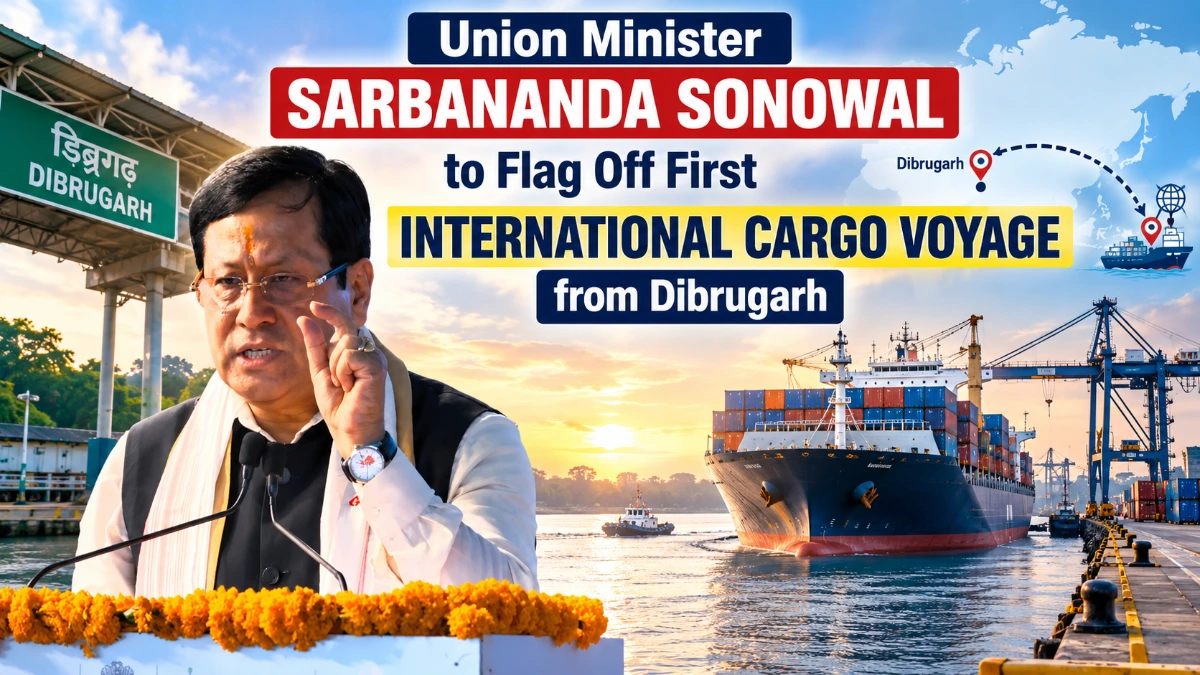
In an epoch-making breakthrough for India’s inland waterways and regional trade connectivity, the first international cargo voyage from Dibrugarh was officially flagged off on October 5, 2026, by Union Minister of Ports, Shipping and Waterways (MoPSW) Sarbananda Sonowal. The historic vessel sailed from the newly upgraded Bogibeel Terminal in Dibrugarh, Assam, carrying an export consignment of green methanol bound for Pangaon Port in Dhaka, Bangladesh.
The ceremony was attended virtually by Assam Chief Minister Dr. Himanta Biswa Sarma as the Chief Guest, alongside senior officials from the Inland Waterways Authority of India (IWAI) and the state government. The maiden voyage revitalizes the historic Brahmaputra riverine trade corridor for the first time since India’s Independence in 1947, charting a new era of commerce between Northeast India and neighboring nations under Prime Minister Narendra Modi’s Act East Policy and the PM Gati Shakti National Master Plan.
Quick Fact Sheet: Maiden Dibrugarh International Cargo Voyage
| Parameter | Official Details |
|---|---|
| Official Event | First International Cargo Voyage from Dibrugarh Flagged Off |
| Flagged Off By | Union Minister Sarbananda Sonowal (MoPSW) |
| Chief Guest (Virtual) | Assam Chief Minister Dr. Himanta Biswa Sarma |
| Flag-Off Date & Time | October 5, 2026 (11:00 AM IST) |
| Origin Terminal | Bogibeel River Terminal, Dibrugarh, Assam |
| Destination Port | Pangaon Inland Container Terminal, Dhaka, Bangladesh |
| Waterway Network | National Waterway-2 (NW-2) via Indo-Bangladesh Protocol Route (IBPR) |
| Cargo Consignment | Methanol (Produced by Assam Petro-Chemicals Limited – APCL) |
| Historical Milestone | First direct commercial export voyage from Upper Assam since 1947 |
| Nodal Agency | Inland Waterways Authority of India (IWAI) |
5 Historic Facts: First International Cargo Voyage from Dibrugarh
Here are the 5 major historic facts and strategic milestones established by this maiden voyage:
1. First Direct Foreign River Cargo from Upper Assam in 79 Years
Prior to India’s Independence and partition in 1947, the Brahmaputra River served as a thriving commercial lifeline, connecting the tea gardens, coal fields, and timber reserves of Upper Assam directly to the ports of Chittagong and Kolkata. For 79 years, this direct navigational link from Dibrugarh remained dormant. The 2026 voyage marks the first time since 1947 that commercial cargo has sailed directly from Dibrugarh to a foreign destination.
2. Strategic Utilization of NW-2 and the Indo-Bangladesh Protocol Route (IBPR)
The cargo vessel navigates along National Waterway-2 (River Brahmaputra) downstream through Guwahati and Dhubri before crossing into Bangladesh via the Indo-Bangladesh Protocol on Inland Water Transit and Trade (IBPR) route. Reaching Pangaon Port near Dhaka without road transshipment showcases the commercial viability of international river-sea integration.
3. Commercial Export of Methanol by Assam Petro-Chemicals Limited (APCL)
The maiden voyage transported an industrial consignment of methanol manufactured by state-run Assam Petro-Chemicals Limited (APCL), Namrup. This milestone marks the first international waterborne export of locally produced petrochemicals from Assam, opening up lucrative chemical export markets across Bangladesh and Southeast Asia.
4. Transformation of Bogibeel into an International River Port
The flag-off signifies the formal operationalization of the Bogibeel Terminal in Dibrugarh as an international multimodal river port. Equipped with heavy cargo handling machinery, roll-on/roll-off (Ro-Ro) ramps, and round-the-clock navigation aids, the terminal positions Dibrugarh as the prime logistics and export nucleus for Upper Assam, Arunachal Pradesh, and Nagaland.
5. Drastic Reduction in Logistics Costs and Carbon Footprint
By circumventing the congested, narrow Siliguri Corridor (popularly called the “Chicken’s Neck”), inland water transport slashes logistics expenditure by up to 30% to 40% compared to traditional road and rail freight. Furthermore, moving bulk petrochemicals via inland waterways reduces carbon emissions and fossil fuel consumption, supporting India’s green transport commitments.
Route & Navigation Architecture: From Dibrugarh to Dhaka
The navigational journey spans over 1,000 kilometers along a synchronized riverine highway:
- Origin Phase (NW-2): Originates at Bogibeel Terminal (Dibrugarh), sailing downstream on the Brahmaputra River past major river ports including Neamati (Jorhat), Pandu (Guwahati), and Jogighopa.
- Border Transit Point: The cargo clears customs and immigration at Dhubri Port, India’s designated border port of call on the Brahmaputra.
- IBPR Phase in Bangladesh: Entering Bangladeshi waters at Chilmari, the vessel follows the Jamuna and Padma rivers along designated protocol routes before docking at the modern Pangaon Inland Container Terminal near Dhaka.
Static GK: National Waterway-2 & Inland Waterways Authority of India (IWAI)
For candidates preparing for competitive examinations, understanding the statutory profile of India’s inland water network is essential:
- National Waterway-2 (NW-2):
- Declared Year: 1988.
- River System: Brahmaputra River.
- Stretch: Sadiya to Dhubri (along the India-Bangladesh border).
- Total Length: 891 Kilometers.
- Operational Centers: Pandu (Guwahati), Dhubri, Jogighopa, Bogibeel (Dibrugarh), and Silghat (Nagaon).
- Inland Waterways Authority of India (IWAI):
- Statutory Establishment: Set up on October 27, 1986, under the Inland Waterways Authority of India Act, 1985.
- Headquarters: Noida, Uttar Pradesh.
- Mandate: Development and regulation of National Waterways for shipping and navigation.
- Parent Ministry: Ministry of Ports, Shipping and Waterways (MoPSW).
- Indo-Bangladesh Protocol (IBPR):
- First Signed: 1972 (regularly renewed to enhance river trade and transit).
- Key Ports of Call: Dhubri, Pandu, Kolkata, Haldia, Karimganj, and Badarpur (India); Narayanganj, Khulna, Mongla, Sirajganj, Ashuganj, and Pangaon (Bangladesh).
High-Yield Takeaways for UPSC, SSC & State PSC Exams
- Milestone: First International Cargo Voyage from Dibrugarh.
- Flagged Off By: Union Minister Sarbananda Sonowal (MoPSW).
- Origin & Destination: Bogibeel Terminal (Dibrugarh, Assam) to Pangaon Port (Dhaka, Bangladesh).
- Commodity Transported: Methanol from Assam Petro-Chemicals Limited (APCL).
- Waterway Identity: National Waterway-2 (Brahmaputra) via Indo-Bangladesh Protocol Route (IBPR).
Practice Questions for Competitive Exams
Multiple Choice Questions (MCQs)
Q1. The first international cargo voyage from Dibrugarh flagged off in October 2026 transported which of the following commodities to Bangladesh?
- (a) Crushed Coal
- (b) CTC Assam Tea
- (c) Methanol
- (d) Limestone
Answer: (c) Methanol
Q2. National Waterway-2 (NW-2) is defined along which of the following river stretches?
- (a) Allahabad (Prayagraj) to Haldia on the Ganga
- (b) Sadiya to Dhubri on the Brahmaputra
- (c) Kottapuram to Kollam on the West Coast Canal
- (d) Kakinada to Puducherry on the Godavari-Krishna
Answer: (b) Sadiya to Dhubri on the Brahmaputra
Q3. Consider the following statements regarding inland water transport in Northeast India:
- National Waterway-2 spans 891 km on the Brahmaputra River from Sadiya to Dhubri.
- The maiden international cargo voyage from Dibrugarh originated at the Bogibeel Terminal and was bound for Pangaon Port in Dhaka.
- The Inland Waterways Authority of India (IWAI) was established as a statutory body in 1986.
Which of the statements given above are correct?
- (a) 1 and 2 only
- (b) 2 and 3 only
- (c) 1 and 3 only
- (d) 1, 2, and 3
Answer: (d) 1, 2, and 3
Frequently Asked Questions (FAQs)
What is the significance of the first international cargo voyage from Dibrugarh?
The first international cargo voyage from Dibrugarh marks the first time since India’s Independence in 1947 that commercial cargo has sailed directly from Upper Assam to a foreign port, restoring the historic Brahmaputra trade corridor to Bangladesh.
Who flagged off the first international cargo voyage from Dibrugarh?
The vessel carried an export consignment of methanol produced by Assam Petro-Chemicals Limited (APCL), Namrup.
What commodity was transported on this maiden international voyage?
The vessel carried an export consignment of methanol produced by Assam Petro-Chemicals Limited (APCL), Namrup.
What route does the cargo vessel follow to reach Dhaka?
The vessel navigates along National Waterway-2 (Brahmaputra River) from Dibrugarh to Dhubri, entering Bangladesh via the Indo-Bangladesh Protocol Route (IBPR) to dock at Pangaon Inland Container Terminal near Dhaka.
What is National Waterway-2 (NW-2)?
National Waterway-2 is an 891-kilometer navigable stretch of the Brahmaputra River extending from Sadiya to Dhubri in Assam, declared as a National Waterway in 1988.
How does this inland waterway route benefit Northeast India?
It reduces freight transportation costs by up to 40% compared to road transport, bypasses the congested Siliguri Corridor, cuts greenhouse gas emissions, and provides direct maritime export access to Bangladesh and Southeast Asian markets.
Also Check : Vithya Ramraj Shatters PT Usha Record: 5 Remarkable Historic Facts in 2026






Leave a Comment