
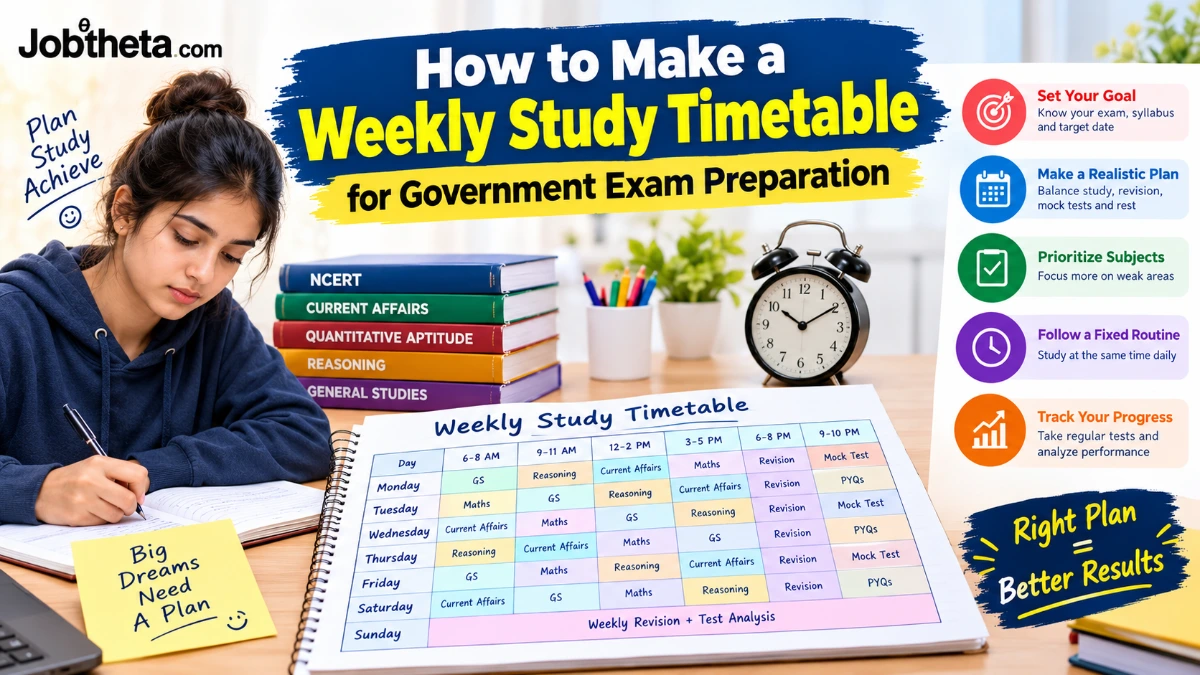
Preparing for prestigious civil and public sector posts requires more than just collecting recommended textbooks; it requires a structured daily execution plan. Crafting an effective weekly study timetable for government exam preparation is the single most important step you can take to bridge the gap between being an ordinary applicant and securing a top rank.
Whether your target is UPSC, SSC CGL, State PSCs, Banking (IBPS/SBI), or Railways, syllabus volume can easily feel overwhelming. Without a realistic roadmap, study sessions turn chaotic, consistency breaks down, and cognitive burnout takes over within weeks.
In this comprehensive guide, you will learn how to design a sustainable, flexible, and high-impact weekly study timetable for government exam preparation that guarantees steady progress without mental exhaustion.
Why You Need a Weekly Study Timetable for Government Exam Preparation
Most aspirants make the mistake of creating daily hour-by-hour to-do lists. While daily targets are useful, they fail to account for unpredictable interruptions, subject imbalances, and cumulative fatigue.
A dedicated weekly study timetable for government exam preparation offers distinct advantages:
- Strategic Subject Balancing: Prevents you from spending six consecutive days on General Studies while completely neglecting Quantitative Aptitude or English.
- Built-in Catch-Up Windows: Gives you scheduled buffer periods so that one missed morning does not derail your entire week.
- Optimized Retention Cycles: Aligns your daily schedule with spaced repetition principles, moving newly memorized facts into long-term memory.
- Stress Reduction: Replaces daily indecision about what to read with automated, disciplined study routines.
7 Steps to Build a Weekly Study Timetable for Government Exam Preparation
Step 1: Audit the Exam Syllabus and Weightage
Before putting pen to paper, review your official exam notification. Divide the entire syllabus into three practical categories:
- Core Conceptual Subjects: Topics requiring deep logical absorption, such as Polity, Indian Economy, and Advanced Mathematics.
- Speed & Skill Subjects: Topics mastered through muscle memory and practice drills, including Reading Comprehension, Reasoning Puzzles, and Mental Math.
- Dynamic Content: Subjects requiring daily tracking, such as Current Affairs, Banking Awareness, and Static General Knowledge.
Step 2: Calculate Your Real Available Study Hours
Never base your schedule on an imaginary 16-hour workday. Calculate your realistic net productive hours:
- Full-Time Aspirants: 8 to 9 high-efficiency hours per day (48 to 54 hours weekly).
- Working Professionals: 4 to 5 focused hours per day (28 to 32 hours weekly with weekend study blocks).
Step 3: Implement the 3-Block Daily Energy System
Group your hours according to your natural cognitive alertness:
- Morning Block (Peak Alertness): Reserve for your hardest conceptual subject or comprehensive syllabus coverage.
- Afternoon Block (Applied Focus): Dedicate to solving previous year questions (PYQs) and sectional practice quizzes.
- Evening Block (Consolidation): Review the day’s current affairs, take short quizzes, and revise formula sheets or flashcards.
Step 4: Follow the “5 + 1 + 1” Weekly Rule
A bulletproof weekly study timetable for government exam preparation should divide the seven days of the week strategically:
- Monday to Friday (5 Days): Heavy conceptual learning and new syllabus acquisition.
- Saturday (1 Day): Full-length mock exams and deep performance error logging.
- Sunday (1 Day): Systematic weekly revision and buffer backlog clearance.
Step 5: Embed Spaced Repetition into Every Slot
Reviewing notes only once before an exam guarantees forgetting the majority of the material. Your timetable must mandate daily 30-minute recall sessions and a comprehensive weekly review every Sunday.
Step 6: Maintain a Strict Saturday Backlog Slot
Unforeseen delays will occur. Instead of feeling guilty and reorganizing your upcoming weekdays, park all incomplete tasks into a dedicated 3-hour Saturday afternoon backlog window.
Step 7: Conduct a Weekly Sunday Audit
Every Sunday evening, calculate your weekly slot completion percentage. If your completion rate is above 80%, maintain your pace; if it drops below 60%, recalibrate your targets to avoid burnout.
Weekly Study Timetable for Government Exam Preparation for Full-Time Aspirants
This 7-day schedule is engineered for aspirants dedicating their entire day to competitive exam preparation, targeting 8 to 9 productive hours daily.
| Day | Slot 1: Morning Focus (06:30 AM – 12:00 PM) | Slot 2: Afternoon Practice (02:30 PM – 05:00 PM) | Slot 3: Evening Revision (06:00 PM – 09:30 PM) |
|---|---|---|---|
| Monday | Current Affairs + Core Subject 1 (Polity / History) | Quantitative Aptitude (Topic Drills) | Sectional Quiz + Day’s Quick Revision |
| Tuesday | Current Affairs + Core Subject 2 (Economy / Geography) | Reasoning & Logical Puzzles | Static GK Recall + Error Log Update |
| Wednesday | Current Affairs + Core Subject 1 (Polity / History) | Quantitative Aptitude (Advanced Practice) | English Grammar Rules & Vocab Review |
| Thursday | Current Affairs + Core Subject 2 (Science & Tech / Environment) | English Comprehension & Cloze Tests | Sectional Mock Test & Speed Drill |
| Friday | Current Affairs + Weak Topic Deep Dive | Mixed Practice Set (Quant + Reasoning) | Weekly Current Affairs Consolidation |
| Saturday | Full-Length Mock Test (Strict Exam Conditions) | Mock Test Detailed Error Analysis | Saturday Backlog Clearance Window |
| Sunday | Spaced Repetition of All Week’s Notes | Formula & Rule Revision | Physical Rest & Upcoming Week Planning |
Weekly Study Timetable for Government Exam Preparation for Working Professionals
For working candidates, consistency on weekdays combined with high-volume weekend sessions provides an ideal balance.
| Time Slot | Target Focus Area | Planned Hours |
|---|---|---|
| 05:30 AM – 07:30 AM | Core Conceptual Theory (Undivided Focus) | 2.0 Hours |
| Commute / Lunch Breaks | Daily News Editorial, Mobile Quizzes, Vocab Flashcards | 1.0 Hour |
| 07:30 PM – 09:30 PM | Problem Solving, PYQs, and Math/Reasoning Drills | 2.0 Hours |
| Saturday | Extended 7-Hour Block: Mock Tests & In-Depth Analysis | 7.0 Hours |
| Sunday | Extended 7-Hour Block: Comprehensive Revision & Weak Topics | 7.0 Hours |
5 Practical Rules to Sustain Your Study Routine for Months
Adhering to your weekly study timetable for government exam preparation requires smart psychological systems:
- Protect the First Hour of Your Morning: Avoid checking social media feeds or message boards upon waking. Start your morning with a clear mind to protect sustained cognitive focus.
- Use the 50/10 Study Interval: Work with intense focus for 50 minutes, then take a mandatory 10-minute break away from all screens.
- The Two-Day Rule: Never allow yourself to miss your scheduled study blocks two days in a row. A one-day pause is necessary rest; a two-day pause begins a negative habit.
- Maintain an Error Notebook: Whenever you take a mock test, record every question you got wrong and review that notebook every Saturday evening.
- Protect Your Sleep: A full 7 to 8 hours of uninterrupted sleep is biologically essential for memory consolidation and sharp analytical performance.
Frequently Asked Questions (FAQ)
How many hours are ideal in a weekly study timetable for government exam preparation?
A realistic benchmark is 48 to 55 focused hours per week for full-time candidates, and 28 to 32 hours per week for working candidates. Consistent, high-efficiency hours produce far better retention than sitting at a desk for 14 distracted hours.
Can I clear competitive exams by studying only on weekends?
Relying solely on weekends makes it difficult to retain high volumes of factual data. Even during busy workweeks, spending 2 to 3 hours daily on weekdays ensures uninterrupted learning momentum.
What should I do when my weekly timetable gets disrupted?
What should I do when my weekly timetable gets disrupted?
Is it better to study one subject per day or rotate subjects?
Is it better to study one subject per day or rotate subjects?
Also Check : Weekly Study Planner: How to Organize a Full Week of Exam Preparation






Leave a Comment