
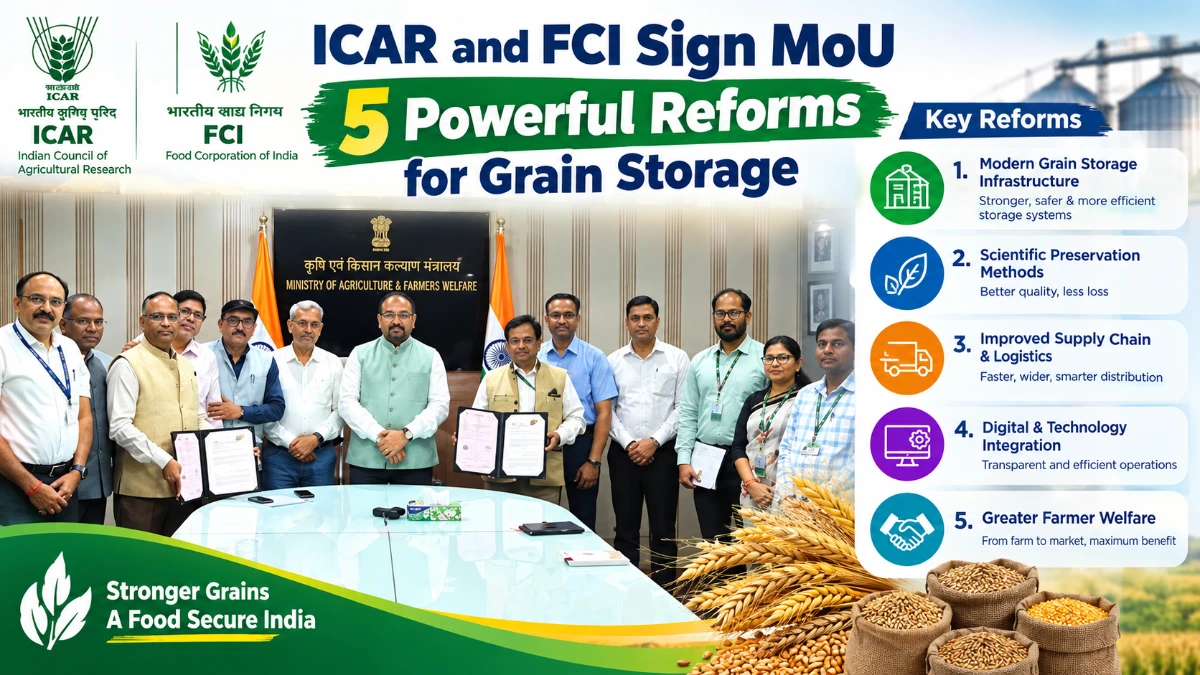
In a major push toward agricultural modernization, the ICAR and FCI signs MoU to pioneer eco-friendly solutions for India’s central grain buffer reserves. The landmark partnership between the Indian Council of Agricultural Research and the Food Corporation of India focuses on safe and sustainable foodgrain storage.
The agreement marks a strategic shift away from hazardous chemical treatments toward non-toxic preservation technologies. Supported by the Department of Food and Public Distribution, the initiative safeguards millions of tonnes of wheat and rice distributed across the nation.
Agricultural scientists and supply chain managers consider this collaboration a vital intervention for public health. By combining scientific innovation with large-scale logistical operations, India aims to set global standards for zero-residue grain storage.
The Hidden Crisis: Severe Pest Resistance to Chemicals
For decades, public grain warehouses have relied heavily on synthetic chemical fumigants like aluminium phosphide and malathion. However, recent empirical surveys revealed that storage pests have developed alarming resistance rates ranging between 72% and 100% in major agricultural states.
This dangerous pest adaptation has forced warehouse managers to increase fumigation frequencies to curb stock losses. Repeated application raises chemical operational costs while steadily increasing exposure risks for ground-level handling personnel.
Furthermore, traditional chemical treatments present persistent environmental challenges and residue concerns in food grain supplies. The urgent need for sustainable pest control spurred this high-priority institutional collaboration.
Three Eco-Friendly Storage Alternatives Being Tested
Under the research framework, the ICAR–Central Institute of Post-Harvest Engineering and Technology (CIPHET) in Ludhiana will spearhead rigorous scientific trials. Researchers will deploy and evaluate three advanced non-chemical preservation methods:
- High-Purity Nitrogen Gas Treatment: Evaluating nitrogen gas with over 99% purity levels to eliminate insects in modern vertical steel silos holding bulk wheat.
- Combined Carbon Dioxide and Phosphine Fumigation: Applying calibrated combinations in bag-stack storage systems across central warehouse depots.
- Hermetic Carbon Dioxide Enclosures: Testing pure carbon dioxide fumigation inside airtight hermetic storage covers to preserve packaged wheat and rice grains without environmental leakage.
These modified atmospheric interventions deplete oxygen levels within grain mass, neutralizing storage pests at all life stages without leaving harmful chemical deposits behind.
Implementation Roadmap: Phase 1 and Phase 2 Timeline
The research and validation project unfolds across two distinct operational stages to ensure nationwide adaptability. Phase 1 spans two years with an allocated research grant of ₹3.28 crore dedicated to pilot facility testing.
During this preliminary phase, scientists will calibrate lethal dosage thresholds, gas retention periods, and cost efficiency across different grain varieties. This rigorous laboratory and warehouse monitoring ensures scientific reliability before wide commercial adoption.
Following the initial two-year cycle, Phase 2 will execute multi-location field trials for one year across India’s diverse agro-climatic zones. The final deliverable will establish standardized operating procedures tailored to regional temperature and humidity variations.
Key Benefits for Farmers, Workers, and Consumers
Transitioning to sustainable fumigation creates multi-dimensional advantages across the agricultural value chain. First and foremost, warehouse personnel and depot workers benefit from significantly reduced chemical inhalation hazards during routine maintenance.
From a food quality perspective, consumers receiving ration allocations through the Public Distribution System receive cleaner, chemical-free grains. Eliminating toxic residues enhances overall nutrition and long-term public health.
Financially, non-chemical atmospheric treatments prevent costly inventory losses and reduce recurring expenditures on imported fumigation compounds. Protecting buffer stocks through sustainable science reinforces India’s long-term agricultural resilience.
Project Overview and Fact Sheet Table
Here is a summary of the strategic agreement and its core research parameters:
| Project Aspect | Official Details |
|---|---|
| Partner Institutions | Indian Council of Agricultural Research (ICAR) & Food Corporation of India (FCI) |
| Executing Institute | ICAR–CIPHET, Ludhiana |
| Sponsoring Body | Department of Food & Public Distribution (DFPD) |
| Phase 1 Duration & Budget | 2 Years | ₹3.28 Crore |
| Phase 2 Scope | 1-Year Multi-Location Trials Across Agro-Climatic Zones |
| Target Commodities | Wheat and Rice Buffer Reserves |
| Core Technologies | High-Purity Nitrogen (>99%), CO2 Combinations, Hermetic Enclosures |
Conclusion: A Greener Future for India’s Granaries
As the ICAR and FCI signs MoU, India takes a decisive leap toward eliminating toxic chemicals from its agricultural supply chain. Through scientific rigor and sustainable logistics, this partnership guarantees that national food reserves remain both safe and nourishing for future generations.
Frequently Asked Questions (FAQs)
Why is the agreement between ICAR and FCI significant?
The agreement is significant because it replaces hazardous chemical fumigants with safe, eco-friendly technologies like nitrogen and carbon dioxide to protect India’s central foodgrain stocks.
Which institute will execute the grain storage project?
The project will be carried out by the ICAR–Central Institute of Post-Harvest Engineering and Technology (CIPHET) located in Ludhiana, Punjab.
What is the budget and duration of Phase 1?
Phase 1 runs for two years with an approved budget of ₹3.28 crore to test modified atmosphere storage methods.
What problems do traditional chemical fumigants cause in grain storage?
Traditional fumigants like aluminium phosphide have led to pest resistance reaching up to 100% in certain regions, alongside occupational health risks for workers and potential chemical residues on grains.
Also Check : RBI Approves Anup Bagchi as HDFC Bank Chief






Leave a Comment