
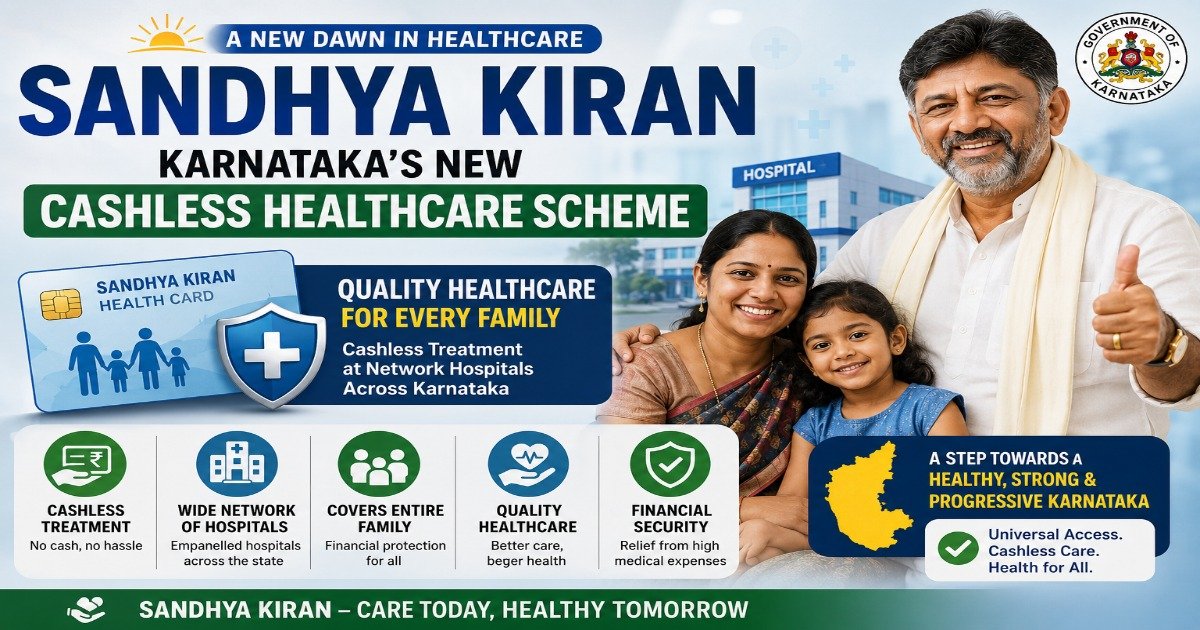
The Karnataka Cabinet approved a new healthcare scheme called Sandhya Kiran. State pensioners below 70 years, family pensioners, and their eligible dependents will now get cashless medical treatment. This move brings real financial relief to retired government employees. It also protects them from sudden, unplanned medical costs.
Officials designed Sandhya Kiran as a contributory scheme. In other words, pensioners will pay a small share of their pension toward it. In return, they gain access to a wide network of empanelled hospitals across the state.
Quick Facts: Sandhya Kiran Scheme
- Approved by: Karnataka State Cabinet
- Scheme name: Sandhya Kiran (Contributory Cashless Healthcare Scheme)
- Beneficiaries at launch: Around 4.93 lakh, including 3.11 lakh state government pensioners below 70 years and their eligible dependents
- Annual treatment cover: Up to Rs 5 lakh per beneficiary at empanelled hospitals
- Implementing agency: Suvarna Arogya Suraksha Trust (SAST)
- Linked system: Integrated with the AB-ArK (Ayushman Bharat–Arogya Karnataka) framework
- Health Minister: U T Khader
- Pensioner contribution: 1.25% of basic pension (service pensioners); 0.75% of basic family pension (family pensioners)
- Estimated annual contributions: Around Rs 117 crore
- Estimated annual treatment cost: Around Rs 81.75 crore
What Is the Sandhya Kiran Scheme?
Sandhya Kiran is a contributory cashless healthcare scheme for Karnataka’s state government pensioners. The Cabinet designed it specifically for pensioners below 70 years of age, along with family pensioners and their eligible dependents.
The scheme works through cashless treatment. This means beneficiaries do not need to pay hospital bills upfront and then wait for reimbursement. Instead, empanelled hospitals treat patients directly, and the scheme settles the costs behind the scenes.
Who Will Benefit From Sandhya Kiran?
At launch, the scheme will initially cover close to 4.93 lakh people. This figure includes 3.11 lakh state government pensioners below 70 years, along with their eligible dependents. Family pensioners also qualify for coverage under the same scheme.
Importantly, this scheme fills a specific gap. Many pensioners once relied on ad-hoc arrangements or separate insurance for medical costs after retirement. Sandhya Kiran now offers them a structured, government-backed safety net instead.
How Much Will Pensioners Contribute?
Sandhya Kiran works on a shared-contribution model. Both pensioners and the state government share the financial burden, so the scheme stays sustainable over time.
Here is how the contributions break down:
- Service pensioners will contribute 1.25 percent of their basic pension.
- Family pensioners will contribute 0.75 percent of their basic family pension.
- The scheme is expected to generate about Rs 117 crore annually through these contributions.
- Annual treatment costs are estimated at around Rs 81.75 crore.
- Beneficiaries will fund 70 percent of this treatment cost, roughly Rs 57.22 crore.
- The state government will fund the remaining 30 percent, roughly Rs 24.53 crore.
To keep the scheme financially stable in the long run, the government also built in a safeguard. If the scheme’s corpus utilisation crosses a certain threshold, the contribution rate will automatically rise by 0.05 percentage points, or five basis points.
Sandhya Kiran: Key Numbers at a Glance
| Metric | Figure |
|---|---|
| Total beneficiaries at launch | ~4.93 lakh |
| State pensioners covered (below 70) | 3.11 lakh |
| Annual treatment cover per beneficiary | Up to Rs 5 lakh |
| Service pensioner contribution | 1.25% of basic pension |
| Family pensioner contribution | 0.75% of basic family pension |
| Estimated annual contributions | ~Rs 117 crore |
| Estimated annual treatment cost | ~Rs 81.75 crore |
| Beneficiary share of treatment cost | 70% (~Rs 57.22 crore) |
| State government share of treatment cost | 30% (~Rs 24.53 crore) |
How Sandhya Kiran Connects to AB-ArK
Sandhya Kiran does not exist in isolation. Instead, the government built it on top of an existing system: Ayushman Bharat–Arogya Karnataka (AB-ArK). This is Karnataka’s broader universal health coverage programme, first introduced in 2018 and later integrated with the central government’s Ayushman Bharat scheme.
Because of this integration, several administrative functions become far simpler. The Suvarna Arogya Suraksha Trust (SAST) will implement Sandhya Kiran and coordinate beneficiary registration, premium collection, hospital network management, cashless treatment delivery, and claims processing. All of this will run seamlessly alongside the existing AB-ArK system. In addition, the benefit packages and revised treatment rates already used under AB-ArK will also apply to Sandhya Kiran. As a result, pensioners gain access to a proven, well-established hospital network from day one, rather than a scheme built entirely from scratch.
Why This Scheme Matters
Healthcare costs in India continue to rise every year, and retirement often brings a drop in income at exactly the wrong time. Many pensioners, therefore, face financial pressure just when medical needs increase.
Sandhya Kiran directly addresses this problem. According to the Chief Minister’s Office, the scheme stands as a vital social security measure. It aims to ensure quality, affordable, and cashless healthcare for state government pensioners and their families. Ultimately, it should significantly reduce the financial burden that comes with unexpected medical expenses.
The scheme also reflects a broader trend among Indian states. More and more governments are moving pensioner healthcare away from one-time reimbursements and toward structured, contributory insurance models. This shift gives retirees more predictable, long-term protection.
Frequently Asked Questions (FAQs)
Q1: What is the Sandhya Kiran scheme?
Sandhya Kiran is a contributory cashless healthcare scheme approved by the Karnataka Cabinet for state government pensioners below 70 years, family pensioners, and their eligible dependents.
Q2: Who is eligible for Sandhya Kiran?
State government pensioners below 70 years of age, family pensioners, and their eligible dependents qualify for the scheme. At launch, it will cover around 4.93 lakh beneficiaries.
Q3: How much healthcare cover does Sandhya Kiran provide?
The scheme offers cashless treatment worth up to Rs 5 lakh per beneficiary each year at empanelled hospitals.
Q4: How much will pensioners need to contribute?
Service pensioners will contribute 1.25 percent of their basic pension. Family pensioners will contribute 0.75 percent of their basic family pension.
Q5: Who will implement the Sandhya Kiran scheme?
The Suvarna Arogya Suraksha Trust (SAST) will implement and manage the scheme. It will handle beneficiary registration, premium collection, hospital network administration, and claims processing.
Q6: How is Sandhya Kiran linked to AB-ArK?
Sandhya Kiran will run in coordination with the existing AB-ArK (Ayushman Bharat–Arogya Karnataka) system. It will use the same benefit packages and treatment rates, giving pensioners access to an already-established hospital network.
Q7: How will the scheme fund pensioners’ treatment costs?
Beneficiary contributions will cover about 70 percent of annual treatment costs, while the Karnataka government will fund the remaining 30 percent.
Q8: Will the contribution rate change over time?
Yes. If the scheme’s corpus utilisation exceeds a set threshold, the contribution rate will automatically increase by 0.05 percentage points to keep the scheme financially sustainable.
Q9: Is Sandhya Kiran the same as Arogya Karnataka?
No. Arogya Karnataka (AB-ArK) is a broader universal health coverage scheme for all eligible residents of the state. Sandhya Kiran is a separate, contributory scheme designed specifically for state government pensioners, though it operates alongside the AB-ArK framework.
Q10: Who announced the Sandhya Kiran scheme?
Karnataka Health and Family Welfare Minister U T Khader announced the scheme, and the state Cabinet subsequently approved it.






Leave a Comment