
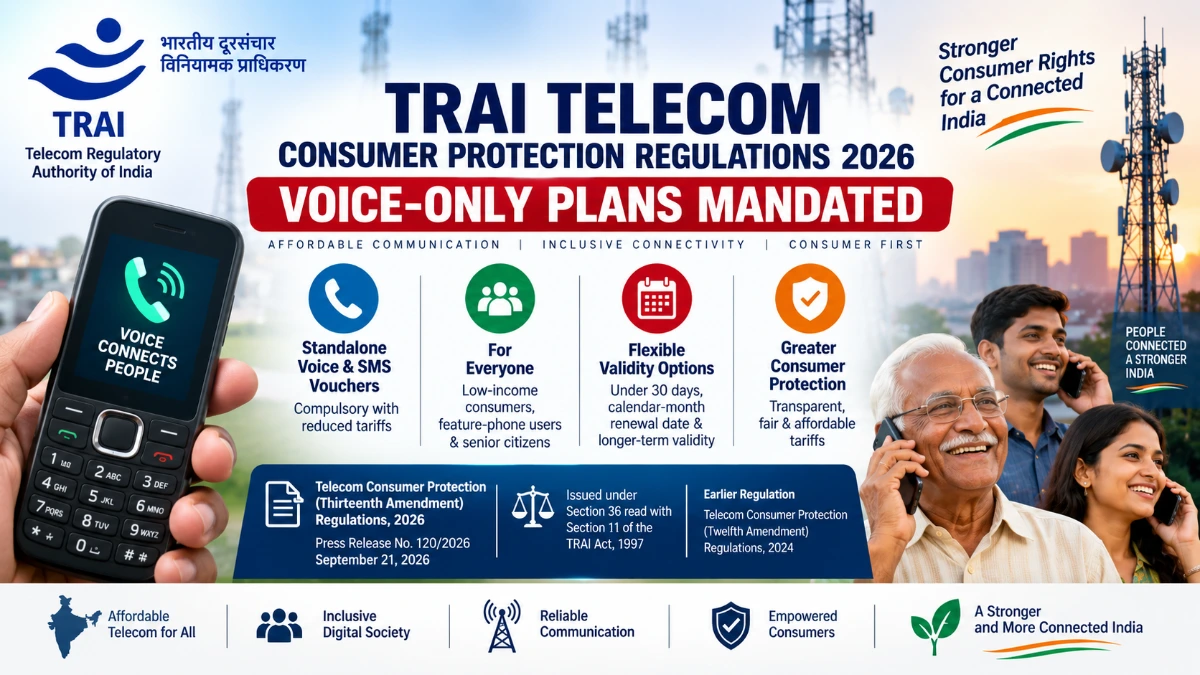
In a consumer-friendly regulatory overhaul, the Telecom Regulatory Authority of India (TRAI) officially notified the Telecom Consumer Protection (Thirteenth Amendment) Regulations, 2026 via Press Release No. 120/2026 on September 21, 2026. Under the newly finalized regulations, all Telecom Service Providers (TSPs) in India are mandated to offer standalone, affordable Voice-and-SMS-only Special Tariff Vouchers (STVs) across various validity periods, effectively eliminating the practice of forced mobile data bundling.
The regulatory move addresses a persistent grievance among rural subscribers, senior citizens, and low-income feature-phone users who were compelled to purchase expensive daily-data combo plans despite only needing calling and texting services. The decision was finalized following extensive consultations, an Open House Discussion, and analysis of 1,132 stakeholder responses.
For competitive exam aspirants preparing for UPSC Civil Services, SSC CGL, Banking, and regulatory body examinations (RBI, SEBI, TRAI), this development is an essential topic in Current Affairs, Governance, and Economic Policy. Below is the complete factual breakdown of the new guidelines, background context, consumer benefits, and key exam takeaways.
Quick Fact Sheet: TRAI Press Release No. 120/2026
| Parameter | Official Detail |
|---|---|
| Issuing Authority | Telecom Regulatory Authority of India (TRAI) |
| Notification Title | Telecom Consumer Protection (Thirteenth Amendment) Regulations, 2026 |
| Press Release Number | Press Release No. 120/2026 |
| Date of Release | September 21, 2026 |
| Key Mandate | Compulsory standalone Voice and SMS vouchers with reduced tariffs |
| Target Beneficiaries | Low-income consumers, basic feature-phone users, and senior citizens |
| Validity Options Mandated | Under 30 days, calendar-month renewal date, and longer-term validity |
| Preceding Regulation | Telecom Consumer Protection (Twelfth Amendment) Regulations, 2024 |
| Statutory Backing | Section 36 read with Section 11 of the TRAI Act, 1997 |
Background: Why Did TRAI Intervene?
In 2024, TRAI implemented the Telecom Consumer Protection (Twelfth Amendment) Regulations, 2024, aiming to expand consumer recharge flexibility. However, post-implementation reviews revealed a market distortion:
- Severe Scarcity of Basic Vouchers: Telecom operators offered very few Voice-and-SMS-only vouchers.
- Concentration on Long Validities: The few available calling vouchers were restricted to long durations (such as 84 days or 365 days), demanding substantial upfront payments.
- Forced Data Bundling: Budget-conscious consumers and owners of basic 2G feature phones who had no use for mobile internet were forced to buy expensive combo packs bundling 1 GB or 1.5 GB per day.
To correct this anomaly, TRAI issued a draft consultation paper on April 7, 2026. Following an Open House Discussion (OHD) held on June 15, 2026, and reviewing 1,132 public and industry representations, TRAI enacted the Telecom Consumer Protection (Thirteenth Amendment) Regulations, 2026.
Salient Features of the 13th Amendment Regulations, 2026
Under Section 5 of the amended regulations, TRAI has directed all mobile operators to launch dedicated Special Tariff Vouchers (STVs) exclusively for Voice and SMS with an appropriate reduction in tariff across three mandatory categories:
1. Validity of Thirty Days and Under
Telecom operators must offer Voice-and-SMS-only vouchers corresponding to every single validity duration of 30 days or less that they currently offer for bundled data packs (e.g., 7-day, 14-day, 21-day, and 28-day recharges).
2. Calendar-Month Renewal Validity
Operators must provide a voice-and-SMS voucher that renews on the exact same calendar date of each month. If a month does not have that corresponding date (for example, the 31st day in February, April, June, September, or November), the renewal date will automatically be the last day of that month.
3. Longer-Duration Option
Telecom service providers must offer at least one long-validity Voice-and-SMS-only voucher corresponding to the longer durations offered for data packs (such as 56-day, 84-day, or annual plans).
Expected Consumer and Industry Impact
Benefits for Consumers
- Substantial Cost Savings: Eliminates the built-in cost of high-speed mobile data for users who only make phone calls and send text messages.
- Financial Flexibility: Low-income daily wage earners can recharge in smaller denominations according to immediate financial capacity.
- Simplified Billing: Calendar-month plans remove confusion caused by artificial 28-day recharge cycles that previously forced subscribers to pay for 13 recharge cycles in a 12-month year.
Impact on Telecom Service Providers
- While average revenue per user (ARPU) metrics may experience marginal realignment in basic tiers, it is expected to reduce churn among 2G subscribers and improve compliance across rural telecom circles.
Static GK: Understanding the Telecom Regulatory Authority of India (TRAI)
For competitive exam candidates, understanding the statutory profile of TRAI is vital:
- Establishment: Established on February 20, 1997, under the Telecom Regulatory Authority of India Act, 1997.
- Statutory Nature: Independent statutory regulatory body established to regulate telecommunication services in India.
- Headquarters: New Delhi.
- Core Mission: To create and nurture conditions for the growth of telecommunications in India, protect the interests of consumers, and provide a fair and transparent policy environment.
- Judicial / Dispute Settlement: In 2000, the TRAI Act was amended to establish the Telecom Disputes Settlement and Appellate Tribunal (TDSAT), separating adjudicatory and dispute-resolution functions from TRAI’s administrative and regulatory role.
High-Yield Takeaways for UPSC, SSC & Competitive Exams
- Act / Regulations: Telecom Consumer Protection (Thirteenth Amendment) Regulations, 2026.
- Press Release: PR No. 120/2026, dated September 21, 2026.
- Primary Regulatory Change: Mandates Voice-and-SMS-only recharges with appropriate tariff reductions for all under-30-day validity periods, calendar-month cycles, and longer tenures.
- Regulatory Body: Telecom Regulatory Authority of India (TRAI).
- Parent Ministry: Ministry of Communications, Government of India.
- Adjudicating Tribunal: TDSAT (Telecom Disputes Settlement and Appellate Tribunal).
Practice Questions for Competitive Exams
Multiple Choice Questions (MCQs)
Q1. Consider the following statements regarding the Telecom Consumer Protection (Thirteenth Amendment) Regulations, 2026, issued by TRAI:
- It mandates telecom service providers to offer Voice-and-SMS-only Special Tariff Vouchers for all validity periods of thirty days and less.
- It requires operators to provide at least one Voice-and-SMS plan that renews on the same date of every calendar month.
- The amendment was released by TRAI via Press Release No. 120/2026 on September 21, 2026.
Which of the statements given above are correct?
- (a) 1 and 2 only
- (b) 2 and 3 only
- (c) 1 and 3 only
- (d) 1, 2, and 3
Answer: (d) 1, 2, and 3
Q2. Under which statutory act was the Telecom Regulatory Authority of India (TRAI) established?
- (a) Indian Telegraph Act, 1885
- (b) Telecom Regulatory Authority of India Act, 1997
- (c) Information Technology Act, 2000
- (d) Telecommunications Act, 2023
Answer: (b) Telecom Regulatory Authority of India Act, 1997
Q3. Which quasi-judicial body is empowered to adjudicate disputes between telecom service providers and consumers or licensing authorities in India?
- (a) Competition Commission of India (CCI)
- (b) Central Consumer Protection Authority (CCPA)
- (c) Telecom Disputes Settlement and Appellate Tribunal (TDSAT)
- (d) Law Commission of India
Answer: (c) Telecom Disputes Settlement and Appellate Tribunal (TDSAT)
Frequently Asked Questions (FAQs)
What are the TRAI Telecom Consumer Protection Regulations 2026?
The TRAI Telecom Consumer Protection Regulations 2026 (13th Amendment), notified via Press Release No. 120/2026 on September 21, 2026, mandate telecom operators to offer affordable, standalone Voice-and-SMS-only recharge vouchers without forced mobile data bundling.
What are the main features of TRAI Press Release No. 120/2026?
The press release mandates telecom companies to offer Voice-and-SMS-only recharges with appropriate tariff reductions for:
Every validity duration of 30 days and below offered for data packs.
Calendar-month validity renewing on the exact same date each month.
At least one longer-duration validity option (e.g., 84 days or annual).
Who will benefit from these new TRAI regulations?
Low-income subscribers, rural users, senior citizens, and people using basic 2G/feature phones will benefit significantly, as they will no longer be forced to pay for unutilized daily high-speed internet data.
What is the calendar-month renewal rule introduced by TRAI?
Under this rule, if a subscriber recharges on a specific date (e.g., the 10th of March), the plan will renew on the 10th of each following month. For dates not present in a given month (e.g., the 31st in a 30-day month), the recharge will expire on the final day of that month.
Why did TRAI issue the 13th Amendment to TCPR?
TRAI observed that following the 12th Amendment in 2024, telecom providers only offered calling-only plans for longer validities (such as 84 days or 365 days), depriving low-income users of affordable, short-duration recharge choices.
When was TRAI established and what is its role?
TRAI was established on February 20, 1997, under the TRAI Act, 1997. It functions as the independent statutory regulator of the telecommunications sector in India to protect consumer interests and ensure fair market practices.





Leave a Comment