
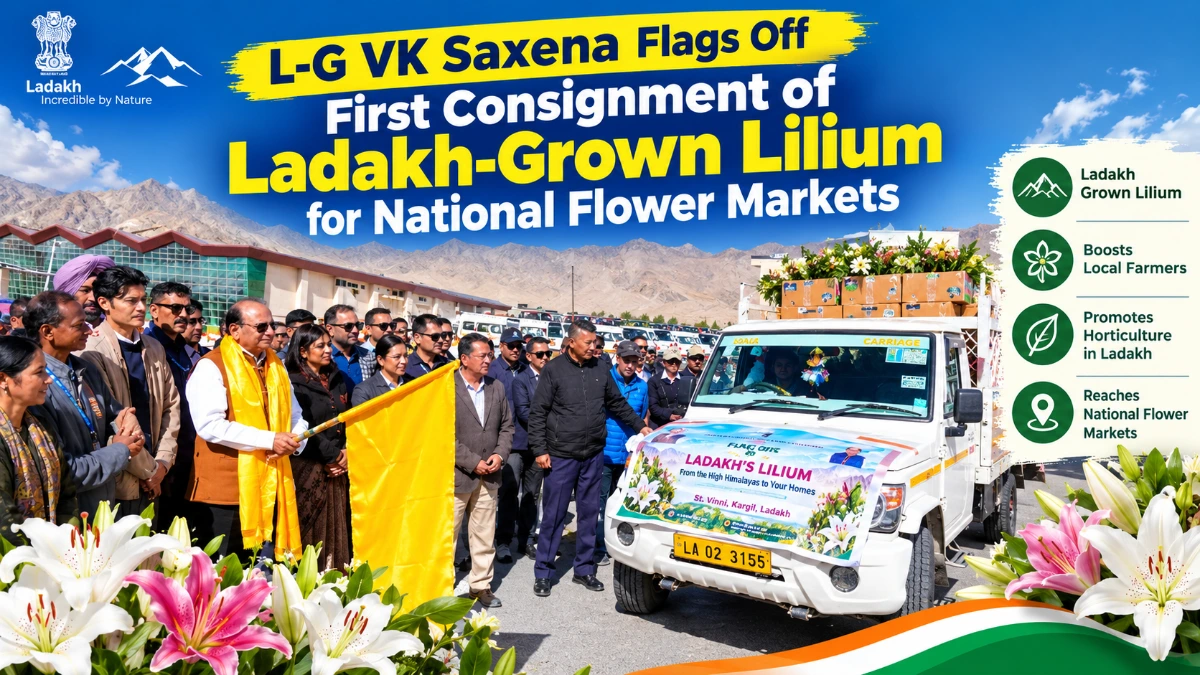
Ladakh-grown Lilium flowers have officially entered India’s national flower markets. Lieutenant Governor Vinai Kumar Saxena flagged off the first air consignment of 15,000 “A-grade” Lilium stems at KBR Airport, Leh, on September 29, 2026. The flowers are headed to Delhi, Mumbai, and Chandigarh, marking a historic first for commercial floriculture in the Union Territory.
This launch builds on a fast-moving project that turned a barren stretch of land in Leh into a flowering field of over 25 lakh blooms in just two months.
Quick Facts
| Detail | Information |
|---|---|
| Event | First consignment of Ladakh-grown Lilium flagged off |
| Flagged Off By | Lieutenant Governor Vinai Kumar Saxena |
| Date | September 29, 2026 |
| Location | KBR Airport, Leh |
| Consignment Size | 15,000 “A-grade” Lilium stems |
| Destination Markets | Delhi, Mumbai, Chandigarh |
| Growing Site | Choglamsar flower field, Leh |
| Altitude | 10,600 feet — world’s highest-altitude flower field |
| Flower Colours | Red, pink, white, yellow, orange |
| Shelf Life | 5–7 days |
Flagged off the first air-consignment of 15,000 “A-grade” Ladakh-grown Liliums to national markets, today from Leh airport, marking a historic step towards creating new livelihoods for our local communities and aesthetic revolution in Ladakh, through commercial floriculture.… pic.twitter.com/rQLvH8U6gb
— LG Ladakh (@lg_ladakh) September 29, 2026
A Historic First for Ladakh’s Economy
Lieutenant Governor Saxena called the initiative historic, describing floriculture as a powerful new tool for creating sustainable livelihoods in Ladakh. He linked the project to Prime Minister Narendra Modi’s vision of financial sustainability for farmers and youth through agricultural diversification.
As a symbolic gesture, the L-G also presented bouquets of Ladakh-grown Liliums to the flight crew members handling the consignment.
What Makes These Liliums Special
The flowers dispatched in this first consignment are classified as “A-grade” — a premium category referring to stems with 4 to 5 buds each. These command higher prices than standard-grade stems.
The consignment includes five vibrant colours:
- Red
- Pink
- White
- Yellow
- Orange
All of them were cultivated at 10,600 feet above sea level, making the Choglamsar field in Leh the highest-altitude flower field anywhere in the world. Despite the harsh, high-altitude conditions, the flowers have a shelf life of 5 to 7 days, long enough to reach and sell in major Indian cities.
Creating Local Jobs and Livelihoods
This project isn’t just about flowers — it’s about people. So far, the initiative has created direct employment for local residents:
| Role | Details |
|---|---|
| Local women workers | 15 women engaged in cutting, sorting, and packaging |
| Daily wage | Rs 900 per person |
| Marketing lead | A local young botanist handling national market outreach |
| Retail price per stem | Rs 150 – Rs 200 |
Liliums are considered premium cut flowers, highly valued in both the floral and hospitality industries across India, which gives this project strong commercial potential.
From Barren Land to a Blooming Field
The transformation of this stretch of land near Leh has been rapid. Here’s how the timeline played out:
| Milestone | Date |
|---|---|
| Foundation laid | June 22, 2026 |
| Plantation began | July 16, 2026 |
| Field inaugurated | September 17, 2026 |
| Total development time | 60 days |
| First consignment dispatched | September 29, 2026 |
Since opening to the public on September 17, 2026, the flower field has drawn hundreds of visitors daily, adding an unexpected tourism boost to the project alongside its commercial goals.
Scaling Up Across Ladakh
Following the success of this pilot project, the Lieutenant Governor has directed Deputy Commissioners across other Ladakh districts — including Kargil, Drass, Sham, Changthang, and Zanskar — to replicate the model locally. Each district has been asked to identify at least 20 acres of land suitable for flower cultivation.
The larger goal is ambitious: bringing at least 200 acres of land across Ladakh under high-value flower farming by next year, transforming more of the region’s rugged terrain into colourful, productive landscapes.
Why This Initiative Matters
| Impact Area | Benefit |
|---|---|
| Livelihood Creation | New income sources for local women and youth beyond traditional farming |
| Economic Diversification | Reduces dependence on conventional agriculture in a harsh climate |
| Eco-Tourism Boost | The flower field itself has become a visitor attraction |
| Regional Identity Shift | Adds colour and vibrancy to Ladakh’s traditionally rugged, dry landscape |
| Scalable Model | Plans to expand floriculture across multiple districts within a year |
Frequently Asked Questions
What did L-G VK Saxena flag off in Ladakh?
Lieutenant Governor Vinai Kumar Saxena flagged off the first air consignment of 15,000 Ladakh-grown Lilium flower stems at KBR Airport, Leh, on September 29, 2026, for dispatch to national flower markets.
Where are the Ladakh Liliums being sent?
The first consignment is being sent to Delhi, Mumbai, and Chandigarh.
Where are these Lilium flowers grown?
They are grown at the Choglamsar flower field in Leh, at an altitude of 10,600 feet, making it the world’s highest-altitude flower field.
What does A-grade Lilium mean?
A-grade Liliums are flower stems with 4 to 5 buds each, which fetch a premium price in the market.
How much do Ladakh Lilium flowers sell for?
These premium cut flowers fetch between Rs 150 and Rs 200 per stem in domestic retail markets.
Who is employed in this floriculture project?
Fifteen local women have been engaged in cutting, sorting, and packaging the Liliums at a daily wage of Rs 900 per person, while a local young botanist handles marketing to national markets.
Will this floriculture project expand to other parts of Ladakh?
Yes. The L-G has directed Deputy Commissioners of other districts, including Kargil, Drass, Sham, Changthang, and Zanskar, to identify at least 20 acres of land each for flower cultivation, with a target of bringing at least 200 acres under high-value flower farming by next year.
When was the Leh Lilium flower field developed?
Its foundation was laid on June 22, 2026, plantation began on July 16, 2026, and it was inaugurated on September 17, 2026 — completed in just 60 days.






Leave a Comment