
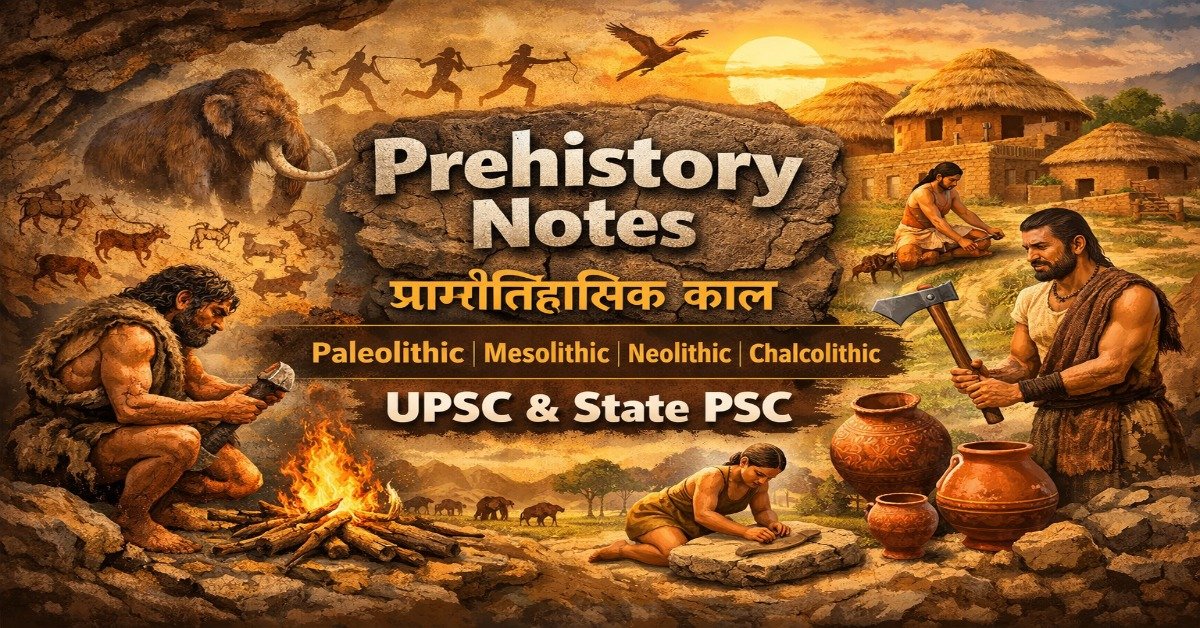
Prehistory (प्रागैतिहासिक काल) is the period of human existence before the invention of writing — known entirely through archaeological evidence. This topic is one of the most frequently tested areas in UPSC, State PSC, SSC, and Railway exams. This article covers all four prehistoric periods — their time spans, characteristic tools, important sites across India, social and economic life, and exam-critical key facts — in a structured, easy-to-revise format in both Hindi and English.
Topics covered: Paleolithic/पुरापाषाण, Mesolithic/मध्यपाषाण, Neolithic/नवपाषाण, Chalcolithic/ताम्रपाषाण, Important Sites, UPSC/State PSC exam tips.
Quick Stats
- Paleolithic Start: ~2.5 million years ago
- Mesolithic Start: 10,000 BCE
- Neolithic Start: 7,000 BCE
- Chalcolithic Start: 3,500 BCE
- Sites in India: 1,500+
- Bhimbetka: UNESCO World Heritage Site
1. Introduction — What is Prehistory? (प्रागैतिहास क्या है?)
The word Prehistory literally means “before history” — the period of human existence that predates the invention of writing. Without written records, we cannot call this period “history” in the conventional academic sense. Instead, our entire understanding of this vast span of time comes from archaeological evidence: stone tools, bone fragments, cave paintings, ash remains, fossilised seeds, pottery shards, and skeletal remains. The study of prehistory is therefore inseparable from the discipline of archaeology — every insight we have about our earliest ancestors is a forensic reconstruction from physical evidence alone.
In the Indian context, the prehistoric period spans from roughly 2.5 million years ago — when the earliest stone-using ancestors first appeared in the subcontinent — to approximately 1,000 BCE, by which point writing and recorded civilisations had emerged. The prehistoric period is nearly 700 times longer than the entire span of recorded Indian history.
The Prehistoric Period (प्रागैतिहासिक काल) in Indian historiography is traditionally divided into four phases: the Paleolithic (Old Stone Age), Mesolithic (Middle Stone Age), Neolithic (New Stone Age), and the Chalcolithic (Copper-Stone Age). Some historians also identify a Proto-historic period — for which writing exists but cannot yet be deciphered, like the Indus Valley Civilisation script.
Key Terminology You Must Know
- Prehistory (प्रागैतिहास): Period before writing; known only through material archaeological evidence.
- Proto-history (आद्य-इतिहास): Period with undeciphered writing — e.g., Indus Valley Civilisation script.
- History (इतिहास): Period with decipherable written records — begins with Vedic period in India.
- Archaeology (पुरातत्त्व): Scientific study of human past through material remains.
- Lithic (पाषाण-संबंधी): Relating to stone — from Greek lithos = stone; hence “Paleolithic” = old stone.
- Microlithic (लघु-पाषाण): Very small stone tools, characteristic of the Mesolithic period.
- Neolithic Revolution: The shift from food gathering to food production (agriculture) — one of history’s most transformative events.
- Knapping: The technique of shaping stone tools by controlled fracturing/chipping with a harder stone.
2. Overview of the Four Prehistoric Periods
The prehistoric timeline of India is not a series of clean, discrete transitions — each period overlaps with the next, and different regions progressed at different rates. The Neolithic period arrived much earlier in north-western India (Mehrgarh, ~7,000 BCE) than in peninsular India. Nevertheless, the four-period framework remains the most useful analytical structure for examinations.
| Period | Time Span | Key Tool | Lifestyle | Key Fact |
|---|---|---|---|---|
| Paleolithic / पुरापाषाण | 2.5 million – 10,000 BCE | Handaxe, Cleaver, Flake, Blade (chipped stone) | Nomadic hunter-gatherers | No pottery, no agriculture; fire discovered |
| Mesolithic / मध्यपाषाण | 10,000 – 6,000 BCE | Microliths (tiny geometric blades) | Semi-nomadic | Cave paintings peak; dog domestication begins |
| Neolithic / नवपाषाण | 7,000 – 1,000 BCE | Polished/ground stone tools — celts, hoes | Settled villages | Neolithic Revolution — agriculture begins; pottery appears |
| Chalcolithic / ताम्रपाषाण | 3,500 – 1,500 BCE | Copper tools + stone | Settled farming, proto-urban | First use of copper; painted ochre pottery |
Prehistoric Timeline
~2,500,000 BCE – 10,000 BCE — Paleolithic Age (पुरापाषाण काल / Old Stone Age)
The longest phase of human prehistory. Humans used crude, unpolished stone tools made by chipping (Knapping). Completely nomadic — hunter-gatherers. No agriculture, no pottery. Sub-divided into Lower, Middle, and Upper Paleolithic. Fire discovered in this period.
~10,000 BCE – 6,000 BCE — Mesolithic Age (मध्यपाषाण काल / Middle Stone Age)
A transitional phase after the last Ice Age. Climate became warmer and drier. Microliths (tiny geometric stone tools) are the hallmark technology. Semi-nomadic lifestyle. Cave paintings at Bhimbetka reach their peak. First animal domestication (dog) in India.
~7,000 BCE – 1,000 BCE — Neolithic Age (नवपाषाण काल / New Stone Age)
The Neolithic Revolution — transition to food production. Polished stone tools, pottery, permanent villages, crops (wheat, barley, rice, millet), domesticated animals. Mehrgarh (Balochistan) is the earliest Neolithic site. Burzahom, Chirand, Koldihwa are key sites in India proper.
~3,500 BCE – 1,500 BCE — Chalcolithic Age (ताम्रपाषाण काल / Copper-Stone Age)
First use of copper and metal tools alongside stone. Painted pottery (ochre-coloured ware), farming communities, early social stratification. Key cultures: Ahar-Banas (Rajasthan), Malwa (MP), Jorwe (Maharashtra), Kayatha (MP). Overlaps with early Harappan Civilisation.
3. Paleolithic Age — पुरापाषाण काल (Old Stone Age)
The Paleolithic Age is the oldest and by far the longest period of human prehistory. The term comes from Greek: palaios (ancient) + lithos (stone). India shows no evidence of the earliest Australopithecine stage found in Africa. The earliest remains found in India suggest habitation by Homo erectus and later Homo sapiens.
The Paleolithic period in India is divided into three sub-phases: Lower Paleolithic (oldest and longest), Middle Paleolithic, and Upper Paleolithic. Tools became progressively more refined, smaller, and more specialised. No pottery exists in the Paleolithic period — pottery appeared only in the Neolithic.
Three Sub-Phases of the Paleolithic
| Sub-Phase | Period | Tools | Human Species | Key Features |
|---|---|---|---|---|
| Lower Paleolithic (निम्न पुरापाषाण) | 2.5 million – 150,000 BCE | Handaxe (हस्त-कुठार), Cleaver (विदारणी), Chopper — large, heavy, bifacial tools from quartzite | Homo erectus | Acheulian & Sohan culture; quartzite dominant; found in river valleys; fire discovered |
| Middle Paleolithic (मध्य पुरापाषाण) | 150,000 – 35,000 BCE | Flake tools (शल्क उपकरण) — Scrapers, Points, Borers; Levallois technique | Archaic Homo sapiens | Tools from flint, jasper, chalcedony; use of animal bones begins; caves and open-air sites |
| Upper Paleolithic (उच्च पुरापाषाण) | 35,000 – 10,000 BCE | Blade tools (फलक उपकरण), Burin (नक्काशी उपकरण) — long, narrow, highly specialised blades | Modern Homo sapiens | Cave paintings begin (Bhimbetka); bone tools; personal ornaments; needles found |
Important Paleolithic Sites in India
- Pallavaram (Tamil Nadu) — First Paleolithic site discovered in India by Robert Bruce Foote in 1863; handaxes found; near Chennai.
- Attirampakkam (Tamil Nadu) — One of the oldest, dated ~1.5 million years ago; Acheulian tools; near Chennai.
- Sohan/Soan Valley (now Pakistan) — Among the oldest sites; Lower Paleolithic choppers; “Sohan Culture.”
- Belan Valley (Uttar Pradesh) — Evidence of all three Paleolithic sub-phases; Neolithic continuity too.
- Bhimbetka (Madhya Pradesh) — Upper Paleolithic rock shelters; cave paintings; UNESCO World Heritage Site.
- Hunsgi Valley (Karnataka) — Largest Acheulian (Lower Paleolithic) tool assemblage in Asia; near Gulbarga.
- Bori (Maharashtra) — Dated ~1.4 million years ago; handaxes under volcanic ash layer; near Pune.
- Didwana (Rajasthan) — Middle Paleolithic tools with ancient lake deposits.
Key Facts About Paleolithic Life
- No pottery — anywhere in Paleolithic period. Pottery first appears in the Neolithic.
- No settled life — completely nomadic; followed animal herds and seasonal food sources.
- Quartzite preference — most Lower Paleolithic tools in India made from quartzite (not flint, which is rare in India).
- Robert Bruce Foote — “Father of Indian Prehistory”; discovered tools at Pallavaram (1863).
- Cave paintings begin only in Upper Paleolithic — not in Lower or Middle; Bhimbetka is the prime example.
- No agriculture — food entirely from hunting and gathering; no plant cultivation anywhere in Paleolithic.
4. Mesolithic Age — मध्यपाषाण काल (Middle Stone Age)
The Mesolithic period represents the bridge between the Paleolithic and Neolithic — driven primarily by dramatic changes in global climate. Around 10,000 BCE, the last Ice Age ended and the Earth’s climate became significantly warmer. The most significant technological response was the development of microliths — extremely small, precisely shaped stone tools, typically made from flint or chert. These tiny blades could be hafted (attached to handles of wood or bone) to create composite tools: arrows, spears, sickles, and knives.
The Mesolithic period in India is also remarkable for its cave paintings and rock art, especially at Bhimbetka (Madhya Pradesh). Dog domestication is first evidenced in India during the Mesolithic, at Adamgarh (Madhya Pradesh) and Bagor (Rajasthan).
Mesolithic Features
| Feature | Details |
|---|---|
| Time Period | ~10,000 BCE to ~6,000 BCE (varies by region) |
| Characteristic Tool | Microliths (लघु पाषाण उपकरण) — tiny, geometric stone tools: crescents, triangles, trapezoids, lunates; hafted into composite tools |
| Tool Material | Flint, chert, chalcedony — fine-grained, hard rocks that could be shaped with great precision |
| Lifestyle | Semi-nomadic — moved seasonally but returned to same rock shelters |
| Animal Domestication | Dog was first domesticated in India — evidence at Adamgarh (MP) and Bagor (Rajasthan) |
| Cave Paintings | Peak period for cave paintings — Bhimbetka (UNESCO), Adamgarh, Mirzapur (UP); hunting scenes, animals, dance, rituals |
| Pottery | Absent in most Mesolithic cultures; primitive pottery appears only at the very end |
| Burials | Evidence of deliberate burial practices — food and tools buried with the dead; suggests belief in afterlife |
| Food Sources | Wild fruits, nuts, roots, fish, shellfish, small and large animals; diet more diverse than Paleolithic due to composite tools |
Important Mesolithic Sites
| Site | Location | Key Significance |
|---|---|---|
| Bhimbetka | Madhya Pradesh | Rock shelters with cave paintings from Paleolithic to medieval. UNESCO World Heritage Site (2003). Discovered by V.S. Wakankar in 1957. |
| Adamgarh | Madhya Pradesh | Earliest evidence of animal domestication (dog) in India. Microliths and cave paintings found. |
| Bagor | Rajasthan | Largest Mesolithic site in India. Dog domestication evidence. Semi-settled lifestyle. On Kothari river. |
| Sarai Nahar Rai | Uttar Pradesh | Human skeletal remains with microliths. Deliberate burials with grave goods. Near Prayagraj. |
| Langhnaj | Gujarat | Microlithic tools, animal bones, human burials. Excavated by H.D. Sankalia. |
| Mahadaha | Uttar Pradesh | Human burials with bone ornaments. Evidence of fishing with bone harpoons. Pratapgarh district. |
Key fact — Bhimbetka: Discovered by V.S. Wakankar in 1957. UNESCO World Heritage Site (2003). 750+ rock shelters. Longest continuous record of cave art in South Asia. Paintings use natural pigments (red/white ochre, green, yellow).
5. Neolithic Age — नवपाषाण काल (New Stone Age)
The Neolithic Age represents the most significant transformation in all of prehistoric human history — the Neolithic Revolution. This was the gradual, multi-generational shift from food gathering to food production. For the first time, humans intentionally cultivated crops, selectively bred animals, and created permanent settlements.
In India, the Neolithic period first appeared in the north-western region — Mehrgarh (now in Balochistan, Pakistan) is the earliest Neolithic site, dated to approximately 7,000 BCE. Neolithic tools were not just chipped but also ground and polished. The Neolithic also saw the invention of pottery — enabling grain storage, cooking, and trade.
Neolithic Features
| Feature | Details |
|---|---|
| Time Period | ~7,000 BCE (Mehrgarh) to ~1,000 BCE (varies by region) |
| Characteristic Tools | Polished/ground stone tools — celts (polished axes), hoes, sickles, grinding stones (querns) |
| Agricultural Crops | Wheat & Barley (NW India — Mehrgarh); Rice (Gangetic plains — Koldihwa, Chirand); Ragi & Horse gram (South India — Piklihal, Hallur); Millet (Deccan) |
| Domesticated Animals | Cattle, sheep, goats, pigs, dogs — first systematic animal husbandry |
| Pottery | Present — hand-made (early phase); wheel-made (later phase); grey ware, black burnished ware |
| Settlements | Permanent villages — mud-brick houses, pit dwellings (Burzahom) |
| Cloth Weaving | Spindle whorls found — evidence of spinning and weaving cloth |
| Burials | Dead buried with grave goods (tools, ornaments, food) |
| Metal Use | None — Neolithic is stone-only; copper comes only in Chalcolithic |
Regional Crop Pattern — Important for Exams
| Region | Crops |
|---|---|
| North-west India (Mehrgarh) | Wheat and Barley — earliest crops in India (~7,000 BCE) |
| Gangetic Plains (Koldihwa, Chirand) | Rice — Koldihwa claims world’s earliest rice cultivation; husk impressions in pottery |
| South India (Piklihal, Utnur, Hallur) | Ragi (Finger millet), Horse gram — suited to drier Deccan climate |
Formula: North-west = Wheat + Barley | Gangetic = Rice | South = Ragi/Millets
Important Neolithic Sites
| Site | Location | Key Significance |
|---|---|---|
| Mehrgarh | Balochistan (Pakistan) | Earliest Neolithic site in subcontinent, ~7,000 BCE. Wheat, barley cultivation. Mud-brick houses. Precursor to Indus Valley Civilisation. |
| Burzahom | Jammu & Kashmir | Pit dwellings. Dog buried with human (unique). Hunting scenes carved on stone slabs. Later phases show copper use. |
| Koldihwa | Uttar Pradesh | Claimed earliest rice cultivation in world (~7,000 BCE). Belan Valley, near Allahabad. |
| Chirand | Bihar | Antler and bone tools. Rice cultivation. Neolithic-Chalcolithic site. On Ghaghara river, Saran district. |
| Piklihal | Karnataka | Ash mounds indicating cattle penning. Rock paintings. Ragi and horse gram cultivation. Southern Neolithic. |
| Utnur | Andhra Pradesh | Ash mounds — seasonal cattle penning sites. Cattle bones dominant. Southern Neolithic culture. |
| Paiyampalli | Tamil Nadu | Neolithic-Megalithic transition. Stone-lined burials. Millet and pulses. |
| Daojali Hading | Manipur/Assam | North-eastern Neolithic. Cord-impressed pottery. Distinct from mainland tradition. |
6. Chalcolithic Age — ताम्रपाषाण काल (Copper-Stone Age)
The Chalcolithic period — from Greek khalkos (copper) + lithos (stone) — marks the critical transition from the Stone Age to the Metal Age. During this phase, humans began using copper alongside stone tools, marking the first use of metal in human history. The Chalcolithic cultures of India are remarkable for their painted pottery — particularly ochre-coloured decorative ware.
These cultures were predominantly agricultural, living in farming villages with social stratification beginning to emerge. Major Chalcolithic cultural zones include the Ahar-Banas culture (Rajasthan), Malwa culture (MP), Jorwe culture (Maharashtra), and Kayatha culture (MP).
Major Chalcolithic Cultures
| Culture | Region | Key Sites | Distinctive Features |
|---|---|---|---|
| Ahar-Banas | SE Rajasthan | Ahar (Tambavati), Balathal, Gilund | Black-and-red pottery; copper smelting; Ahar = “City of Copper” (Tambavati) |
| Malwa Culture | Madhya Pradesh, N. Maharashtra | Navdatoli, Eran, Kayatha | Richest Chalcolithic culture; large flat-based pottery; well-planned settlements |
| Jorwe Culture | Maharashtra (Deccan) | Jorwe, Inamgaon, Daimabad, Nevasa | Ochre-coloured matt pottery; infant urn burials under house floors; social stratification at Inamgaon |
| Kayatha Culture | Madhya Pradesh | Kayatha (near Ujjain), Nagda | One of oldest Chalcolithic cultures; cream-slipped ware with red/purple designs; copper bangles |
| Prabhas/Rangpur | Saurashtra, Gujarat | Prabhas Patan (Somnath), Rangpur | Lustrous red ware; connections with Harappan Civilisation; barley, bajra cultivation |
| Savalda Culture | N. Maharashtra, Deccan | Savalda, Walki | Earliest Chalcolithic in Deccan; plain black-burnished pottery |
Key Features of the Chalcolithic Age
- First use of metal — Copper (not iron; iron came much later in Iron Age ~1,000 BCE).
- Painted pottery — characteristic ochre-coloured (red-on-black/black-on-red) decorative pottery.
- Advanced agriculture — wheat, barley, lentils, peas, millet; grain storage pits found.
- Social differentiation — craft specialisation; some households show more wealth; early social hierarchy.
- Inamgaon (Maharashtra) — best-studied Chalcolithic site; proto-urban layout; craft zones; storage; child burial practices.
- Daimabad (Maharashtra) — famous for spectacular bronze sculptures (chariot with rider, rhinoceros, elephant, buffalo).
- Ahar (Rajasthan) — called “Tambavati” (City of Copper); evidence of copper smelting.
- No iron — Chalcolithic cultures did not use iron; iron technology came later in the Iron Age.
7. Stone Tools — Types, Periods & Functions
Understanding the typology of prehistoric stone tools is crucial for competitive examinations. Stone tools were manufactured using knapping — the controlled fracturing of stone by striking it with a harder object.
| Tool | Period | Description | Function |
|---|---|---|---|
| Handaxe (हस्त-कुठार) | Lower Paleolithic | Large, teardrop-shaped, bifacially worked; 10–25 cm long; made from quartzite | Cutting, butchering, digging; most characteristic Lower Paleolithic tool |
| Cleaver (विदारणी) | Lower Paleolithic | Rectangular with sharp straight cutting edge at the tip; bifacially worked | Chopping, splitting animal bones and carcasses |
| Chopper | Lower Paleolithic | Core tool, one or more flakes removed to create working edge; unifacial | Chopping wood, breaking bones |
| Flake Tools (शल्क उपकरण) | Middle Paleolithic | Thin flakes struck from core (Levallois technique); light and sharp | Cutting, scraping meat, working hides |
| Scraper (खुरचनी) | Middle Paleolithic | Flake tool with retouched working edge for scraping | Scraping hides for leather; smoothing wood |
| Blade Tools (फलक उपकरण) | Upper Paleolithic | Long, narrow flakes — at least twice as long as wide; struck from prepared core | Cutting; used as knife blades; highly versatile |
| Burin (नक्काशी उपकरण) | Upper Paleolithic | Blade with pointed, chisel-like end; engraving tool | Engraving bone, antler, stone; creating cave art |
| Microliths (लघु पाषाण उपकरण) | Mesolithic | Tiny geometric tools (1–5 cm): crescents, triangles, trapezoids; hafted into composite tools | Arrow tips, spear barbs, sickle teeth; multi-purpose composite tools when hafted |
| Polished Axe / Celt (पॉलिशित कुल्हाड़ी) | Neolithic | Stone axe ground and polished smooth; often perforated for hafting | Clearing forests, agriculture, carpentry; the defining Neolithic tool |
| Grinding Stone / Quern (चक्की पत्थर) | Neolithic | Flat lower stone + hand stone; used for grinding grain | Grinding wheat, barley, millet into flour |
8. Comparison Table — All Four Periods (Most Asked in Exams)
This comparison table is one of the most frequently tested formats in UPSC, State PSC, and SSC examinations. Examiners often set questions that require distinguishing between the characteristics of different prehistoric periods.
| Feature/विशेषता | Paleolithic/पुरापाषाण | Mesolithic/मध्यपाषाण | Neolithic/नवपाषाण | Chalcolithic/ताम्रपाषाण |
|---|---|---|---|---|
| Period | 2.5 million–10,000 BCE | 10,000–6,000 BCE | 7,000–1,000 BCE | 3,500–1,500 BCE |
| Characteristic Tool | Handaxe, Cleaver, Flake, Blade (chipped stone) | Microliths (tiny geometric blades) | Polished/ground stone tools — celts, hoes | Copper tools + stone — copper axes, bangles |
| Tool Material | Quartzite (mainly) | Flint, chert, chalcedony | Multiple stones | Copper (first metal) + stone |
| Lifestyle | Nomadic | Semi-nomadic | Settled villages | Settled farming — proto-urban |
| Food Source | Hunting + gathering only | Hunting + gathering + early domestication | Agriculture + animal husbandry | Advanced agriculture + trade |
| Pottery | ABSENT ❌ | ABSENT ❌ | Present ✅ (hand-made then wheel-made) | Painted pottery ✅ (ochre-coloured) |
| Agriculture | Absent ❌ | Absent ❌ | Present ✅ (wheat, barley, rice, millet) | Advanced ✅ (multiple crops + storage) |
| Metal Use | None | None | None (stone only) | Copper ✅ (first metal ever used) |
| Cave Paintings | Begin in Upper Paleolithic | Peak — Bhimbetka | Decline | Rare |
| Animal Domestication | None | Dog only (Adamgarh, Bagor) | Cattle, sheep, goat, pig | All + developed herding |
| Human Species | Homo erectus → Homo sapiens | Modern Homo sapiens | Modern Homo sapiens | Modern Homo sapiens |
| Key Indian Site | Attirampakkam, Bhimbetka, Hunsgi | Bhimbetka, Bagor, Sarai Nahar Rai | Mehrgarh, Burzahom, Koldihwa, Chirand | Ahar, Navdatoli, Inamgaon, Kayatha |
9. Exam-Focused Key Points — What You Must Memorise
High-Frequency Exam Facts
- Robert Bruce Foote — First to discover Paleolithic tools in India at Pallavaram (Tamil Nadu) in 1863. “Father of Indian Prehistory.”
- Attirampakkam (Tamil Nadu) — One of oldest Paleolithic sites; tools dated ~1.5 million years ago; Acheulian tools; near Chennai.
- Bhimbetka (MP) — Discovered by V.S. Wakankar in 1957; UNESCO World Heritage Site (2003); longest continuous cave art record in South Asia.
- First domestication of dog in India — Mesolithic; Adamgarh (MP) and Bagor (Rajasthan).
- Bagor (Rajasthan) — Largest Mesolithic site in India; on Kothari river.
- Koldihwa (UP) — Claimed earliest rice cultivation in world (~7,000 BCE); Belan Valley.
- Mehrgarh (Balochistan) — Earliest Neolithic site in Indian subcontinent (~7,000 BCE); precursor to Indus Valley Civilisation.
- Burzahom (Kashmir) — Pit dwellings; dog buried with human (unique finding); hunting scene carved on stone.
- Chirand (Bihar) — Antler/bone tools; Neolithic-Chalcolithic; on Ghaghara river, Saran district.
- Ahar (Rajasthan) — Also called “Tambavati” (City of Copper); Ahar-Banas Chalcolithic culture; copper smelting.
- Inamgaon (Maharashtra) — Best-excavated Chalcolithic (Jorwe culture) site; infant urn burials; early social stratification.
- Navdatoli (MP) — Malwa Chalcolithic; on Narmada river; richest Chalcolithic culture.
- Pottery ABSENT in Paleolithic AND Mesolithic — appears only in Neolithic; painted pottery = Chalcolithic.
- Agriculture ABSENT in Paleolithic AND Mesolithic — begins in Neolithic; advanced in Chalcolithic.
- Copper first used in Chalcolithic — NOT iron; iron comes in Iron Age (~1,000 BCE in India).
Common Exam Traps — Do NOT Make These Mistakes
- ❌ Bhimbetka ≠ Paleolithic only — It has art from Upper Paleolithic through Mesolithic to medieval. Most famous paintings are Mesolithic.
- ❌ Mehrgarh is NOT in India — Present-day Balochistan, Pakistan; still used as reference for Indian subcontinent Neolithic.
- ❌ Chalcolithic ≠ Bronze Age — Chalcolithic = copper only; Bronze Age = copper + tin alloy (bronze). India’s Bronze Age = Indus Valley Civilisation.
- ❌ First metal ≠ Iron — First metal = Copper (Chalcolithic); Iron came much later in Iron Age.
- ❌ Robert Bruce Foote ≠ Bhimbetka discoverer — Foote discovered Pallavaram (1863); Bhimbetka was discovered by V.S. Wakankar (1957).
- ❌ Neolithic Revolution = agriculture, not just new tools — The polished tools are a marker, but the fundamental change is food production.
- ❌ Microliths ≠ only Mesolithic — Microliths continued into early Neolithic in some regions.
10. Official Links & Resources
- NCERT Ancient Indian History: ncert.nic.in
- Archaeological Survey of India: asi.nic.in
- Bhimbetka (UNESCO World Heritage): whc.unesco.org
- IGNOU Study Material (Ancient History): egyankosh.ac.in
- UPSC Syllabus Reference: upsc.gov.in
11. Frequently Asked Questions
1. What is the difference between Prehistory, Proto-history, and History?
Prehistory (प्रागैतिहास): Period before writing. No written records. Knowledge comes entirely from archaeological evidence — tools, fossils, cave paintings, pottery. Covers Paleolithic, Mesolithic, Neolithic, and Chalcolithic periods.
Proto-history (आद्य-इतिहास): Writing exists but has not been fully deciphered. The Indus Valley Civilisation falls here — it had a script, but we cannot read it. Therefore neither truly prehistoric nor historic.
History (इतिहास): Period with decipherable written records. In India, broadly begins with the Vedic period (~1,500 BCE), though the earliest decipherable inscriptions are Ashokan edicts (3rd century BCE).
Sequence: Prehistory → Proto-history → History = No writing → Undeciphered writing → Literate civilisation.
2. What was the Neolithic Revolution and why is it so significant?
The Neolithic Revolution is the shift from food-gathering (hunting-gathering) to food-producing (farming) economy — one of the most important events in all of human history.
Before the Neolithic Revolution: completely nomadic; very slow population growth; no pottery, no stored food, no permanent settlements; no social specialisation.
After the Neolithic Revolution: permanent villages (people could stay year-round); accelerated population growth (farming fed more people per unit of land); food surplus (stored grain = security against famine); craft specialisation (potters, weavers, traders could emerge); social hierarchy (those who controlled surplus grain gained power); trade (surplus food and goods could be exchanged).
These changes eventually led to cities, writing, governments, and armies — all the complex institutions of civilisation.
3. What are the three sub-phases of the Paleolithic period?
1. Lower Paleolithic (निम्न पुरापाषाण) — 2.5 million to 150,000 BCE: Oldest and longest sub-phase. Tools: Handaxe, Cleaver, Chopper — large, heavy, bifacial quartzite tools. Acheulian Culture and Sohan Culture. Fire discovered. Species: Homo erectus.
2. Middle Paleolithic (मध्य पुरापाषाण) — 150,000 to 35,000 BCE: Tools: Flake tools — Scrapers, Points, Borers; smaller and more refined. Levallois technique (preparing a stone core to produce a predetermined flake shape). Tools from flint, jasper, chalcedony. Species: Archaic Homo sapiens.
3. Upper Paleolithic (उच्च पुरापाषाण) — 35,000 to 10,000 BCE: Tools: Blade tools, Burin — long, narrow, highly specialised. Cave paintings begin (Bhimbetka). Bone and antler tools appear; personal ornaments; needles found. Species: Modern Homo sapiens.
4. What are the major Chalcolithic cultures of India and their key sites?
Ahar-Banas Culture — South-east Rajasthan. Key sites: Ahar (“Tambavati”/City of Copper), Balathal, Gilund. Features: Black-and-red pottery; copper smelting; cattle bones dominant.
Kayatha Culture — Madhya Pradesh (near Ujjain). Key sites: Kayatha, Nagda. Features: One of oldest Chalcolithic cultures; cream-slipped pottery with red/purple designs; copper bangles.
Malwa Culture — Madhya Pradesh, N. Maharashtra. Key sites: Navdatoli, Eran, Kayatha. Features: Richest Chalcolithic culture; well-planned settlements; multiple crops.
Jorwe Culture — Maharashtra (Deccan). Key sites: Jorwe, Inamgaon, Daimabad, Nevasa. Features: Ochre-coloured pottery; infant urn burials; social stratification at Inamgaon.
Prabhas/Rangpur Culture — Saurashtra, Gujarat. Key sites: Prabhas Patan (Somnath), Rangpur. Features: Lustrous red ware; Harappan connections.
Exam tip: Jorwe culture at Inamgaon is the most tested — shows earliest social stratification.
5. What is the significance of Bhimbetka? Who discovered it?
Location: Madhya Pradesh, Vindhya hills near Bhopal (Raisen district). Discovered by: V.S. Wakankar (Vishnu Shridhar Wakankar) in 1957. UNESCO World Heritage Site: declared in 2003.
Significance: contains over 750 rock shelters, ~400+ with cave paintings. Paintings date from Upper Paleolithic through Mesolithic to medieval era — the longest continuous record of human artistic activity in South Asia. Paintings depict hunting scenes, animals (bison, rhino, elephant, deer), dancing, rituals, battles, and domestic activities. Natural pigments used: red and white ochre (iron oxide), green, yellow — mixed with animal fat or plant sap. Evidence of human habitation from the Lower Paleolithic period. Most frequently exam-tested prehistoric site in India.
6. What were microliths and why were they so important?
Microliths (from Greek: mikros = small + lithos = stone) are the defining tool technology of the Mesolithic period — extremely small, precisely shaped stone tools, typically 1 to 5 cm in length.
Geometric forms: Crescent/Lunate, Triangle, Trapezoid, Point/Arrowhead, Blunt-backed blade.
Why microliths were important: they were hafted (attached) into wooden or bone handles using resin, creating multi-purpose composite tools — sickles with multiple teeth, arrows with barbed tips, spears. From one piece of stone, many microliths could be produced (material efficiency). The same technology could create hunting, harvesting, and fishing tools. If one piece broke, only that piece needed replacement.
Material: mostly flint, chert, chalcedony — fine-grained rocks that could be precisely shaped.
7. What crops were grown in different regions of India during the Neolithic period?
North-western India (Mehrgarh, Balochistan): Wheat and Barley — earliest crops in India (~7,000 BCE). Also cotton.
Gangetic Plains (Koldihwa UP, Chirand Bihar): Rice — Koldihwa claims world’s earliest rice cultivation (~7,000 BCE); husk impressions in pottery.
Southern India (Piklihal, Utnur Karnataka/AP, Hallur Karnataka): Ragi (Finger millet) and Horse gram — suited to drier Deccan climate. Also sorghum and pearl millet.
Pulses (lentils, peas, horse gram) — grown across all Neolithic regions as protein supplement.
Easy exam formula: North-west → Wheat + Barley | Gangetic plain → Rice | South India → Ragi + Millets.






Leave a Comment