
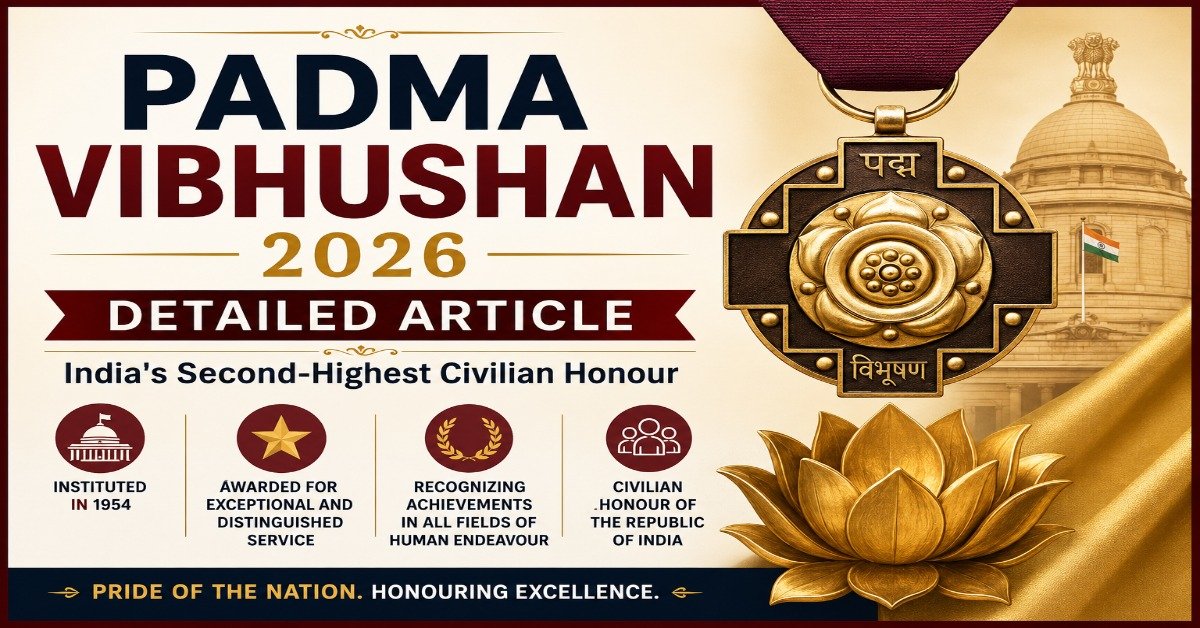
About the Padma Vibhushan
The Padma Vibhushan is the second-highest civilian honour given by the Government of India, ranking only below the Bharat Ratna. It was started in 1954 to honour people who have done exceptional and outstanding service to the nation. Every year, on the eve of Republic Day (January 26), the Government announces the names of Padma award winners. The President of India then formally presents these awards at Rashtrapati Bhavan.
For the year 2026, President Droupadi Murmu approved 131 Padma awards in total — five Padma Vibhushans, thirteen Padma Bhushans, and 113 Padma Shris. Among these, 16 awards were given posthumously (to people who had already passed away) and 19 recipients were women. The five people chosen for the Padma Vibhushan in 2026 come from very different fields — cinema, judiciary, classical music, journalism, and politics. Their stories together show the best of what India produces.
A quick-reference summary of all five Padma Vibhushan recipients for the year 2026:
| S.No. | Name | Field | State | Key Contribution |
| 1 | Shri Dharmendra Singh Deol (Posthumous) | Art | Maharashtra | 65+ year career, 300+ films; iconic role in Sholay; He-Man of Bollywood |
| 2 | Shri K. T. Thomas | Public Affairs | Kerala | Former Supreme Court Judge; landmark judgments on criminal & constitutional law |
| 3 | Ms. N. Rajam | Art | Uttar Pradesh | Pioneered Gayaki Ang on violin; ~40 years at BHU; trained generations of musicians |
| 4 | Shri P. Narayanan | Literature & Education | Kerala | Co-founder & Chief Editor, Janmabhoomi; 100+ translations into Malayalam |
| 5 | Shri V. S. Achuthanandan (Posthumous) | Public Affairs | Kerala | Founding member of CPI(M); CM of Kerala 2006–11; century of struggle for workers’ rights |
1. SHRI DHARMENDRA SINGH DEOL (Posthumous) Field: Art (Cinema) | State: Maharashtra
Dharmendra Singh Deol was one of the greatest stars Hindi cinema has ever produced. When the Government of India announced the Padma Vibhushan for him in January 2026, it was not just honouring an actor — it was recognising a cultural force that shaped Bollywood for more than six decades.
He was born on December 8, 1935, in the village of Nasrali in Punjab. His real name was Dharam Singh Deol. He grew up in a simple Jat Sikh family in Phagwara, Kapurthala district. He completed his schooling at Government Senior Secondary School, Lalton Kalan, Ludhiana, and his intermediate studies at Ramgarhia College, Phagwara. He came to Mumbai with big dreams, entered the film industry after winning a talent contest, and made his Bollywood debut in 1960 with the film Dil Bhi Tera Hum Bhi Tere.
Though that first film was not a big hit, it opened the door to an extraordinary career. In the 1960s, Dharmendra became the favourite romantic hero of the nation — tall, handsome, and full of charm. By the early 1970s, he had reinvented himself as a powerful action star. Films like Phool Aur Patthar (1966), Satyakam (1969), Chupke Chupke, Sita Aur Geeta, and Dream Girl became classics, each showing a different side of his talent.
But his greatest achievement came with Sholay in 1975 — widely considered one of the finest films ever made in India. Dharmendra played Veeru, a funny, loyal, and lovable character opposite Amitabh Bachchan. His rooftop drunk scene, where Veeru threatens to jump off a water tank unless Basanti agrees to marry him, is one of the most remembered moments in Indian film history. It showed that Dharmendra could do comedy and drama with equal ease.
Over his career spanning more than 300 films, he worked across every era of Hindi cinema — from black-and-white films in the early 1960s all the way to modern productions in the 2020s. He appeared in Rocky Aur Rani Kii Prem Kahaani as recently as 2023. He was popularly called the “He-Man of Bollywood” and “Garam Dharam” — nicknames that captured both his physical energy and his warm, down-to-earth personality. Directors valued his professionalism, audiences loved his honesty on screen, and fellow actors admired him deeply as a human being.
Beyond films, Dharmendra also entered politics briefly. He won the Bikaner Lok Sabha seat in 2004 but served only one term before returning to cinema. He is survived by his two families — his first wife Prakash Kaur and their children Sunny Deol, Bobby Deol, Ajeeta, and Vijeta; and his second wife, actor-politician Hema Malini, and their daughters Esha Deol and Ahana Deol.
Dharmendra had been unwell in his later years and passed away on November 24, 2025, in Mumbai — just a fortnight before his 90th birthday. The entire country mourned his loss. In January 2026, the Government announced the posthumous Padma Vibhushan for him. On May 25, 2026, at Rashtrapati Bhavan, Hema Malini received the award on his behalf from President Droupadi Murmu. Their daughter Ahana Deol was seen emotional in the audience. Hema Malini said afterward, “Dharmendra represented India’s soul and humility. This honour is a recognition of his extraordinary lifetime of service to art and the nation.”
Dharmendra had previously received the Padma Bhushan in 2012. This Padma Vibhushan, though posthumous, is the final and highest tribute from a grateful nation to one of its most beloved sons.
Born: December 8, 1935 | Died: November 24, 2025 | Career: 65+ years, 300+ films | Previous Award: Padma Bhushan (2012)
2. SHRI K. T. THOMAS Field: Public Affairs (Judiciary) | State: Kerala
Justice Kallupurackal Thomas Thomas, known to everyone as K. T. Thomas, is one of the most respected judges India has ever produced. His Padma Vibhushan in 2026 recognises not just a brilliant legal career but a life defined by moral courage, intellectual honesty, and selfless public service.
He was born in 1937 in Kottayam district, Kerala. He completed his early schooling at Baker Memorial School and CMS College High School in Kottayam, his undergraduate studies at CMS College, and his legal education at Madras Law College in Chennai. After finishing his studies, he joined the chambers of a leading Kottayam lawyer, Joseph Maliakal, and soon set up his own independent practice. He became well known for his work on both civil and criminal cases and built a strong reputation in the courts of Kerala.
In 1960, he formally enrolled as an advocate at the Kerala High Court. In 1976, he represented India at the World Conference on Peace held in Texas, USA, where he was elected Chairman of one of the commissions — an early sign of the respect he commanded beyond India’s borders.
In 1977, he was directly appointed as District and Sessions Judge, securing the top position in the competitive selection process. This was a major achievement that reflected both his deep legal knowledge and his professional standing. From there, his rise through the judicial system was steady and impressive. He was appointed Additional Judge of the Kerala High Court in 1985 and became a permanent judge in 1986. In September 1995, he served as Acting Chief Justice of the Kerala High Court. In March 1996, he was elevated to the Supreme Court of India, where he served until his retirement in 2002.
During his time at the Supreme Court, Justice Thomas was involved in some of the most significant cases of the era. He is especially remembered for presiding over the bench that upheld the death sentences of four convicts in the Rajiv Gandhi assassination case in 1999. This was an enormously high-profile case, and delivering that judgment required great moral strength and unwavering commitment to the law. His rulings on criminal law and constitutional matters are considered landmark judgments, studied in law schools and referenced in courts across India even today.
After retirement, Justice Thomas did not step back from public life. On the recommendation of the Chief Justice of Kerala, he was appointed Chairman of three government committees — a responsibility he accepted without taking any salary. In 2017, the Kerala Government constituted the Kerala Law Reforms Commission under his chairmanship. He has also written several books in Malayalam, including his memoir Honeybees of Solomon published in 2008, in which he reflects on his judicial journey with great candour.
His son, Justice Bechu Kurian Thomas, is a judge of the Kerala High Court — a testament to the legacy of legal excellence Justice Thomas has built. He had previously received the Padma Bhushan in 2007. The 2026 Padma Vibhushan honours a lifetime of exceptional contribution to India’s judiciary and democratic institutions.
Born: 1937, Kottayam, Kerala | Supreme Court tenure: 1996–2002 | Key case: Rajiv Gandhi assassination verdict (1999) | Previous Award: Padma Bhushan (2007)
3. MS. N. RAJAM Field: Art (Hindustani Classical Music) | State: Uttar Pradesh
When you first hear Dr. N. Rajam play the violin, you may close your eyes and wonder whether you are listening to a singer or a string instrument. That is the greatest achievement of this remarkable musician — she taught the violin to speak in the language of the human voice. Over more than seven decades of total devotion to Indian classical music, she has transformed the way the violin is understood and played in the Hindustani tradition.
Dr. N. Rajam was born on April 8, 1938, in Chennai (then called Madras), in a family with roots in Kerala. Her father, N. Narasimhan, was himself a gifted musician — a student of the legendary violinist T. Chowdiah. She began learning the violin at the remarkably young age of three, trained by her father from childhood. Her early training was in the Carnatic (South Indian) classical tradition, and she showed extraordinary talent from the very beginning. As a child of just 12 or 13 years, she performed alongside the great Bharat Ratna M. S. Subbulakshmi, travelling to different cities across India — an opportunity she has always described as golden.
The turning point in her career came when her father moved to Bombay and developed a deep love for Hindustani (North Indian) classical music. Inspired by him, the young Rajam took up Hindustani music — a difficult transition because the two systems are very different in structure, style, and approach. She trained under Pandit Omkarnath Thakur, one of the greatest masters of the Benaras gharana of Hindustani vocal music. This training changed everything.
Under his guidance, Dr. Rajam developed what would become her most famous and lasting contribution to Indian music: the Gayaki Ang. In simple terms, this is a style of playing the violin that imitates the way a human voice sings. In Hindustani classical music, the human voice is considered the highest form of musical expression. All the subtle movements, the microtonal shifts, the ornaments and emotional colours that a great singer produces — Dr. Rajam found a way to produce all of these on a violin. She effectively gave the violin a human voice. This made the violin a complete and independent solo instrument in the Hindustani tradition, not just an accompaniment to vocalists.
She spent close to four decades teaching at Banaras Hindu University (BHU) in Varanasi — first as a professor, then as Head of the Music Department, and finally as Dean of the Faculty of Performing Arts. During this time, she trained thousands of students who went on to become fine musicians themselves. Among her most celebrated students is her niece, the renowned violinist Kala Ramnath, who is widely considered the finest inheritor of her musical tradition. She also trained her own daughter and granddaughters in music.
Today she lives in Thane district, Maharashtra, and continues to teach. She has recently launched an initiative called Swar Sadhana Tapovan to revive the traditional Gurukul system of music education — where students learn in a close, residential setting with their teacher.
Dr. Rajam had previously received the Padma Shri in 1984, the Sangeet Natak Akademi Award in 1990, the Sangeet Natak Akademi Fellowship in 2012, and the Padma Bhushan in 2004. With the 2026 Padma Vibhushan, she becomes one of the very rare artists in India to have received all three tiers of the Padma awards — Padma Shri, Padma Bhushan, and Padma Vibhushan. It is a honour that matches the full measure of her extraordinary life in music.
Born: April 8, 1938, Chennai | Signature contribution: Gayaki Ang on violin | BHU: ~40 years | Previous Awards: Padma Shri (1984), Padma Bhushan (2004)
4. SHRI P. NARAYANAN Field: Literature and Education | State: Kerala
Shri P. Narayanan is a man who has spent nine decades proving that the pen, when used with sincerity and discipline, is one of the most powerful tools of public service. As a journalist, author, translator, and public intellectual, he has contributed to Malayalam literature and education in ways that have touched countless lives across Kerala and beyond.
He was born on May 28, 1936, in Manakkad, Thodupuzha, in present-day Idukki district, Kerala. From early in his life, he was drawn to both intellectual work and social engagement. He has been associated with the Rashtriya Swayamsevak Sangh (RSS) and served as the State Organisational General Secretary of the RSS in Kerala, as well as a member of the national executive committee of the Bharatiya Jana Sangh.
His most prominent contribution to public life is his role as co-founder and former Editor-in-Chief of Janmabhoomi, one of Kerala’s well-known Malayalam daily newspapers. For decades, he guided the editorial direction of this publication, shaping the way thousands of readers thought about culture, society, politics, and public life. His journalism was always grounded in a belief in Indian culture and civilisational values, communicated with intellectual clarity and sincerity across generations of readers.
But journalism was only one part of his contribution. P. Narayanan is also a prolific author and translator. He wrote nearly ten original books on subjects ranging from culture and philosophy to social history. More impressively, he translated more than 100 works into Malayalam — spanning a wide range of subjects and authors from across the world. This is a remarkable achievement by any measure. Through his translations, he brought the ideas of the world to the doorstep of the ordinary Malayalam reader — making literature, thought, and knowledge accessible to people who might never have reached those works otherwise.
He is now approximately 90 years old, and his life stands as a testimony to the idea that devotion to words, ideas, and education is its own form of distinguished public service. The Padma Vibhushan in 2026 honours this long, rich, and multifaceted contribution to literature and education in India.
Born: May 28, 1936, Thodupuzha, Kerala | Role: Co-founder & Chief Editor, Janmabhoomi | Translations: 100+ works into Malayalam | Original Books: ~10
5. SHRI V. S. ACHUTHANANDAN (Posthumous) Field: Public Affairs (Politics) | State: Kerala
The life of V. S. Achuthanandan is one of the most extraordinary stories in modern Indian politics. He lived for 101 years, and almost every single one of those years was spent fighting — for workers, for farmers, for the poor, and for the ideals of social justice and equality. His Padma Vibhushan in 2026, awarded posthumously, is the nation’s tribute to a century of fearless struggle.
He was born on October 20, 1923, in Punnapra, Alappuzha — a place that would later become famous as the site of one of India’s earliest communist workers’ uprisings. He grew up in deep poverty. As a child, he was forced to drop out of school and went to work — first as a tailor, then in a coir factory. But while working in the factory, he listened to the conversations of trade union workers and communist leaders, and his political awakening began.
In 1946, when he was just 23 years old, he took part in the historic Punnapra-Vayalar uprising — a workers’ rebellion against the Dewan’s rule in the princely state of Travancore. It was one of the most significant labour revolts in pre-Independence India. During a brutal police crackdown, Achuthanandan was so badly injured that he was presumed dead and nearly thrown off a cliff. He survived, was arrested, and came back stronger.
Over the following decades, he paid a heavy price for his political beliefs. He spent five and a half years in prison and four and a half years living underground as a fugitive — all in service of his political convictions. A member of the Communist Party since before his 18th birthday, he was in 1964 one of the 32 founding members of the Communist Party of India (Marxist), or CPI(M), formed after a split from the undivided Communist Party of India.
He first entered the Kerala Legislative Assembly in 1967 and remained a force in state politics for more than four decades. He served as Leader of the Opposition in the Kerala Assembly across multiple terms. His greatest period of authority came when he led the Left Democratic Front to victory in the 2006 elections and served as Chief Minister of Kerala from 2006 to 2011. His tenure as Chief Minister was remembered for his bold anti-encroachment actions — including the famous campaign against illegal encroachments in the hill town of Munnar — and for his strong anti-corruption stance.
What truly made Achuthanandan special, however, was not any single political achievement but his extraordinary bond with ordinary people. Known simply as “VS” by millions of Malayalis, he was seen as a man of the people in the truest sense — simple in his ways, honest to a fault, and always more comfortable among common people than among the powerful. His political opponents too respected him for his personal integrity. Even those who disagreed with his politics acknowledged that he was never in it for personal gain.
He remained politically active until 2018, when a minor stroke slowed him down. He passed away on July 21, 2025, at the age of 101, at SUT Hospital in Thiruvananthapuram, after a cardiac arrest in June. The Government of Kerala declared three days of official mourning. Tens of thousands of people filled the streets to pay their last respects. He was the last surviving founding member of the CPI(M), and with his passing, a historic era came to an end.
The announcement of the posthumous Padma Vibhushan in January 2026 carried a touch of historical irony, since the CPI(M) has a long tradition of its leaders declining civilian honours from the Central Government. Had Achuthanandan been alive, he would in all likelihood have refused it. But his family decided to accept the award, with his son V. A. Arun Kumar saying: “The bigger honour is the one he had received from countless millions in Kerala.” The CPI(M) state leadership also chose not to oppose the family’s decision. In accepting it, they acknowledged what the whole country already knew — that VS belonged not just to the Left, but to all of India.
Born: October 20, 1923, Punnapra, Alappuzha | Died: July 21, 2025 (Age 101) | Chief Minister of Kerala: 2006–2011 | CPI(M) founding member: 1964 | Years imprisoned: 5.5 years for political struggle
CONCLUSION: Five Lives, One India
The five recipients of the Padma Vibhushan in 2026 are very different from one another — a Bollywood superstar from Punjab, a distinguished judge from Kottayam, a violin maestro who made Varanasi her home, a journalist and translator who served the Malayalam reader for nine decades, and a communist leader who rose from poverty to lead his state.
Yet they share one common thread: each of them devoted their life not to personal comfort or wealth, but to something larger than themselves — art, justice, music, knowledge, or the welfare of the poor.
Dharmendra gave India laughter, tears, and the joy of the movies across generations. K. T. Thomas gave it the faith that the law can be both wise and humane. N. Rajam gave it music of a beauty that touches the soul. P. Narayanan gave it the tools of literacy and literary connection. And V. S. Achuthanandan gave it a century of fearless struggle for the marginalised.
When the Padma Vibhushan is awarded to people of this quality, it does more than honour them — it tells the story of India itself. A country of extraordinary diversity, where cinema and communism, classical music and constitutional law, all find their place in the national imagination. These five lives are, each in their own way, five faces of an extraordinary nation.






Leave a Comment