

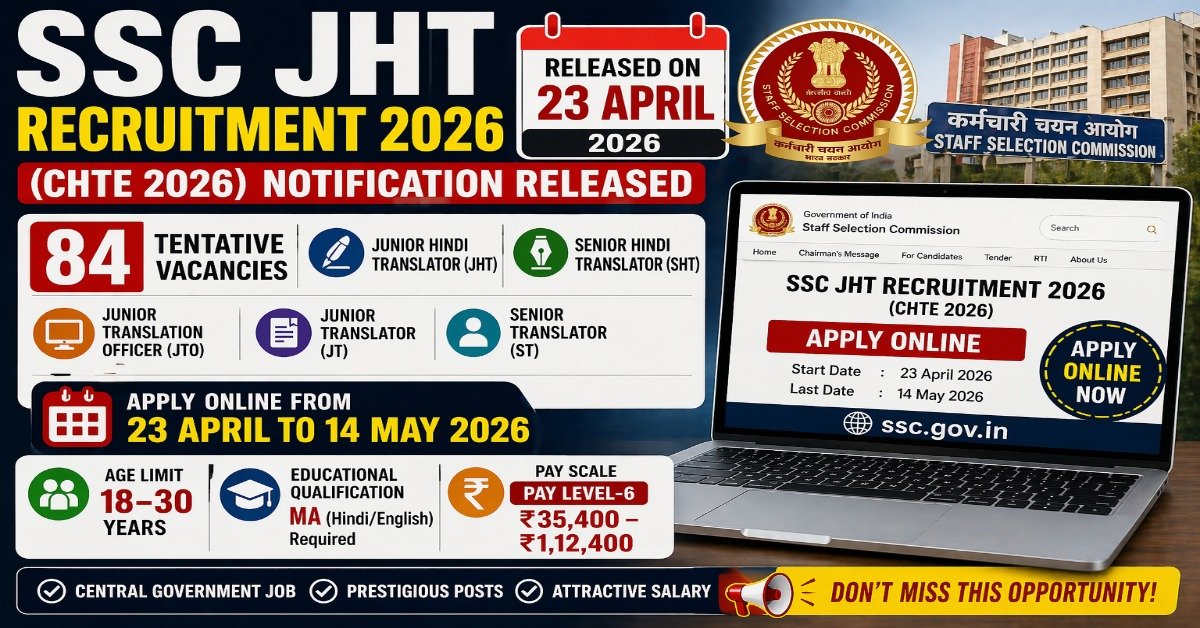
Apply well before deadline — server load increases near last date14 May 2026
Only permitted fields can be corrected — not all details are editable19–20 May 2026
Central Secretariat Official Language Service (CSOLS)
Armed Forces HQ (AFHQ) & Other Depts
Various Ministries/Departments
Various Ministries/Departments
Various Ministries/Departments
Various Ministries/Departments
| Post | Full Name | Level | Pay Scale (7th CPC) | Key Departments |
|---|---|---|---|---|
| JHT | Junior Hindi Translator | Level-6 | ₹35,400–₹1,12,400 | CSOLS, Ministries/Depts |
| JTO | Junior Translation Officer | Level-6 | ₹35,400–₹1,12,400 | AFHQ, Other Organisations |
| JT | Junior Translator | Level-6 | ₹35,400–₹1,12,400 | Various Central Depts |
| SHT | Senior Hindi Translator | Level-7 | ₹44,900–₹1,42,400 | Various Ministries |
| ST | Senior Translator | Level-7 | ₹44,900–₹1,42,400 | Various Ministries |
| STO | Senior Translation Officer | Level-7 | ₹44,900–₹1,42,400 | Various Ministries/Orgs |
| Total 84 tentative vacancies distributed across these posts and departments. BRO (Border Roads Organisation) vacancies are open to male candidates only. Exact post-wise and category-wise vacancy breakup will be updated at ssc.gov.in → For Candidates → Tentative Vacancy. All posts are permanent central government positions with 7th Pay Commission salary, DA, HRA, TA, medical benefits, and career growth. | ||||
Educational Qualification (Any ONE of the following three options):
Candidates who hold a Diploma or Certificate Course in Translation from a recognised institution, along with relevant work experience in translation from Hindi to English and/or English to Hindi, may also be considered eligible. Check the official notification PDF for specific duration requirements of the diploma and experience.
Age Limit (as on 01 August 2026):
| Category | Age Range | Date of Birth Range |
|---|---|---|
| General (UR) / EWS | 18–30 years | 02 August 1996 to 01 August 2008 (both inclusive) |
| OBC (Non-Creamy Layer) | 18–33 years (3 yrs relaxation) | 02 August 1993 to 01 August 2008 |
| SC / ST | 18–35 years (5 yrs relaxation) | 02 August 1991 to 01 August 2008 |
| PwBD (UR/EWS) | Up to 40 years (10 yrs relaxation) | On or after 02 August 1986 |
| PwBD (OBC) | Up to 43 years (13 yrs relaxation) | On or after 02 August 1983 |
| PwBD (SC/ST) | Up to 45 years (15 yrs relaxation) | On or after 02 August 1981 |
| All age relaxations as per Government of India rules. Ex-Servicemen (ESM): service rendered + 3 years additional relaxation. Age relaxation benefits are applicable only to candidates belonging to those categories, subject to production of valid certificates at document verification. | ||
Vacancies earmarked for the Border Roads Organisation (BRO) are open to male candidates only. Female candidates are not eligible for BRO posts within SSC JHT 2026. Female candidates are, however, eligible for all other posts under CSOLS, AFHQ, and other Ministries/Departments — and they are also fully exempted from paying the application fee.
| Category | Application Fee | Payment Mode |
|---|---|---|
| General (UR) / OBC (NCL) / EWS — Male | ₹100/- | Online only — BHIM UPI / Net Banking / Debit Card / Credit Card at ssc.gov.in |
| SC / ST / PwBD / Women / Ex-Servicemen | Exempted (₹0) | |
| Correction window fee: ₹200 for the first correction attempt and ₹500 for the second correction attempt (all candidates, no category exemption for correction fee). Application fee once paid is non-refundable. Candidates are advised to verify all details before final submission to avoid correction charges. | ||
| Post Category | Posts | Pay Level | Pay Scale | Estimated In-Hand |
|---|---|---|---|---|
| Junior Level | JHT, JTO, JT | Level-6 (7th CPC) | ₹35,400–₹1,12,400/month | ~₹45,000–₹50,000/month (varies by city) |
| Senior Level | SHT, ST, STO | Level-7 (7th CPC) | ₹44,900–₹1,42,400/month | ~₹58,000–₹65,000/month (varies by city) |
| In-hand salary is an estimate including basic pay + DA + HRA (X/Y/Z city) + TA. Actual salary depends on the posting location. Central government employees also receive LTC, children education allowance, advances, and annual increments. | ||||
| Paper | Mode | Sections | Questions | Marks | Duration | Merit Wt. |
|---|---|---|---|---|---|---|
| Paper-I | CBT (Online) | General Hindi + General English | 200 (100+100) | 200 | 2 hrs (1 hr per section) | 50% |
| Paper-II | Descriptive (Pen-Paper) | Translation + Essay (Hindi & English) | — | 200 | 2 hrs | 100% |
| Total Combined (for merit) | 300 effective marks (100 from Paper-I + 200 from Paper-II) | |||||
| Negative marking in Paper-I: 0.25 marks per wrong answer. No negative marking in Paper-II. Paper-I has a sectional timer of 1 hour each for Hindi and English — you cannot move between sections. Paper-I is used to shortlist candidates for Paper-II. Paper-II is the merit-deciding paper. Final selection is based on combined weighted marks: (Paper-I marks × 0.5) + Paper-II marks. | ||||||
Paper-I Qualifying Marks (Minimum required to be shortlisted for Paper-II):
| Category | Minimum Qualifying Marks in Paper-I |
|---|---|
| General (UR) / EWS | 30% — i.e., 60 marks out of 200 |
| OBC (Non-Creamy Layer) | 25% — i.e., 50 marks out of 200 |
| SC / ST / PwBD / Ex-Servicemen | 20% — i.e., 40 marks out of 200 |
| These qualifying marks are the minimum threshold to be shortlisted for Paper-II. Clearing the qualifying threshold does NOT guarantee shortlisting — actual shortlisting depends on the number of vacancies and merit among all candidates who cleared the qualifying marks. Marks in Paper-I are normalised if the exam is conducted in multiple shifts. | |
Stage 1 — Paper-I: Computer Based Examination (August–September 2026)
The first stage is a Computer Based Examination (CBT) of 200 questions across two sections — General Hindi (100 marks) and General English (100 marks) — with a 1-hour sectional timer each. Negative marking of 0.25 per wrong answer. Candidates must score the minimum qualifying marks as per category (30%/25%/20%) to be shortlisted for Paper-II. Marks are normalised if multiple shifts are conducted. After Paper-I, a tentative answer key is uploaded and candidates can raise objections by paying ₹50 per question.
Stage 2 — Paper-II: Descriptive Examination
Candidates shortlisted from Paper-I appear for the descriptive Paper-II (pen and paper mode), which tests translation skills and essay writing in both Hindi and English. No negative marking. Paper-II carries 100% weightage in the final merit — twice that of Paper-I. This is the most critical stage. Candidates with strong bilingual writing and translation proficiency have a significant advantage here. The final selection merit is: (Paper-I marks × 50%) + Paper-II marks (100%).
Stage 3 — Document Verification
Candidates shortlisted based on combined merit are called for Document Verification (DV) at respective SSC regional offices. Candidates must carry originals and self-attested copies of: educational qualification certificates, date of birth proof, category (SC/ST/OBC/EWS) certificate, PwBD/Ex-SM certificate (if applicable), and other specified documents. Candidates who fail document verification or whose documents are found invalid are disqualified.
Stage 4 — Post Allocation (Merit-cum-Preference)
Final post allocation to selected candidates is based on merit-cum-preference — candidates fill their post and location preferences, and SSC allocates accordingly based on merit rank. The Sliding Framework Mechanism (introduced by SSC for all exams) allows candidates to accept their allotted post (Fix) or opt for a higher-preference post if it becomes available (Float). Selected candidates are appointed to the respective Central Government Ministry/Department.
Complete OTR (One-Time Registration) at ssc.gov.in
Visit ssc.gov.in. If you have not already done OTR (One-Time Registration), complete it first. Click on "New User — Register Now" and provide: Name, Date of Birth, Gender, Mobile Number, Email ID, and Aadhaar/ID proof. OTR creates a permanent SSC profile used for all SSC exams. Set a strong password and keep your Registration Number and password safe for future use. If you have previously registered on the new SSC portal, simply log in with your credentials.
Find and Click SSC JHT 2026 (CHTE 2026) Apply Link
After logging in, go to Recruitment → Latest Notifications or look for the "Combined Hindi Translators Examination 2026" in the list of active recruitments. Click on "Apply" next to the CHTE 2026 notification. Read the notification and instructions page carefully before proceeding. Confirm that you meet all eligibility conditions before filling the application.
Fill Application Form — Personal, Educational & Preference Details
Fill in your personal details (auto-populated from OTR), educational qualification details (university name, year, marks/grade, subject of master's degree), category, preferred exam centre, post preference (JHT/JTO/SHT etc.), and language option. Carefully select your post preference order — this determines allocation during merit-cum-preference post allocation. Upload your passport-size photograph (JPEG, 20–50 KB) and signature in the prescribed format.
Pay ₹100 Application Fee (if applicable)
General/OBC/EWS male candidates pay ₹100 online through BHIM UPI, Net Banking, Debit Card, or Credit Card. SC/ST/PwBD/Women/Ex-Servicemen candidates are fee-exempted and can proceed directly to submission without payment. Keep the payment receipt/transaction ID for your records. Fee once paid is non-refundable under any circumstances.
Final Review, Submit & Download Confirmation by 14 May 2026
Carefully review all filled details — personal info, educational qualification, photograph, signature, post preference, category, exam centre. Once satisfied, click "Submit". Download and print the final application form immediately for your records. Do not wait until the last day — SSC portals can experience high traffic near deadlines. If you need to correct any mistake, the correction window opens on 19–20 May 2026 (correction fee ₹200 first time, ₹500 second time).
| Paper | Section | Topics Covered |
|---|---|---|
| Paper-I (CBT) 200 marks 100Q each | General Hindi (100 questions) | Comprehension and grammar: Unseen passages, sentence completion, synonyms/antonyms, idioms and phrases in Hindi, translation from English to Hindi, grammar rules, verb forms, sentence correction, fill in the blanks, vocabulary |
| General English (100 questions) | English grammar and comprehension: Unseen passages, reading comprehension, synonyms and antonyms, idioms/phrases, one-word substitution, sentence improvement, active/passive voice, direct/indirect speech, error spotting, fill in the blanks, vocabulary | |
| Paper-II (Descriptive) 200 marks 2 hours | Translation (Hindi ↔ English) | Translation of passages from Hindi to English and English to Hindi — tests fluency, accuracy, vocabulary range, contextual understanding, and ability to retain meaning across languages |
| Essay Writing (Hindi and/or English) | Essay on contemporary topics — social issues, government schemes, national events, environment, culture, economy — tests structured thought, language clarity, vocabulary, and expression in both Hindi and English | |
| Paper-II is the most critical stage — it directly determines final merit. Candidates should practise extensive translation (news articles, government circulars, literary texts) and develop strong bilingual writing skills. Reading newspapers, official Government of India documents, and quality literature in both Hindi and English is the best preparation strategy. | ||
- Translation practice is non-negotiable: Practise translating government notifications, newspaper editorials, and PIB press releases daily. These are the closest in style to what appears in Paper-II.
- Build vocabulary in both languages: Maintain a notebook of Hindi technical terms (paryayavachi shabda, rajbhasha terminology) and their English equivalents. Many government-specific Hindi terms have standardised English equivalents that examiners expect.
- Essay structure matters: Use the introduction–body–conclusion format. Examiners reward organised, coherent essays over rambling answers. Practice 400–500 word essays on current topics in both languages.
- Read government documents: The Official Language Act, Rajbhasha notifications, and Ministry circulars give you exposure to formal government Hindi (Sarkari Hindi) — the exact register tested in the paper.
- Paper-I strategy — sectional timer: With 1 hour per section and 100 questions, you have 36 seconds per question. Practice speed and accuracy separately for Hindi and English sections — do not neglect either.
- Negative marking in Paper-I: With –0.25 per wrong, skip genuinely uncertain questions. A wrong answer effectively costs you 1.25 marks (0.25 penalty + 1 mark you didn't earn). Focus on accuracy in vocabulary and grammar questions.
Hindi Translators and Translation Officers play a vital constitutional role in the Central Government. Under the Official Languages Act, 1963 and the Official Language Policy of India, all Central Government communications are required to be in Hindi (and English). JHT/SHT officers are responsible for translating official documents, government reports, circulars, speeches, and correspondence between Hindi and English in Ministries and Departments. They also assist in implementing the Hindi promotion programmes of the Department of Official Language under the Ministry of Home Affairs. This is a unique career that combines linguistic excellence with central government service — ideal for candidates with strong bilingual proficiency in Hindi and English.
Never Miss an SSC JHT Admit Card, Result, or Notification!
Join 1000+ job seekers on WhatsApp & the JobTheta App — free, instant, no spam.
