
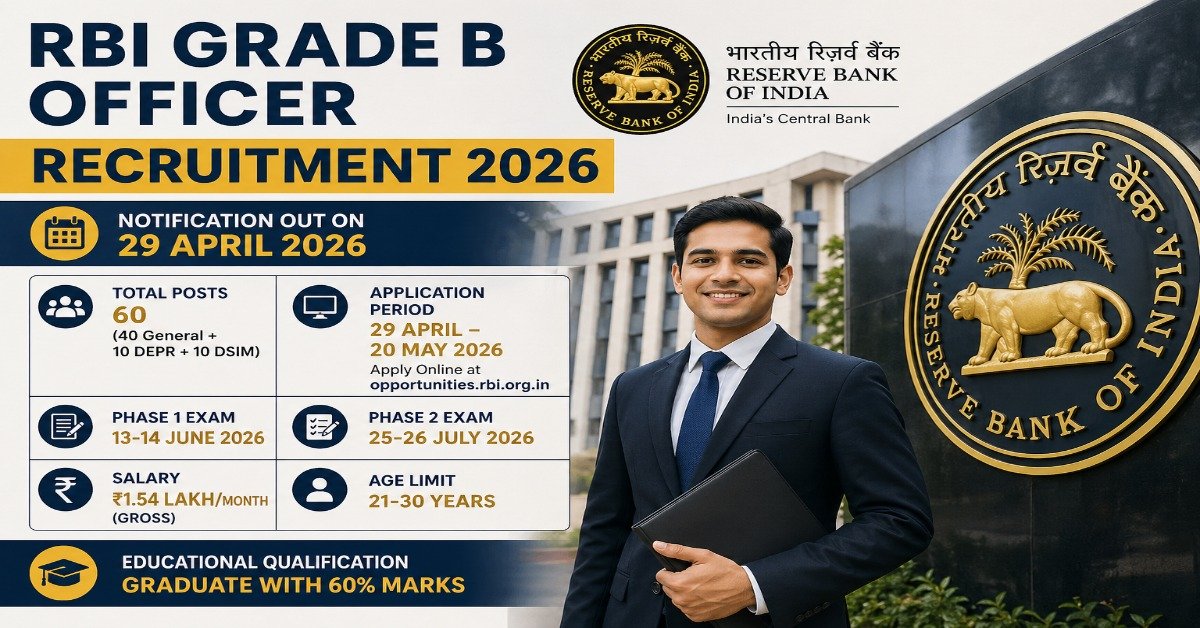
The Reserve Bank of India Services Board (RBISB), Mumbai has released Advertisement No. RBISB/DA/01/2026-27 for 60 posts of Officers in Grade ‘B’ (Direct Recruit — DR) across three cadres — General, DEPR (Department of Economic and Policy Research), and DSIM (Department of Statistics and Information Management) for Panel Year 2026. This is one of the most prestigious recruitment drives in Indian banking — offering a gross monthly salary of approximately ₹1,54,936, a defined-benefit pension, leased accommodation, and a career path that can reach the level of Deputy Governor of India’s central bank. The online application window is open from 29 April to 20 May 2026 at opportunities.rbi.org.in. Notably, vacancies have halved from 120 in 2025 to 60 in 2026, making this cycle significantly more competitive.
Quick Facts:
- 60 Total Posts — General / DEPR / DSIM
- India’s Central Bank — RBI
- Apply: 29 April–20 May 2026 (6 PM)
- Phase 1: 13–14 June 2026
- Age: 21–30 Years (as on 01.09.2026)
- Gross: ~₹1,54,936 / Month
- Vacancies Down 50% from 2025 — Very Competitive
- Fee: ₹600 (Gen/OBC/EWS) | ₹100 (SC/ST/PwBD)
At a Glance:
| Stat | Value |
|---|---|
| Total Posts | 60 |
| General Posts | 40 |
| DEPR + DSIM | 10+10 |
| Gross/Month | ₹1.55L |
| Apply Deadline | 20 May |
| Phase 1 Exam | 13 Jun |
01. Recruitment Overview
Advt. RBISB/DA/01/2026-27 — Released 29 April 2026 — Reserve Bank of India Services Board, Mumbai
| Particulars | Details |
|---|---|
| Conducting Authority | Reserve Bank of India Services Board (RBISB), Mumbai |
| Advertisement No. | RBISB/DA/01/2026-27 |
| Notification Released | 29 April 2026 (Short notice: 28 April 2026) |
| Post Name | Officer in Grade ‘B’ (Direct Recruit — DR) on Probation |
| Cadres / Streams | Grade ‘B’ (DR) – General | Grade ‘B’ (DR) – DEPR | Grade ‘B’ (DR) – DSIM |
| Panel Year | 2026 |
| Total Vacancies | 60 Posts — General: 40 | DEPR: 10 | DSIM: 10 (including PwBD reserved posts) |
| Application Opens | 29 April 2026 |
| Application Closes | 20 May 2026 (6:00 PM IST) |
| Application Mode | Online only at opportunities.rbi.org.in |
| Application Fee | ₹600 (General/OBC/EWS) | ₹100 (SC/ST/PwBD) — plus applicable taxes |
| Age Limit | 21 to 30 years as on 01 September 2026 (born between 02.09.1995 and 01.09.2004) |
| Qualification (General/DSIM) | Graduation with minimum 60% marks (50% for SC/ST/PwBD) |
| Qualification (DEPR) | Master’s Degree in Economics / Finance / related with minimum 55% marks |
| Selection Process | Phase I (Prelims) → Phase II (Mains) → Interview |
| Phase I Exam Date | 13 June 2026 (General + DSIM) & 14 June 2026 (DEPR) |
| Phase II Exam Date | 25 July 2026 (General) & 26 July 2026 (DEPR + DSIM) |
| Pay Scale | ₹78,450 – 4050(9) – ₹1,14,900 – EB – 4050(2) – ₹1,23,000 – 4650(4) – ₹1,41,600 |
| Gross Monthly Salary | ~₹1,54,936 per month (incl. DA, HRA, CCA, and other allowances) — ↑₹4,562 from 2025 |
| Attempts Allowed | General/EWS: 6 attempts maximum | SC/ST/OBC/PwBD: No limit (within age) |
| Jurisdiction | Courts at Mumbai only for any disputes |
| Official Website | rbi.org.in | Apply at: opportunities.rbi.org.in |
Critical 2026 Alert — Vacancy Count Halved: RBI Grade B 2026 announces only 60 vacancies compared to 120 in 2025 — a sharp 50% reduction. With a similar or higher applicant pool competing for half the seats, this cycle will be among the most competitive in recent years. Only candidates who are thoroughly prepared for both Phase I and Phase II, and who bring exceptional subject-matter depth to the interview, can realistically expect selection in 2026.
02. Important Dates & Exam Schedule
Apply by 20 May — Phase 1 on 13–14 June — Phase 2 on 25–26 July — all dates confirmed in official notification
| Event | Date |
|---|---|
| Official Short Notice Published in Newspapers | 28 April 2026 |
| Detailed Notification PDF Released — Advt. RBISB/DA/01/2026-27 — full notification with vacancy, eligibility, syllabus, exam pattern, and application instructions | 29 April 2026 |
| Online Application Registration Opens — opportunities.rbi.org.in — click “New Registration” | 29 April 2026 |
| Last Date to Submit Online Application and Pay Fee — apply well before the deadline; server load on last days can cause technical issues | 20 May 2026 (6:00 PM) |
| Phase I (Prelims) Exam — General & DSIM Streams — CBT, 200 marks, 120 minutes, qualifying in nature | 13 June 2026 |
| Phase I (Prelims) Exam — DEPR Stream — Paper I Economics (Objective) + Paper II English (Descriptive) | 14 June 2026 |
| Phase I Result & Phase II Shortlist Announced — only Phase II marks + Interview marks count for final merit | To be Announced |
| Phase II (Mains) Exam — General Stream — 3 Papers: ESI (Obj+Desc) + FM&M (Obj+Desc) + English Descriptive — 300 total marks | 25 July 2026 |
| Phase II (Mains) Exam — DEPR & DSIM Streams — post-specific papers | 26 July 2026 |
| Interview — for Phase II qualified candidates | After Phase II — To be Announced |
| Final Result & Appointment (Panel Year 2026) | After Interview |
Apply before 15 May 2026 — last-day server congestion is common. Confirm: Phase I marks do NOT count in final merit. Study for Phase II from Day 1.
03. Three Streams — Which One Is Right for You?
General, DEPR, and DSIM — understand each stream’s role, qualification, and eligibility before applying
Grade B (DR) — General
Monetary Policy, Banking Regulation, Financial Markets, Currency Management
| Detail | Value |
|---|---|
| Vacancies | 40 Posts |
| Qualification | Any Graduation (60%) |
| Phase 1 Exam | 13 June 2026 |
| Phase 2 Exam | 25 July 2026 |
| Max Attempts | 6 (General Cat.) |
Grade B (DR) — DEPR
Department of Economic and Policy Research — Economic Analysis, Policy Advisory
| Detail | Value |
|---|---|
| Vacancies | 10 Posts |
| Qualification | M.A. Economics (55%) |
| Phase 1 Exam | 14 June 2026 |
| Phase 2 Exam | 26 July 2026 |
| Max Attempts | No Limit |
Grade B (DR) — DSIM
Department of Statistics and Information Management — Data, Banking Stats, External Sector
| Detail | Value |
|---|---|
| Vacancies | 10 Posts |
| Qualification | M.Sc. Statistics (55%+) |
| Phase 1 Exam | 13 June 2026 |
| Phase 2 Exam | 26 July 2026 |
| Max Attempts | No Limit |
Which Stream Should You Choose?
- General stream is the most accessible — any graduate with 60% marks is eligible regardless of discipline. It is also the most popular and most competitive. Syllabus focuses on Economic and Social Issues (ESI), Finance and Management (FM), and descriptive English writing.
- DEPR stream is for candidates with a strong background in Economics — typically M.A. or M.Sc. Economics from a recognised central university. The Phase 2 papers are at Master’s-degree standard in Economics. If your academic specialisation is Economics and you are comfortable with post-graduate level monetary theory, macroeconomics, and quantitative economics, DEPR is a rewarding niche choice with lower absolute competition for 10 seats.
- DSIM stream is for statisticians and quantitative researchers — requiring a Master’s in Statistics, Mathematical Statistics, or Mathematical Economics. The Phase 2 exam is highly specialised. Candidates from IIT or central university postgraduate Statistics programmes are natural fits.
04. Category-wise Vacancy Breakdown
60 posts across General, OBC, SC, EWS, ST — with PwBD reservations within these categories
| Category | Vacancies |
|---|---|
| General/UR | 25 |
| OBC (NCL) | 16 |
| SC | 9 |
| EWS | 6 |
| ST | 4 |
| Stream | UR/Gen | OBC | SC | EWS | ST | Total |
|---|---|---|---|---|---|---|
| General (DR) | 16 | 11 | 6 | 4 | 3 | 40 |
| DEPR (DR) | 5 | 3 | 1 | 1 | — | 10 |
| DSIM (DR) | 4 | 2 | 2 | 1 | 1 | 10 |
| Grand Total | 25 | 16 | 9 | 6 | 4 | 60 |
PwBD (Persons with Benchmark Disabilities) reservations are identified within the above figures as per applicable government norms. Verify exact PwBD post classification from the official notification at rbi.org.in. OBC candidates must belong to the Non-Creamy Layer with a valid NCL certificate.
OBC and EWS Certificate Requirements:
- OBC-NCL certificate must be in the Central Government prescribed format for the financial year 2025-26 — certificates issued for state government purposes are not accepted by RBI
- EWS income and asset certificate must be valid for the current financial year and based on income of FY 2024-25 — issued by the competent authority (Sub-Divisional Magistrate or above)
- Reservation benefits and age relaxation are applicable only to Indian nationals who meet all category conditions
05. Eligibility Criteria — All Three Streams
Age, qualification, attempts — all conditions as on 01 September 2026
Educational Qualification — Stream-wise
| Stream | Required Qualification | Min. Marks (Gen/EWS) | Min. Marks (SC/ST/PwBD) |
|---|---|---|---|
| General (DR) | Bachelor’s Degree in any discipline from a recognised university/institution | 60% in graduation | 50% in graduation |
| DEPR (DR) | Master’s Degree in Economics / Applied Economics / Business Economics / Econometrics; OR Master’s in Finance with Economics as core subject | 55% in post-graduation | 55% in post-graduation |
| DSIM (DR) | Master’s Degree in Statistics / Mathematical Statistics / Mathematical Economics / Econometrics / Data Science; OR 4-year Bachelor’s (Honours) in Statistics | 55% in qualifying degree | 55% in qualifying degree |
All qualifications must be from UGC-recognised universities or institutions approved by AICTE, MCI, or equivalent statutory body. Candidates in final year of qualifying degree are NOT eligible — the degree must already be in hand by the date of application.
Age Limit & Relaxations
| Category | Age Limit |
|---|---|
| General / EWS (unreserved) | 21 to 30 years as on 01.09.2026 (born between 02.09.1995 and 01.09.2004) |
| OBC (Non-Creamy Layer) | 21 to 33 years (+3 years relaxation) |
| SC / ST | 21 to 35 years (+5 years relaxation) |
| PwBD (General/EWS) | 21 to 40 years (+10 years) |
| PwBD (OBC-NCL) | 21 to 43 years (+13 years) |
| PwBD (SC/ST) | 21 to 45 years (+15 years) |
| Ex-Servicemen | Relaxation as per Government of India guidelines |
Attempts Limit — General / EWS: Maximum 6 attempts for Grade B General stream. SC / ST / OBC / PwBD: No restriction on attempts within age limit. DEPR and DSIM: No attempt cap for any category.
Critical Eligibility Points — Read Before Applying:
- CGPA / grade format: If your degree shows CGPA or grade points, you must provide the university-issued conversion formula in your application — RBI uses the official conversion to verify the 60% / 55% threshold
- Final-year students are ineligible: The degree must already be awarded and not merely promised based on a provisional or tentative result
- Only one stream per application: A candidate can apply to only one stream (General, DEPR, or DSIM) per recruitment cycle — choose based on your academic background and career goals
- Attempt count for General: The attempt limit applies specifically to the General stream only — previous attempts in DEPR or DSIM do not count toward the General stream limit
- All decisions of the Board on eligibility matters are final and subject to jurisdiction of Courts at Mumbai only
06. Application Fee
₹600 for General/OBC/EWS — ₹100 for SC/ST/PwBD — plus applicable taxes — non-refundable
| Category | Fee Amount |
|---|---|
| General / UR | ₹600 + taxes |
| OBC (Non-Creamy Layer) | ₹600 + taxes |
| EWS | ₹600 + taxes |
| SC / ST | ₹100 + taxes |
| PwBD | ₹100 + taxes |
Payment mode: Online — Credit Card / Debit Card / Net Banking — through the RBI application portal at opportunities.rbi.org.in only. The application fee is strictly non-refundable once paid. Verify your eligibility, category, and all documents before proceeding to payment. Never pay through any third-party portal — RBI will not be responsible for payments made outside the official portal.
07. Salary, Pay Scale & Benefits
₹78,450 basic — ₹1,54,936 gross monthly — plus pension, leased housing, medical, and concessional loans
RBI Officer Grade B — Pay Scale (7th CPC): ~₹1,54,936/Month Gross. Basic Pay ₹78,450 | ↑ ₹4,562 from 2025 | Pay Scale: ₹78,450 – ₹1,41,600 (16 years). Includes: DA (Periodic), HRA/Leased Quarters, Defined Benefit Pension, Full Medical Coverage, Concessional Loans, Leave Fare Concession.
| Compensation Component | Details |
|---|---|
| Starting Basic Pay | ₹78,450 per month |
| Full Pay Scale Progression | ₹78,450 – 4050(9) – ₹1,14,900 – EB – 4050(2) – ₹1,23,000 – 4650(4) – ₹1,41,600 over 16 years |
| Gross Monthly Salary (at Joining) | ~₹1,54,936 per month including DA, HRA/Leased accommodation, CCA, and other allowances |
| Dearness Allowance (DA) | Revised periodically by RBI as per cost-of-living index |
| House Rent Allowance | Staff quarters at major RBI offices at subsidised rates; or HRA at 15% of basic pay where RBI quarters unavailable |
| Pension | Defined Benefit Pension Scheme — one of very few government institutions still offering defined-benefit (not NPS) pension to new recruits |
| Medical Benefits | Full medical coverage for the officer and all dependants under RBI Medical Scheme |
| Concessional Loans | Home loan, car loan, and personal loan at significantly below-market rates — up to ₹75+ lakh for housing loans at preferential rates |
| Leave Fare Concession (LFC) | Annual travel reimbursement for the officer and family |
| Conveyance & Telephone Allowance | Reimbursements for official travel and communication costs |
| Children’s Education Allowance | Assistance for children’s schooling expenses |
| Newspaper / Book Allowance | Reimbursement for reading material |
The RBI Grade B gross salary of ~₹1,54,936/month is significantly higher than SBI PO (~₹94,000–₹98,000/month) and comparable to the best compensation packages in the central government financial sector.
08. Exam Pattern — Phase I & Phase II
Phase I is purely qualifying — final merit uses only Phase II marks + Interview scores
The Most Important Rule — Phase I Does NOT Count: Many aspirants make the critical mistake of over-preparing for Phase I at the expense of Phase II. Phase I is a qualifying screening test only — its marks are not added to your final merit list. The final selection ranking is based entirely on Phase II marks (300 marks) + Interview marks (50 marks). A candidate who barely clears Phase I cutoffs but scores high in Phase II will rank above someone who topped Phase I. Plan your preparation accordingly.
Phase I (Prelims) — General & DSIM Stream — 13 June 2026 — 200 total marks, 120 minutes, negative marking ¼ per wrong answer, Computer-Based Test.
| Section | Questions | Marks |
|---|---|---|
| General Awareness | 30 | 60 |
| English Language | 30 | 30 |
| Quantitative Aptitude | 30 | 60 |
| Reasoning | 30 | 60 |
| Total (General / DSIM Phase I) | 120 Qs | 200 marks — 120 minutes |
Sectional minimum cutoffs apply — you must clear both sectional cutoffs AND the overall cutoff to qualify for Phase II. English Language questions are English-only; all other sections can be attempted in Hindi or English.
Phase I (Prelims) — DEPR Stream — 14 June 2026
| Paper | Type | Marks | Duration |
|---|---|---|---|
| Paper I — Economics | Objective (MCQ) | 100 | 120 min |
| Paper II — English | Descriptive (Typed) | 100 | 120 min |
| Total (DEPR Phase I) | Obj + Descriptive | 200 marks | 240 min |
Phase II (Mains) — General Stream — 25 July 2026 (Marks Count in Merit)
| Paper | Type | Marks | Duration |
|---|---|---|---|
| Paper I — Economic & Social Issues (ESI) | 50% Objective + 50% Descriptive | 100 | 120 min |
| Paper II — English (Writing Skills) | Descriptive only | 100 | 90 min |
| Paper III — Finance & Management (FM&M) | 50% Objective + 50% Descriptive | 100 | 120 min |
| Total (General Phase II) | Obj + Descriptive | 300 marks | 5.5 hours |
Sectional cutoffs apply in Phase II as well — high aggregate but failure in any one section means elimination. All descriptive answers must be typed on a computer — there is no handwriting option.
Interview — Final Stage (50 Marks)
| Aspect | Details |
|---|---|
| Marks | 50 marks — added to Phase II marks to prepare the final merit list |
| Focus Areas | Subject knowledge (ESI, FM, Banking Regulation for General); Academic specialisation depth (DEPR/DSIM); Current economic developments; RBI’s role and recent policy decisions; Analytical thinking; Communication and leadership potential |
| Final Merit | Phase II (300) + Interview (50) = Total 350 marks — merit list prepared category-wise based on this combined score |
Absence from the Interview automatically disqualifies the candidate from final selection — even if Phase II marks are high. Appear for the Interview without fail.
09. Syllabus Overview — Phase I & Phase II
Topic-wise coverage across all three streams — General Awareness and ESI carry maximum weightage
| Subject | Stream | Key Topics |
|---|---|---|
| General Awareness (Phase I) | Gen, DSIM | Current affairs — India and global; RBI and monetary policy; Banking and financial sector developments; Union Budget; Economic Survey; International organisations; Capital markets; Financial inclusion and fintech; Social sector schemes |
| English Language (Phase I) | Gen, DSIM | Reading comprehension; Vocabulary; Grammar and sentence correction; Cloze test; Para jumbles; Error detection |
| Quantitative Aptitude (Phase I) | Gen, DSIM | Data Interpretation; Arithmetic — percentages, profit and loss, SI/CI, time-speed-distance, ratios; Number series; Permutation and combination; Probability |
| Reasoning (Phase I) | Gen, DSIM | Logical reasoning; Coded inequalities; Syllogisms; Seating arrangement; Puzzles; Alphanumeric series; Input-output; Data sufficiency |
| Economics (Phase I — DEPR) | DEPR | Microeconomics; Macroeconomics (IS-LM, monetary and fiscal policy); International economics (trade theory, BOP); Indian economy; Development economics; Mathematical economics and econometrics basics |
| Economic and Social Issues (Phase II Paper I) | Gen | Growth and development; Poverty and inequality; Infrastructure; Globalisation; Social sector — health, education, gender; Environmental economics; India’s economic policy; Union Budget analysis; RBI Annual Report; Financial Stability Report topics |
| Finance and Management (Phase II Paper III) | Gen | Financial system — RBI, banks, NBFCs, capital markets; Financial regulation and supervision; Corporate governance; Risk management; Monetary policy transmission; International finance; Management principles |
| English Descriptive (Phase II Paper II) | Gen, DEPR | Essay writing (economic/social topics — 600 words); Précis writing; Reading comprehension; Business/official letter writing; Report writing — all typed on computer |
| Economics Papers (Phase II — DEPR) | DEPR | Standard of Master’s level University Economics examination — monetary economics, public finance, international trade, econometrics, Indian economic policy — based on RBI publications |
| Statistics Papers (Phase II — DSIM) | DSIM | Probability theory and statistical inference; Regression analysis; Time series analysis; Sampling theory; Index numbers; Data management and database concepts; Econometrics; Statistical methods applied to banking and financial data |
The official syllabus is indicative, not exhaustive. RBI uses its own publications — Monetary Policy Reports, Financial Stability Reports, Report on Trend and Progress of Banking — as primary source material for General Awareness and ESI questions. Reading these quarterly is essential.
10. Career Path & Growth — Where Can You Reach?
RBI offers one of the clearest and most prestigious career ladders in all of Indian government service
An RBI Grade B Officer joins as a Manager in Grade B — but this is just the starting point of a career that can, over decades of dedicated service, reach the very top of India’s financial regulatory architecture. Unlike most government services where promotions are subject to departmental exams at multiple stages, RBI promotions from Grade B to Grade C are based on Annual Confidential Reports (ACRs), performance, and seniority — no mandatory written examination is required. This makes the growth journey both merit-driven and relatively less exam-dependent post-joining.
Career Ladder (bottom to top):
Grade B Officer (where you join, 2026 recruitment) → Grade C Officer → Grade D Officer → Assistant General Manager (AGM) → Deputy General Manager (DGM) → General Manager (GM) → Chief General Manager (CGM) → Executive Director (ED) → Governor / Deputy Governor — RBI
What Makes RBI’s Career Unique:
- Policy work from Day 1: Unlike banking jobs that are commercial or operational, RBI officers work on monetary policy, financial regulation, currency management, and banking supervision — intellectually stimulating and nationally significant work
- Research culture: Especially in DEPR and DSIM, officers engage in published economic research — contributing to RBI publications that influence India’s financial system
- International exposure: Senior RBI officers regularly represent India at IMF, World Bank, BIS, and G20 financial forums
- Defined-benefit pension: In an era where most government services have switched to NPS, RBI still offers a defined-benefit pension scheme — securing retirement comprehensively
- Transfer to premier financial bodies: RBI officers are occasionally seconded to the Ministry of Finance, SEBI, NABARD, and international financial institutions — broadening career exposure
11. How to Apply Online — Step by Step
Apply at opportunities.rbi.org.in — deadline 20 May 2026, 6 PM — apply before 15 May to be safe
- Visit the Official RBI Recruitment Portal — Open opportunities.rbi.org.in in any browser. Navigate to Current Vacancies / Recruitment and locate the advertisement for Officers in Grade B (DR) — General/DEPR/DSIM — Advt. RBISB/DA/01/2026-27. Download and read the full official notification PDF before proceeding — all eligibility conditions and instructions are legally binding.
- Click “New Registration” and Create Your Account — Click “Click Here for New Registration” at the top-right corner of the portal. Enter your name, date of birth, valid email ID, and mobile number. Your registration ID and password will be sent to the provided email and mobile. Save these credentials securely — you will use them to log in and complete the form.
- Fill Personal, Educational, and Professional Details — Log in using your registration ID and password. Fill in personal details (date of birth, category, nationality), educational qualifications (graduation/post-graduation — institution, year, marks%), and any relevant work experience details if applicable. Select your stream carefully — General, DEPR, or DSIM — you cannot apply for multiple streams in the same cycle. Select your preferred exam centre city.
- Upload Photograph, Signature, and Documents — Upload your recent passport-size photograph (4.5 cm × 3.5 cm, JPEG format, under 50 KB) and signature (JPEG, under 20 KB). Upload any additionally required documents as specified in the notification — including category certificates for reserved category candidates. Ensure all uploads are clear and within the prescribed file size limits.
- Pay Application Fee and Submit — Pay ₹600 (General/OBC/EWS) or ₹100 (SC/ST/PwBD) plus applicable taxes via Credit Card, Debit Card, or Net Banking through the RBI portal. After successful payment, preview your entire application carefully before final submission. Submit and download the confirmation page / application printout — this is your proof of application.
- Download Admit Card and Appear for Phase I — Admit cards for Phase I (Prelims) will be released approximately 10–15 days before the exam date — around late May or early June 2026. Download and print the Phase I admit card from opportunities.rbi.org.in using your registration ID. Carry a printed copy along with a valid original photo ID to the exam centre. Phase I is on 13 June (General/DSIM) and 14 June (DEPR).
Quick Checklist: Apply only at opportunities.rbi.org.in | Only one stream per candidate | Deadline: 20 May 2026, 6 PM | Apply before 15 May — avoid server rush
12. Frequently Asked Questions
Q1. How many vacancies are there in RBI Grade B 2026 — and how does it compare to last year?
RBI has announced 60 total vacancies for Grade B Officers in 2026 under Advt. RBISB/DA/01/2026-27 — distributed as 40 posts for General, 10 for DEPR, and 10 for DSIM. This is a significant reduction from the 120 vacancies announced in 2025 — effectively halving the seats available. With a similar applicant pool (lakhs of candidates appear every year), the 2026 cycle will be among the most competitive in recent memory. Aspirants must prepare with greater rigour, particularly for Phase II which determines the final merit.
Q2. What is the last date to apply for RBI Grade B 2026?
The last date to submit the online application and pay the fee is 20 May 2026 at 6:00 PM IST. Online registration opened on 29 April 2026 at opportunities.rbi.org.in. We strongly recommend completing your application by 15 May 2026 — last-day server congestion on the RBI portal is common and can cause submission failures. A delayed submission attempt on 20 May carries risk of technical issues.
Q3. Is Phase I of RBI Grade B 2026 counted in the final merit?
No — and this is the most important rule to internalise. Phase I (Preliminary Examination) is a screening round only. Its marks are not counted in the final merit list under any circumstances. Final selection is based entirely on marks scored in Phase II (Mains) — 300 marks — and the Interview — 50 marks, totalling 350 marks. Phase I exists only to filter the applicant pool to a manageable number of candidates for Phase II. A candidate who clears Phase I cutoffs with minimum marks but excels in Phase II can outrank someone who topped Phase I.
Q4. What is the gross salary of an RBI Grade B Officer in 2026?
The approximate gross monthly salary of an RBI Grade B Officer at the time of joining in 2026 is ₹1,54,936 per month — an increase of ₹4,562 over the 2025 level. This includes the starting basic pay of ₹78,450, Dearness Allowance, HRA (or leased accommodation in lieu), City Compensatory Allowance, and other standard allowances. Beyond the gross salary, officers also receive a defined-benefit pension, concessional home and car loans, full medical coverage for family, and Leave Fare Concession — making the total compensation package one of the most attractive in government service in India.
Q5. Can an engineering or science graduate apply for RBI Grade B General stream?
Yes, absolutely. The General stream of RBI Grade B accepts graduates from any discipline — Arts, Commerce, Science, Engineering, Law, or any other field — from a recognised university, provided they have secured a minimum of 60% marks in graduation (50% for SC/ST/PwBD). There is no stream restriction for the General post. Many engineers and science graduates successfully crack RBI Grade B General every year. The Phase II syllabus (ESI and FM) requires economic and financial knowledge that can be built through focused self-study regardless of prior academic background.
Q6. How many attempts are allowed in RBI Grade B 2026?
For the General stream, candidates in the General and EWS categories can appear a maximum of 6 times across their career. Reserved category candidates — SC, ST, OBC, and PwBD — have no restriction on the number of attempts for the General stream, provided they are within the age limit. For DEPR and DSIM streams, there is no attempt cap for any category. Each appearance in Phase I of any stream counts as one attempt toward the attempt limit for that stream.
Q7. What is the difference between DEPR and DSIM streams in RBI Grade B?
Both DEPR and DSIM are specialist research streams at RBI, but they serve different analytical functions. DEPR (Department of Economic and Policy Research) is RBI’s primary economic research arm — officers here conduct macroeconomic research, analyse monetary and fiscal policy, prepare the Monetary Policy Report, and provide inputs for RBI Governor’s speeches and RBI’s Annual Report. The qualification required is a Master’s in Economics or a related field. DSIM (Department of Statistics and Information Management) focuses on data collection, compilation, and statistical analysis of India’s banking system, corporate sector, and external sector. Officers here manage India’s financial databases and produce statistical publications. The qualification is a Master’s in Statistics, Mathematical Statistics, or Mathematical Economics.
Q8. What are the RBI Grade B 2026 exam dates?
The confirmed exam dates as per the official notification are: Phase I — 13 June 2026 for General and DSIM streams; 14 June 2026 for DEPR stream. Phase II — 25 July 2026 for General stream; 26 July 2026 for DEPR and DSIM streams. Admit cards for Phase I are typically released 10–15 days before the exam — approximately late May or early June 2026 — and must be downloaded from opportunities.rbi.org.in. Interview dates will be announced after Phase II results are declared.
Q9. How competitive is RBI Grade B 2026 compared to SEBI Grade A or SBI PO?
RBI Grade B is broadly considered the most prestigious and difficult central-banking exam in India — more selective than SBI PO and comparable in intensity to SEBI Grade A. The combination of Phase II’s depth (requiring genuine understanding of monetary economics, financial regulation, and social policy), the descriptive writing component, and the rigorous interview makes it a multi-month preparation commitment. SBI PO has higher vacancies (2,000+) and focuses on commercial banking aptitude. SEBI Grade A has a comparable depth but focuses more on capital markets regulation. RBI Grade B stands apart because the work involves India’s central banking and monetary policy function — a role of national significance — and the compensation and career ceiling (Deputy Governor level) are superior to both SBI PO and SEBI Grade A over a full career.
Q10. What is the job profile of an RBI Grade B Officer?
An RBI Grade B Officer works at India’s central bank and engages in a wide range of critically important functions depending on the department: monetary policy formulation, banking supervision and regulation, foreign exchange management, government securities management, currency issuance and distribution, financial consumer protection, and economic research. Officers in the General stream may be posted in various departments within RBI, while DEPR officers focus exclusively on economic and policy research and DSIM officers manage statistical operations and data systems. All officers are permanently employed, receive a defined-benefit pension, and are based at various RBI offices across India — including its headquarters in Mumbai and regional offices in major cities.
13. Official Links & Resources
Apply and verify all information only from official RBI sources — rbi.org.in and opportunities.rbi.org.in
- RBI Grade B Recruitment 2026 — Official Notification (Advt. RBISB/DA/01/2026-27) — https://opportunities.rbi.org.in/scripts/bs_viewcontent.aspx?Id=4997
- Apply Online — opportunities.rbi.org.in — Click “New Registration” to start — https://opportunities.rbi.org.in
- Reserve Bank of India Official Website — https://rbi.org.in
RBI Contact Details:
Organisation: Reserve Bank of India Services Board (RBISB)
Headquarters: Reserve Bank of India, Central Office, Shahid Bhagat Singh Marg, Fort, Mumbai – 400001
Website: rbi.org.in | Apply at: opportunities.rbi.org.in
Jurisdiction: Courts at Mumbai only for any disputes arising from this recruitment
All future updates — Phase I admit card, Phase I result, Phase II schedule, Phase II admit card, interview call letter, final result — will be published exclusively on the official RBI website. Do not rely on unofficial coaching institute announcements or Telegram group updates for any schedule-related information.




Leave a Comment